- Product Description Description
- Table of Contents TOC
- List of Table & Figure LOT
- Get Free Sample PDF Sample PDF
Market Size, 2025
$19.89 BnMarket Estimate, 2026
$21.16 BnMarket Forecast, 2034
$34.76 BnCAGR, 2026–2034
6.40%Asia-Pacific Crop Protection Pesticides Market Size, Growth, Trends & Forecast (2026–2034)
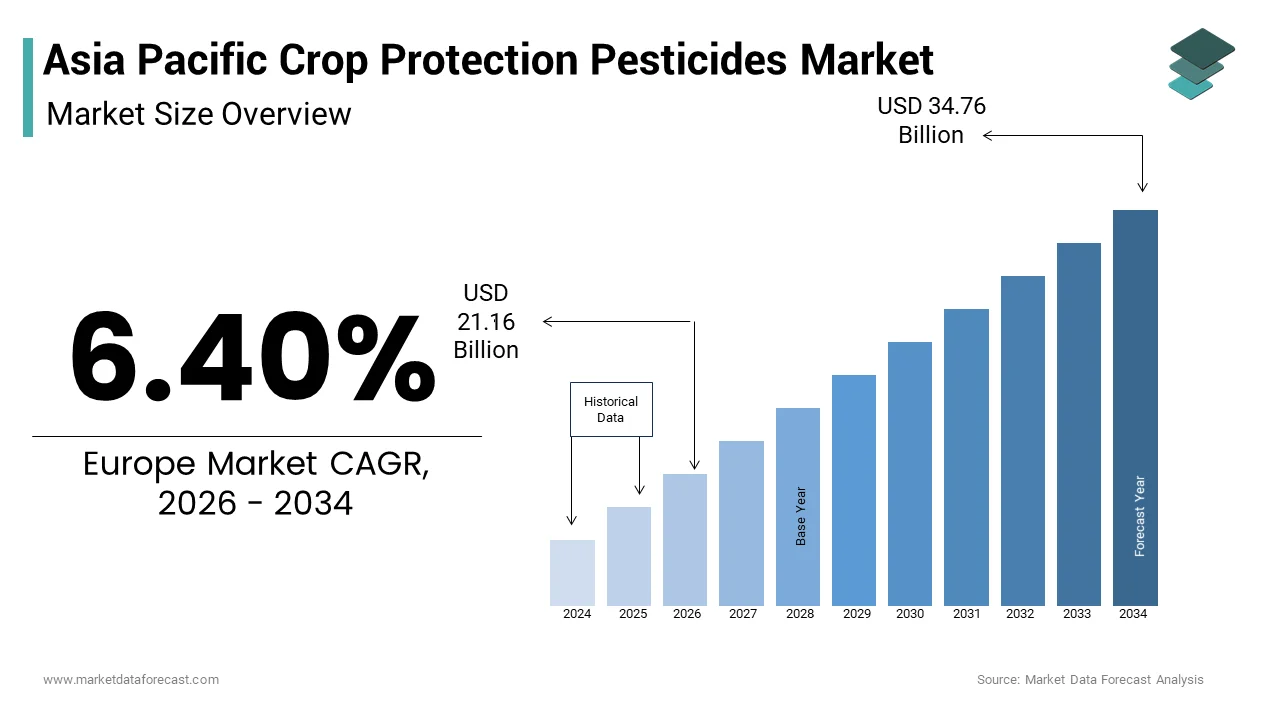
The Asia-Pacific crop protection pesticides market size was valued at USD 19.89 billion in 2025, stands at USD 21.16 billion in 2026, and is anticipated to reach USD 34.76 billion by 2034, registering a compound annual growth rate (CAGR) of 6.40% during the forecast period from 2026 to 2034. Propelled by evolving agricultural technologies, advancements in agricultural chemistry, rising farmer awareness regarding crop savings, and the ecological and environmental benefits of bio-pesticides, the Asia-Pacific market continues strong and steady expansion.
Key Executive Metrics (At-a-Glance)
- 2025 Base Valuation: USD 19.89 Billion
- 2026 Current Valuation: USD 21.16 Billion
- 2034 Forecast Valuation: USD 34.76 Billion
- Compound Annual Growth Rate (CAGR): 6.40% (2026–2034)
- Dominant Product Segment: Herbicides (dominating the crop protection chemicals market, followed by synthetic fungicides)
- Dominant Application Segment: Crop-based Applications (Grains & Cereals, Oilseeds, Fruits & Vegetables)
- Dominant Country Markets: China and India (leading the region in pesticide consumption, alongside specialized consumption like rice in South Korea and crop-based volume in Japan)
Core Market Drivers
- Technological & Chemical Advancements: Continuous innovation in agricultural practices empowering farmers to achieve effective pest management.
- Rising Pesticide Awareness: Increasing understanding of potential crop savings and ecological benefits associated with bio-pesticides across developing nations.
Primary Market Restraints & Challenges
- High R&D Costs: Mounting expenses associated with research and development for new pesticide solutions.
- Controversies: Ongoing debates and controversies surrounding the adoption of genetically modified (GM) crops.
Asia-Pacific Crop Protection Pesticides Market Segmentation Breakdown
| Segment Category | Largest (Dominant) Sub-Segment | Other Included Sub-Segments |
|---|---|---|
| By Crop-based Application | Grains & Cereals, Oilseeds, and Fruits & Vegetables | Specific crop applications across regional food staples (e.g., rice in South Korea) |
| By Non-crop-based Application | Synthetic & Bio-Pesticides (Herbicides dominate overall chemistry) | Turf & Ornamental Grass, Other Applications |
| By Country | China and India (regional consumption leaders) | Japan, South Korea, Australia, New Zealand, Thailand, Malaysia, Vietnam, Philippines, Indonesia, Singapore, Rest of APAC |
Major Industry Players Profiled
Key corporations shaping the Asia-Pacific crop protection pesticides market include Syngenta AG, Bayer CropScience, BASF, Dow AgroSciences, DuPont, Sumitomo Chemical, Nufarm Ltd., FMC Corp., Novozymes A/S, Monsanto, Arysta Life Sciences, and Marrone Bio Innovations, among others.
Asia-Pacific Crop Protection Pesticides Market Size
The Asia-Pacific crop protection pesticides market size was valued at USD 19.89 billion in 2025 and is anticipated to reach USD 21.16 billion in 2026 to reach USD 34.76 billion by 2034, growing at a CAGR of 6.40% during the forecast period from 2026 to 2034.
Bio-pesticides are beneficial to the ecological chain and environment and are also effective in controlling agricultural pests.
In the Asia-Pacific region, continuously evolving technology and advancement are driving the most important change in farming practices. Uprising technology and advancements in agricultural chemistry are enabling farmers to engage in effective pest management. The increasing awareness about pesticides has not only resulted in increased use of pesticides but also an increase in awareness regarding potential crop savings in developing nations. On the negative side, restraints limiting market growth include mounting costs of research and development and the controversy surrounding the adoption of genetically modified crops.
REPORT COVERAGE
| REPORT METRIC | DETAILS |
| Market Size Available | 2025 to 2034 |
| Base Year | 2025 |
| Forecast Period | 2026 to 2034 |
| CAGR | 6.40% |
| Segments Covered | By Crop Based Application, Non-Crop Based Application, and Region. |
| Various Analyses Covered | Global, Regional, & Country Level Analysis, Segment-Level Analysis, DROC, PESTLE Analysis, Porter’s Five Forces Analysis, Competitive Landscape, Analyst Overview on Investment Opportunities |
| Regions Covered | India, China, Japan, South Korea, Australia, New Zealand, Thailand, Malaysia, Vietnam, Philippines, Indonesia, Singapore, and the Rest of APAC |
| Market Leaders Profiled | Marrone Bio Innovations, DuPont, Arysta Life Sciences, BASF, and Dow AgroSciences are the most active companies in the Asia-Pacific Crop Protection Pesticides market, along with American Vanguard, Cheminova, Chemtura Corp, Monsanto, Natural Industries, Bayer CropScience, Novozymes A/S, Nufarm Ltd, Sumitomo Chemical, Syngenta AG, Valent Biosciences, FMC Corp, Isagro SpA, Ishihara Sangyo Kaisha, Makhteshim Agan, Chr Hansen, and BioWorks. |
SEGMENT ANALYSIS
By Non-crop-based Application
The pesticide market is also segmented into types, which are further subdivided into Synthetic and Bio-pesticides. Each of these is further subdivided into Herbicides, Insecticides, Fungicides, Other Synthetic Pesticides, and Bio-herbicides, Bio-insecticides, Bio-fungicides, and Other Bio-pesticides, respectively. The crop protection chemicals market is being dominated by herbicides, followed by synthetic fungicides.s
COUNTRY ANALYSIS
Being the world’s largest as well as most populous continent, Asia-Pacific is one of the key markets for crop protection chemicals. The use of pesticides is becoming a common practice in countries such as India, China, and other less developed countries in the region, leading to the growth in areas where there had previously been very little or no pesticide usage. China and India are the leaders in the consumption of pesticides in the region. Crop-based applications occupy the largest share of the volume of pesticide consumption in Japan. Rice is the most important food crop in South Korea, accounting for a large share of the pesticide market in this region.
KEY MARKET PLAYERS
Some of the major key players in the Asia-Pacific crop protection pesticides market are
- Marrone Bio Innovations
- DuPont
- Arysta Life Sciences
- BASF
- Dow AgroSciences
- American Vanguard
- Cheminova
- Chemtura Corp
- Monsanto
- Natural Industries
- Bayer CropScience
- Novozymes A/S
- Nufarm Ltd
- Sumitomo Chemical
- Syngenta AG
- Valent Biosciences
- FMC Corp
- Isagro SpA,
- Ishihara Sangyo Kaisha
- Makhteshim Agan
- Chr Hansen
- BioWorks.
MARKET SEGMENTATION
This research report on the Asia-Pacific crop protection pesticides market is segmented and sub-segmented into the following categories.
By Crop-based Application
- Grains & Cereals
- Oilseeds and Fruits & Vegetables
By Non-crop-based Application
- Turf & Ornamental Grass
- Other Applications
By Country
- India
- China
- Japan
- South Korea
- Australia
- New Zealand
- Thailand
- Malaysia
- Vietnam
- Philippines
- Indonesia
- Singapore
- Rest of APAC