- Product Description Description
- Table of Contents TOC
- List of Table & Figure LOT
- Get Free Sample PDF Sample PDF
Market Size, 2025
$309.01 BnMarket Estimate, 2026
$373.9 BnMarket Forecast, 2034
$1,718 BnCAGR, 2026–2034
21%Global 4K TV Market Size, Growth, Trends & Forecast (2026–2034)
The global 4K TV market was valued at USD 309.01 billion in 2025, is predicted to reach USD 373.9 billion in 2026, and is projected to scale up to USD 1,718 billion by 2034, registering a compound annual growth rate (CAGR) of 21% during the forecast period from 2026 to 2034. Driven by advancements in graphic engines, a surge in streaming services adoption, and falling panel manufacturing prices, the market continues to experience robust global expansion.
Key Executive Metrics (At-a-Glance)
- 2025 Base Valuation: USD 309.01 Billion
- 2026 Current Valuation: USD 373.9 Billion
- 2034 Forecast Valuation: USD 1,718 Billion
- Compound Annual Growth Rate (CAGR): 21% (2026–2034)
- Dominant Screen Size Segment: 55 to 65 Inches (capturing major urban household preference)
- Fastest-Growing Screen Size Segment: Greater than 65 Inches (experiencing rapid consumer preference for home theater setups)
- Dominant Region: Asia-Pacific (led by massive manufacturing and consumption scales in China) & North America
Core Market Drivers
- Graphic & Content Evolution: Advanced GPUs, high-definition streaming platforms, and widespread adoption of UHD cameras by filmmakers.
- Consumer Purchasing Power: Rising disposable incomes and general price reductions on television graphics engines and panels by key manufacturers.
Primary Market Restraints & Challenges
- High Overall Costs: Premium pricing models associated with large-format and advanced-display units (such as high-end OLED and specialized panels).
Global 4K TV Market Segmentation Breakdown
| Segment Category | Leading Sub-Segment (2025 Base) | Fastest-Growing Sub-Segment (2026–2034) |
|---|---|---|
| By Screen Size | 55 to 65 Inches (ideal for compact urban spaces) | Greater than 65 Inches (high-growth home theater segment) |
| By Products | Television (core volume driver) | Monitors & Digital Signage (commercial and gaming adoption) |
| By End-User | Household (primary revenue contributor) | Public / Commercial (expanding hospitality and enterprise uses) |
| By Region | North America & Asia-Pacific (mass consumer base) | Asia-Pacific (driven by rising disposable incomes in China and India) |
Major Industry Players Profiled
Key market leaders shaping the global 4K TV industry include Samsung Electronics Co., Ltd., Sony Corporation, LG Electronics Inc., Sharp Corporation, Panasonic Corp., Canon Inc., Innolux Corp., and Blackmagic Design Pty Ltd.
 Download Free Sample Report
Global 4K TV Market Size
The global 4K TV market was worth USD 309.01 billion in 2025. The global market size is predicted to reach USD 373.9 billion in 2026 and USD 1,718 billion by 2034, growing at a CAGR of 21% during the forecast period.
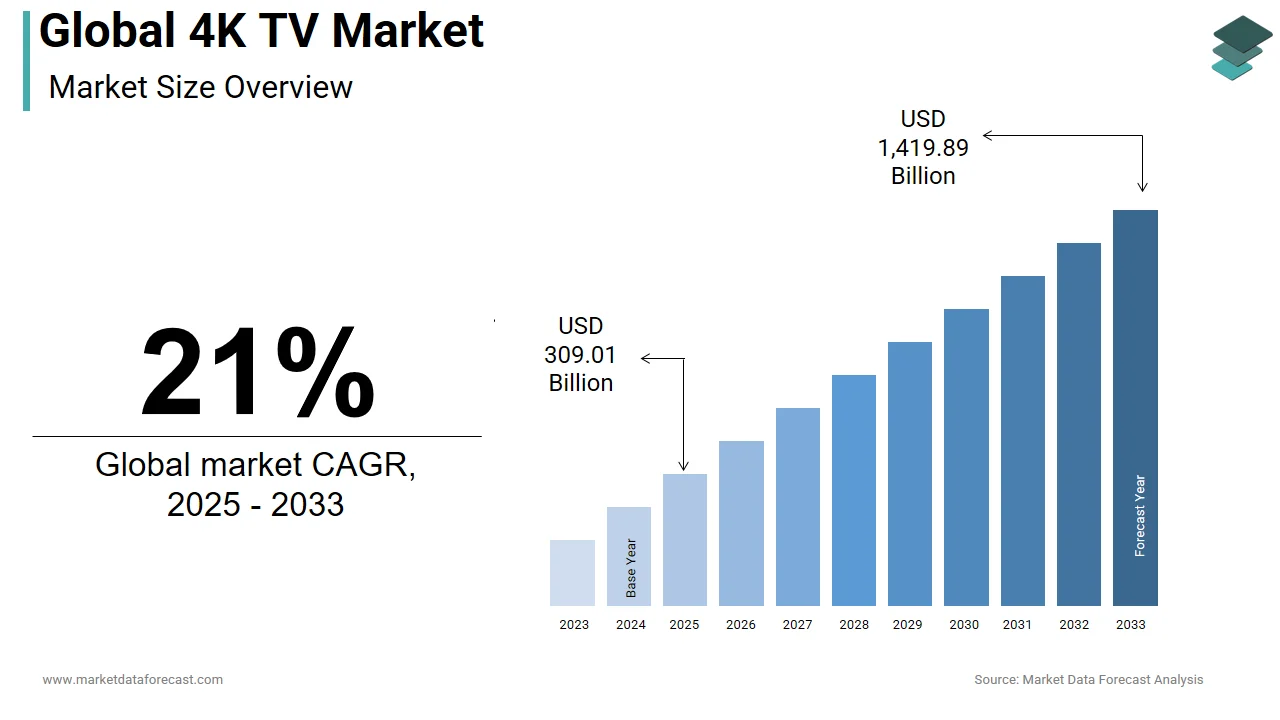
The evolving nature of the customer electronic industry, improvements in graphic engines of televisions, the rise in pressure on manufacturers to scale back prices, and recognition of ultra-high-definition technology & its advantages have fueled the demand for UHD televisions within the past few years. The latest GPUs permit advanced technical images and have improved the content quality significantly; hence, they're widely employed in the production and distribution of UHD content. Customers are becoming aware of using such content, which is further anticipated to spur market growth.
The 4K word refers to 4000-pixel resolution, and a 4K TV offers vibrant colors with better quality. Because of its high resolution and high picture quality, it's utilized in live shows and concerts. 4K television is additionally utilized in game consoles, military, aerospace, and medicine. The increasing purchasing power of consumers has increased demand for 4K TVs because of the rising trend within the electronics industry, and manufacturers have reduced the costs of television graphics engines. Filmmakers are turning towards UHD (Ultra High Definition) technology. They're also employed in weddings, award ceremonies, and conferences. However, the value of those TVs is extremely high.
MARKET DRIVERS
Factors like advancement in graphic technology in television and growing demand for top-end electronics are believed to be the dynamic factors behind the rapid climb of the 4K TV market across the world.
Also, the popularity of ultra-high-definition televisions and the growing purchasing power of consumers are the main factors propelling the expansion of the 4K TV market. Likely, growing demand for 4K televisions for better picture quality and increased penetration of UHD set-top boxes are projected to spice up the demand for 4K TVs. The swelled income of the population across the world, supported by the positive GDP figures in growing nations, is supporting the penetration of consumer electronics.
The increasing adoption of streaming services for entertainment is mainly driving the 4k TV market. Moreover, the growing use of ultra-high-definition camcorders and cameras for shooting by filmmakers is predicted to spice up the expansion of the global 4k TV market. To provide the audience with a better and more real-life experience, filmmakers and production houses are using advanced and ultra-high-definition cameras for shooting. The photographs shot on these cameras are experienced better on ultra-high-definition displays like 4K TVs. Furthermore, the supply of high-definition content players like Blu-ray players augmented the expansion of the 4k TV market. However, the high overall cost is the major restraining factor for the expansion of the 4k TV market. Nevertheless, the increasing application of telepresence & telemedicine and military intelligence gathering & monitoring are predicted to supply lucrative chances for the key players within the global 4k TV market.
The television industry has witnessed drastic changes within the past decade thanks to the development of LCD, LED, OLED, and AMOLED technologies.
The 4K TVs are the newest offering developed by the manufacturers, which produce ultra-high-definition pictures. The 4k TV market is very competitive and consolidated. Only some leading market players have command over an oversized part of the market share. The key players within the market, including Samsung Electronics Co., Ltd., Sony Corporation, LG Electronics Inc., Sharp Corporation, et al., specialize in developing new panel technologies to supply cost-efficient and energy-efficient displays with better resolution.
REPORT COVERAGE
| REPORT METRIC | DETAILS |
| Market Size Available | 2025 to 2034 |
| Base Year | 2025 |
| Forecast Period | 2026 to 2034 |
| CAGR | 21% |
| Segments Covered | By Screen Size, Products, End-User, and Region |
|
Various Analyses Covered | Global, Regional & Country Level Analysis, Segment-Level Analysis, DROC, PESTLE Analysis, Porter’s Five Forces Analysis, Competitive Landscape, Analyst Overview on Investment Opportunities |
| Regions Covered | North America, Europe, APAC, Latin America, Middle East & Africa |
|
Market Leaders Profiled | Samsung Electronics, Sony Corp, Canon Inc., Innolux Corp., Panasonic Corp., Blackmagic Design Pty Ltd., LG Electronics Corp. (Japan), and Others. |
REGIONAL ANALYSIS
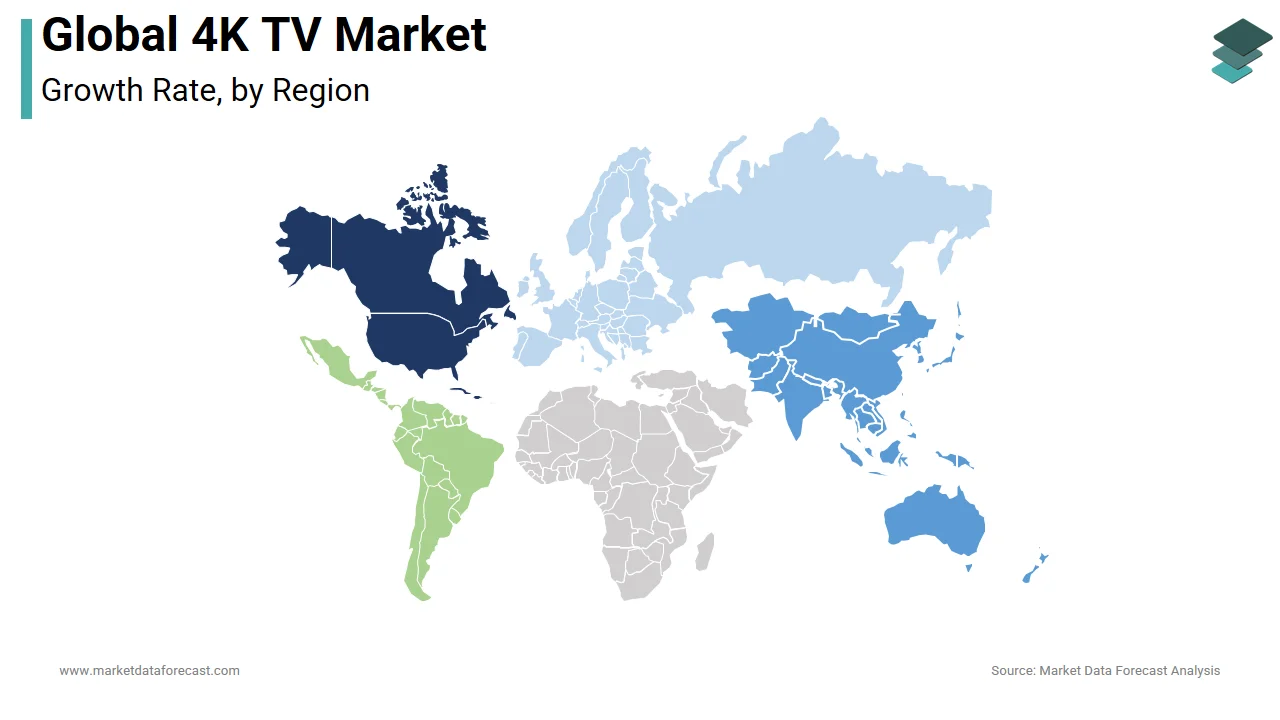
Asia Pacific held the most important share, as China has transformed into the most important consumer of 4K TVs. The mass availability of 4K TVs, let alone low-price offerings, is the major big behind the huge consumption of 4K TVs within the country. As an early adopter, North America witnessed significant development with the introduction of 4K TVs, a trend expected to continue over the predicted period. Further, the regional 4K TV market growth is additionally attributed to the increasing adoption of 4K set-top boxes that allow exploiting the total capability of 4K TVs with improved picture quality. The region is anticipated to witness tremendous growth thanks to a drop in the prices of 4K TVs; quite half the American population will own a minimum of one 4K TV. The EU 4K TV market also exhibited moderate growth because of increasing demand from Germany and the United Kingdom. The proliferation of TVs supporting HDR is expected to be a key factor driving the expansion in developed markets.
KEY MARKET PARTICIPANTS
The major companies operating in the global 4k TV market include Samsung Electronics, Sony Corp, Canon Inc., Innolux Corp., Panasonic Corp., Blackmagic Design Pty Ltd., LG Electronics Corp. (Japan), Sharp Corp. (Japan), and others.
RECENT MARKET HAPPENINGS
-
In October 2019, Vu Televisions had over 105 lakh television sets and emerged as one of the leading organizations within the 4K TV market with its 4K range of smart Televisions. The company has experienced a 30 percent growth since its inception in 2006. within the large size television category, the corporate is understood for its unique Vu 100 (100-inch TV).
MARKET SEGMENTATION
This research report on the global 4K TV market has been segmented and sub-segmented based on the Screen Size, Products, End-user, and Region.
By Screen Size
-
55 Inches
-
65 Inches
By Products
-
Television
-
Digital Signage
-
Set-Top Box
-
Monitor
-
Smartphone
-
Laptop
-
Tablet
-
Projector
-
Blu-Ray Player
-
Camera
By End-User
-
Public
-
Household
By Region
-
North America
-
The United States
-
Canada
-
Rest of North America
-
-
Europe
-
The United Kingdom
-
Spain
-
Germany
-
Italy
-
France
-
Rest of Europe
-
-
The Asia Pacific
-
India
-
Japan
-
China
-
Australia
-
Singapore
-
Malaysia
-
South Korea
-
New Zealand
-
Southeast Asia
-
-
Latin America
-
Brazil
-
Argentina
-
Mexico
-
Rest of LATAM
-
-
The Middle East and Africa
-
Saudi Arabia
-
UAE
-
Lebanon
-
Jordan
-
Cyprus
-