- Product Description Description
- Table of Contents TOC
- List of Table & Figure LOT
- Get Free Sample PDF Sample PDF
Market Size, 2025
$823.14 MnMarket Estimate, 2026
$931.30 MnMarket Forecast, 2034
$2500 MnCAGR, 2026–2034
13.14%Asia-Pacific Biostimulants Market Size, Growth, Trends & Forecast (2026–2034)
The Asia-Pacific biostimulants market size was valued at USD 823.14 million in 2025, is anticipated to reach USD 931.30 million in 2026, and is projected to expand up to USD 2,500.46 million by 2034, registering a robust compound annual growth rate (CAGR) of 13.14% during the forecast period from 2026 to 2034. Driven by a rapidly expanding population, mounting food demand, rising farmer awareness regarding soil vitality, and active government support for organic and sustainable farming across major countries like India, China, Japan, and Australia, the APAC region stands as one of the fastest-growing markets globally.
Key Executive Metrics (At-a-Glance)
- 2025 Base Valuation: USD 823.14 Million
- 2026 Current Valuation: USD 931.30 Million
- 2034 Forecast Valuation: USD 2,500.46 Million
- Compound Annual Growth Rate (CAGR): 13.14% (2026–2034)
- Dominant Ingredient Segment: Humic Acids & Fulvic Acids (holding more than 30% market share due to superior soil restructuring and nutrient-chelating properties)
- Dominant Application Segment: Foliar Application (most favored for direct, fast-action nutrient and stress-mitigation delivery across crop life cycles)
- Dominant Crop Type Segment: Cereals & Oilseeds (leading the regional market as staple foods like rice, corn, wheat, and soybeans receive extensive government and agronomic backing)
- Key Regional Countries: India, China, Japan, South Korea, Australia, New Zealand, and Southeast Asian nations (Thailand, Malaysia, Vietnam, Philippines, Indonesia, Singapore)
Core Market Drivers & Restraints
- Drivers: Escalating food security demands, growing farmer awareness, preference for organic and eco-friendly biological inputs over soil-damaging synthetic fertilizers, and supportive regional subsidies/soil health missions.
- Restraints: Volatile economic conditions and high R&D costs associated with novel biological formulations.
Asia-Pacific Biostimulants Market Segmentation Breakdown
| Segment Category | Covered Sub-Segments / Details |
|---|---|
| By Active Ingredients | Fulvic Acid, Protein Hydrolysates, Seaweed Extracts, Amino Acid, Humic Acid (market leader at >30% share), and Others |
| By Application | Seed, Foliar (most favored delivery method), and Soil |
| By Crop Type | Cereals & Oilseeds (leading market segment), Fruits & Vegetables, Turfs & Ornaments, and Others |
| By Country | India, China, Japan, South Korea, Australia, New Zealand, Thailand, Malaysia, Vietnam, Philippines, Indonesia, Singapore, and Rest of APAC |
Major Industry Players Profiled
Key market leaders dominating the competitive Asia-Pacific biostimulants landscape include BASF SE, Biostadt India Limited, Valagro SpA, Novozymes A/S, Biolchim SpA, Isagro SpA, and Koppert B.V.
Asia-Pacific Biostimulants Market Size
The Asia-Pacific biostimulants market size was valued at USD 823.14 million in 2025 and is anticipated to reach USD 931.30 million in 2026 to reach USD 2500.46 million by 2034, growing at a CAGR of 13.14%, from 2026 to 2034.
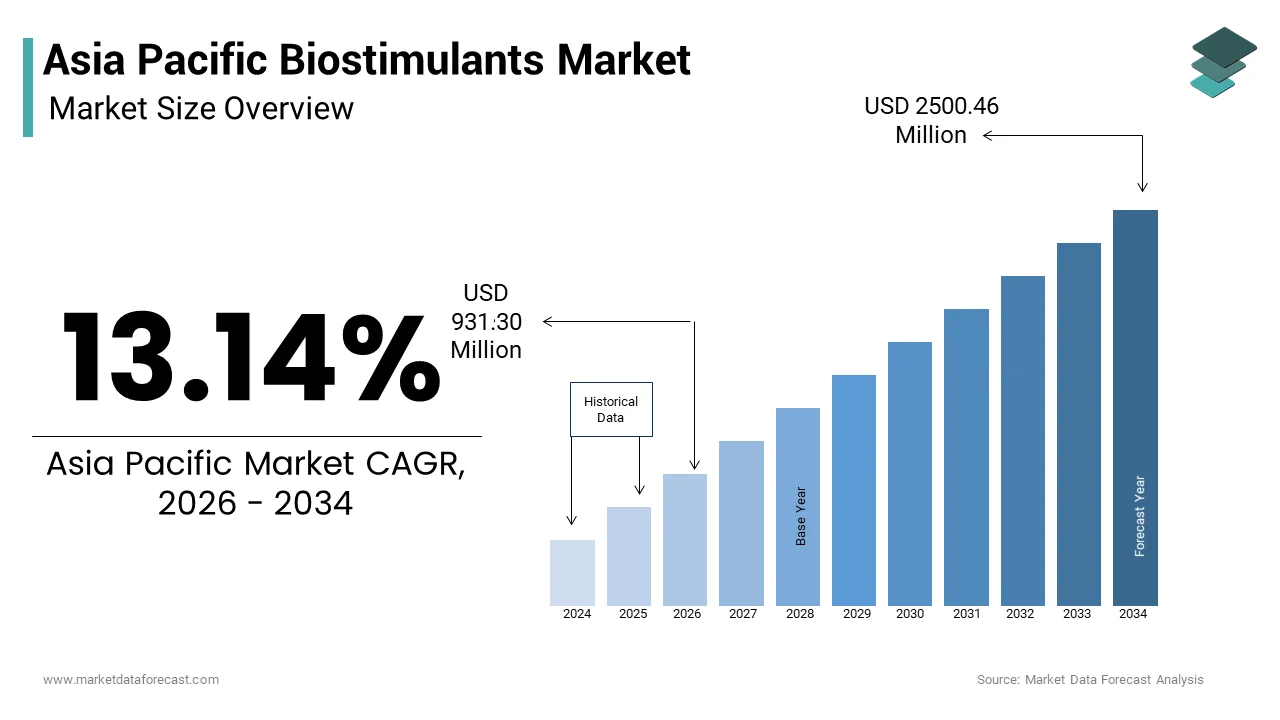
Biostimulants promote plant development in several established ways throughout the crop's lifespan, from seed sprouting to crop maturity. They enhance the plant’s capability to integrate nutrients and grow properly.
Biostimulants improve soil quality and enhance product quality, thereby generating better profits for crop cultivators and providing healthier foods for customers. Healthy soil grasps water more effectively and is more resilient to erosion. Biostimulants also help in tackling some of the most important challenges that world agriculture currently faces.
MARKET DRIVERS
The growth of the Asia-Pacific Biostimulants market is majorly due to factors such as growing awareness among farmers, mounting food demand due to an increasing population, and government subsidies. Biostimulants are gaining increasing importance in the agriculture sector due to their environmentally friendly and organic character. However, factors such as volatile economies and high R&D costs involved in this field are impeding the growth of the market in this region.
REPORT COVERAGE
| REPORT METRIC | DETAILS |
| Market Size Available | 2025 to 2034 |
| Base Year | 2025 |
| Forecast Period | 2026 to 2034 |
| CAGR | 13.14% |
| Segments Covered | By Active Ingredients, Application, Crop Type & By Region |
| Various Analyses Covered | Global, Regional & Country Level Analysis, Segment-Level Analysis, DROC, PESTLE Analysis, Porter’s Five Forces Analysis, Competitive Landscape, Analyst Overview on Investment Opportunities |
| Regions Covered | China, India, Japan, South Korea, Australia & Etc. |
| Market Leaders Profiled | BASF SE, Biostadt India Limited, Valagro SpA, Novozymes A/S, Biolchim SpA, Isagro SpA, and Koppert B.V. |
SEGMENT ANALYSIS
By Active Ingredients Insights
In this segment, humic acids and fulvic acids lead the market for Biostimulants, accounting for more than 30% of the market.
By Application Insights
The foliar technique of application is the most favored for biostimulant supply, as it delivers ingredients in a much more direct manner when compared to the others.
By Crop Insights
Cereals & Oilseeds lead the market based on Crop Type, and this trend is expected to remain the same during the forecast period.
COUNTRY ANALYSIS
The Asia-Pacific region is geographically segmented into China, India, Japan, South Korea, and Australia. The growth of the market in this region is reinforced by the increasing demand to step up the output of intensely promoted food crops such as soybeans, rice, corn, and wheat. Biostimulants not only boost crop growth during severe conditions in these regions but also increase crop return and quality. Farmers in this region prefer biostimulants instead of synthetic stimulants, as the former not only enhances crop yield but also improves land fertility, while the latter may damage land fertility at the price of enhancing crop yield.
Important strategies such as product expansions and investments have been implemented by the key players in the biostimulants industry. These companies are improving their capabilities by diversifying their commercial operations across high-growth markets with efficient distribution systems.
KEY MARKET PLAYERS
These are the market players that are dominating the Asia Pacific biostimulants market.
- BASF SE
- Biostadt India Limited
- Valagro SpA
- Novozymes A/S
- Biolchim SpA
- Isagro SpA
- Koppert B.V.
MARKET SEGMENTATION
This research report on the Asia Pacific biostimulants market is segmented Ans sub-segmented into the following categories.
By Active Ingredients
- Fulvic Acid
- Protein Hydrolysates
- Seaweed Extracts
- Amino Acid
- Humic Acid
- Others
By Application
- Seed
- Foliar
- Soil
By Crop Type
- Fruits & Vegetables
- Cereals & Oilseeds
- Turfs & Ornaments
- Others
By Country
- India
- China
- Japan
- South Korea
- Australia
- New Zealand
- Thailand
- Malaysia
- Vietnam
- Philippines
- Indonesia
- Singapore
- Rest of APAC