- Product Description Description
- Table of Contents TOC
- List of Table & Figure LOT
- Get Free Sample PDF Sample PDF
Market Size, 2025
$136.11 BnMarket Estimate, 2026
$146.18 BnMarket Forecast, 2034
$258.78 BnCAGR, 2026–2034
7.4%Chile Cards and Payments Market Size, Growth, Trends & Forecast (2026–2034)
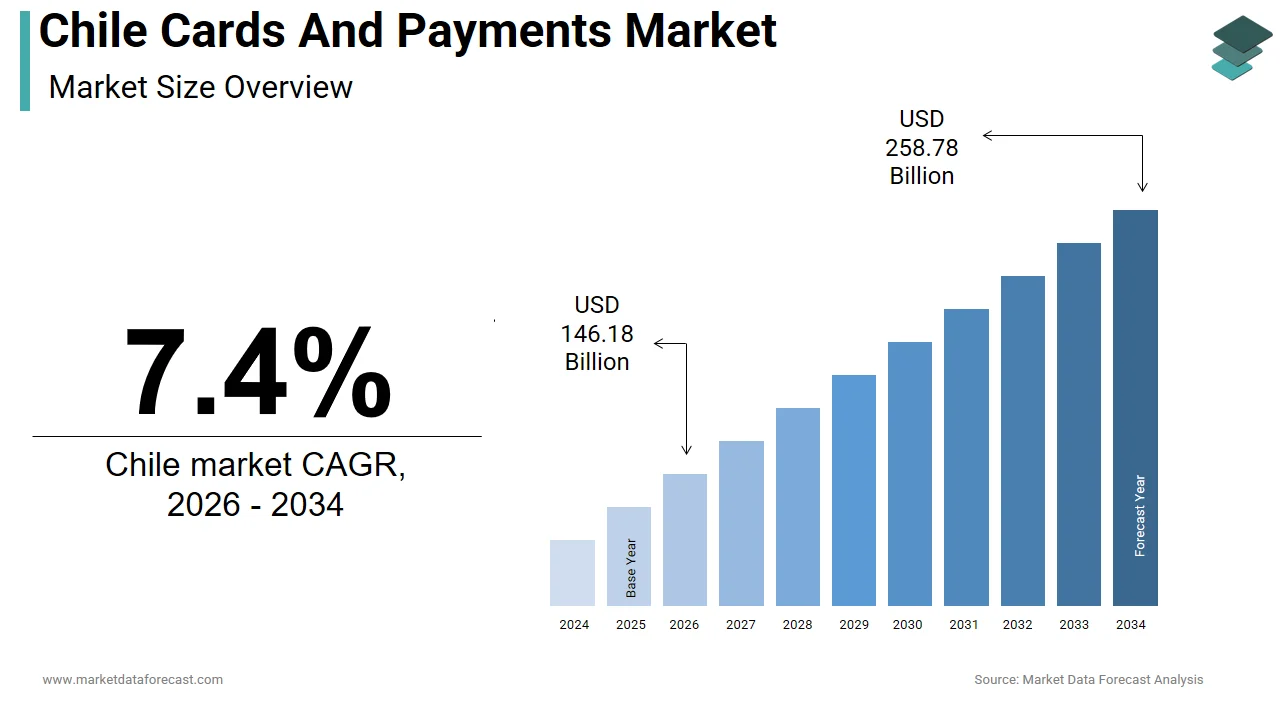
The Chile cards and payments market was valued at USD 136.11 billion in 2025, reached USD 146.18 billion in 2026, and is projected to reach USD 258.78 billion by 2034, growing at a compound annual growth rate (CAGR) of 7.4% from 2026 to 2034. Propelled by rapid digitalization, massive growth in e-commerce, nationwide mobile payment adoption, and real-time interbank transfer infrastructure, the Chilean financial landscape demonstrates steady long-term expansion.
Key Executive Metrics (At-a-Glance)
- 2025 Base Valuation: USD 136.11 Billion
- 2026 Current Valuation: USD 146.18 Billion
- 2034 Forecast Valuation: USD 258.78 Billion
- Compound Annual Growth Rate (CAGR): 7.4% (2026–2034)
- Regional Highlights: Urban centers like Santiago drive card penetration, while mobile point-of-sale (mPOS) terminals expand digital acceptance among small businesses.
Core Market Drivers & Growth Triggers
- Digitalization & E-Commerce: High smartphone penetration, contactless NFC terminals covering over 90% of POS networks, and booming online retail platforms.
- Real-Time Systems: The rollout of instant fund transfer systems like SPeL by the Central Bank of Chile, improving transaction speed and liquidity for SMEs and gig workers.
Primary Market Restraints & Challenges
- Rural Cash Dependency & Fraud Risks: Persistent preference for cash in rural micro-merchants, coupled with cybersecurity vulnerabilities and limited financial literacy among lower-income groups.
- Regulatory Complexity: Overlapping jurisdictions between banking and non-bank regulators increasing compliance and licensing hurdles for fintech startups.
Chile Cards and Payments Market Segmentation Breakdown
| Segment Category | Sub-Segments / Leading Components |
|---|---|
| By Cards | Debit Cards, Credit Cards, Prepaid Cards |
| By Payment Terminals | POS (Point of Sale), ATMs |
| By Payment Instruments | Credit Transfers, Direct Debit, Cheques, Payment Cards |
Major Industry Players Profiled
Key financial institutions shaping the Chilean cards and payments market include BancoEstado, Banco de Chile, Santander Chile, Banco de Crédito e Inversiones, Banco Falabella, CAT Administradora de Tarjetas, Banco Itaú Chile, and Redcompra.
 Download Free Sample Report
Chile Cards and Payments Market Size
The Chile cards and payments market was worth USD 136.11 billion in 2025. The Chile market is predicted to reach USD 146.18 billion in 2026 and USD 258.78 billion by 2034, growing at a CAGR of 7.4% during the forecast period.
MARKET DRIVERS
Rapid Digitalization and Mobile Payment Growth
Chile has experienced a significant shift toward digital payments, driven by increased smartphone penetration, improved internet connectivity, and rising consumer preference for convenience. This trend has been further accelerated by platforms like Bizum Chile, launched in partnership with major banks including Banco Santander and Banco Estado, which enables instant peer-to-peer money transfers. Additionally, contactless card usage has grown rapidly, with over 90% of point-of-sale (POS) terminals now supporting NFC technology.
Expansion of E-commerce and Online Retail
E-commerce in Chile has seen exponential growth, directly boosting demand for card and digital payment solutions. This surge has necessitated secure and efficient payment systems, particularly credit and debit cards, as well as alternative payment methods like digital wallets. Notably, Mercado Pago and PayPal have expanded their presence, offering localized payment options that cater to diverse consumer preferences. Moreover, the rise of cross-border e-commerce has led to an increase in international card transactions, with Mastercard reporting a 31% year-on-year increase in cross-border card spending among Chilean consumers in 2023. As consumer confidence in online shopping grows, so does the reliance on electronic payment instruments, making e-commerce a pivotal driver of the cards and payments market.
MARKET RESTRAINTS
High Cash Dependency in Rural and Lower-Income Segments
Despite progress in digital payment adoption, cash remains dominant in many parts of Chile, especially in rural areas and among lower-income populations. A 2023 survey by the Central Bank of Chile found that only 46% of micro-merchants in rural regions accepted card payments, compared to 82% in Santiago and other major cities. This gap limits the reach of card-based payment systems and hinders nationwide digital transformation efforts. Cash dependency is also reinforced by behavioral factors. Around 40% of respondents in a 2023 Latin American Consumer Finance Survey cited concerns about digital fraud and lack of trust in online systems as reasons for preferring cash.
Fragmented Regulatory Landscape and Compliance Burdens
The regulatory environment for payments in Chile, while evolving, presents challenges for fintechs and traditional financial institutions alike. Although Chile has made strides in fostering innovation, the coexistence of multiple regulatory frameworks creates uncertainty and increases compliance costs. The Superintendence of Banks and Financial Institutions (SBIF) oversees banking operations, while the Undersecretariat of Treasury manages non-bank payment service providers, leading to overlapping jurisdictions. According to a 2023 report by Deloitte, this fragmentation has delayed the licensing process for new fintech players by an average of 6–8 months. Moreover, the introduction of the Electronic Money Issuers Law (Ley de Emisores de Dinero Electrónico) in 2021 required many startups to restructure their business models to comply with capital adequacy and anti-money laundering (AML) standards, which is resulting in increased operational expenses.
MARKET OPPORTUNITIES
Growth of Embedded Finance and Banking-as-a-Service (BaaS)
Embedded finance and Banking-as-a-Service (BaaS) are emerging as key opportunities in Chile, enabling non-financial companies to integrate payment solutions into their platforms without requiring full banking licenses. Major retailers, ride-hailing apps, and utility providers are partnering with licensed banks to issue branded virtual cards and offer instant financing options at the point of sale.
Adoption of Real-Time Payments and Interbank Transfer Systems
Chile’s transition toward real-time payment systems is unlocking new opportunities for speed, efficiency, and financial inclusion. The Sistema de Pagos en Línea (SPeL), introduced by the Central Bank of Chile, allows for immediate fund transfers between banks, which eliminates delays associated with traditional ACH systems. Real-time payments are particularly beneficial for gig workers, freelancers, and SMEs that require instant access to funds. Platforms like Mercado Pago and Transbank have integrated SPeL into their payout mechanisms, enhancing user experience and reducing settlement risks. The success of SPeL has also inspired pilot programs for cross-border real-time payments with neighboring countries, which signals potential regional integration. As adoption grows, real-time systems are poised to become a core component of Chile’s digital payment infrastructure.
MARKET CHALLENGES
Cybersecurity Risks and Rising Fraud Incidents
As digital payments gain traction in Chile, the risk of cyberattacks and payment fraud has risen sharply. Many rely on third-party vendors for fraud detection, which can lead to vulnerabilities if not properly managed. The SBIF issued updated cybersecurity guidelines in late 2023, mandating stronger authentication protocols and real-time fraud monitoring systems. However, enforcement remains inconsistent, and awareness among end-users remains low, posing ongoing threats to the market’s integrity.
Limited Financial Literacy among Low-Income Populations
Financial literacy gaps pose a significant challenge to expanding card and digital payment usage in Chile, particularly among lower-income groups. According to the OECD’s 2023 Financial Literacy Survey, only 54% of Chileans demonstrated a basic understanding of financial concepts such as interest rates, budgeting, and digital security, well below the OECD average of 67%. This knowledge deficit leads to mistrust in digital tools and reluctance to adopt formal banking services. A 2023 study by the Central Bank of Chile found that 32% of unbanked individuals cited confusion about how to use digital payment systems as a primary barrier to entry. Efforts to improve financial education, such as the "Cuenta RUT" program and school-based initiatives by the Ministry of Education, have shown some success, but reach remains uneven, especially in rural areas.
MARKET KEY HIGHLIGHTS
The customer attractive initiatives like work/café branches with an integrated banking space, a cafeteria, an open co-working space for meetings, and free Wi-Fi by Santander Chile Bank and Caja Vecina banking terminals by BancoEstado, providing more convenient banking and customer services.
The campaigns to educate the Chilean citizens to understand the financial and bank services, like the You Decide gaming app offering a virtual budget to users and asking them to utilize it in the best possible way by the government-funded Solidarity and Social Investment, and Step by Step, better decision, by the National Consumer Service for elderly individuals.
The increasing demand for mobile point-of-sale (mPOS) terminals is encouraging banks like BancoEstado to partner with Sum-up to offer mobile card payment terminals to small businesses, and Transbank to launch an mPOS solution that enables small businesses and service providers to accept card payments with the aid of a smartphone and Bluetooth-supported wireless pinpad card reader.
KEY MARKET PLAYERS
Top players in the Chile cards and payments market include
- BancoEstado
- Banco de Chile
- Santander Chile
- Banco de Crédito e Inversiones
- Banco Falabella
- CAT Administradora de Tarjetas
- Banco Itaú Chile
- Redcompra
MARKET SEGMENTATION
This research report on the Chile Cards and Payments market has been segmented and sub-segmented based on the following categories.
By Cards
- Debit Cards
- Credit Cards
- Prepaid Cards
By Payment Terminals
- POS
- ATM's
By Payment Instruments
- Credit Transfers
- Direct Debit
- Cheques
- Payment Cards