- Product Description Description
- Table of Contents TOC
- List of Table & Figure LOT
- Get Free Sample PDF Sample PDF
Market Size, 2025
$1.98 BnMarket Estimate, 2026
$2.14 BnMarket Forecast, 2034
$3.94 BnCAGR, 2026–2034
7.94%Europe Eubiotics Market Size
The Europe eubiotics market size was valued at USD 1.98 billion in 2025 and is anticipated to reach a valuation of USD 2.14 billion in 2026 and USD 3.94 billion by 2034, growing at a CAGR of 7.94%, from 2026 to 2034.
Current Introduction and Definition of the Europe Eubiotics Market
Eubiotics refer to a category of feed and food additives designed to promote a balanced and beneficial microbial ecosystem in the gastrointestinal tract,t thereby enhancing host health and productivity. In Europe, pe these include probiotics, prebiotics,ics prebi,otics organic acids, essential oils,s and phytogenics used predominantly in livestock nutrition but increasingly in human functional foods and dietary supplements. The concept centers on modulating gut microbiota without the antimicrobial resistance risks associated with conventional growth promoters. According to the European Food Safety Authority (EFSA), more than 150 microbial strains and over 80 botanical compounds are authorized for use in animal feed under Regulation (EC) No 1831/2003, following rigorous safety and efficacy evaluations. The European Commission’s Farm to Fork Strategy explicitly promotes eubiotics as alternatives to antimicrobials, with a target to reduce veterinary antibiotic sales by 50% by 2030. This regulatory push aligns with consumer sentiment. According to a 2023 Eurobarometer survey, 68% of Europeans prefer meat and dairy products from antibiotic-free systems. Unlike therapeutic interventions, eubiotics function preventively and require consistent dietary inclusion, embedding them into long-term production protocols across poultry, swine, and aquaculture sectors. These regulatory, consumer, and operational dynamics position eubiotics not as niche additives but as foundational tools in Europe’s transition toward sustainable, residue-free animal agriculture.
MARKET DRIVERS
EU Regulatory Push to Phase Out Antimicrobial Growth Promoters
The European Union’s aggressive policy framework to curb antimicrobial resistance has become the foremost driver of eubiotics adoption across livestock production systems. According to the European Commission, the 2022 implementation of the Veterinary Medicinal Products Regulation prohibits the routine use of antibiotics for growth promotion or prophylaxis, restricting therapeutic use to diagnosed conditions under veterinary oversight. This legal shift compels farmers to seek viable alternatives to maintain gut health and productivity. The Farm to Fork Strategy reinforces this by setting a binding target to reduce antimicrobial sales in animals by 50% by 2030 compared to 2018 levels. According to the European Surveillance of Veterinary Antimicrobial Consumption (ESVAC), sales of antibiotics for food-producing animals declined by 53% between 2011 and 2022, with a 12.7% drop between 2021 and 2022 alone, signalling strong policy traction. In response, major integrators like PHW Group in Germany and Aviagen in the UK now formulate all broiler feeds with blends of organic acids and probiotics. National action plans in Denmark and the Netherlands mandate eubiotic inclusion in both organic and conventional farms. This regulatory imperative transforms eubiotics from optional supplements into essential components of compliant and sustainable European animal husbandry.
Rising Consumer Demand for Antibiotic-Free and Clean Label Animal Products
European consumers are increasingly influencing production practices through strong preferences for meat, dairy, and eggs produced without routine antibiotic use, which is further boosting the expansion of the European eubiotics market. According to a 2022 Eurobarometer survey, 65% of EU citizens expressed concern about antimicrobial resistance and supported stricter rules on antibiotic use in farming. In Germany, as per the Federal Office of Consumer Protection and Food Safety, antibiotic-free poultry labeling has expanded significantly, with major producers offering certified products. According to the European Consumer Organisation, clean label expectations now extend to feed ingredients, with a growing share of consumers supporting transparency on gut health additives. This market pressure incentivizes producers to adopt eubiotics not only for regulatory compliance but also for brand differentiation. Companies like ForFarmers and Agrifirm have launched premium feed lines featuring probiotic and phytogenic blends marketed directly to conscious consumers. This convergence of ethical consumption, retail governance, and producer response solidifies eubiotics as a cornerstone of Europe’s responsible protein narrative.
MARKET RESTRAINTS
Stringent and Fragmented Authorization Processes for Feed Additives
Despite strong policy support, the regulatory pathway for eubiotic approval in Europe remains a significant barrier due to its rigorous scientific requirements and procedural complexity. According to the European Food Safety Authority (EFSA), the authorization of a single microbial strain or botanical compound under Regulation (EC) No 1831/2003 requires extensive data on safety for target species, consumers, and the environment, plus demonstrated efficacy through controlled trials. As per the European Feed Manufacturers’ Federation (FEFAC), the average approval timeline exceeds three years, with costs often surpassing €1.5 million per dossier. This burden disproportionately affects small and medium enterprises, which limits innovation and diversity. Furthermore, national interpretations of efficacy criteria vary, as seen in 2022 when Germany rejected a yeast-based additive approved in France, citing insufficient trial data. The European Commission’s 2023 review of feed additive legislation acknowledged these bottlenecks and noted that only 12 new eubiotic substances were authorized between 2020 and 2023, despite over 60 applications. This regulatory friction delays the introduction of novel strains and plant extracts that could address emerging gut health challenges in livestock, thereby constraining the market’s responsiveness to evolving production needs.
Inconsistent Efficacy Under Field Conditions and Lack of Standardized Metrics
The performance of eubiotics in commercial farming environments often diverges from controlled trial results due to variability in animal genetics, feed composition, hygiene, and management practices, which further hampers the growth of the European eubiotics market. According to a 2024 meta-analysis by the European Federation of Animal Science, probiotic efficacy in swine production varied by up to 40% across farms in Southern versus Northern Europe due to differences in diet and climate. Unlike pharmaceuticals, eubiotics lack universally accepted biomarkers to quantify gut health outcomes, which makes it difficult to demonstrate consistent return on investment. The European Committee for Standardization (CEN) has yet to establish validated protocols for measuring microbial modulation or barrier integrity in live animals. Consequently, farmers rely on indirect indicators like feed conversion ratio or mortality, which can be influenced by multiple factors. As per a 2023 survey by European Livestock Voice, 52% of producers discontinued eubiotic use after one cycle due to perceived lack of tangible benefits. Without standardized efficacy metrics and real-world validation frameworks, confidence in eubiotics remains uneven, which is hindering widespread and sustained adoption across diverse European production systems.
MARKET OPPORTUNITIES
Integration of Precision Nutrition and Microbiome Diagnostics
The convergence of gut microbiome analytics and precision feeding is transforming eubiotic deployment from generic supplementation to targeted interventions, which is a prominent opportunity in the European eubiotics market. According to the European Joint Programme on Agricultural Systems, over 30 pilot farms in the Netherlands and Denmark are using fecal metagenomics to guide probiotic and prebiotic selection in dairy herds, resulting in 8–12% improvements in feed efficiency. The European Institute of Innovation and Technology (EIT Food) supported a 2023 consortium to develop on-farm microbiome test kits paired with AI-driven recommendation engines for poultry and swine operations. These tools enable producers to align eubiotic formulations with specific microbial deficiencies to enhance performance predictability. Regulatory alignment is emerging. EFSA established a working group on microbiome-based claims in 2024, which is signalling future harmonization. As data-driven nutrition gains traction, eubiotics are poised to become dynamic components of personalized livestock health strategies.
Expansion into Aquaculture and Alternative Livestock Systems
Eubiotics are gaining traction in aquaculture and novel protein systems, which is another noteworthy opportunity in the European eubiotics market. According to the European Commission’s 2023 Blue Economy Report, EU aquaculture production reached 1.2 million tons, with species like sea bass, seabream, and salmon highly susceptible to gut dysbiosis. Unlike terrestrial livestock, antibiotic use post-stocking is restricted in aquaculture, which is making preventive gut health management essential. As per the European Aquaculture Society, over 70% of new fish feed formulations in 2023 included organic acids or yeast derivatives to enhance disease resistance. In parallel, insect farming and cellular agriculture, prioritized under the EU Protein Plan, are exploring eubiotics to optimize microbial environments in black soldier fly larvae and bioreactor cultures. Startups in Belgium and Sweden are testing phytogenic blends to reduce pathogenic load in insect frass used as fertilizer. These sectors operate under strict biosecurity and sustainability mandates, which make them ideal for eubiotic integration.
MARKET CHALLENGES
Limited Understanding of Strain-Specific and Synergistic Effects
Scientific uncertainty around strain compatibility and synergistic effects remains a major barrier for the European eubiotics market. According to EFSA, many commercial probiotic blends lack evidence of strain compatibility or additive efficacy. As per a 2024 study in Frontiers in Microbiology, certain Lactobacillus and Bacillus combinations used in poultry feed inhibited each other’s colonization, reducing efficacy by up to 35%. Additionally, according to the University of Ghent research, high doses of some phytogenic compounds can degrade beneficial bacteria, complicating formulation. Without validated biomarkers or mechanistic clarity, formulators rely on empirical mixing, leading to variable field performance. Horizon Europe has allocated €40 million to map eubiotic interactions using multi-omics approaches, but practical outcomes remain years away. Until strain-level functionality and synergy are decoded, confidence among producers and regulators will remain limited.
Supply Chain Vulnerability of Natural Raw Materials
The eubiotics supply chain is exposed to climate and geopolitical shocks, which further challenge the expansion of the European eubiotics market. According to the European Environment Agency, extreme drought in 2023 reduced oregano and thyme yields in Southern Europe by 28%, directly impacting phytogenic production. Eurostat’s agricultural input cost index reported a 22% price increase in molasses in 2024. High-value strains like Saccharomyces cerevisiae are produced in just three certified EU-based GMP facilities, as noted by the European Probiotics Association, creating bottlenecks. Additionally, 40% of citrus bioflavonoids used in eubiotics are imported from non-EU countries, many of which face export restrictions. These dependencies lead to formulation inconsistencies and cost volatility, complicating long-term feed planning. While synthetic alternatives exist, they often fail to meet clean label expectations. Without localized and resilient sourcing models, the eubiotics supply chain will remain a structural vulnerability in Europe’s sustainable livestock agenda.
REPORT COVERAGE
| REPORT METRIC | DETAILS |
| Market Size Available | 2025 to 2034 |
| Base Year | 2025 |
| Forecast Period | 2026 to 2034 |
| CAGR | 7.13% |
| Segments Covered | By Type, Prebiotics, Livestock, And By Country |
| Various Analyses Covered | Global, Regional & Country Level Analysis; Segment-Level Analysis, DROC, PESTLE Analysis, Porter’s Five Forces Analysis, Competitive Landscape, Analyst Overview of Investment Opportunities |
| Regions Covered | UK, France, Spain, Germany, Italy, Russia, Sweden, Denmark, Switzerland, Netherlands, Turkey, Czech Republic, & Rest of Europe |
| Market Leaders Profiled | Addcon, BASF SE, Royal DSM, and CHR. Hansen A/S, Behn Meyer Group, Kemin Industries Inc., E. I. Du Pont De Nemours and Company, Cargill Incorporated, Novus International Inc., Beneo Group. |
SEGMENTAL ANALYSIS
By Type Insights
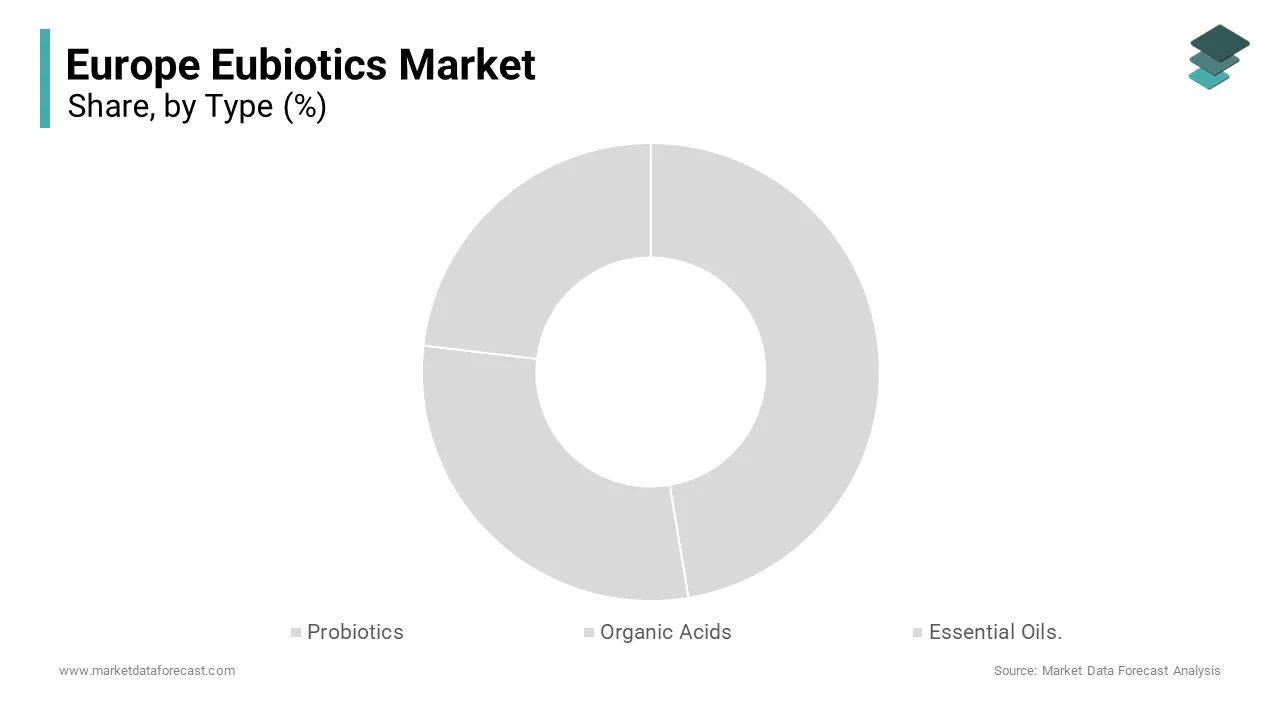
The probiotics segment dominated the market by holding 41.4% of the regional market share in 2025. The dominance of the probiotics segment in the European eubiotics market is primarily attributed to their proven efficacy in modulating gut microbiota, enhancing nutrient absorption, and reducing pathogenic colonization in livestock. Among probiotic strains, Lactobacilli and Bifidobacteria dominate, with over 85 authorized strains under EU feed additive legislation. As per the European Commission’s 2023 antimicrobial reduction report, 62% of EU broiler producers now routinely include probiotics in starter feeds to compensate for the ban on antibiotic growth promoters. Additionally, probiotics are permitted under the EU Organic Regulation EC 834/2007, which is making them compatible with certified organic systems. According to the research from the University of Copenhagen, probiotic supplementation in dairy calves reduced diarrhea incidence by 34% and improved weight gain by 12% over six weeks. This combination of regulatory acceptance, scientific validation, and production benefit ensures probiotics remain the cornerstone of European eubiotic strategies.
The bifidobacteria segment is the fastest-growing probiotic subsegment and is estimated to register a CAGR of 10.8% over the forecast period. As per the European Federation of Animal Science, trials in Germany and the Netherlands showed that Bifidobacterium animalis reduced post-weaning diarrhea in piglets by 41% and lowered veterinary treatment costs by 27%. Unlike Lactobacilli, Bifidobacteria produce acetate and lactate in ratios that more effectively inhibit Salmonella and E. coli colonization, as validated by the French National Institute for Agricultural Research. According to Wageningen University, Bifidobacteria maintain >85% survival in pelleted feed post-thermal processing. EFSA granted full authorization to three new Bifidobacteria strains in 2023 for ruminant use, marking a regulatory milestone.
By Livestock Insights
The poultry segment dominated the European eubiotics market for livestock in 2025. The 2006 EU ban on antibiotic growth promoters had its most immediate impact on poultry, which is prompting early adoption of eubiotics. As per the European Commission’s 2023 monitoring report, 74% of broiler operations now use at least two eubiotic categories,s typically probiotics and organic acids. EFSA estimates that necrotic enteritis causes €2 billion in annual losses, which makes preventive microbiome management essential. Retailer mandates for antibiotic-free production further accelerate eubiotic adoption. Leading integrators like Hendrix and Aviagen have standardized eubiotic blends across all European hatcheries.
The aquaculture segment is the fastest-growing livestock segment and is estimated to grow at a CAGR of 12.7% over the forecast period. The EU aims to increase domestic seafood production to 2.5 million tons by 2030 under strict antimicrobial restrictions. As per the European Aquaculture Society, 65% of new feed formulations for sea bass and salmon in 2023 included probiotic yeast or prebiotic blends. Trials by the Hellenic Centre for Marine Research showed that Bacillus subtilis reduced vibriosis-related mortality by 28% in Mediterranean farms. EU organic aquaculture regulations prohibit antibiotic use, and certified operations grew by 19% in 2023. With climate change increasing pathogen pressure, eubiotics are becoming essential for sustainable aquaculture expansion.
COUNTRY ANALYSIS
Germany Eubiotics Market Analysis
Germany accounted for the highest share of 20.5% of the European market in 2025. The dominance of Germany in the European market can be credited to its large intensive livestock sector, stringent antimicrobial policies, and advanced feed manufacturing infrastructure. Over 80% of German poultry and swine operations incorporate multi-component eubiotic blends as standard practice following the national Antibiotic Minimization Strategy launched in 2021. The German Research Foundation has funded over €15 million since 2022 for microbiome research in livestock, with projects at the University of Leipzig demonstrating significant reductions in Campylobacter through targeted probiotic use. Additionally, Germany hosts Europe’s highest concentration of feed additive producers, including EW Nutrition and Dr. Eckel, which supply specialized eubiotic formulations across the continent. Retailer requirements from Aldi and Lidl for antibiotic-free meat further enforce adoption. This ecosystem of regulatory rigor, scientific investment, and industrial capacity ensures Germany remains the cornerstone of Europe’s eubiotics landscape.
Netherlands Eubiotics Market Analysis
The Netherlands plays a pivotal role in the European eubiotics market. The high livestock density, a pioneering approach to antibiotic reduction, and leadership in circular feed innovation are driving the eubiotics market growth in the Netherlands. The Dutch government’s “From Farm to Fork” covenant mandates a 70% reduction in veterinary antibiotic use since 2009, a target achieved through widespread eubiotic integration in piglet and broiler production. Wageningen University serves as a European hub for gut health research, with trials showing that phytogenic–organic acid combinations improve feed efficiency by 6% in weaned piglets. The country also leads in sustainable sourcing, with companies like Royal DSM producing prebiotics from dairy side streams and algae. Over 90% of Dutch dairy calf farms now use probiotic supplements as standard practice, according to the Dutch Dairy Association. This blend of policy ambition, scientific excellence, and circular innovation sustains the Netherlands’ position as a high-impact eubiotics market.
France Eubiotics Market Analysis
France maintains a strong position in the European eubiotics market. The large poultry and ruminant sectors, commitment to organic farming, and investment in alternative solutions under the Écophyto Plan are contributing to the growth of the French eubiotics market. Over 25,000 organic dairy and beef farms rely exclusively on eubiotics for gut health management, as synthetic antimicrobials are prohibited under EU organic rules. The French National Institute for Agricultural Research has validated the efficacy of native Lactobacillus strains isolated from Alpine pastures, showing enhanced colonization resilience in ruminants. France is also Europe’s largest producer of chicory, providing a domestic source of inulin for prebiotic formulations. Retailer initiatives like Carrefour’s “Without Routine Antibiotics” label have driven widespread adoption of eubiotic protocols in conventional poultry production. This fusion of agroecological policy, agricultural heritage, and market-driven demand cements France’s role as a diverse and resilient eubiotics market.
Spain Eubiotics Market Analysis
Spain plays a significant role in the European eubiotics market. The dominant pork and poultry sectors and the rapid expansion of aquaculture are driving the Spanish eubiotics market expansion. As the EU’s largest pork producer, Spain has seen widespread adoption of gut health solutions in post-weaning phases, particularly following the 2022 EU ban on zinc oxide. The Spanish Pig Farming Association reports that a majority of integrators now use Bifidobacteria and GOS blends in pig diets. In aquaculture, Spanish feed mills have pioneered the use of marine-derived prebiotics from seaweed extracts to enhance immunity in sea bream, with trials showing notable reductions in mortality. Climate challenges, including heat stress, further amplify eubiotic use, as organic acids help maintain gut integrity during the summer months. This combination of production scale, climatic adaptation, and innovation in both terrestrial and aquatic systems ensures Spain’s continued prominence in the European eubiotics market.
Denmark Eubiotics Market Analysis
Denmark holds an influential position in the European eubiotics market due to its world-leading antimicrobial stewardship policies, integrated livestock systems, and scientific leadership in young animal nutrition. The “Yellow Card” scheme, introduced in 2010, imposes penalties on farms exceeding antibiotic use thresholds, driving near-universal adoption of eubiotics in piglet production. Over 95% of Danish pig farms now use multi-strain probiotic and prebiotic combinations during the critical weaning window, according to the Danish Pig Research Centre. Denmark also pioneered the use of GOS in milk replacers, with Arla Foods and DLG collaborating on commercial formulations that reduce diarrhea and improve daily gain. The country’s organic sector, covering a significant share of agricultural land, mandates eubiotic use across all species. With a strong tradition of farmer cooperatives and data-driven management, Danish producers consistently achieve among the lowest antibiotic use rates in Europe, making eubiotics a foundational element of national animal health strategy.
COMPETITIVE LANDSCAPE
Competition in the Europe Eubiotics Market is defined by scientific differentiation, regulatory expertise, and regional adaptability among a mix of multinational nutrition companies and specialized biotech firms. The landscape is shaped by high barriers to entry,y including EFSA authorization cos, ts complex efficacy validation, and the need for localized field trials. Incumbents like DSM-Firme, Nich, BASF, and Lallemand dominate through integrated portfolios that span prob,iotics prebiotics, and phytogenics backed by decades of microbiome research. However, niche players focusing on novel strains fofmarine prebiotics or fermentation byproducts are gaining traction by addressing specific gaps, such as aquaculture immunity or heat stress mitigation. Unlike commodity feed additives, value is determined by biological performance, traceability, and compatibility with antibiotic-free protocols rather than price alone. Competition is further intensified by retailer and integrator demands for transparent and auditable feed solutions. As the EU advances its Farm to Fork goals, the market rewards companies that combine regulatory agility,y scientific rig, and practical farm-level relevance in their eubiotic offerings.
KEY MARKET PLAYERS
Some of the major companies dominating the Europe eubiotics market with their products and services include
- Addcon
- BASF SE
- Royal DSM
- Lallemand Animal Nutrition
- CHR. Hansen A/S
- Behn Meyer Group
- Kemin Industries Inc.
- E. I. Du Pont De Nemours and Company
- Cargill Incorporated
- Novus International Inc.
- Beneo Group.
Top Players In The Market
- DSM-Firmenich is a leading innovator in the Europe Eubiotics Market, offering a comprehensive portfolio of probiotics, prebiotics, and phytogenic solutions for livestock and aquaculture. The company leverages its global research network to develop strain-specific probiotics validated under European farm conditions. In 2024, DSM-Firmenich launched DelvoNutri BIFIDO, a Bifidobacteria-based product tailored for piglet gut health in compliance with the EU zinc oxide ban. It also expanded its fermentation capacity at its plant in Delft, the Netherlands,s to meet growing demand for GOS derived from dairy side streams. Through partnerships with European feed integrators and research institutions, ns DSM-Firmenich reinforces its role asscience-drivenven partner in sustainable animal nutrition across the continent.
- BASF SE plays a pivotal role in the Europe Eubiotics Market through its innovative feed enzymes and probiotic solutions under the Nutrilife and Enviva brands. The company integrates gut health additives into holistic nutritional programs for poultry and swine aligned with EU antimicrobial reduction goals. In early 2024, BASF introduced a new coated organic acid blend designed to withstand pelleting temperatures while delivering targeted release in the lower gut of broilers. It also deepened collaboration with Wageningen University to study microbiome modulation in dairy calves using next-generation sequencing. These initiatives enhance BASF’s scientific credibility and support its mission to advance animal health through precision nutrition in Europe.
- Lallemand Animal Nutrition exerts a significant influence on the Europe Eubiotics Market with its proprietary yeast and bacterial strains used across the ruminant, poultry, and aquaculture sectors. The company’s Probiofit and Levucell product lines are widely adopted in organic anantibiotic-freeee production systems throughout Western and Northern Europe. In 2024, Lallemand inaugurated a dedicated R&D center in Mirande, France, focused on strain selection for heat stress resilience in Mediterranean livestock operations. It also partnered with Danish pig producers to validate a multi-strain probiotic protocol that reduced post weaning diarrhea by 38% in commercial trials. By combining microbial expertise with on-farm validation, Lallemand strengthens its reputation as a trusted partner in European sustainable livestock farming.
Top Strategies Used by the Key Market Participants
Key players in the Europe Eubiotics Market pursue four core strategies to reinforce their positions. First, they invest in strain-specific research to validate efficacy under European farm conditions and meet stringent EFSA requirements. Second, they develop multi-component formulations combining probiotics, prebiotics, and organic acids for synergistic gut health effects. Third, do they align product innovation with regulatory milestones such as the EU zinc oxide ban and antimicrobial reduction targets? Fourth,rth they expand local production and R&D infrastructure within Europe to ensure supply resilience and rapid response to regional challenges. Additionally, companies forge strategic partnerships with feed mmillsil universities,a nd producer cooperatives to co-develop and validate solutiin real-worldldld settings. These approaches collectively enhance scientific legitimacy, regulatory compliance,e and on-farm impact across Europe’s diverse livestock landscape.
MARKET SEGMENTATION
This research report on the Europe Eubiotics market is segmented and sub-segmented into the following categories.
By Type
- Probiotics
- Lactobacilli
- Bifidobacterial
- Others
- Organic Acids
- Essential Oils.
By Prebiotics
- Prebiotics
- Inquilino Fructooligosaccharides
- Galactooligosaccharides
- Others.
By Livestock
- Swine
- Aquaculture
- Horses
- Others.
By Country
- UK
- France
- Spain
- Germany
- Italy
- Russia
- Sweden
- Denmark
- Switzerland
- Netherlands
- Turkey
- Czech Republic
- Rest of Europe