- Product Description Description
- Table of Contents TOC
- List of Table & Figure LOT
- Get Free Sample PDF Sample PDF
Market Size, 2025
$0.89 BnMarket Estimate, 2026
$1.03 BnMarket Forecast, 2034
$3.31 BnCAGR, 2026–2034
15.72%Europe Real Time Location Systems Market Report Summary
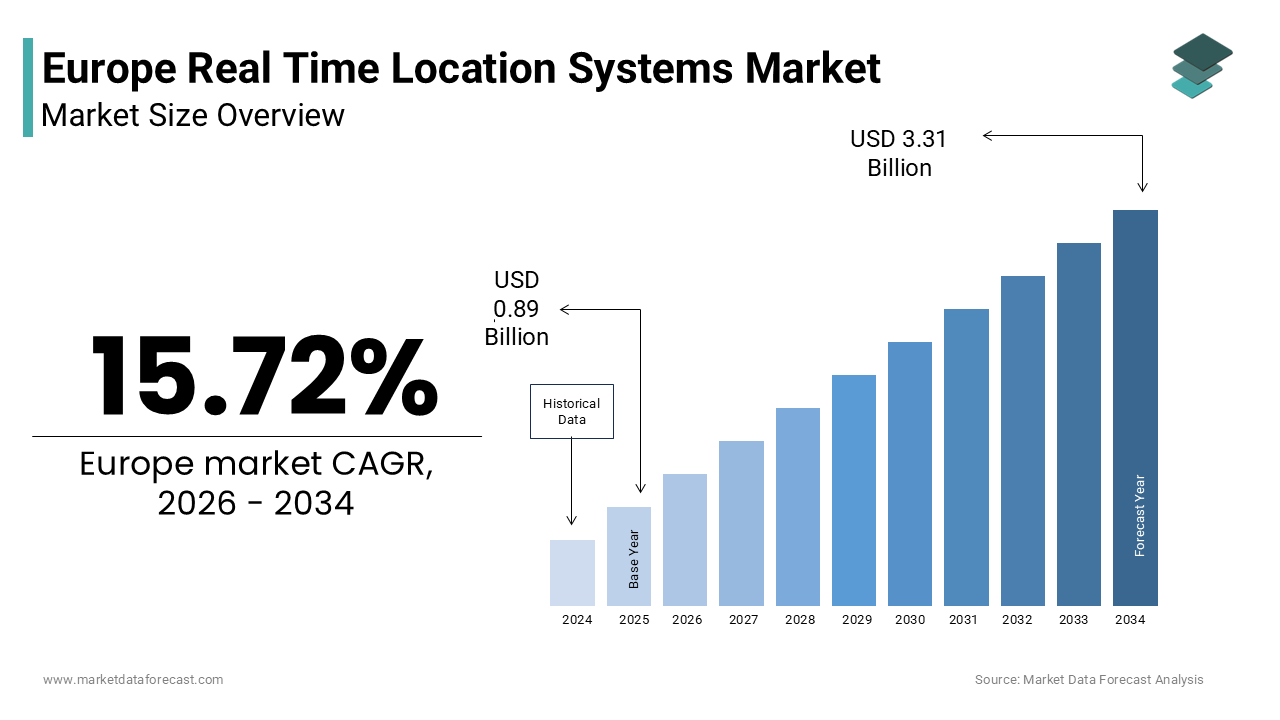
The Europe real time location systems market was valued at USD 0.89 billion in 2025, is estimated to reach USD 1.03 billion in 2026, and is projected to reach USD 3.31 billion by 2034, growing at a CAGR of 15.72% during the forecast period from 2026 to 2034. The growth of the Europe real time location systems market is driven by accelerating digital transformation across healthcare and manufacturing sectors, increasing adoption of Industry 4.0 technologies, and rising demand for real-time asset visibility and workflow optimization. Expanding deployment of ultra wideband, Bluetooth Low Energy, Wi-Fi RTT, and RFID-based tracking solutions integrated with AI analytics and enterprise platforms is further fueling market growth. Moreover, growing smart city initiatives, digital twin integration, and strong regulatory focus on cybersecurity and data governance are positioning real time location systems as critical infrastructure enabling operational efficiency, safety, and resource optimization across Europe.
Key Market Trends
-
Rising adoption of ultra wideband and Bluetooth Low Energy technologies delivering high-precision indoor positioning across hospitals, factories, and logistics facilities.
-
Increasing integration of RTLS platforms with digital twin environments and AI-driven analytics for predictive operational intelligence.
-
Growing deployment of real-time location systems in smart factories to enable material traceability, worker safety monitoring, and production optimization.
-
Expansion of smart city and public safety initiatives leveraging hybrid indoor–outdoor positioning systems.
-
Strengthening emphasis on cybersecurity, interoperability, and GDPR-compliant data management frameworks for connected tracking solutions.
Segmental Insights
- Based on model, The ultra wideband segment was the largest and held a significant share of the Europe real time location systems market in 2025. The segment’s dominance is attributed to superior positioning accuracy, reliability in complex indoor environments, and increasing adoption across healthcare and advanced manufacturing facilities.
- Based on product type, The hardware segment accounted for 52.4% of the Europe real time location systems market share in 2025. Tags, anchors, gateways, and wearable devices form the foundational infrastructure required for location deployments, resulting in substantial initial investment and segment leadership.
- Based on industry vertical, The healthcare segment was the largest, occupying a prominent share of 31.6% of the Europe real time location systems market in 2025. The dominance of this segment stems from increasing need for asset tracking, patient safety monitoring, workflow optimization, and regulatory compliance across modern healthcare environments.
Regional Insights
The Europe real time location systems market is witnessing rapid growth across major economies, supported by strong investments in industrial automation, healthcare digitization, and smart infrastructure development.
-
Germany was the largest contributor to the Europe real time location systems market, driven by advanced manufacturing ecosystems, automotive digitalization initiatives, and strong Industry 4.0 adoption.
-
The United Kingdom and France continue to perform strongly, supported by smart healthcare infrastructure modernization, logistics automation, and smart city deployment programs.
-
Nordic countries are emerging as innovation hubs, benefiting from early adoption of digital healthcare technologies, advanced connectivity infrastructure, and strong public-sector digitization initiatives.
-
Italy and other Southern European countries are gradually expanding adoption, supported by increasing investments in manufacturing modernization and enterprise digital transformation initiatives.
Competitive Landscape
The Europe real time location systems market is characterized by the presence of global technology providers, specialized industrial solution vendors, and software-driven analytics innovators competing on accuracy, cybersecurity, interoperability, and enterprise integration capabilities. Leading companies are focusing on AI-enabled location intelligence platforms, cloud-based analytics services, and seamless integration with ERP, digital twin, and building management systems to enhance value delivery. Strategic partnerships across healthcare, automotive, logistics, and public infrastructure sectors, along with strong regulatory compliance capabilities, are strengthening competitive positioning. Prominent players in the Europe real time location systems market include Securitas AB, Zebra Technologies Corporation, Impinj Inc., Siemens AG, GE Healthcare, Qorvo Inc., Alien Technology LLC, TeleTracking Technologies Inc., Midmark Corporation, Litum, Ubisense Group Plc, Sonitor Technologies AS, CenTrak Inc., Savi Technology, and Sewio Networks.
 Download Free Sample Report
Europe Real Time Location Systems Market Size
The Europe real time location systems market size was valued at USD 0.89 billion in 2025 and is anticipated to reach USD 1.03 billion in 2026 from USD 3.31 billion by 2034, growing at a CAGR of 15.72% during the forecast period from 2026 to 2034.
A Real-Time Location System (RTLS) is an automated technology used to continuously identify and track the location of objects or people in real time within a defined space, such as a building or campus. These systems leverage technologies such as ultra wideband, Bluetooth Low Energy, Wi Fi RTT, and RFID to enable dynamic visibility across healthcare, manufacturing, logistics, and smart infrastructure environments. Unlike generic tracking tools, modern real time location systems in Europe are increasingly integrated with enterprise workflows, digital twins, and AI driven analytics to support operational decision making. According to research, asset tracking and RTLS adoption in large European hospitals is accelerating, with a notable growth rate in the coming years as hospitals move to improve equipment utilization and staff workflow. Furthermore, The European Commission, through the Horizon Europe program and Digital Europe Programme, is supporting numerous smart manufacturing pilots that deploy IoT and real-time location infrastructure to optimize supply chain, material flow, and worker safety. The market is also shaped by the EU’s Cyber Resilience Act, which mandates stringent data security for connected devices. Consequently, real time location systems in Europe are evolving from passive tracking tools into intelligent, secure, and interoperable platforms that enhance efficiency, safety, and resource optimization across critical sectors.
MARKET DRIVERS
Digital Transformation of Healthcare Infrastructure
The modernization of European healthcare facilities is a major accelerator for the Europe real-time location systems market. This trend is fueled by aging populations and the need for operational efficiency. Current healthcare expenditure in the EU exceeded 1.7 trillion euros in 2023, with significant, ongoing investment from the EU budget and the Digital Europe Programme targeting digital infrastructure. Hospitals face chronic shortages of mobile assets such as infusion pumps wheelchairs and defibrillators. Studies indicate that nurses spend 20 to 60 minutes per shift searching for equipment, reducing direct patient care time. In response, institutions like Karolinska University Hospital in Sweden and Charité in Berlin have deployed ultra wideband based tracking systems that reduce equipment search time and improve asset utilization. The Digital Europe Programme, with a total budget of €7.6 billion through 2027, supports the digital transformation of health systems. Besides, staff duress alerts and contact tracing capabilities, validated during pandemic response, have become standard requirements. This convergence of clinical efficiency mandates regulatory support and workforce safety ensures sustained demand for precise indoor location systems across Europe’s healthcare landscape.
Smart Factory and Industry 4.0 Integration Initiatives
The region’s aggressive push toward industrial digitization under the Industry 5.0 framework is significantly boosting RTLS deployment in manufacturing and logistics, which in turn drives the growth of the Europe real time location systems market. According to the European Commission, a vast majority of large industrial enterprises across major European economies have successfully integrated core digital technologies, significantly exceeding earlier estimates. In automotive plants, these systems monitor work in progress across assembly lines, reducing bottlenecks and enabling just in sequence part delivery. Volkswagen utilizes high-precision tracking tags for battery logistics to ensure traceability and reduce errors, while global logistics providers like DB Schenker deploy low-power wireless beacons to enhance automated sorting precision. The EU’s Important Project of Common European Interest on Next Generation Batteries mandates full traceability of cell production, further driving adoption. This integration of location intelligence into production ecosystems transforms real time location systems from optional add ons into essential nervous systems of modern European industry.
MARKET RESTRAINTS
Stringent Data Privacy and Cybersecurity Regulations
The region’s rigorous data protection and cybersecurity frameworks, particularly the General Data Protection Regulation and the Cyber Resilience Act, are inhibiting the expansion of the Europe real time location systems market. This is affecting the RTLS vendors. These laws impose strict requirements on the collection storage and processing of location data, especially when tracking individuals. Data protection authorities are increasing their oversight of digital surveillance in professional environments, leading to more rigorous scrutiny of how employers implement tracking software and automated management tools. Systems that track employee movement must implement granular consent mechanisms data anonymization and end to end encryption, increasing development complexity and cost. Providers of location-based services are facing rising financial and operational requirements to align with European security standards, as regulatory frameworks for internet-connected devices become more stringent. Small and medium enterprises struggle disproportionately with these burdens due to limited legal and technical resources. These regulations enhance user trust and data integrity. At the same time, they raise barriers to innovation and market entry, acting as a structural restraint on solution scalability and feature velocity.
Interoperability Challenges Across Legacy Infrastructure
The fragmented technological landscape and incompatibility with existing building management and enterprise systems are further hindering the expansion of the Europe real time location systems market. Many hospitals factories and warehouses operate on legacy Wi Fi networks or proprietary automation platforms that lack standardized APIs for location data integration. High-precision Real-Time Location Systems (RTLS) are currently gaining traction. However, many industrial sites, particularly in certain European regions, are still upgrading their infrastructure to support sub-meter accuracy as part of their digital transformation efforts. Retrofitting older facilities often requires costly upgrades to cabling power supply and backhaul capacity. Moreover, the coexistence of multiple wireless protocols, such as RFID Bluetooth and ultra wideband, creates signal interference and inconsistent performance. Ultra-Wideband (UWB) tracking systems, when used in densely packed, metallic warehouse environments, require proper calibration and optimization to maintain high positioning accuracy, as metal racking can otherwise lead to significant location drift. The interoperability gap will continue to impede seamless deployment and limit return on investment for organizations seeking to digitize their physical operations. This issue will persist until harmonized communication standards and modular gateway architectures become widespread.
MARKET OPPORTUNITIES
Integration with Digital Twin and Predictive Analytics Platforms
The convergence of RTLSs with digital twin and AI driven analytics gives a transformative opportunity to move beyond tracking toward predictive operational intelligence, which is predicted to fuel the growth of the Europe real time location systems market. Modern platforms now ingest live location data into dynamic virtual replicas of factories hospitals or warehouses, enabling simulation based optimization and anomaly detection. Siemens uses real-time location data and digital twins to optimize production workflows in automotive manufacturing, while Philips leverages AI and clinical data integration to enhance resource management and patient care efficiency. Furthermore, the European Union provides significant funding through various programs to support the development of digital twin technologies for critical infrastructure. These integrations transform raw coordinates into actionable insights, such as predicting forklift congestion or nurse workload imbalances, unlocking new value streams in efficiency safety and resource planning across Europe’s digitizing economy.
Expansion of Smart City and Public Safety Applications
The rollout of urban resilience and public safety initiatives across European cities is opening high impact possibilities for outdoor and hybrid real time location systems, which is anticipated to drive the expansion of the Europe real time location systems market. Under the EU Mission on Climate Neutral and Smart Cities, over 100 municipalities are deploying sensor networks that include location enabled emergency response tools. Emergency services are increasingly adopting high-precision indoor positioning technology to enhance the safety and coordination of personnel in low-visibility environments. Similarly, smart parking and waste management systems use vehicle mounted trackers to optimize municipal fleet routes, cutting fuel consumption by 15 percent in pilot zones. Upcoming European satellite infrastructure is designed to provide secure, high-speed connectivity that supports critical communications for government and civil protection services. This civic tech momentum positions real time location systems as critical enablers of safer more responsive urban environments across Europe.
MARKET CHALLENGES
Fragmented Spectrum Allocation and Radio Frequency Regulations
Inconsistent national regulations governing radio frequency spectrum usage are constraining the deployment of RTLS and the growth of the Europe real time location systems market. This is the case despite technological maturity. Ultra wideband, the most accurate indoor technology, operates in the 6 to 8.5 GHz band, but permissible power levels and channel availability vary significantly across member states. Standard European regulations for ultra-wideband (UWB) impose uniform, low-power transmission limits across member states to ensure interference protection. These discrepancies complicate pan European product design and certification, forcing vendors to maintain multiple hardware variants. Furthermore, fragmented spectrum management is widely recognized by industry bodies as a factor that can delay product launches and elevate research and development costs. The current regulatory patchwork will continue to delay innovation and inflate costs until the EU achieves full harmonization under the Radio Equipment Directive. This lack of unity ultimately limits the scalability of high-precision location solutions across the single market.
Shortage of Skilled Integrators and Data Scientists
The acute shortage of professionals skilled in system integration, data analytics, and wireless network design is limiting the growth of the European real time location systems market. Research indicates a persistent and growing shortage of high-level technical professionals, particularly in fields driving the digital transition across major industrial economies. Deploying a real time location system involves complex tasks including RF site surveys tag placement algorithm tuning and API development for ERP integration, tasks that require cross domain expertise. A significant portion of industrial digital transformation efforts in Europe are hindered by a critical lack of specialized technical experts and integrators capable of implementing advanced technologies. Vocational education pipelines have failed to keep pace. European vocational and technical education programs are struggling to integrate specific emerging specialized technology modules at the pace required to meet official digital decade objectives. This human capital bottleneck not only inflates implementation costs but also limits the ability to extract actionable insights from location data, undermining ROI and slowing market maturation across Europe.
REPORT COVERAGE
| REPORT METRIC | DETAILS |
| Market Size Available | 2025 to 2034 |
| Base Year | 2025 |
| Forecast Period | 2026 to 2034 |
| CAGR | 15.72% |
| Segments Covered | By Model, Product Type, Industry Vertical and Region |
| Various Analyses Covered | Regional & Country Level Analysis, Segment-Level Analysis, DROC, PESTLE Analysis, Porter’s Five Forces Analysis, Competitive Landscape, Analyst Overview on Investment Opportunities |
| Countries Covered | UK, France, Spain, Germany, Italy, Russia, Sweden, Denmark, Switzerland, the Netherlands, Turkey, the Czech Republic, and the Rest of Europe. |
| Market Leaders Profiled | Clean Cells, SGS S.A, Merck KGaA, Parker Hannifin, Red Source Technologies, Sartorius AG, Charles River Laboratories International Inc., Texcell Inc., Viral Inactivated Plasma Systems SA, Danaher Corporation, and WuXi Pharma Tech Inc., |
SEGMENTAL ANALYSIS
By Model Insights
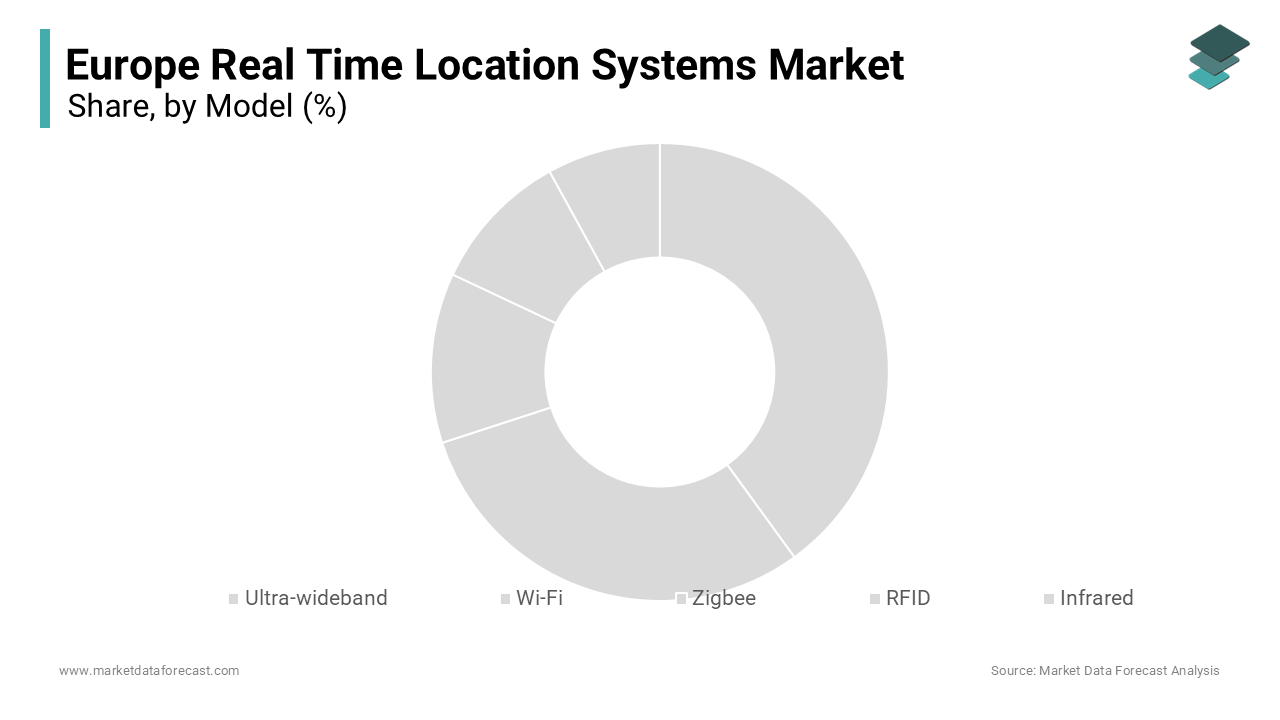
The ultra wideband segment dominated the Europe real time location systems market and accounted for a 36.8% share in 2025. The dominance of the segment is driven by its unmatched precision, delivering sub 10 centimeter accuracy in complex indoor environments such as hospitals, factories, and warehouses. Unlike Wi Fi or Bluetooth, ultra wideband uses short pulse radio waves that are highly resistant to multipath interference from metal structures and dense machinery. Ultra-wideband technology is increasingly selected for material and tool tracking in European smart factory pilots due to its reliability in high-noise industrial environments, according to industrial adoption trends. Major healthcare institutions, including those in Sweden, are adopting real-time location systems to track mobile assets, which reduces equipment search times and improves the efficiency of asset turnover. The technology’s low power consumption and secure time of flight ranging also align with the EU Cyber Resilience Act’s data integrity requirements. Automotive manufacturers like BMW and Stellantis now mandate full traceability of battery modules on assembly lines. Consequently, ultra-wideband has become the de-facto standard for mission-critical indoor positioning across Europe’s high-value sectors.
The Wi Fi Round Trip Time segment is anticipated to witness the fastest CAGR of 24.3% over the forecast period due to its seamless integration with existing enterprise Wi Fi 6 infrastructure and cost effective deployment. Unlike dedicated systems requiring new hardware, Wi Fi RTT leverages standard access points to provide meter level accuracy without additional tags or anchors. European digital strategies and high digital intensity among large businesses are establishing a robust foundation for enhanced, location-aware connectivity across the region. Major retailers are exploring Wi-Fi RTT for in-store asset tracking and layout optimization to improve consumer engagement. In logistics, DB Schenker uses Wi Fi RTT to monitor pallet flow in distribution centers where ultra wideband installation is cost prohibitive. Furthermore, the ratification of the IEEE 802.11az standard enhances indoor location accuracy. Wi-Fi RTT is rapidly becoming the go-to solution for scalable, enterprise-wide location intelligence across Europe’s commercial and public sectors. This growth is driven by its minimal capital expenditure and compatibility with billions of existing smartphones.
By Product Type Insights
The hardware segment led the Europe real time location systems market and captured a share of 52.4% in 2025. The leading position of the segment is attributed to the foundational role of physical components, such as tags, anchors, gateways, and wearable badges, in enabling any location deployment. Hospital real-time location systems require varying numbers of tags and anchors based on coverage needs, while warehouse tagging demands depend largely on inventory volume. Initial hospital technology budgets are heavily weighted toward hardware costs due to strict compliance requirements for medical-grade, certified devices. Semiconductor advances have also driven miniaturization. Advanced, low-power semiconductors are enabling the development of smaller, more energy-efficient IoT tags for wearable and tool-tracking applications. Besides, the EU’s Radio Equipment Directive mandates stringent electromagnetic compatibility testing, favoring established hardware vendors with compliance expertise. This capital intensive nature of deployment ensures hardware remains the primary revenue driver, even as software and analytics gain strategic importance.
The software segment is likely to experience the fastest CAGR of 28.7% between 2026 and 2034 owing to demand for intelligent analytics, workflow automation, and digital twin integration. Modern real time location platforms now offer dashboards that transform raw coordinates into actionable insights, such as predicting equipment shortages in operating rooms or detecting forklift congestion in warehouses. Siemens digital solutions, including Comos and Tecnomatix, improve automotive manufacturing efficiency by creating digital twins that optimize material flow, which reduces production bottlenecks and variability. In healthcare, Philips' HealthSuite supports healthcare operational efficiency by integrating data, such as patient admission rates and staff workflows, to aid in managing nurse workload. The European Innovation Council and European Commission are providing significant funding through 2027 to support the development and adoption of AI technologies, including applications in critical infrastructure and operational efficiency. Cloud based subscription models further accelerate adoption, allowing SMEs to access enterprise grade analytics without upfront licensing fees. As organizations shift from tracking to prediction, software is becoming the highest value layer in the real time location stack, driving recurring revenue and deep customer stickiness across Europe.
By Industry Vertical Insights
In 2025, the healthcare segment was the largest segment in the Europe real time location systems market and held a 31.6% share. The supremacy of the segment is credited to acute operational pressures including aging populations equipment shortages and regulatory mandates for patient safety. According to Eurostat, the EU population aged 65 and over was approximately 97.1 million on 1 January 2024. This represents a significant long-term trend of population aging across all Member States, driving increased demand for healthcare services. Nursing staff often spend a meaningful portion of their working hours looking for mobile medical equipment, a task that detracts from direct patient care. Prominent European medical centers are adopting advanced tracking technologies to reduce the time staff spend locating equipment and to make better use of their available assets. European Union funding initiatives are increasingly supporting the digital transformation of hospitals, including the implementation of systems that improve staff safety and manage infectious disease tracking. Most major European medical facilities are expected to adopt asset-tracking solutions in the near future, as these technologies are becoming central to improving patient outcomes and managing resources effectively.
The automotive segment is on the rise and is expected to be the fastest growing segment in the market by witnessing a CAGR of 32.1% between 2026 and 2034. The rapid growth of the segment is propelled by the sector’s shift toward electric vehicle production, which demands unprecedented traceability and precision in battery and component assembly. Under the EU’s Important Project of Common European Interest on Next Generation Batteries, all cell manufacturers must implement full digital traceability from raw materials to finished packs. Volkswagen's Zwickau plant utilizes advanced automated logistics and digital, container-tracking systems to ensure accurate battery module sequencing and minimize assembly line errors. Similarly, Stellantis employs real-time location systems (RTLS) to monitor robotic tools during assembly, improving efficiency and reducing the time required for model changeovers. The rise of modular EV platforms, requiring flexible production flows, further amplifies demand for dynamic location intelligence. Battery capacity expansion is accelerating across Europe. As a result, real-time location systems are becoming crucial "nervous system" technology for managing logistics and production in the continent's automotive transition.
REGIONAL ANALYSIS
Germany Real Time Location Systems Market Analysis
Germany outperformed other countries in the Europe real time location systems market and accounted for a 26.5% share in 2025. This position of the German market is attributed to by its status as the industrial manufacturing heartland of the continent and the primary adopter of Industry 4.0 initiatives. In this region, sophisticated logistics hubs and automotive assembly plants rely on the deep integration of active RFID and UWB technologies to maintain necessary asset visibility for JIT (just-in-time) production. There is a severe need to optimize supply chain efficiency and reduce inventory carrying costs in Germany. This is driven by the massive manufacturing sector, which accounts for a notable share of the national gross domestic product. The German Engineering Federation indicates that investments in digital solutions for industrial assets are evolving, with location systems gaining traction among connectivity technologies. The presence of global technology leaders like Siemens and Bosch fosters a robust ecosystem for research and development, ensuring continuous innovation in sensor accuracy and data analytics capabilities. Furthermore, the government's High Tech Strategy provides substantial funding for projects that integrate artificial intelligence with location data, lowering the barrier for small and medium enterprises to adopt these advanced systems. The Fraunhofer Institute suggest that a significant number of large German manufacturing facilities are exploring or deploying location systems for internal transport and tool tracking. This combination of industrial necessity, technological prowess, and supportive policy ensures Germany remains the dominant force in the regional landscape.
United Kingdom Real Time Location Systems Market Analysis
The United Kingdom was the second largest country in the Europe real time location systems market and occupied a 18.6% share in 2025. This position of the UK market is supported by its rapid adoption of tracking technologies within the healthcare sector and advanced retail logistics networks. The current market landscape is characterized by accelerating demand for patient flow management systems, aimed at minimizing wait times and optimizing staff deployment within the National Health Service, alongside a heightened need for inventory transparency in e-commerce fulfillment centers. A major driving factor is the post pandemic imperative to improve operational efficiency and patient safety, which has forced hospital trusts to accelerate the deployment of real time location systems for tracking medical equipment and monitoring patient movements. Multiple studies show that an increasing number of acute hospital trusts are implementing asset tracking technology to reduce the time staff spend searching for critical devices. The retail sector has also emerged as a unique growth vector, using these systems to enhance the customer experience through personalized promotions and efficient stock management in large department stores. According to various sources, challenges in warehouse staffing correlate with a shift toward investment in automated tracking and robotics solutions. Furthermore, the strong presence of innovative startups and research universities drives the development of advanced Bluetooth low energy and Wi-Fi based positioning systems tailored for dense urban environments. As per research, the government's Digital Strategy continues to support pilot projects that demonstrate the economic viability of location intelligence, solidifying the UK role as a key growth engine.
France Real Time Location Systems Market Analysis
France maintains a noteworthy position in the Europe real time location systems market by serving as a critical hub for the modernization of its aerospace, luxury goods, and transportation supply chains. The market status in this region is marked by a strategic national push toward the Industry of the Future initiative that encourages the digitization and automation of traditional manufacturing processes to enhance global competitiveness. The main driver is the need to secure high value assets and streamline logistics operations in sectors where counterfeiting and theft pose significant risks, such as luxury fashion and aviation components. A study indicates that investments in IoT and tracking solutions represent a substantial portion of new technology installations in large industrial complexes. The aerospace sector, dominated by giants like Airbus, utilizes these systems for moving heavy components across vast assembly halls, requiring high precision and reliable coverage. Additionally, the booming e-commerce sector in France has led to the construction of massive automated fulfillment centers near major urban areas, driving demand for swarm robotics and real time inventory visibility. Sources suggest that the adoption of real-time location systems in the agro-food sector is increasing due to strict traceability requirements and labor challenges. The government France 2030 investment plan specifically allocates funds for robotics and AI, fostering a conducive environment for both domestic manufacturers and international integrators to expand their operations.
Italy Real Time Location Systems Market Analysis
Italy witnessed a consistent growth in the Europe real time location systems market, renowned for its specialized application of tracking technologies in the fashion, automotive, and food and beverage industries where provenance and speed are paramount. The market status here is unique due to the prevalence of small and medium-sized enterprises that require scalable and cost-effective visibility solutions to maintain their global export competitiveness in high value markets. A key driving factor is the need to combat counterfeiting and ensure authentic supply chain transparency for luxury brands, making real time location systems an essential tool for brand protection and customer trust. The automotive cluster in Turin has become a global showcase for autonomous logistics, where fleets of robots managed by real time location systems handle the movement of parts in harsh environments. Furthermore, the strong design culture in Italy influences the development of aesthetically pleasing and user-friendly tracking interfaces. As per research, the integration of real time location systems with enterprise resource planning systems is becoming standard practice, allowing Italian manufacturers to achieve real time visibility and optimization of their internal logistics flows.
Netherlands Real Time Location Systems Market Analysis
The Netherlands is anticipated to expand in the Europe real time location systems market over the forecast period by functioning as a pioneer in the development and deployment of tracking solutions for intralogistics and sustainable supply chain management within its massive port infrastructure. The market status in this region is defined by a strong cultural emphasis on innovation, logistics efficiency, and early adoption of cutting edge technologies across all transport and distribution sectors. A major driving factor is the presence of the Port of Rotterdam, the largest seaport in Europe, which acts as a living lab for testing and deploying advanced real time location systems to manage container flows and optimize terminal operations. The Dutch government commitment to becoming a carbon neutral nation has spurred interest in electric and energy efficient autonomous platforms that rely on precise location data to minimize power consumption and idle time. Furthermore, the collaboration between leading technical universities and industry players fosters a vibrant ecosystem for testing and refining new navigation technologies in real world scenarios.
COMPETITIVE LANDSCAPE
The competition in the Europe real time location systems market is characterized by a dynamic interplay between global technology giants, specialized industrial solution providers, and agile software innovators. Established players leverage decades of wireless expertise and enterprise integration capabilities to offer end to end platforms, while niche firms compete through vertical specific precision and data sovereignty assurances. Intense rivalry centers on accuracy, cybersecurity, and interoperability, particularly as organizations demand seamless integration with existing IT infrastructure. Regulatory compliance—especially under the General Data Protection Regulation and Cyber Resilience Act—acts as both a barrier and a differentiator, favoring companies with robust privacy by design architectures. Simultaneously, the shift from hardware sales to software as a service models is reshaping revenue structures and customer relationships. This multifaceted environment rewards technical excellence, sectoral depth, and authentic alignment with Europe’s digital sovereignty and industrial modernization agenda, making the market highly competitive yet rich with opportunity for value driven innovation rooted in trust and intelligence.
KEY MARKET PLAYERS
Some of the companies that are playing a dominating role in the Europe Real Time Location Systems Market include
- Securitas AB
- Zebra Technologies Corporation
- Impinj, Inc.
- Siemens AG
- GE Healthcare
- Qorvo Inc.
- Alien Technology, LLC
- TeleTracking Technologies, Inc.
- Midmark Corporation
- Litum
- Ubisense Group Plc
- Sonitor Technologies AS
- CenTrak, Inc.
- Savi Technology
- Sewio Networks
Top Players in the Europe Real Time Location Systems Market
Zebra Technologies Corporation
Zebra Technologies is a global leader in enterprise asset intelligence with deep integration across European healthcare, logistics, and manufacturing sectors. The company specializes in ultra wideband and Bluetooth Low Energy based real time location systems that deliver sub meter accuracy for tracking people, tools, and inventory. It also expanded its cloud based Location Services Engine to support seamless integration with SAP and Oracle ERP systems across EU enterprises. Through partnerships with automotive OEMs like BMW and logistics leaders such as DHL, Zebra deploys scalable solutions that comply with EU data privacy and cybersecurity mandates. These initiatives reinforce its global reputation for precision and interoperability while strengthening its foothold in Europe’s digitizing industrial and care environments.
Ubisense Group plc
Ubisense is a UK based pioneer in high precision industrial location systems, renowned for its ultra wideband SmartSpace platform used in aerospace, automotive, and defense applications across Europe. The company focuses on mission critical tracking where millimeter level accuracy and deterministic performance are non negotiable. It also integrated its system with Siemens’ Digital Twin Suite to enable predictive workflow simulation in battery gigafactories. By prioritizing industrial ruggedness, data sovereignty, and compliance with EN 303 645 cybersecurity standards, Ubisense strengthens its influence in Europe’s advanced manufacturing corridors while exporting its precision engineering expertise to global defense and aviation markets.
TeleTracking Technologies Inc
TeleTracking is a specialized provider of real time location solutions for healthcare environments, with significant adoption across European university hospitals and public health systems. The company’s platform tracks staff, patients, and mobile assets to optimize bed turnover, reduce wait times, and enhance emergency response. It also achieved full compliance with the EU Cyber Resilience Act through end to end encryption and granular consent management for staff tracking. By aligning its solutions with European healthcare digitization mandates and workforce safety priorities, TeleTracking cements its role as a trusted partner in transforming clinical operations through intelligent visibility
Top Strategies Used by the Key Market Participants
Key players in the Europe real time location systems market pursue several strategic imperatives to maintain competitiveness and regulatory alignment. First they prioritize ultra wideband and Wi Fi RTT technologies to balance accuracy scalability and cost across diverse environments. Second they embed artificial intelligence and predictive analytics into software platforms to transform raw location data into actionable operational insights. Third they ensure strict compliance with the General Data Protection Regulation and Cyber Resilience Act through end to end encryption granular consent mechanisms and certified data handling. Fourth they integrate location systems with enterprise resource planning digital twin and building management platforms to enable seamless workflow automation. Fifth they form strategic partnerships with sector leaders in healthcare automotive and logistics to co develop use case specific solutions and accelerate adoption. These strategies collectively enable companies to differentiate beyond hardware and respond effectively to Europe’s unique regulatory technological and operational landscape.
MARKET SEGMENTATION
This research report on the Europe Real Time Location Systems Market has been segmented and sub-segmented based on the following categories.
By Model
- Ultra-wideband
- Wi-Fi
- Zigbee
- RFID
- Infrared
By Product Type
- Hardware
- Software
- Service
By Industry Vertical
- Transportation and logistics
- Healthcare
- Retail manufacturing and processing
- Automotive
By Country
- UK
- France
- Spain
- Germany
- Italy
- Russia
- Sweden
- Denmark
- Switzerland
- Netherlands
- Turkey
- Czech Republic
- Rest of Europe