- Product Description Description
- Table of Contents TOC
- List of Table & Figure LOT
- Get Free Sample PDF Sample PDF
Market Size, 2025
$814.41 BnMarket Estimate, 2026
$869.95 BnMarket Forecast, 2034
$1474.74 BnCAGR, 2026–2034
6.82%Executive Summary: Europe Road Freight Transportation Market
- Market Scope: In-depth regional analysis of Europe's road freight ecosystem, encompassing vehicle classes, end-user industries, regulatory impacts, digital logistics platforms, and country-level profiles.
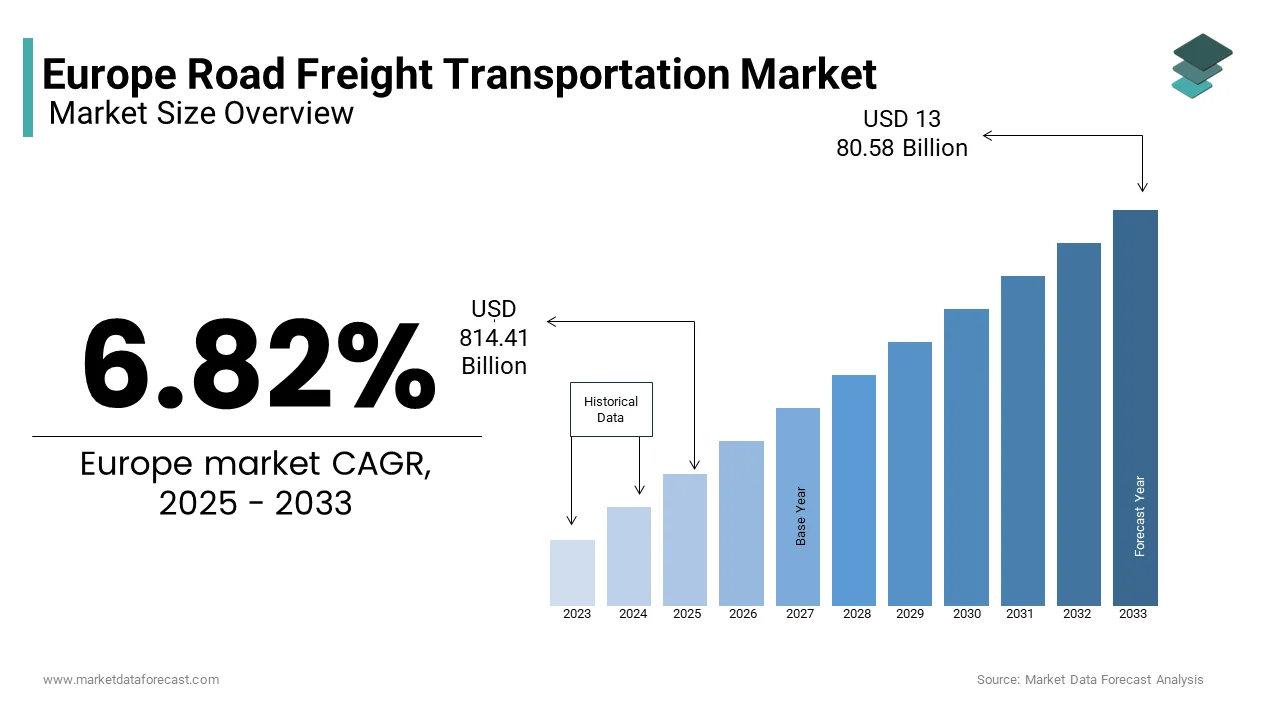
- Market Valuation: Valued at USD 814.41 billion in 2025, reaching USD 869.95 billion in 2026, and projected to expand to USD 1,474.74 billion by 2034, growing at a solid CAGR of 6.82% from 2026 to 2034.
- Primary Growth Drivers: Exponential e-commerce parcel growth, tight integration of Central and Eastern European manufacturing supply chains, and rising cross-border commercial demands.
Key Market Segment Metrics
| Category | Leading Segment (Base Position) | Fastest-Growing / High-Growth Segment |
|---|---|---|
| By End-User Industry | Wholesale and Retail Trade (held the largest share at 38.2% in 2024, driven by lean inventory replenishment and e-commerce) | Manufacturing Industry (projected at a 5.8% CAGR, fueled by regionalized nearshoring clusters in Central and Eastern Europe) |
| By Country / Region | Germany (largest contributor holding 24.3% share in 2024, anchored by its industrial core, output, and the EU's largest truck fleet) | Italy (anticipated to achieve the fastest CAGR driven by fragmented industrial districts and heavy reliance on local road networks) |
Major Market Players & Industry Landscape
Market Structure: Highly competitive landscape comprising large integrated global logistics providers, specialized regional fleets, and tech-driven digital freight matching platforms scaling up asset efficiency.
Key Companies: DB Schenker, DHL Freight, Geodis (SNCF Logistics), Kuehne+Nagel, DSV, A.P. Moller - Maersk, CMA CGM Group, Wincanton Plc, Primafrio, and United Parcel Service of America, Inc.
Europe Road Freight Transportation Market Size
The European road freight transportation market size was valued at USD 814.41 billion in 2025 and is anticipated to reach USD 869.95 billion in 2026 from USD 1474.74 billion by 2034, growing at a CAGR of 6.82% during the forecast period from 2026 to 2034.
Current Introduction of the Europe Road Freight Transportation Market
The road freight transportation is the backbone of the continent’s logistics ecosystem, facilitating the movement of goods via trucks, across national and regional supply chains. It encompasses a diverse fleet of light commercial vehicles, rigid trucks, and articulated lorries operating under stringent regulatory frameworks governing safety, emissions, and driver working hours. According to Eurostat, over 80 % of inland freight tonnage moved within the European Union in 2024 was transported by road with its irreplaceable role in commercial circulation. This reliance is further amplified by the density of small and medium enterprises, which account for 99 % of all businesses in the EU as per the European Commission, and typically depend on road transport for inventory replenishment and distribution. The sector also intersects with broader policy imperatives, such as the European Green Deal, which mandates a 90 % reduction in transport related greenhouse gas emissions by 2050, thereby compelling systemic transformation in vehicle technology, routing efficiency, and energy sourcing across the road freight value chain.
MARKET DRIVERS
Expansion of E-Commerce Driving Parcel and Less Than Truckload Demand
The exponential growth of online retail has emerged as a pivotal driver of road freight activity, across Europe in the parcel and less than truckload segments, where frequency and precision outweigh volume consolidation. The expansion of e-commerce is solely driving the growth of the Europe road freight transportation market. This surge necessitates dense delivery networks capable of executing same day or next day fulfilment, where a model inherently reliant on road transport due to its agility and route adaptability. Urban logistics hubs in cities like Paris, Berlin, and Madrid, now process over 200,000 parcels daily, requiring fleets of vans and mid-size trucks to navigate narrow streets and comply with low emission zone restrictions. A 2024 study by the International Transport Forum found that e commerce generated 3.2 billion urban delivery trips across Europe annually, a figure projected to double by 2030. Retailers increasingly outsource last mile operations to specialized carriers who deploy dynamic routing algorithms and micro depots to maintain service levels. Consequently, road freight operators are investing in smaller electric vehicles and shift based driver scheduling to meet the temporal and spatial demands of digital commerce, transforming traditional bulk haulage models into high frequency, time sensitive distribution systems.
Integration of Manufacturing Supply Chains Across Central and Eastern Europe
The deepening industrial integration between Western European brand owners and Central and Eastern European contract manufacturers continues to fuel consistent road freight demand, across intra EU corridors. The integration of manufacturing Countries such as Poland, Czechia, Slovakia, and Romania, have become pivotal assembly and component production hubs for automotive, electronics, and machinery sectors, driven by skilled labor availability and competitive operational costs. According to the Industrial Connectivity Index, foreign direct investment in manufacturing within these nations grew by 18 % compared to 2022, with over 60% of output destined for markets in Germany, France, and Italy. This geographic specialization necessitates tightly synchronized just in time deliveries, where road transport remains the only viable mode due to inflexible rail schedules and limited inland waterway access. For instance, automotive plants in Wolfsburg and Stuttgart receive up to 15 daily truck shipments from suppliers in Bratislava and Gyor, carrying parts with shelf lives measured in hours. As nearshoring accelerates in response to global trade volatility, road freight operators are establishing dedicated shuttle services with GPS monitored temperature and shock control to ensure seamless material flow across this manufacturing belt.
MARKET RESTRAINTS
Stringent CO2 Emission Regulations Under the EU Fit for 55 Package
The European Union’s Fit for 55 legislative package imposes binding decarbonization targets that significantly constrain operational flexibility and capital planning in the road freight sector. The stringent emission of CO2 is additionally to enhance the growth of Europe road freight transportation market. As per the European Parliament’s 2023, adoption of the Regulation on CO2 Standards for Heavy Duty Vehicles, new trucks must achieve a reduction in carbon emissions by 2030 and 90% by 2040 compared to 2019 baselines. This mandates rapid fleet electrification or adoption of alternative fuels such as hydrogen or renewable diesel, both of which entail substantial investment and infrastructure gaps. Operators face not only vehicle acquisition costs, which can be 3 to 4 times higher for battery electric trucks, but also range limitations that disrupt long haul economics. Cross border journeys exceeding 500 kilometers remain largely incompatible with current battery technology, forcing reliance on transitional solutions like biofuels, whose supply is neither scalable nor price stable. These regulatory pressures compress profit margins while demanding strategic reconfiguration of depot locations, maintenance protocols, and driver training, thereby acting as a structural restraint on organic capacity expansion in the near term.
MARKET CHALLENGES
Persistent Shortage of Qualified Heavy Goods Vehicle Drivers
A chronic deficit of certified truck drivers continues to undermine the reliability and scalability of road freight operations, despite robust cargo demand is a quiet challenge for the growth of Europe road freight transportation market. According to the European Commission’s 2024 Mobility Workforce Assessment, the EU faces a shortfall of approximately 400,000 professional drivers, with the most acute gaps in Germany, Italy, and Poland, where vacancy rates exceed 15 % in long distance haulage. This scarcity stems from an aging workforce over 45 % of current drivers are aged 50 or older, as well as unattractive working conditions including extended time away from home, inconsistent rest facilities, and administrative burdens from cross border compliance. A survey by the International Road Transport Union revealed that carriers reported declining applicant numbers for HGV licenses between 2022 and 2024. The shortage forces companies to decline contracts, consolidate routes inefficiently, or rely on costly agency drivers who lack familiarity with cargo handling protocols. Moreover, the EU’s Mobility Package, which limits cabotage and enforces mandatory weekly rest away from base, further reduces driver utilization rates. Without coordinated vocational training incentives and improved social recognition of the profession, this human capital bottleneck will persist as a fundamental constraint on the sector’s ability to meet evolving logistics demands.
Deployment of Digital Freight Matching Platforms Enhancing Asset Utilization
The proliferation of AI powered digital freight platforms for optimizing truck utilization and reducing empty mileage is another challenge for the growth of Europe road freight transportation market. Historically, independent hauliers and small fleets operated with load fill rates below 60 % due to information asymmetry and manual tendering processes. However, as per the European Logistics Association’s 2025 Technology Adoption Survey, over 35 % of road freight transactions now occur via digital marketplaces such as Transporeon, Freightos, and Uber Freight Europe, which use real time data to match available capacity with shipper demand. These platforms integrate telematics, electronic logging devices, and predictive analytics to forecast lane imbalances and suggest backhaul opportunities, thereby cutting empty runs, which accounted for 28 % of all truck kilometers in 2023, according to the European Environment Agency. In Germany and the Netherlands, early adopters reported a 12 to 18 % improvement in asset productivity within six months of platform integration. Furthermore, blockchain enabled smart contracts automate invoicing and payment settlement, reducing administrative delays. As these ecosystems mature and incorporate carbon tracking and dynamic pricing, they enable carriers to monetize efficiency gains while supporting shippers’ sustainability reporting requirements, creating a virtuous cycle of transparency and performance in the road freight marketplace.
REPORT COVERAGE
| REPORT METRIC | DETAILS |
| Market Size Available | 2025 to 2034 |
| Base Year | 2025 |
| Forecast Period | 2026 to 2034 |
| CAGR | 6.82% |
| Segments Covered | By End-User Region. |
| Various Analyses Covered | Global, Regional, and Country Level Analysis; Segment-Level Analysis, DROC; PESTLE Analysis; Porter’s Five Forces Analysis; Competitive Landscape; Analyst Overview of Investment Opportunities |
| Regions Covered | UK, France, Spain, Germany, Italy, Russia, Sweden, Denmark, Switzerland, Netherlands, Turkey, Czech Republic, and the Rest of Europe |
| Market Leaders Profiled | Cma Cgm Group, Turners (Soham) Ltd, Db Schenker (Deutsche Bahn Group (Db Group)), A.P. Moller - Maersk, Deutsche Post Ag (Dhl Group), Wincanton Plc, Dsv (Dsv Panalpina), Kuehne+Nagel, Primafrio, United Parcel Service Of America, Inc. |
SEGMENTAL ANALYSIS
By End-User Industry
The wholesale and retail trade segment was the largest by accounting for 38.2% of the Europe Road Freight Transportation market share in 2024 with the sector’s structural dependence on frequent, time sensitive replenishment cycles driven by consumer demand volatility and lean inventory practices. As per Eurostat, the EU recorded over 5.2 million retail establishments in 2024, 98 % of which are small or medium sized enterprises lacking dedicated logistics infrastructure and thus relying entirely on third party road carriers for stock rotation. The rise of omnichannel retail, where physical stores double as fulfillment centers for online orders has intensified delivery frequency, a 2024 study by the European Retail Roundtable found that urban supermarkets, now receive an average of 1.7 deliveries per day, up from 0.9 in 2019. Additionally, the expansion of discount retail chains like Aldi and Lidl across Southern and Eastern Europe has necessitated high frequency trunking between regional distribution centers and store networks, often using rigid trucks under 18 tonnes.
The manufacturing industry segment is likely to grow at a fastest CAGR of 5.8 % throughout the forecast period with the reconfiguration of industrial supply chains toward regionalized production clusters following global trade disruptions. According to the study, foreign direct investment in EU manufacturing rose by 22 % in 2024, with automotive, electronics, and pharmaceutical sectors leading nearshoring initiatives in Central and Eastern Europe. These new facilities operate under just in time principles requiring multiple daily deliveries of components, where a model inherently dependent on road transport due to its precision and flexibility. For example, automotive plants in Slovakia and Czechia receive over 300 truckloads weekly from German and Austrian suppliers, as documented by the European Automobile Manufacturers Association. Furthermore, the European Chips Act has spurred construction of semiconductor fabs in France and Italy, each demanding temperature controlled and vibration monitored shipments of raw materials and wafers.
COUNTRY ANALYSIS
Germany Road Freight Transportation Market Analysis
Germany was the largest contributor of the European road freight transportation market by holding 24.3% of the share in 2024 from its role as the continent’s industrial engine and central logistics nexus. Home to Europe’s largest manufacturing base, Germany generated over 2.1 trillion euros in industrial output in 2024, much of which relies on tightly synchronized inbound and outbound trucking. Moreover, Germany operates the largest fleet of registered trucks in the EU, exceeding 3.2 million units by enabling unmatched domestic coverage. Strategic investments in logistics hubs, such as Duisburg and Leipzig have further cemented its status as a transshipment gateway for goods entering from Eastern Europe and exiting to Scandinavia.
France Road Freight Transportation Market Analysis
France was ranked second by occupying 16.2% of the Europe road freight transportation market share in 2024 with its extensive agricultural output and centralized distribution architecture. Paris alone receives over 12,000 food delivery trucks daily, as per some reports. Additionally, France’s strategic location bridges Iberian, Benelux, and Mediterranean trade lanes by making it a transit corridor with the A6 and A7 motorways handle more than 25,000 heavy vehicles per day, per data from the French Directorate General for Infrastructure. Recent mandates requiring low emission zones in all cities with over 150,000 inhabitants have also accelerated fleet modernization, positioning France as a testing ground for sustainable urban freight models that influence broader EU policy.
Italy Road Freight Transportation Market Analysis
Italy road freight transportation market growth is likely to have fastest CAGR throughout the forecast period with its fragmented industrial geography and reliance on road transport due to underdeveloped rail alternatives. The country hosts over 4.5 million small and medium enterprises, concentrated in industrial districts like Emilia, Romagna, and Veneto, where just in time production of machinery, textiles, and furniture demands hyper local delivery networks. The Po Valley alone accounts for 40% of national truck traffic, serving as a manufacturing and distribution spine linking Milan, Turin, and Bologna.
United Kingdom Road Freight Transportation Market Analysis
The United Kingdom Road Freight Transportation market growth is propelled with the adaptation to new customs protocols and strong domestic logistics integration. Despite no longer being an EU member, the UK remains deeply interconnected through short sea and landbridge routes via Dover and Calais, with over 1.8 million trucks crossing the English Channel annually, as per the sources. Domestically, the country operates one of Europe’s most efficient last mile networks, driven by high urban population density and advanced warehouse automation. The UK’s retail sector, valued at 450 billion pounds in 2024, relies heavily on same day replenishment, generating consistent demand for light and medium duty vans. Major logistics parks near Birmingham, Manchester, and London serve as national distribution anchors, handling non-food retail flows.
Netherlands Road Freight Transportation Market Analysis
The Netherlands road freight market growth is likely to grow with the infrastructure and strategic delta location to function as Europe’s primary import gateway. Rotterdam Port, the largest in Europe, handled 467 million tons of cargo in 2024, according to the Port Authority, with over 80 % of containerized goods distributed inland via road within 48 hours. The country’s compact geography and world class highway network, featuring the Randstad urban ring that enable same day delivery to 170 million consumers across Germany, Belgium, and France. Dutch logistics providers operate highly automated distribution centers in Venlo and Moerdijk that serve, as pan European fulfillment hubs for global brands like Amazon and Unilever. The government’s Green Deal for Freight aims for 30 % zero emission city deliveries by 2030, accelerating trials of hydrogen refueling along the A12 corridor. This blend of geographic advantage, regulatory foresight, and private sector efficiency cements the Netherlands as a linchpin in continental supply chain fluidity.
COMPETITIVE LANDSCAPE
The Europe Road Freight Transportation market features intense competition among large integrated logistics firms small regional carriers and digital disruptors. Dominant players leverage scale technological investment and sustainability credentials to secure long term contracts with multinational shippers while smaller operators compete on niche flexibility and local knowledge. Regulatory pressures particularly around emissions driver working hours and cross border rules create both barriers and opportunities shaping strategic differentiation. Digitalization has lowered entry barriers for asset light platforms that match capacity with demand in real time intensifying price competition. However, service quality reliability and green performance increasingly outweigh cost as key selection criteria especially among retail and manufacturing clients.
KEY MARKET PLAYERS
A few of the market players in the European road freight transport market include
- Cma Cgm Group
- Turners (Soham) Ltd
- DHL Freight
- SNCF Logistics (Geodis)
- Db Schenker (Deutsche Bahn Group (Db Group))
- A.P. Moller – Maersk
- Deutsche Post Ag (Dhl Group)
- Wincanton Plc
- Dsv (Dsv Panalpina)
- Kuehne+Nagel
- Primafrio
- United Parcel Service Of America, Inc.
Top Players In The Market
- DB Schenker is a leading global logistics provider with deep integration across European road freight networks, offering comprehensive full truckload and less than truckload services. The company contributes significantly to global supply chain resilience through its multimodal capabilities and digital tracking platforms. In Europe, it operates one of the largest certified green fleets, aligning with EU decarbonization mandates. Recently, DB Schenker expanded its electric van fleet in urban centers like Berlin, Paris, and Amsterdam under its GoGreen program and launched a real time carbon calculator for shippers with its sustainability leadership and enhancing client retention in environmentally conscious sectors.
- DHL Freight, part of Deutsche Post DHL Group, plays a pivotal role in European road transportation through its dense network of linehaul routes and cross border expertise. It supports global trade by connecting European industrial hubs with international markets via integrated air ocean and road solutions. To strengthen its position, DHL Freight recently implemented AI driven dynamic routing across its Western European operations and partnered with Volvo to pilot hydrogen powered trucks on the Hamburg Milan corridor, demonstrating commitment to innovation and regulatory compliance while improving service reliability and reducing emissions.
- Geodis, a subsidiary of France’s state owned SNCF Group, is a major force in European road freight, specializing in contract logistics and high frequency distribution. It contributes to the global market by managing complex supply chains for automotive, retail, and healthcare clients across continents. Geodis enhanced its European footprint by opening a new automated hub near Lyon dedicated to e commerce fulfillment and introduced a blockchain based platform for real time customs documentation, streamlining cross border movements and reducing administrative delays for clients operating in post Brexit and EU regulatory environments.
Top Strategies Used by the Key Market Participants
Key players in the Europe Road Freight Transportation market focus on fleet electrification to comply with EU emission standards investing in alternative fuel vehicles and charging infrastructure. They deploy digital freight platforms using artificial intelligence for dynamic load matching and route optimization. Companies are expanding multimodal hubs near major consumption centers to enhance last mile efficiency. Strategic partnerships with vehicle manufacturers and energy providers accelerate zero emission transitions. Additionally, they implement blockchain enabled documentation systems to simplify cross border compliance and reduce transit delays thereby improving service reliability and customer retention across fragmented regulatory landscapes.
MARKET SEGMENTATION
This research report on the European road freight transport market size is segmented and sub-segmented into the following categories.
By End-User Industry
- Agriculture, Fishing, and Forestry
- Construction
- Manufacturing
- Oil and Gas, Mining and Quarrying
- Wholesale and Retail Trade
- Others
By Country
- UK
- Russia
- Germany
- Italy
- France
- Spain
- Sweden
- Denmark
- Poland
- Switzerland
- Netherlands
- Rest of Europe