- Product Description Description
- Table of Contents TOC
- List of Table & Figure LOT
- Get Free Sample PDF Sample PDF
Market Size, 2025
$6.64 BnMarket Estimate, 2026
$7.02 BnMarket Forecast, 2034
$11.02 BnCAGR, 2026–2034
5.78%Europe Sunglasses Market Report Summary
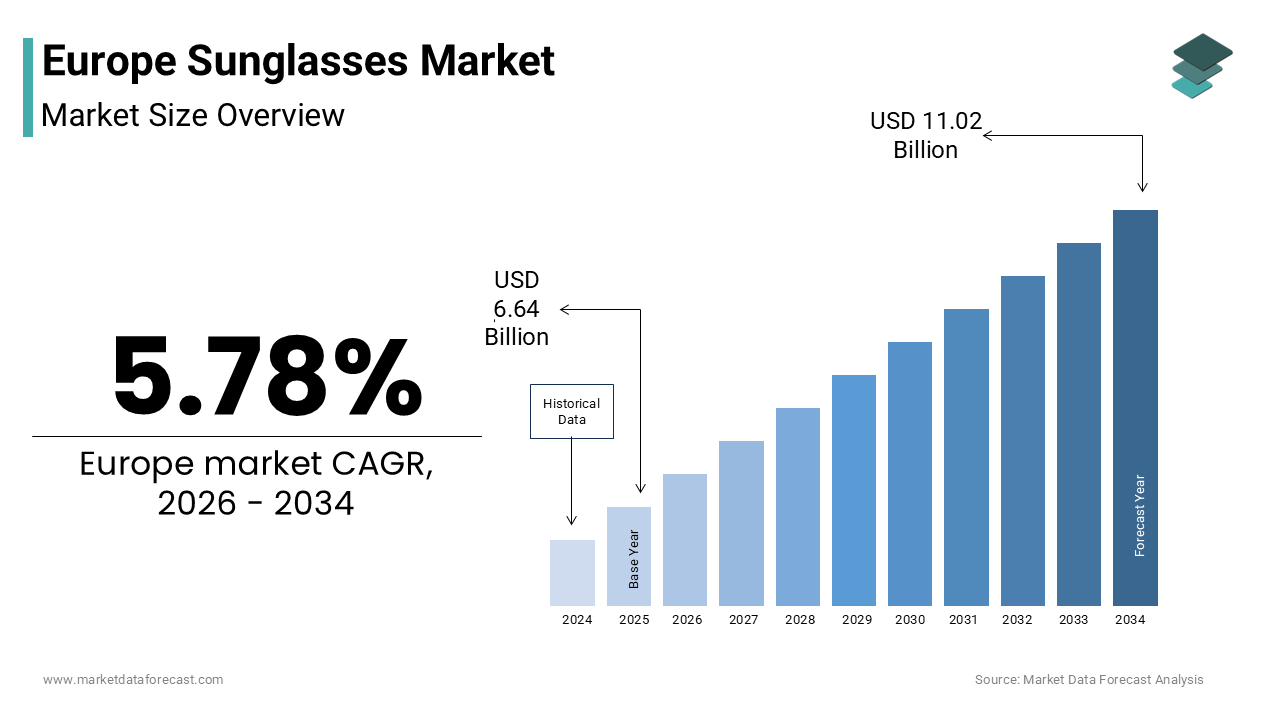
The Europe sunglasses market was valued at USD 6.64 billion in 2025, is estimated to reach USD 7.02 billion in 2026, and is projected to reach USD 11.02 billion by 2034, growing at a CAGR of 5.78% during the forecast period from 2026 to 2034. The growth of the Europe sunglasses market is driven by rising awareness of UV-related ocular health risks, strong integration of eyewear into European fashion culture, and expanding premium and sustainable product portfolios. Regulatory frameworks such as the EU Personal Protective Equipment Regulation (EU 2016/425) mandating UV400 protection standards further strengthen consumer confidence. Additionally, climate change-driven increases in UV exposure, growth in tourism, and the emergence of smart and sustainable eyewear innovations are supporting steady market expansion across Europe.
Key Market Trends
-
Rising demand for polarized and UV400-certified sunglasses is driven by increasing health awareness.
-
Strong cultural positioning of sunglasses as fashion statements in Italy and France.
-
Expansion of sustainable and bio-based frame materials aligned with EU Circular Economy policies.
-
Growing adoption of smart sunglasses with Bluetooth and AR capabilities.
-
Rapid growth of online retail channels supported by virtual try-on and AR technologies.
Segmental Insights
-
Based on product type, the polarized segment held a significant share of the Europe sunglasses market in 2024, supported by demand for glare reduction in driving, water sports, and outdoor recreation.
-
The polarized segment is projected to grow at a notable CAGR during the forecast period due to technological enhancements such as photochromic polarization and increased safety awareness.
-
Based on end user, the women segment accounted for 48.3% of the Europe sunglasses market share in 2024, driven by strong fashion integration and higher purchase frequency.
-
The kids segment is expected to register the fastest growth, supported by increasing pediatric UV protection awareness across European countries.
-
Based on distribution channel, the offline retail stores segment held a prominent share in 2024, owing to consumer preference for physical trials and professional fitting services.
-
The online retail segment is projected to expand at the fastest CAGR, supported by augmented reality try-on tools and flexible return policies.
Regional Insights
The Europe sunglasses market demonstrates varied regional dynamics shaped by climate, fashion leadership, and tourism intensity.
-
Italy led the Europe sunglasses market with a 24.3% share in 2024, driven by its dominance in global eyewear manufacturing and luxury brand production.
-
France held the second-largest share at 18.4% in 2024, supported by luxury fashion influence and strict regulatory enforcement of UV protection standards.
-
The United Kingdom is projected to witness strong growth due to high e-commerce penetration and rising health awareness campaigns.
-
Germany shows steady growth driven by a preference for optical precision and performance-oriented eyewear.
-
Spain continues to expand due to intense solar exposure and strong tourism inflows supporting year-round demand.
Competitive Landscape
The Europe sunglasses market is highly competitive, characterized by vertically integrated global giants, luxury brand licensors, independent designers, and fast-fashion retailers. Leading companies focus on brand licensing, sustainability initiatives, digital retail expansion, and smart eyewear innovation to maintain a competitive advantage. The market remains fragmented below the top tier, with regional players emphasizing localized design and material innovation. Prominent players operating in the Europe sunglasses market include EssilorLuxottica S.A., Safilo Group S.p.A., Kering Eyewear, De Rigo Vision S.p.A., Marcolin S.p.A., Maui Jim Inc., Luxottica Group S.p.A., Polaroid Eyewear, Serengeti Eyewear, and Specsavers Optical Group Ltd.
Europe Sunglasses Market Size
The europe sunglasses market size was valued at USD 6.64 billion in 2025 and is anticipated to reach USD 7.02 billion in 2026 from USD 11.02 billion by 2034, growing at a CAGR of 5.78% during the forecast period from 2026 to 2034.
Sunglasses are dual purpose as both functional eye protection devices and key fashion accessories, reflecting regional preferences for design, quality, and health consciousness. Defined by their ability to filter ultraviolet (UV) radiation and reduce glare, modern sunglasses are regulated under the European Union’s Personal Protective Equipment Regulation (EU 2016/425), which mandates standardized UV400 protection and lens category labeling. Beyond aesthetics, their role in preventing ocular damage, including cataracts and photokeratitis is increasingly recognized by public health authorities. According to the World Health Organization Regional Office for Europe, over 60 % of the European population is exposed to UV index levels above 3 during spring and summer months, particularly in southern regions such as Spain, Italy, and Greece. As per the European Environment Agency, climate change has extended high UV exposure periods by an average of 12 days per year since 2000 across Mediterranean countries. These environmental and health dynamics underscore the growing necessity of certified eyewear.
MARKET DRIVERS
Rising Awareness of Ocular Health and UV Radiation Risks
The public health campaigns and scientific evidence linking UV exposure to long term eye damage have significantly elevated consumer demand is greatly influencing the growth of Europe sunglasses market. The European Commission’s Scientific Committee on Health Environmental and Emerging Risks states that cumulative UV exposure contributes to nearly 20% of cataract cases in adults, over 50 in high sunlight regions. Such exposure increases the need for reliable eye protection. National health agencies have responded proactively, where France’s Agence Nationale de Securite Sanitaire launched a 2023 public initiative emphasizing the importance of CE marked sunglasses with proper UV400 labeling for children whose lenses transmit more UV than adults. Similarly, the German Ophthalmological Society reports that 68 % of ophthalmologists now routinely advise patients on sunglass selection during routine visits.
Strong Cultural Integration of Eyewear in European Fashion Identity
The embedded position in Europe’s sartorial culture, where eyewear functions as a signature element of personal style and social identity is additionally enhancing the growth of Europe sunglasses market. In countries like Italy and France, home to global luxury houses such as Luxottica and Kering, sunglasses are not merely accessories but extensions of brand storytelling and aesthetic philosophy. According to the Italian Trade Agency, Italy alone accounts for over 70% of global luxury eyewear production, with domestic consumers exhibiting high brand loyalty and willingness to pay premium prices for design authenticity. The influence extends beyond fashion capitals, where urban consumers in Germany, Spain, and the Netherlands consider sunglasses a non-negotiable component of daily attire during daylight hours, regardless of weather. Social media further amplifies this trend that eyewear features in 31 % of influencer fashion content across Instagram and TikTok in Western Europe.
MARKET RESTRAINTS
Proliferation of Counterfeit and Non Compliant Products
The widespread availability of counterfeit and substandard sunglasses undermining both consumer safety and brand integrity is restraining the growth of Europe sunglasses market. The enforcement remains inconsistent across member states by allowing non-compliant products to infiltrate online and informal retail channels. Many of these imitations lack essential UV filters, offering false protection that can exacerbate ocular damage by causing pupil dilation without blocking harmful rays. The Spanish Consumer Safety Agency reported in 2024 that low-cost sunglasses tested in street markets and online marketplaces failed to meet minimum UV400 standards. This not only endangers public health but also erodes trust in mid-tier brands that compete on quality rather than price.
Economic Volatility and Discretionary Spending Sensitivity
The macroeconomic instability that directly impacts discretionary consumer expenditure in the mid to premium areas is also degrading the growth of Europe sunglasses market. Sunglasses, despite their health utility, are often categorized as non-essential purchases during periods of financial uncertainty. According to the European Central Bank, real household consumption growth in the euro area slowed to 0.7 % in 2023, the lowest since 2013 excluding pandemic years, driven by persistent inflation and rising interest rates. In response, consumers increasingly delay or downgrade eyewear purchases, as per a 2024 survey by GfK across six major European markets, 39 % of respondents indicated they would opt for lower priced alternatives or extend the lifespan of existing sunglasses amid economic pressure. This shift disproportionately affects independent designers and premium labels that rely on full price sell through. While value oriented and private label offerings gain traction, the overall market experiences margin compression and reduced innovation investment, constraining long term growth potential in a category heavily dependent on aspirational appeal.
MARKET OPPORTUNITIES
Integration of Smart and Connected Eyewear Technologies
The emergence of smart sunglasses equipped with audio streaming, augmented reality displays, and biometric sensors is soelly ascribed to boost new opportunities for the growth of Europe sunglasses market. Unlike traditional eyewear, these devices merge fashion with digital functionality, appealing to tech savvy urban consumers seeking seamless lifestyle integration. As per the European Telecommunications Standards Institute, wearable electronics shipments in Western Europe grew by 22 % in 2023, with smart eyewear representing the fastest growing subcategory. Regulatory alignment also supports growth, the EU’s Radio Equipment Directive provides a clear compliance pathway for Bluetooth enabled devices, accelerating time to market. Furthermore, European privacy laws like GDPR enhance consumer trust in data handling, a critical factor for biometric features. As 5G infrastructure expands and AI driven personalization advances, smart sunglasses are poised to evolve from novelty gadgets into mainstream accessories.
Expansion of Sustainable and Circular Business Models
The sustainability has evolved from a niche concern to a core strategic imperative in the Europe sunglasses market, driven by stringent environmental regulations and conscious consumerism. The European Commission’s Circular Economy Action Plan mandates increased use of recycled materials and extended producer responsibility, compelling brands to redesign products and supply chains. As per the European Environment Agency, many consumers in Sweden, Germany, and the Netherlands prefer eyewear made from bio based or ocean recovered plastics, influencing purchasing decisions more than brand heritage in some demographics. Leading players have responded decisively in 2024 Safilo launched a fully recyclable acetate line using castor oil derived polymers, while Marcolin introduced a take back program recovering over 12,000 frames annually for material reuse. Certifications such as Cradle to Cradle and B Corp are gaining traction, with 28 European eyewear brands achieving one or both by early 2025, according to the study. This shift not only reduces environmental impact but also commands price premiums sustainable models sell at 18 to 30 % higher margins according to industry pricing analyses.
MARKET CHALLENGES
Fragmented Regulatory Landscape for Optical Claims
The inconsistencies in national interpretation of optical and health related marketing claims create significant challenges for sunglasses manufacturers operating. The fragmented regulatory landscape for optical claims is one of the challenges for the growth of the Europe sunglasses market. While the PPE Regulation sets baseline requirements for UV protection, individual member states impose additional rules on labeling, testing protocols, and permissible terminology. For instance, Germany’s Federal Institute for Occupational Safety and Health requires third party certification for any sunglass advertised as “protective,” whereas Spain permits self-declaration if ISO standards are met.
Intensifying Competition from Fast Fashion and Private Labels
The escalating pressure from fast fashion retailers and supermarket private labels that offer trend aligned designs at a fraction of the cost of branded counterparts is additionally impeding the growth of Europe sunglasses market. Chains such as H&M Zara and Primark, now dedicate entire seasonal collections to eyewear, leveraging agile supply chains to replicate runway styles within weeks. According to Eurostat, private label and fast fashion sunglasses accounted for 34 % of unit sales in the EU in 2023, up from 22 % in 2019. These products typically retail between 5 and 15 euros, undercutting even entry level designer lines by 60 to 80%. While many comply with basic CE marking, their rapid turnover discourages investment in optical quality or durability. This commoditization erodes the perceived value of authentic eyewear, compresses margins for mid-tier brands, and shifts competition toward speed and aesthetics rather than innovation or eye health.
REPORT COVERAGE
| REPORT METRIC | DETAILS |
| Market Size Available | 2025 to 2034 |
| Base Year | 2025 |
| Forecast Period | 2026 to 2034 |
| CAGR | 5.78% |
| Segments Covered | By Product Type, End-User, Product Category, Distribution Channel, and Region |
| Various Analyses Covered | Regional & Country Level Analysis, Segment-Level Analysis, DROC, PESTLE Analysis, Porter’s Five Forces Analysis, Competitive Landscape, Analyst Overview on Investment Opportunities |
| Countries Covered | UK, France, Spain, Germany, Italy, Russia, Sweden, Denmark, Switzerland, the Netherlands, Turkey, the Czech Republic, and the Rest of Europe. |
| Market Leaders Profiled | EssilorLuxottica S.A., Safilo Group S.p.A., Kering Eyewear, De Rigo Vision S.p.A., Marcolin S.p.A., Maui Jim Inc., Luxottica Group S.p.A., Polaroid Eyewear, Serengeti Eyewear, and Specsavers Optical Group Ltd. |
SEGMENTAL ANALYSIS
By Product Type Insights
The polarized segment was accounted in holding a significant share of the Europe sunglasses market in 2024 due to their superior optical performance in reducing glare from reflective surfaces such as water roads and snow for both safety and visual comfort. The primary driver is heightened consumer awareness of visual health and driving safety. According to the European Transport Safety Council, glare from wet or icy roads contributes to nearly 14 % of daytime traffic incidents during transitional seasons, prompting road safety agencies in Germany Sweden and the Netherlands to recommend polarized eyewear for drivers. Additionally, outdoor recreation trends amplify demand, as per Eurostat, over 57 million Europeans participated in water-based leisure activities in 2023, including sailing fishing and beachgoing, where polarized lenses significantly enhance visual clarity. Regulatory standards also reinforce adoption, the European Committee for Standardization’s EN ISO 12312 1 explicitly recognizes polarization as a performance-enhancing feature, though not mandatory. Major brands like Ray-Ban Oakley and Persol have made polarization standard across premium lines, further normalizing its presence. The emergence of safety advocacy lifestyle trends and brand positioning solidifies polarized sunglasses as the preferred choice across urban and recreational contexts.
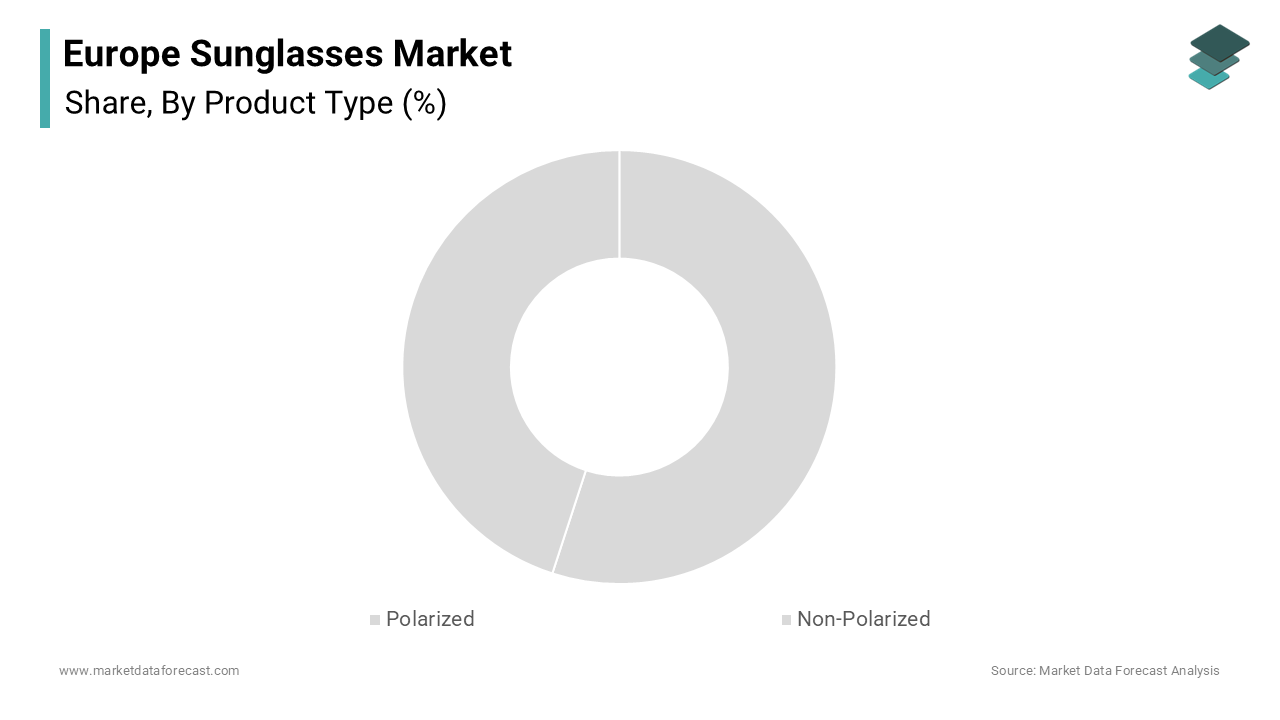
The polarized segment is projected to expand at a CAGR of 7.2 % from 2025 to 2033 owing to the technological refinements that enhance accessibility and functionality beyond traditional applications. Recent innovations include photochromic polarized lenses that adapt to changing light conditions, where a feature increasingly adopted in everyday urban eyewear. Moreover, automotive partnerships are expanding use cases, where Volvo and BMW now include polarized test kits in new vehicle deliveries across Scandinavia and Central Europe to demonstrate reduced dashboard glare. Environmental factors also play a role, where the European Environment Agency notes that snow cover duration in the Alps has increased by 9 days on average since 2020 due to erratic winter patterns, boosting demand for high performance polarized ski goggles and sunglasses.
By End User Insights
The women segment was the largest by holding 48.3% of the Europe sunglasses market share in 2024 owing to the cultural and commercial positioning of sunglasses as essential fashion accessories within female grooming and identity expression. In Southern and Western Europe particularly, eyewear functions as a daily style anchor comparable to handbags or footwear. According to the European Fashion Council, women in Italy France and Spain purchase an average of 2.3 pairs of sunglasses annually, compared to 1.4 for men, driven by seasonal collections and influencer led trends. Retail strategies reinforce this pattern, where luxury houses such as Gucci Prada and Dior consistently debut women’s sunglasses on runways before men’s lines, signaling priority in design investment. Furthermore, the rise of “facewear” aesthetics on platforms like Instagram, where oversized cat eye and shield styles dominate amplifies aspirational consumption. This blend of fashion centrality social validation and retail focus ensures women remain the core demographic driving volume and innovation.
The kids segment is anticipated to expand at a fastest CAGR of 9.4% throughout the forecast period with the mounting medical guidance and parental awareness regarding cumulative UV damage to developing eyes. The European Academy of Paediatrics states that children receive up to three times more annual UV exposure than adults due to outdoor activity patterns and larger pupil size, increasing lifetime risk of cataracts and macular degeneration. Consequently, national health bodies have intensified outreach, where Spain’s Ministry of Health launched a 2023 campaign distributing UV protection guidelines to all primary schools, while Sweden’s Public Health Agency mandates sunglass recommendations in pediatric vision screenings. Product innovation supports adoption; lightweight TR90 frames and shatterproof polycarbonate lenses now meet stringent EU toy safety directives (EN71), easing parental concerns about durability and toxicity. Retailers have responded with dedicated children’s sections, Zara Kids and H&M Mini reported year on year growth in eyewear sales in 2024.
By Distribution Channel Insights
The offline retail stores segment was accounted in holding a prominent share of the Europe sunglasses market in 2024 owing to the sustained by the experiential and trust based nature of eyewear purchasing, where fit frame compatibility and lens quality require physical evaluation. Optical chains such as GrandOptical in France Pearle in the Netherlands and Apollo Optik in Germany operate over 8,500 combined locations across Western Europe, offering professional fitting services and immediate product trials. Luxury brands further reinforce brick and mortar reliance premium sunglasses from labels like Dolce & Gabbana and Versace, which are sold through mono brand boutiques or authorized department stores like Galeries Lafayette and Harrods, where ambiance and service enhance perceived value. Additionally, regulatory compliance plays a role, where EU PPE rules require clear labeling of UV protection and lens category, which physical retailers can verify on site, reducing consumer uncertainty.
The online retail stores segment is deemed to witness a fastest CAGR of 11.3 % from 2025 to 2033 from enhanced digital shopping tools that mitigate traditional barriers to virtual eyewear purchases. Virtual try on technology powered by augmented reality has achieved remarkable accuracy, platforms like Zalando and ASOS now offer 3D face mapping that simulates frame fit with 92% user satisfaction across trials in Germany and the UK. Free return policies further reduce risk, over 70 % of major online retailers in Europe offer no cost returns within 30 days, thereby encouraging experimentation. Moreover, exclusive online drops from brands like Gentle Monster and Blenders create urgency and collectibility. With logistics networks ensuring next day delivery in major cities and AI driven personalization improving recommendation accuracy, online channels are rapidly closing the experiential gap, capturing younger demographics and driving double digit growth.
REGIONAL ANALYSIS
Italy Sunglasses Market Analysis
Italy was the top performer of the Europe sunglasses market by significantly occupying 24.3% of share in 2024 owing to its unrivaled position as the global epicenter of eyewear design and manufacturing. Home to Luxottica Safilo and Marcolin the country produces over 80 % of the world’s luxury sunglasses and dominates European brand portfolios. According to the Italian National Institute of Statistics, domestic per capita sunglass ownership is driven by strong fashion culture and year round sun exposure in southern regions. The Made in Italy label carries immense prestige with French and German consumers associating Italian eyewear with superior craftsmanship, as per a 2024 Euromonitor survey. Tourism further boosts sales, where over 60 million international visitors in 2023 purchased eyewear as souvenirs with Venice Milan and Florence serving as key retail hubs.
France Sunglasses Market Analysis
France sunglasses market growth was positioned second by capturing 18.4% of share in 2024 with its luxury fashion authority and high consumer spending on personal accessories. Paris serves as the creative nucleus where brands like Chanel Dior and Saint Laurent debut seasonal sunglass collections that set global trends. The country’s regulatory environment also fosters quality, wherethe French General Directorate for Competition Policy enforces strict penalties for false UV claims ensuring consumer trust in certified products. Urban lifestyle patterns drive consistent demand, where a 2024 Kantar study found that Parisians wear sunglasses daily from April to September regardless of cloud cover due to aesthetic norms. Additionally, France’s overseas territories like Réunion and Martinique maintain tropical UV exposure year-round sustaining off season sales.
UK Sunglasses Market Analysis
The United Kingdom sunglasses market growth is ascribed to have fastets CAGR throughout the forecast period with its dynamic retail sector and high e-commerce penetration. London functions as a trend laboratory where street style and celebrity influence converge to shape mass market preferences. The NHS’s public health campaigns on UV eye protection have raised awareness, where a 2024 survey revealed that 59 % of Britons now check CE and UV400 labels before purchasing. Festival and outdoor culture also fuels demand, over 4.5 million people attended major music festivals like Glastonbury and Reading in 2023 where statement sunglasses are wardrobe staples. Despite post Brexit trade complexities UK brands like Finlay & Co and Cubitts have leveraged local craftsmanship narratives to gain traction domestically and in EU markets. This blend of digital agility cultural relevance and health consciousness sustains the UK’s strong market standing.
Germany Sunglasses Market Analysis
Germany sunglasses market growth is likely to grow with the preference for technical precision durability and functional design over pure fashion. German consumers prioritize optical performance with 73% considering polarization and anti-reflective coatings essential features, according to a 2024 GfK survey. The country’s strong optometry network over 9,000 registered practices serves as a trusted point of sale where professional advice influences purchasing decisions. Outdoor activity participation drives volume, many adults engage in hiking cycling or water sports during summer months necessitating reliable eye protection. Brands like Rodenstock and Zeiss leverage their ophthalmic heritage to offer hybrid prescription sunglasses gaining ground in the premium segment.
Spain Sunglasses Market Analysis
Spain sunglasses market growth is likely to grow with the intense solar exposure high tourism inflows and a deeply ingrained sun culture. With over 3,000 hours of sunshine annually in regions like Andalusia and the Canary Islands sunglasses are year-round necessities rather than seasonal accessories. According to Spain’s National Statistics Institute domestic sales peak in March ahead of summer aligning with school holidays and beach preparation rituals. Tourism massively amplifies demand, over 85 million international visitors in 2023 created a robust souvenir and replacement market particularly in coastal hotspots like Barcelona Ibiza and Malaga. Local brands such as Hawkers have capitalized on this ecosystem achieving global reach through social media driven direct to consumer models. Public health initiatives also contribute, where the Spanish Ophthalmology Society runs annual “Protect Your Vision” campaigns in schools and pharmacies emphasizing UV risks.
COMPETITIVE LANDSCAPE
The competition in the Europe sunglasses market is highly dynamic characterized by a blend of vertically integrated giants independent designers fast fashion retailers and private labels. Dominant players like EssilorLuxottica and Kering Eyewear leverage brand equity manufacturing scale and retail control to command premium positioning while mid tier brands compete on design differentiation and sustainability narratives. Simultaneously fast fashion chains such as Zara and H&M exert downward pressure through trend responsive low cost offerings that capture volume especially among younger demographics. The market is further fragmented by regional preferences with Southern Europe favoring bold fashion statements and Northern Europe prioritizing technical performance and durability. Regulatory compliance particularly around UV protection labeling and material safety adds complexity requiring rigorous testing and documentation. Innovation in materials smart features and circular business models has become a key battleground as companies seek to balance style functionality and environmental responsibility.
KEY MARKET PLAYERS
Some of the key players operating in the Europe sunglasses market include
- EssilorLuxottica S.A.
- Safilo Group S.p.A.
- Kering Eyewear
- De Rigo Vision S.p.A.
- Marcolin S.p.A.
- Maui Jim Inc.
- Luxottica Group S.p.A.
- Polaroid Eyewear
- Serengeti Eyewear
- Specsavers Optical Group Ltd.
Top Players in the Europe Sunglasses Market
EssilorLuxottica
EssilorLuxottica is a dominant force in the Europe sunglasses market through its ownership of iconic brands such as Ray-Ban Oakley and Vogue Eyewear alongside manufacturing partnerships with luxury houses including Prada Giorgio Armani and Burberry. The company integrates design innovation optical science and global distribution to maintain leadership across premium and mass segments. In recent years EssilorLuxottica has strengthened its European position by expanding its retail footprint with over 120 new mono brand stores across Spain, Germany, and France in 2024. The company also launched sustainable collections using bio-based acetate and recycled ocean plastics aligning with EU environmental directives. Its vertical integration from lens technology to retail enables rapid response to fashion cycles and consumer demand for certified UV protection.
Kering Eyewear
Kering Eyewear drives significant influence in the Europe sunglasses market by managing eyewear development distribution and marketing for luxury brands under the Kering group such as Gucci Saint Laurent and Bottega Veneta as well as external partners like Lindberg and Puma. The company emphasizes artisanal craftsmanship bold design and digital storytelling to appeal to affluent European consumers. It also introduced circularity initiatives including frame recycling programs in collaboration with Italian material innovators reinforcing alignment with European sustainability mandates.
Safilo Group
Safilo Group maintains a strong foothold in the Europe sunglasses market through licensed partnerships with globally recognized brands including Dior Fendi Tommy Hilfiger and Smith Optics. Headquartered in Italy the company leverages decades of manufacturing expertise to deliver high quality frames that meet stringent EU safety and environmental standards. Safilo accelerated its sustainability transformation by launching its first fully recyclable acetate line derived from castor oil and achieving carbon neutrality across its Padua production facility. The company also deepened collaborations with European optical chains and department stores to enhance in store visibility and introduced limited edition collections tied to cultural events in France and Spain to drive seasonal engagement and brand relevance.
Top Strategies Used by the Key Market Participants
Key players in the Europe sunglasses market pursue distinct yet complementary strategies to sustain competitive advantage. Vertical integration enables control over design manufacturing and retail ensuring quality consistency and margin optimization. Brand licensing remains pivotal with major manufacturers securing long term agreements with luxury fashion houses to access global prestige and creative equity. Sustainability has evolved into a core strategic pillar with companies investing in bio based materials closed loop recycling and carbon neutral production to comply with EU green regulations and meet consumer expectations. Digital transformation is another critical focus including virtual try on AI driven personalization and social commerce integrations to capture online growth.
MARKET SEGMENTATION
This research report on the Europe Sunglasses Market has been segmented and sub-segmented based on the following categories.
By Product Type
- Polarized
- Non-Polarized
By End User
- Men
- Women
- Kids
By Product Category
- Mass
- Premium
By Distribution Channel
- Offline Retail Stores
- Online Retail Stores
By Country
- UK
- France
- Spain
- Germany
- Italy
- Russia
- Sweden
- Denmark
- Switzerland
- Netherlands
- Turkey
- Czech Republic
- Rest of Europe