- Product Description Description
- Table of Contents TOC
- List of Table & Figure LOT
- Get Free Sample PDF Sample PDF
Market Size, 2025
$657.2 BnMarket Estimate, 2026
$696.63 BnMarket Forecast, 2034
$1,111 BnCAGR, 2026–2034
6%Executive Summary: Germany Cards and Payments Market
- Market Scope: Comprehensive market analysis covering payment cards, alternative payment instruments, terminal infrastructure (POS/ATMs), Open Banking frameworks (PSD2), and digital wallet ecosystems in Germany.
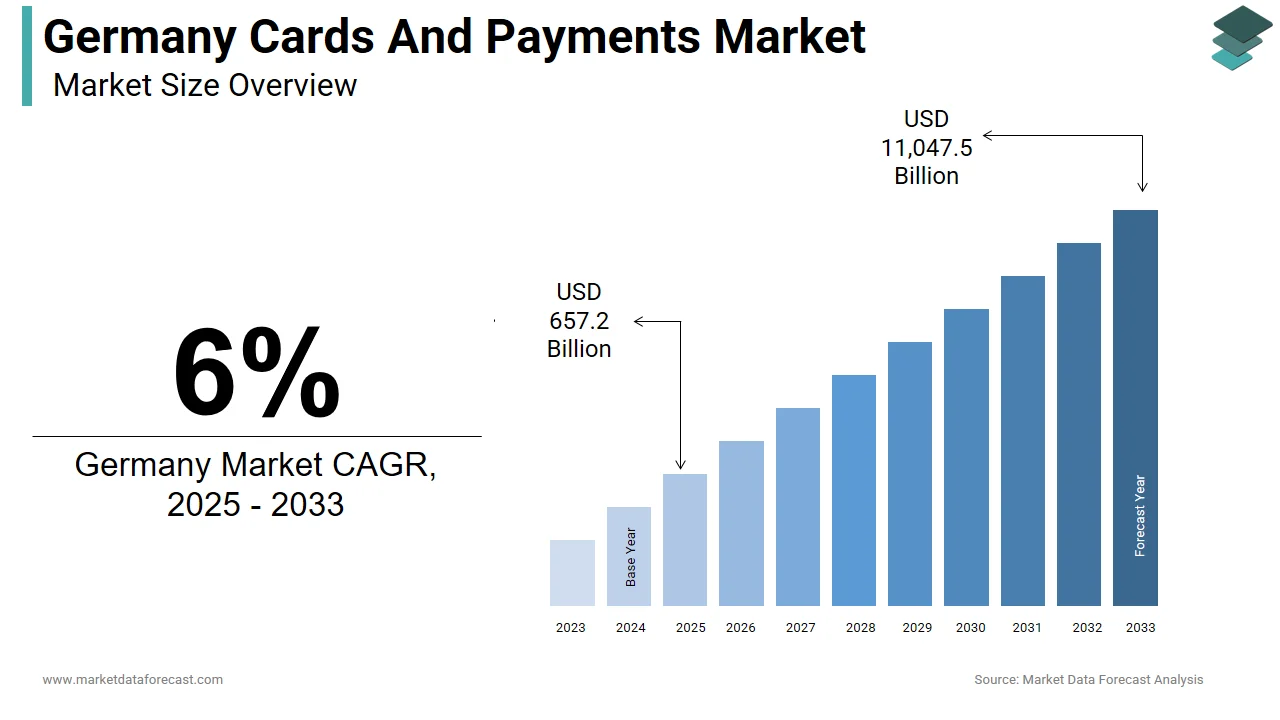
- Market Valuation: Valued at USD 657.20 billion (2025), estimated at USD 696.63 billion in 2026, and projected to reach USD 1,111.00 billion by 2034, registering a steady CAGR of 6.00% (2026–2034).
- Primary Growth Drivers: High digital penetration and rising contactless payment adoption (NFC usage exceeding 65% for lower-value POS transactions), government-backed financial innovation via PSD2 Open Banking mandates, and the rapid expansion of Buy Now, Pay Later (BNPL) services. Restraints include a persistent preference for cash among older demographics and SMEs, alongside fragmentation among multiple competing payment platforms.
Key Market Segment Metrics (2026–2034)
| Category | Leading Segment (2025 Position) | Fastest-Growing Segment |
|---|---|---|
| By Payment Cards | Debit cards (the dominant Girocard system holds ~32% expenditure share and drives everyday physical retail) | Contactless credit cards and mobile wallet integrations (Apple Pay / Google Pay) |
| By Payment Terminals | POS Terminals (command maximum market share with over 1.1 million active terminals processing billions of Girocard transactions) | Contactless NFC-enabled POS infrastructure |
| By Payment Instruments | Direct Debit / Electronic Direct Debit (ELV) (leads retail checkout volume due to speed, low processing costs, and consumer trust) | SEPA Instant Credit Transfers and BNPL e-commerce financing |
Major Market Participants & Market Structure
Market Structure: Highly regulated and mature European banking and fintech landscape supervised by BaFin and the Deutsche Bundesbank, featuring traditional commercial banks, savings banks (Sparkassen), cooperative banks (Volksbanken), and digital-first neo-banks competing on API openness, instant payments, and fraud prevention.
Key Companies: Deutsche Bank, Postbank, Commerzbank, Deutsche Kreditbank (DKB), Deutscher Sparkassen- und Giroverband (DSGV), Bundesverband der Deutschen Volksbanken und Raiffeisenbanken (BVR), ING Bank, Visa, Mastercard, and American Express.
Germany Cards And Payments Market Size
The Germany cards and payments market size was valued at USD 657.2 billion in 2025. This market is expected to grow at a CAGR of 6% from 2026 to 2034 and be worth USD 1,111 billion by 2034, from USD 696.63 billion in 2026.
MARKET DRIVERS
High Digital Penetration and Growth in Contactless Payment Adoption
One of the key drivers of Germany’s cards and payments market is the high level of digital penetration, coupled with a strong shift toward contactless payment methods. The Deutsche Bundesbank reported that in 2023, contactless transactions accounted for over 65% of all point-of-sale (POS) card transactions under €25, up from just 20% in 2019. Leading banks such as Deutsche Bank and Commerzbank have expanded their NFC-enabled card offerings, while local fintechs like N26 and Solaris have integrated mobile wallet solutions. Additionally, Apple Pay and Google Pay gained significant traction, with a significant number of users by the end of 2023. These trends indicate a structural shift in consumer behavior, supported by robust telecom infrastructure and growing trust in secure digital transactions.
Government Support for Financial Innovation and Open Banking Initiatives
Another major driver of Germany’s cards and payments market is the government-backed push for financial innovation through open banking and digital transformation initiatives. As an early adopter of the EU’s revised Payment Services Directive (PSD2), Germany has enabled third-party providers to offer payment initiation and account information services, fostering competition and innovation. According to the Federal Financial Supervisory Authority (BaFin), as of late 2023, more than 400 fintech firms had been authorized to operate under PSD2 regulations. Major Banks, including DKB, ING Germany, and Postban,k have launched API platforms to support seamless integration with fintech startups. A 2023 report by McKinsey noted that open banking contributed to a 22% increase in digital banking engagement among younger consumers. With a stable regulatory environment and strong data protection standards, Germany is well-positioned to continue leading in digital finance within the European Union.
MARKET RESTRAINTS
Persistent Preference for Cash among Older Demographics and SMEs
Despite rising digital adoption, a major restraint on Germany’s cards and payments market is the continued preference for cash, particularly among older demographics and small-to-medium enterprises (SMEs). According to a 2023 survey conducted by the German Retail Association (HDE), a significant portion of individuals aged 60 and above used cash for a substantial share of their daily purchases. Similarly, the KfW Research Institute found that only 30% of SMEs accepted non-cash payments regularly, citing concerns about transaction fees, security, and limited technical know-how. The Deutsche Bundesbank reported that in 2023, cash-in-circulation reached a substantial level, accounting for one-half of total retail transactions by volume. This behavioral inertia slows down the transition to a fully digitized payment ecosystem and requires targeted education campaigns and cost-reduction strategies to encourage broader adoption.
Fragmentation of Payment Platforms and Limited Interoperability
Another constraint in Germany's cards and payments market is the fragmentation of payment platforms, which limits interoperability and creates inefficiencies in the digital payment landscape. Unlike unified systems seen in countries like Sweden or South Korea, Germany hosts a wide array of competing mobile and QR code-based payment solutions, including PayPal, Apple Pay, Paydirekt, and numerous bank-specific apps. According to a 2023 report by EY Germany, there were over 30 active digital payment providers operating in the country, leading to duplication of infrastructure and reduced economies of scale. A survey by the German Consumer Council found that 62% of consumers used two or more payment apps due to inconsistent merchant acceptance, creating friction and reducing overall user experience.
MARKET OPPORTUNITIES
Expansion of Buy Now, Pay Later (BNPL) Services across Retail and E-Commerce
A growing opportunity in Germany’s cards and payments market is the rapid expansion of Buy Now, Pay Later (BNPL) services, particularly within the e-commerce and retail sectors. International players like Klarna, Afterpay (before acquisition), and local operators) such as RatePAY and Scalapay have expanded their presence across major retailers, including Amazon, MediaMarkt, and Otto.de. Data from the German Banking Industry Committee indicates that BNPL transaction value reached €12 billion in 2023, reflecting a 30% annual increase. These services appeal to younger consumers seeking flexible payment options without long-term debt commitments. As regulatory frameworks evolve to accommodate BNPL while ensuring consumer protection, this segment is poised to become a mainstream alternative to traditional credit cards, offering substantial revenue opportunities for payment providers.
Rise of Super App Ecosystems Integrating Financial and Payment Services
The emergence of super app ecosystems presents a transformative opportunity for Germany’s cards and payments market, allowing non-financial platforms—from ride-hailing apps to entertainment services to integrate payment and credit services directly into their interfaces. The Federation of German Consumer Organizations reported that in 2023, over 50% of mid-sized German companies adopted at least one form of embedded financial service to streamline checkout processes and enhance customer experience. As demand for seamless, frictionless transactions rises, embedded finance is set to become a key growth driver in Germany’s evolving digital payments landscape.
MARKET CHALLENGES
Increasing Sophistication of Financial Fraud and Identity Theft
Despite Germany’s advanced digital payment infrastructure, the sector faces a growing challenge from increasingly sophisticated financial fraud and identity theft schemes. Phishing attacks, fake merchant sites, and synthetic identity fraud have become more prevalent, exploiting weaknesses in multi-factor authentication and consumer awareness. BaFin highlighted in its 2023 annual report that card-not-present (CNP) fraud accounted for over 60% of all digital payment fraud cases. Although major banks like Deutsche Bank and HypoVereinsbank have implemented AI-based fraud detection systems, many consumers, especially seniors, are still vulnerable to social engineering tactics. Tackling this growing threat requires coordinated efforts between regulators, financial institutions, and technology providers to strengthen verification protocols, enhance consumer education, and invest in next-generation fraud prevention technologies.
MARKET KEY HIGHLIGHTS
The gaining prominence of alternative payment options in Germany, like Vodafone Wallet, a digital wallet for customers to make in-store contactless payments, and Deutsche Bank Mobile, launched by Deutsche Bank for its customers on Android devices using their card details to pay at places where MasterCard PayPass is accepted.
The development of a pan-European instant credit transfer scheme by the European Payments Council in Single Euro Payments Area (SEPA) markets to enhance the use of electronic payments and provide instant transfers up to EUR 15,000 within 10 seconds at any point of time throughout the year. UniCredit also started its real-time payment platform apart from SEPA Instant Credit Transfer (SCT Inst).
Growing adoption of digital-only banks like telecom provider Telefónica Deutschland and Fidor Bank partner mobile-only bank, O2 banking app, allowing P2P transfers and loans, offering MasterCard debit card, N26, and Fidor Bank.
SEGMENTAL ANALYSIS
By Cards Insights
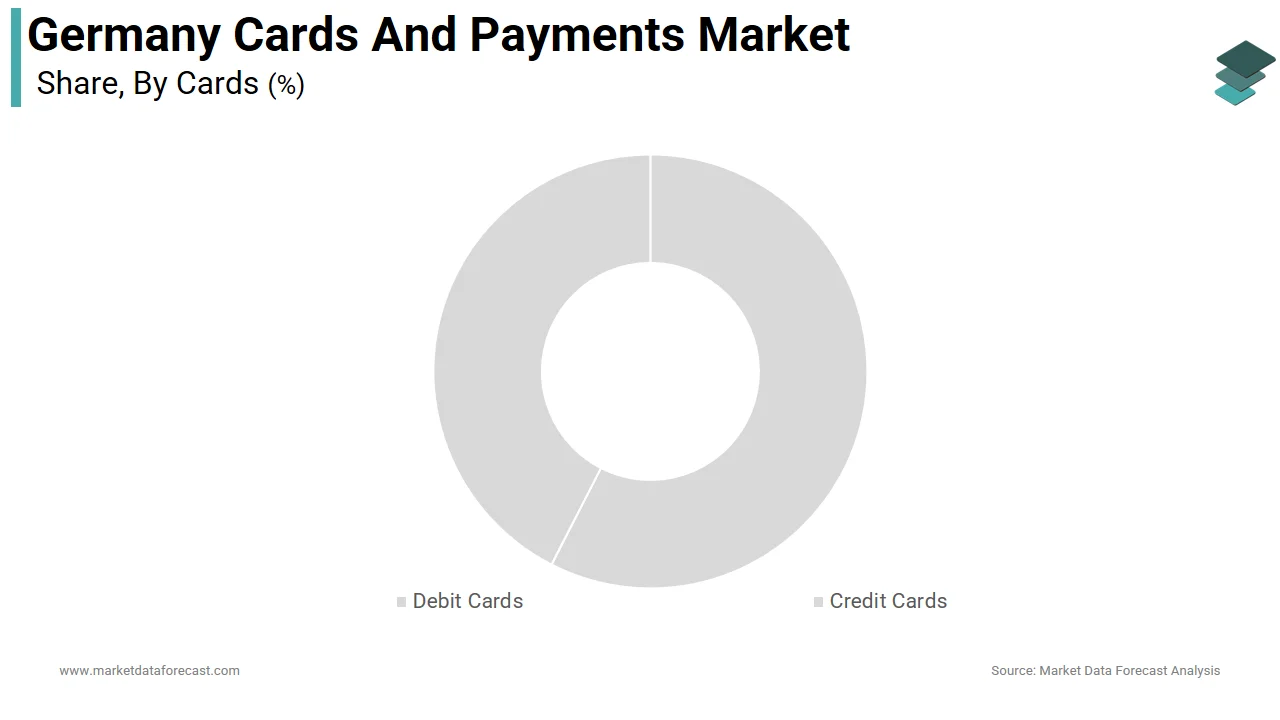
Debit cards are the most used segment of the German cards and payments market and are expected to witness further increases in their application during the forecast period.
- According to the Deutsche Bundesbank, in Germany, debit cards (basically the giro card) were ranked the second most commonly applied form of payment, representing about 23 per cent of the number of transactions, and in terms of turnover, it holds a 32 per cent share of overall expenditure.
The market share of this segment surged significantly during the COVID-19 pandemic, consumers progressively utilised this card to pay for smaller transaction amounts.
By Payment Terminals Insights
The POS (point of sale) segment holds the maximum share of the German cards and payments market and is projected to elevate its proportion throughout the estimation period. Among all the POS, Girocard is the most favoured payment system among German people for buying in stores and shops, and is also extensively used for e-commerce payments.
- As per Alcineo, about 100 million cards were issued, which executed around 7.5 billion payment transactions using 1,132,000 active terminals. Also, 84 per cent of transactions on Girocard are contactless.
The market size of this has expanded due to the advantages it provides to people and merchants by facilitating the application of both contactless and contact girocards for cash withdrawals and payment in shops.
By Payment Instruments Insights
Direct debit is the most used category of the German cards and payments market, and the segment is anticipated to drive forward during the forecast period. Moreover, the segment’s market growth was mainly fuelled by electronic direct debit (ELV). Its quick payment processing, low costs, high acceptance rate in consumers, comfort in paying, and lower wait times at checkout contribute to the growth of the segment.
COUNTRY ANALYSIS
Germany's cards and payments market is growing at a steady rate and is believed to see further progress during the forecast period. According to research on the country’s payment behaviour, customers are progressively becoming digital. This possibly provides a benefit to those dealers and traders who can fully accept the resulting payment trends.
KEY MARKET PLAYERS
The major players in the Germany cards and payments market include
- Deutsche Bank
- Postbank
- Commerzbank
- Deutsche Kreditbank (DKB)
- Deutscher Sparkassen- und Giroverband (DSGV)
- Bundesverband der Deutschen Volksbanken und Raiffeisenbanken (BVR)
- ING Bank
- Landesbanken
- Telefónica Deutschland
- Fidor Bank
- Girocard
- Visa
- Mastercard
- American Express
- Diners Club
GERMANY CARDS AND PAYMENTS MARKET NEWS
- In November 2024, it was reported that Germany will introduce a new payment card for people seeking asylum across the country. Today, they are only pay using vouchers or cash.
MARKET SEGMENTATION
This research report on the Germany cards and payments market is segmented and sub-segmented into the following categories.
By Payment Instruments
- Debit Cards
- Credit Cards
- Prepaid Cards
By Payment Terminals
- POS
- ATM's
By Payment Instruments
- Credit Transfers
- Direct Debit
- Cheques
- Payment Cards