- Product Description Description
- Table of Contents TOC
- List of Table & Figure LOT
- Get Free Sample PDF Sample PDF
Market Size, 2025
$2.65 BnMarket Estimate, 2026
$2.88 BnMarket Forecast, 2034
$5.57 BnCAGR, 2026–2034
8.6%Latin America Specialty Fertilizers Market Size & Forecast (2026–2034)
- Market Scope: Comprehensive analysis of the Latin American specialty fertilizers industry, covering product actions, formulations, applications across crop and non-crop sectors, and country-level dynamics.
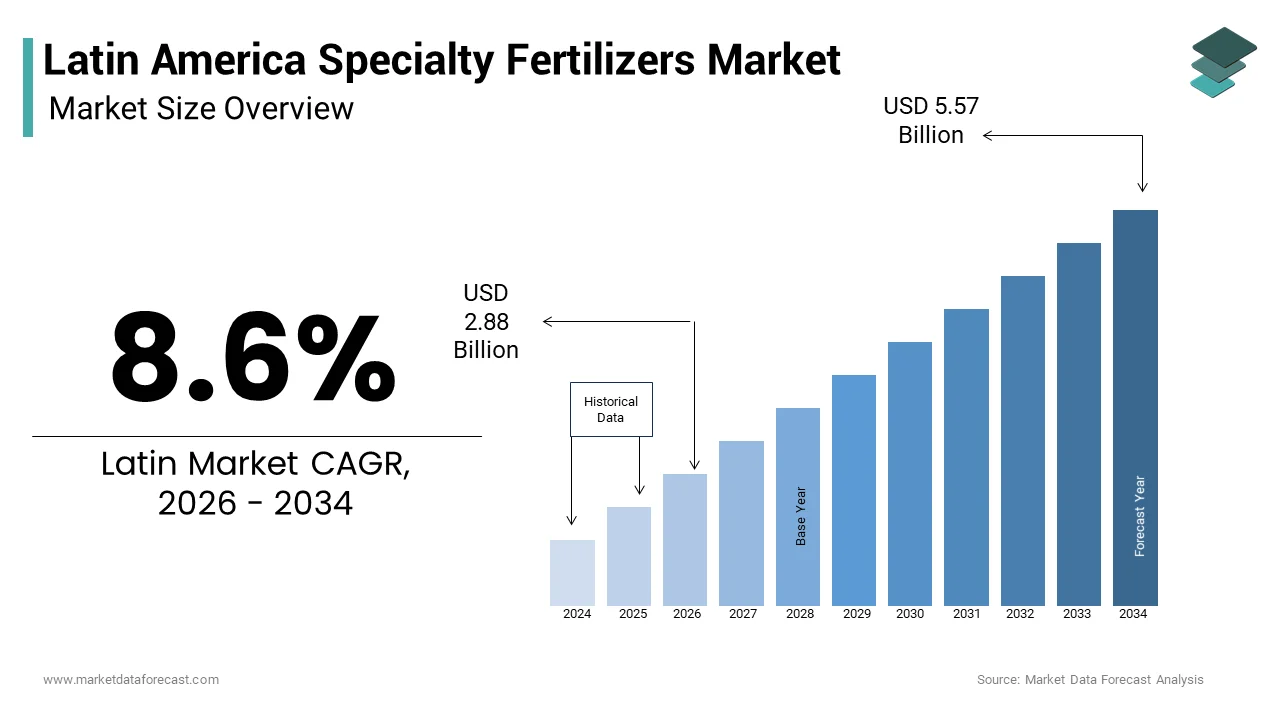
- Market Valuation: Valued at USD 2.65 billion in 2025, reaching USD 2.88 billion in 2026, and projected to scale up to USD 5.57 billion by 2034, growing at a solid CAGR of 8.6% from 2026 to 2034.
- Primary Growth Drivers: Rising regional demand for food due to limited cultivable land vs. growing populations, increasing health concerns regarding conventional fertilizers, and government backing for high-efficiency nutrient management.
Market Segmentation Breakdown
| Category | Segments Covered |
|---|---|
| By Action | Controlled-Release Fertilizers, Slow-Release Fertilizers |
| By Product Types | Phosphatic Fertilizers, Potassic Fertilizers, Nitrogenous Fertilizers |
| By Application | Crop-Based Application, Non-Crop-Based Application |
| By Country | Brazil, Mexico, Argentina (and the rest of South America) |
Key Industry Players
Sociedad Química y Minera S.A. (Chile), Haifa Chemicals (Israel), Sinochem Group (China), The Mosaic Company (USA), Verdesian Life Sciences (US), Yara International (Norway), Potash Corporation of Saskatchewan (Canada), Agrium (Canada), Sungro Seeds (India), and Vardhaman Fertilizers and Seeds (India).
 Download Free Sample Report
Latin America Specialty Fertilizers Market Size
The Latin America specialty fertilizers market size will reach USD 2.65 billion in 2025 and is anticipated to reach USD 2.88 billion in 2026 to USD 5.57 billion by 2034, growing at a CAGR of 8.6% from 2026 to 2034.
Speciality fertilizers high-analysisysis and completely water-soluble fertilizers. These are available in mono, double, and multi-nutrient combinations. They are available in liquid form and in crystalline state and can be applied to plants through fertigation or foliar application to maximize fertilizer use efficiency and crop productivity, minimize production cost, and improve the quality of the crop and its produce.
Specialty fertilizers reduce the loss of nutrients, especially nitrates, and loss of ammonia due to evaporation, which subsequently decreases the risk of environmental pollution. The demand for these fertilizersrapidlyfast rising because of all the advantages they provide over traditional fertilizers. They help reduce the environmental effects that traditional fertilizers pose to the earth.
The main driver of the Latin American specialty fertilizers market is the rising demand for food. Latin American region consists of several countries with inadequate cultivable land to sustaitheirts large population. This puts added stress on the system to produce efficiently. Here, specialty fertilizers are required to boost the soil fertility and improve food production rates. Other drivers of the industry include increasing health concerns due to the use of conventional fertilizers, growing government support, and lower less larequirementsement. As for the constraints of the market, it is the lack of awareness about specialty fertilizers that makes people still prefer conventional fertilizers. Also, the fact that specialty fertilizers are expensive compared to their conventional counterparts also doesn’t htheir its cause.
REPORT COVERAGE
| REPORT METRIC | DETAILS |
| Market Size Available | 2025 to 2034 |
| Base Year | 2025 |
| Forecast Period | 2026 to 2034 |
| CAGR | 8.6% |
| Segments Covered | By Action, Product, Application, and Region. |
| Various Analyses Covered | Global, Regional, and Country-Level Analysis, Segment-Level Analysis; DROC, PESTLE Analysis; Porter’s Five Forces Analysis; Competitive Landscape; Analyst Overview of Investment Opportunities |
| Regions Covered | Brazil, Mexico, Argentina |
| Market Leaders Profiled | Sociedad Quimica y Minera S.A (Chile), Haifa Chemicals (Israel), Sinochem Group (China), Vardhaman, Fertilizers and Seeds (India), Sungro Seeds (India), The Mosaic Company (USA), Verdesian Life Sciences (US), Agrium (Canada), Potash Corporation of Saskatchewan (Canada), Yara International (Norway). |
COUNTRY ANALYSIS
Based on geography, the Latin America market is divided into Mexico, Brazil, Argentina, andthe restt of the South American countries. The Latin American market is only a minor player globally and is the second smallest market. The region, though,h has aabove-averagege CAGR of 8.6% owing to the developing stature of the region.
KEY MARKET PLAYERS
Some of the major companies dominating the market, by their products and services, include
- Sociedad Química YayMinera .S.A (Chile)
- Haifa Chemicals (Israel)
- Sinochem Group (China)
- Vardhaman Fertilizers and Seeds (India)
- Sungro Seeds (India)
- The Mosaic Company (USA)
- Verdesian Life Sciences (US)
- Agrium (Canada)
- Potash Corporation of Saskatchewan (Canada)
- Yara International (Norway).
MARKET SEGMENTATION
This research report on the Latin America specialty fertilizers market is segmented and sub-segmented into the following categories.
By Action
- Controlled-Release Fertilizers
- Slow-Release Fertilizers
By Product Types
- Phosphatic Fertilizers
- Potassic Fertilizers
- Nitrogenous Fertilizers
By Application
- Crop-Based Application
- Non-Crop-Based Application
By Country
- Brazil
- Mexico
- Argentina