- Product Description Description
- Table of Contents TOC
- List of Table & Figure LOT
- Get Free Sample PDF Sample PDF
Market Size, 2025
$2.20 TnMarket Estimate, 2026
$2.31 TnMarket Forecast, 2034
$3.39 TnCAGR, 2026–2034
4.9%Executive Summary: U.S. Construction Market
- Market Scope: Comprehensive market analysis covering construction types, building methods, investment sources, regional states, and key metropolitan hubs across the United States.
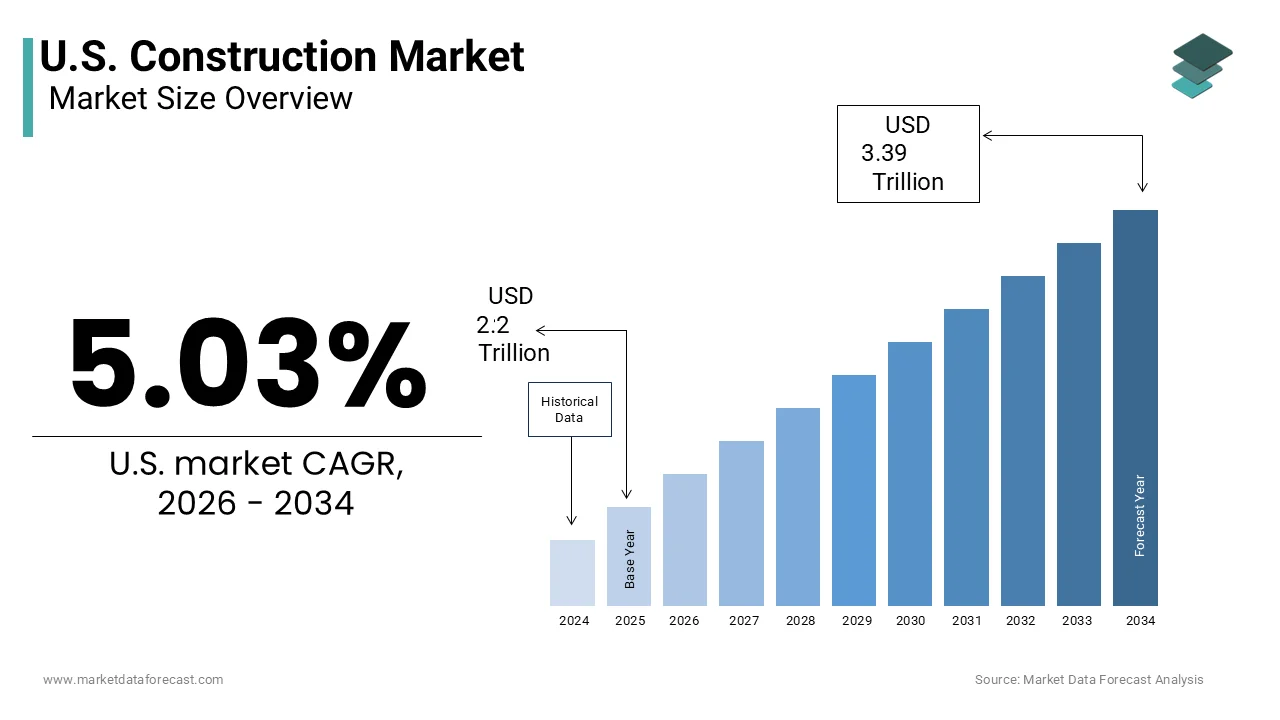
- Market Valuation: Valued at USD 2.2 trillion (2025), estimated at USD 2.31 trillion (2026), and projected to reach USD 3.39 trillion by 2034, registering a CAGR of 4.9% (2026–2034).
- Primary Growth Drivers: Persistent structural housing deficits, climate-driven infrastructure reinforcement, federal funding programs (such as the CHIPS Act and IIJA), and surging adoption of modern construction methods.
Key Market Segment Metrics (2026–2034)
| Category | Leading Segment (2025 Position) | Fastest-Growing Segment |
|---|---|---|
| By Construction Type | Residential Construction (held 54.3% share in 2025 due to accumulated national housing shortages) | Infrastructure Construction (projected at a 14.7% CAGR driven by grid and transit funding) |
| By Construction Method | Conventional On-Site Construction (dominant baseline due to regulatory code alignment) | Modern Methods of Construction / MMC (projected at a 23.1% CAGR including 3D printing and modular building) |
| By Investment Source | Private Capital (accounting for 75.7% of total market investments) | Public-Private Partnerships and Federal Stimulus Spending (CHIPS Act, IIJA) |
| By State / Region | California (top performer with 14.9% share in 2025) and Texas (ranking second with 11.4% share) | Florida (rapid growth driven by post-disaster rebuilding and climate code overhauls) |
Major Market Players & Market Structure
Market Structure: Highly competitive landscape led by established engineering giants, commercial builders, and residential leaders competing on digital project management, modular automation, and sustainable building technologies.
Key Companies: D.R. Horton, Emcor Group, Fluor Corporation, Hensel Phelps, Lennar Corporation, Kiewit Corporation, AECOM, Bechtel Corporation, Clark Construction Group LLC, DPR Construction, Jacobs Engineering Group Inc., Turner Construction Company, PCL Construction Enterprises Inc., Skanska USA, The Whiting-Turner Contracting Company, Gilbane Building Company, McCarthy Holdings Inc., Tutor Perini Corporation, Clark Builders Group, and Mortenson Construction.
U.S. Construction Market Size
The U.S. construction market was valued at USD 2.2 trillion in 2025 and is estimated to reach USD 2.31 trillion in 2026, and is projected to reach USD 3.39 trillion by 2034, growing at a CAGR of 4.9% from 2026 to 2034.
The construction is the physical manifestation of demographic urgency, infrastructural decay, and technological recalibration. As per the National Association of Home Builders, nearly 3.8 million additional homes are needed by 2030 to meet demand, which has led to delays that have increased average project timelines by 67% since 2019.
MARKET DRIVERS
Climate-Driven Infrastructure Reinforcement in Coastal and Wildfire Zones
The accelerating frequency of extreme weather events has transformed construction from routine development into climate adaptation engineering, which is accelerating the growth of the U.S. construction market. According to the National Oceanic and Atmospheric Administration, coastal counties experienced 27 separate billion-dollar weather disasters between 2020 and 2023, more than any prior four-year period in recorded history. Simultaneously, California’s 2023 Wildfire Resilience Code now requires fire-retardant siding, ember-resistant vents, and defensible space landscaping for all structures within 100 feet of wildland interfaces, affecting over 1.2 million new builds annually.
Workforce Retention Through Apprenticeship Expansion in Skilled Trades
The U.S. construction sector is reinventing labor pipelines through federally funded apprenticeships targeting underrepresented demographics, which is driving the growth of the U.S. construction market. According to the U.S. Department of Labor’s Office of Apprenticeship, enrollment in registered construction trades programs rose 31% between 2021 and 2023, with women and veterans accounting for 44% of new entrants, up from 27% in 2019. Programs like Build America, backed by the Infrastructure Investment and Jobs Act, provide stipends, childcare support, and certified credentialing for electricians, plumbers, and HVAC technicians.
MARKET RESTRAINTS
Permitting and Zoning Bottlenecks Delaying Housing Development
The regulatory inertia continues to strangle the supply, which is a major factor hampering the growth of the US construction market. In San Francisco, 63% of proposed multifamily projects are delayed or denied due to height restrictions, parking mandates, and neighborhood objections, as revealed by the Urban Land Institute’s 2023 Regulatory Burden Index. These delays inflate project costs by up to 38%, according to McGraw-Hill Construction’s Cost of Delay Report, effectively pricing out affordable housing developers.
Supply Chain Fragmentation and Material Substitution Undermining Quality Control
The volatile global pricing and inconsistent domestic sourcing, forcing contractors into reactive substitution practices that compromise structural integrity, are also limiting the growth of the US construction market. According to the U.S. Geological Survey, domestic production of structural steel declined 19% between 2020 and 2023, while imports from countries with lax quality controls surged by 41%.
MARKET OPPORTUNITIES
Modular and Prefabricated Construction as a Response to Labor and Time Constraints
The modular and prefabricated construction is creating new opportunities for the growth of the US construction market. Companies like Boxabl and Katerra have partnered with municipal housing authorities to deploy factory-built tiny homes and multi-unit apartments that reduce on-site labor hours by 60% and construction timelines by 50%. The technology enables precision manufacturing in controlled environments, minimizing waste and rework while allowing for standardized compliance with energy codes.
Public-Private Partnerships Repurposing Abandoned Infrastructure into Mixed-Use Hubs
The decaying industrial sites, vacant retail centers, and shuttered schools present vast, underutilized real estate ripe for adaptive reuse, which will also elevate the growth of the US construction market. Projects like the transformation of Detroit’s Michigan Central Station into a mobility innovation campus that is funded equally by Ford Motor Company and the City of Detroit demonstrate how private capital can catalyze public regeneration. These ventures bypass NIMBY resistance by integrating community benefit clauses into development agreements, turning reconstruction into equitable revitalization rather than displacement.
MARKET CHALLENGES
Cybersecurity Vulnerabilities in Smart Construction Systems Expose Infrastructure
The construction sites have become high-value targets for cyberattacks, which is one of the challenging factors for the growth of the US construction market. A 2023 incident at a federal hospital construction site in Ohio resulted in the deletion of 14 terabytes of architectural blueprints and safety compliance records, delaying the project by nine months and triggering an OSHA violation audit. The absence of federal cybersecurity standards for construction projects leaves the nation’s physical infrastructure vulnerable to sabotage, espionage, or accidental corruption.
The Erosion of Craftsmanship Due to Declining Vocational Education in Secondary Schools
The decline of shop classes and trade-focused curricula in public high schools has severed the pipeline of skilled labor, which is also hindering the growth of the US construction market. The consequence is visible with a 31% increase in defective drywall installations, improper electrical junctions, and misaligned framing reported in 2023 inspections by the International Code Council. Without foundational training, even the most advanced technologies cannot compensate for basic competence.
REPORT COVERAGE
| REPORT METRIC | DETAILS |
| Market Size Available | 2025 to 2034 |
| Base Year | 2025 |
| Forecast Period | 2026 to 2034 |
| Segments Covered | By Construction Type, Construction Method, and Region. |
| Various Analyses Covered | Global, Regional, and Country-Level Analysis, Segment-Level Analysis, Drivers, Restraints, Opportunities, Challenges; PESTLE Analysis; Porter’s Five Forces Analysis, Competitive Landscape, Analyst Overview of Investment Opportunities |
| Countries Covered | New York, Massachusetts, Pennsylvania, Illinois, Ohio, Michigan, Texas, Florida, Georgia, California, Washington, Colorado. |
| Market Leaders Profiled | D.R. Horton, Emcor Group, Fluor Corporation, Hensel Phelps, Lennar Corporation, Kiewit Corporation, AECOM, Bechtel Corporation, Clark Construction Group LLC, DPR Construction, Jacobs Engineering Group Inc., Turner Construction Company, PCL Construction Enterprises Inc., Skanska USA, The Whiting-Turner Contracting Company, Gilbane Building Company, McCarthy Holdings Inc., Tutor Perini Corporation, Clark Builders Group, Mortenson Construction |
SEGMENTAL ANALYSIS
By Construction Type Insights
The residential construction segment was the largest and held 54.3% of the US construction market share in 2025, with a structural housing deficit that has accumulated over decades. As per the National Association of Realtors, 79% of first-time buyers prioritize proximity to family over urban amenities, driving suburban and exurban expansion. The residential sector endures because housing remains the most fundamental human need, and the U.S. has failed to provide it at scale for over a generation. The infrastructure construction segment is lucratively growing with an anticipated CAGR of 14.7% from 2025 to 2033. Simultaneously, the Inflation Reduction Act funneled $65 billion into grid resilience, water system upgrades, and broadband expansion, triggering unprecedented public works mobilization. These projects bypass private profit motives entirely as they are public obligations made visible in concrete and copper.
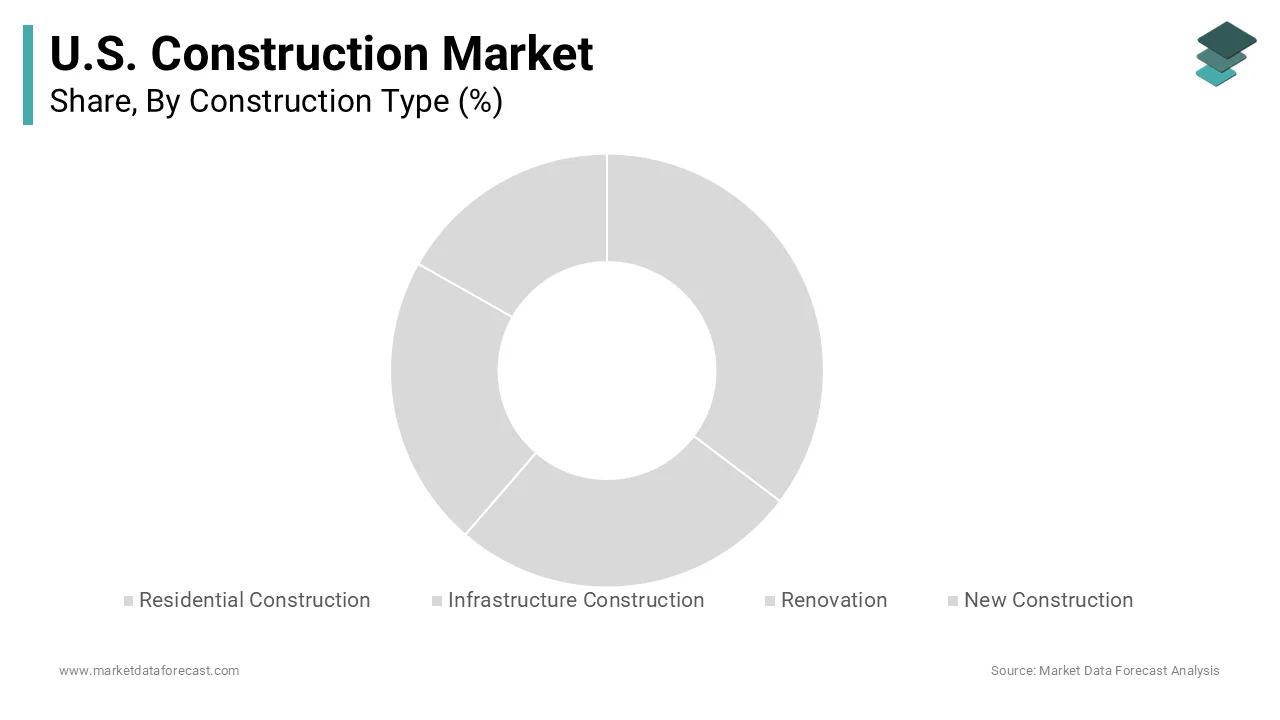
The renovation segment accounted in holding 6% share in 2025 from economic pragmatism and infrastructural obsolescence, as the average U.S. home is 43 years old, and retrofitting is often cheaper and faster than new construction in dense urban cores where land acquisition is prohibitive. As per a 2023 study by the Urban Institute, 68% of homeowners in coastal cities chose major renovations over relocation due to rising insurance premiums and zoning restrictions. The new construction segment is likely to grow with an expected CAGR of 11.3% from 2025 to 2033. While renovation addresses decay, new construction responds to the need with the 3.8 million-unit housing shortfall identified by Harvard’s Joint Center for Housing Studies.
By Construction Method Insights
The conventional on-site construction segment held a significant share of the US construction market in 2025 due to efficiency, but also to institutional inertia and regulatory entrenchment. Over 90% of local building codes are written explicitly for stick-built, site-assembled structures, making prefabricated alternatives legally cumbersome, even when faster and safer, according to the International Code Council’s 2023 Compliance Review.
The modern methods of construction segment is likely to grow with an expected CAGR of 23.1% from 2025 to 2033, with labor scarcity, climate urgency, and federal procurement mandates. Meanwhile, companies like ICON and Lendlease deployed 3D-printed homes in Texas and Arizona using proprietary concrete formulations that reduce material use by 60% and carbon emissions by 47%, according to the National Renewable Energy Laboratory.
By Investment Source Insights
Private capital still funds most construction activity, accounting for 75.7% of investments, but public spending is growing rapidly thanks to historic federal funding. For example, the CHIPS Act has allocated USD 52.7 billion, sparking new semiconductor fabs along with supporting supplier facilities and worker housing. In Canada, public-private partnerships valued at USD 58 billion help spread risk while ensuring projects in transport, energy, and social infrastructure are ready to start.
Public funding often encourages private investors to contribute at a 3:1 ratio, boosting overall demand and expanding the North American construction market. However, developers relying on private loans face higher interest rates, especially for multifamily and office projects, until the market stabilizes.
COUNTRY LEVEL ANALYSIS
California Construction Market Analysis
California was the top performer of the U.S. construction market by occupying 14.9% of the share in 2025, with the nation’s most populous state and innovation epicenter, making it a laboratory for regulatory experimentation and climate-driven adaptation. The state also leads in wildfire-resilient design: every new structure in fire-prone zones must now include ember-resistant vents, non-combustible roofing, and 100-foot defensible space buffers, as enforced by Title 24 amendments.
Texas Construction Market Analysis
Texas was ranked second by holding 11.4% of the U.S. construction market share in 2025. Between 2020 and 2023, Houston added 287,000 new housing units, more than any other metro area, with 71% of them single-family detached homes on large lots, as per the Texas Real Estate Research Center. Texas is also pioneering industrial-scale modular manufacturing, where Dallas-based Skyline Champion now produces 1,200 manufactured homes weekly for deployment across the Southwest, which is supplying affordable housing to communities shut out of traditional markets.
Florida Construction Market Analysis
The Florida construction market is likely to grow with significant growth opportunities in the coming years. Florida’s 2023 Building Code overhaul mandated hurricane-rated windows, elevated foundations, and reinforced roof-to-wall connections for all new builds, which is a response to Hurricane Ian’s $50 billion in damages. Insurance premiums have surged 150% since 2021, forcing developers to cut corners on insulation and flashing.
COMPETITIVE LANDSCAPE
The U.S. construction market in 2025 is highly competitive, dominated by established players such as Turner Construction, Kiewit Corporation, Bechtel, and MasTec, who lead in large-scale commercial, industrial, and infrastructure projects, while emerging firms like Sekisui House and integrated suppliers such as Lowe’s (through its acquisition of Foundation Building Materials) are expanding rapidly into residential and professional contractor segments. Growth is driven by rising demand for housing, infrastructure development, and technological adoption, with companies increasingly leveraging modular construction, digital tools, and AI-driven project management to reduce costs, mitigate labor shortages, and improve efficiency. Strategic consolidation, sustainability initiatives, and supply chain integration further shape competition, creating a dynamic landscape where traditional giants and agile newcomers vie to capture market share across diverse sectors.
KEY MARKET PLAYERS
Some of the companies that are playing a dominating role in the global U.S. Construction Market include
- D.R. Horton
- Emcor Group
- Fluor Corporation
- Hensel Phelps
- Lennar Corporation
- Kiewit Corporation
- AECOM
- Bechtel Corporation
- Clark Construction Group LLC
- DPR Construction
- Jacobs Engineering Group Inc.
- Turner Construction Company
- PCL Construction Enterprises Inc.
- Skanska USA
- The Whiting-Turner Contracting Company
- Gilbane Building Company
- McCarthy Holdings Inc.
- Tutor Perini Corporation
- Clark Builders Group
- Mortenson Construction
MARKET SEGMENTATION
This research report on the U.S. construction market is segmented and sub-segmented into the following categories:
By Construction Type
- Residential Construction
- Infrastructure Construction
- Renovation
- New Construction
By Construction Method
- Conventional On-Site Construction
- Modern Methods of Construction (MMC)
By Investment Source
- Private Sector
- Public Sector
By Country
- California
- Texas
- Florida
- Rest of the United States