Global Acoustic Vehicle Alerting System Market Size, Share, Trends & Growth Forecast Report, Segmented By Vehicle, Propulsion, Component, Mounting Position, Sales Channel, and Region (North America, Europe, Asia-Pacific, Latin America, Middle East, and Africa), Industry Analysis From 2025 to 2033
Global Acoustic Vehicle Alerting System Market Size
The global acoustic vehicle alerting system market was valued at USD 2.69 billion in 2024 and is anticipated to reach USD 3.71 billion in 2025 from USD 49.15 billion by 2033, growing at a CAGR of 38.10% during the forecast period from 2025 to 2033.
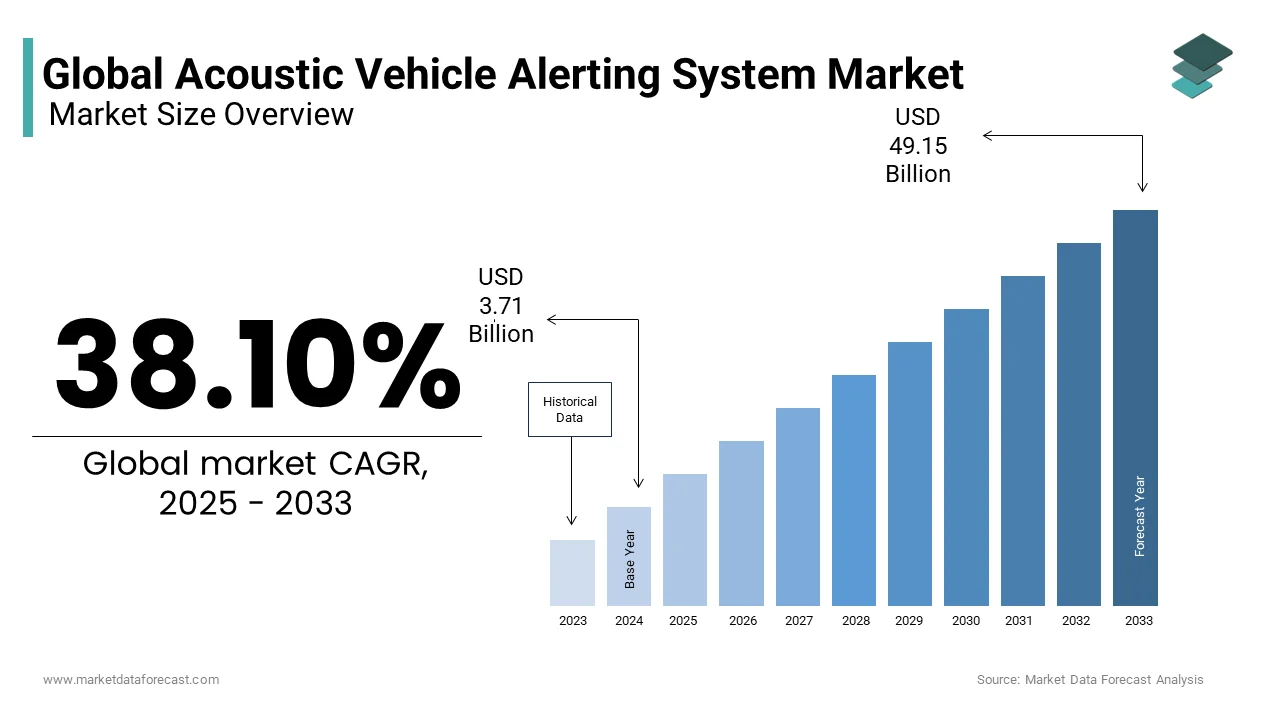
At the point when the automobile is working at a lower speed, the acoustic automobile alerting framework warns cyclists or drivers about the vehicle's presence. Consequently, the gadget is created to diminish the danger of accidents. An acoustic automobile informing framework could either be incorporated or independently accessible.
Government mandates are the key variables affecting the worldwide acoustic vehicle alerting system market. As of late, the EU's enactment has commanded the establishment of acoustic vehicle alerting systems (AVAS) in the new models of electric and hybrid vehicles presented since July 2019. The European Union, however, and the National Highway Traffic Safety Administration of the U.S. have shown counterfeit emission rules for their electric and hybrid automobiles.
MARKET DRIVERS
The acoustic vehicle alerting system market is foreseen to develop in the estimated time frame, attributable to the increasing demand from different governments to introduce AVAS frameworks. Expanding concerns identified with passenger security are additionally driving the interest in AVAS frameworks. The rising investment in electric automobiles overall is anticipated to encourage the development of a worldwide acoustic vehicle alerting system market across all regions.
MARKET RESTRAINTS
However, significant expenses of electric automobiles and different government guidelines with respect to AVAS frameworks could hamper the development of the acoustic automobile alerting framework market during the period from 2020 to 2027.
REPORT COVERAGE
| REPORT METRIC | DETAILS |
| Market Size Available | 2024 to 2033 |
| Base Year | 2024 |
| Forecast Period | 2025 to 2033 |
| CAGR | 38.10% |
| Segments Covered | By Vehicle, Propulsion, Sound, Component, Mounting Position, Sales Channel, and Region. |
|
Various Analyses Covered | Global, Regional & Country Level Analysis, Segment-Level Analysis, DROC, PESTLE Analysis, Porter’s Five Forces Analysis, Competitive Landscape, Analyst Overview of Investment Opportunities |
| Regions Covered | North America, Europe, APAC, Latin America, Middle East & Africa |
| Market Leaders Profiled | BMW AG, Aptiv, Brigade Electronics, Daimler AG, Delphi Technologies, Denso Corporation, Honda Motor Co., Ltd, Kendrion N.V., Kufatec GmbH & Co. KG, Mando-Hella Electronics Corp, Nissan Motor Company Ltd, Sound Racer, Tesla Inc., Texas Instruments, Volkswagen AG, and Others. |
SEGMENT ANALYSIS
By Vehicle Insights
Commercial automobiles are likewise expected to hold a significant share in the market's development during the forecasted period. This is because of the new guidelines set down in Europe and the U.S. that order the establishment of AVAS even in heavy vehicles, for exampletransportts and trucks. In addition, progression in the vehicle parts market has likewise positively affected the acoustic vehicle alerting system market development.
By Propulsion Insights
The PHEV segment is estimated to expand with a notable growth rate in the coming years, with the increasing need for fuel-efficient vehicles and a curbing of carbon emissions.
By Sales Channel Insights
The aftermarket segment accounts for a substantial portion of the global acoustic vehicle alerting system market, which is anticipated to expand steadily in the outlook period.
REGIONAL ANALYSIS
The Asia Pacific market is trailed by North America because of the existence of driving organizations such as Tesla and Ford. The U.S. and Canada are likely to be significant supporters of development in this region owing to the new guidelines set somewhere around the administrations with respect to emission standards. Europe's locale has an enormous demand in rising nations because of increasing interest in electric automobiles, and the development of advanced cars is increasing in this area. The Asia Pacific is forecast to show the quickest development during the estimated time frame. This is primarily a result of the development of the vehicle industry in developing nations such as South Korea, Japan, India, and China. Also, the legislatures in this area are encouraging the adoption of electric automobiles. The Middle East and Africa region is likely to have a moderate share in the acoustic vehicle alerting system market when compared with other regions.
COMPETITIVE LANDSCAPE
KEY MARKET PLAYERS
A few of the market players in the global acoustic vehicle alerting system market include
- BMW AG
- Aptiv
- Brigade Electronics
- Daimler AG
- Delphi Technologies
- Denso Corporation
- Honda Motor Co., Ltd
- Kendrion N.V
- Kufatec GmbH & Co. KG
- Mando-Hella Electronics Corp
- Nissan Motor Company Ltd
- Sound Racer
- Tesla Inc
- Texas Instruments
- Volkswagen AG.
RECENT MARKET NEWS
- Electric and hybrid automobiles are very peaceful at low speeds, and research has just demonstrated that these vehicles are bound to be more engaged with people on foot than cars with internal combustion engines. The Quiet Vehicle Sounder (QVS) guarantees your tranquil car is heard by emitting a mix of protected bbs®-tek sound frequencies and tonal sounds.
- Mercedes-Benz needs to install a warning sound in EVs to warn people on foot. Different microphones are being introduced in the exterior to build up an independently designed e-sound for every electric model.
- CR-V Hybrid models benefit from another Acoustic Vehicle Alerting System (AVAS) intended to build awareness among pedestrians when going under electric or power. A speaker mounted in the front bumper produces an unmistakable, perceptible alert that differs in volume depending on the volume and is easily audible to people on foot, yet almost indistinct to the driver or travelers under most conditions.
- Kendrion's sound actuator conveys sound more widely than an ordinary loudspeaker, which implies it offers an all more evenly distributed sound field. In addition, as a closed framework, it is dust-tight and waterproof, making it support-free for business administrators.
- SoundRacer says that looming enactment around the globe will necessitate that electric automobiles produce a noise at low speed (otherwise known as the pedestrian system). Rather than having this be a blare or a tweet, SoundRacer says that EV drivers may value a thundering motor sound, similar to that of a V12 Ferrari or a Mustang V8.
- Hella has declared the improvement of an Acoustic Vehicle Alerting System (AVAS). The framework has been created for hybrid and electric vehicles to be more secure for walkers and other street users. The structure will create the sound of an inward ignition motor, consequently alerting others to its presence in the region.
MARKET SEGMENTATION
This research report on the global Acoustic Vehicle Alerting System Market is segmented and sub-segmented into the following categories.
By Vehicle Type
- Passenger Cars
- Commercial Vehicles
- Two-Wheelers (E-scooters/Mopeds, E-motorcycles)
By Propulsion Type
- Battery Electric Vehicles (BEVs)
- Plug-in Hybrid Electric Vehicles (PHEVs)
- Hybrid Electric Vehicles (HEVs)
- Fuel Cell Electric Vehicles (FCEVs)
By Sound Type
- Synthetic Engine Sounds
- Customizable Sounds
- Pre-Defined OEM Sounds
By Component
- Speakers
- Electronic Control Units (ECUs)
- Sensors
By Mounting Position
- Integrated
- Separated
By Sales Channel
- Original Equipment Manufacturers (OEMs)
- Aftermarket
By Region
- North America
- Europe
- Asia-Pacific
- Latin America
- Middle East and Africa
Frequently Asked Questions
What is driving the growth of the AVAS market?
Mandates from global regulators—such as the EU’s 2019 requirement and U.S. NHTSA’s quiet car rules—require electric and hybrid vehicles to emit audible alerts below 30 km/h to protect pedestrians, especially the visually impaired, fueling rapid adoption.
How does AVAS enhance road safety?
By generating artificial sounds that mimic engine noise or use distinctive tones, AVAS ensures vulnerable road users can detect approaching silent EVs and hybrids, significantly reducing low-speed collision risks in urban environments.
Which regions lead AVAS adoption and regulation?
Europe is at the forefront due to strict EU Regulation No. 540/2014, followed by North America and Japan; emerging markets are gradually aligning as EV penetration rises and safety standards evolve.
What are the key technical challenges in AVAS design?
Balancing sound effectiveness with urban noise pollution, ensuring consistent audibility across vehicle speeds, and integrating systems that adapt to ambient conditions without driver intervention remain engineering priorities.
Who are the major players in the AVAS market?
Leading suppliers include Harman International (Samsung), Bosch, Valeo, Siemens, and specialized firms like Sonitron and AVEE—combining automotive acoustics expertise with OEM partnerships for seamless integration.
Are AVAS sounds standardized across vehicles?
While regulations define minimum sound levels and frequency ranges, automakers often customize AVAS tones for brand identity—though future harmonization may occur to avoid confusion among pedestrians.
How is AVAS evolving with vehicle automation?
Next-gen AVAS integrates with ADAS and V2X systems to emit directional or context-aware alerts (e.g., louder when reversing or near crosswalks), enhancing situational awareness in increasingly autonomous driving environments.
Does AVAS impact electric vehicle range or performance?
Minimal—modern AVAS units consume very low power (typically under 50 watts) and have negligible effect on battery range, making them a lightweight yet critical safety feature in EV design.
Access the study in MULTIPLE FORMATS
Purchase options starting from
$ 2500
Didn’t find what you’re looking for?
TALK TO OUR ANALYST TEAM
Need something within your budget?
NO WORRIES! WE GOT YOU COVERED!
Call us on: +1 888 702 9696 (U.S Toll Free)
Write to us: sales@marketdataforecast.com