- Product Description Description
- Table of Contents TOC
- List of Table & Figure LOT
- Get Free Sample PDF Sample PDF
Market Size, 2025
$2.92 BnMarket Estimate, 2026
$3.08 BnMarket Forecast, 2034
$4.75 BnCAGR, 2026–2034
5.56%Executive Summary: Global Advanced Combat Helmet Market
- Market Scope: Comprehensive global advanced combat helmet market analysis covering material types, technology integrations, end-users, applications, regional frameworks, and soldier modernization drivers.
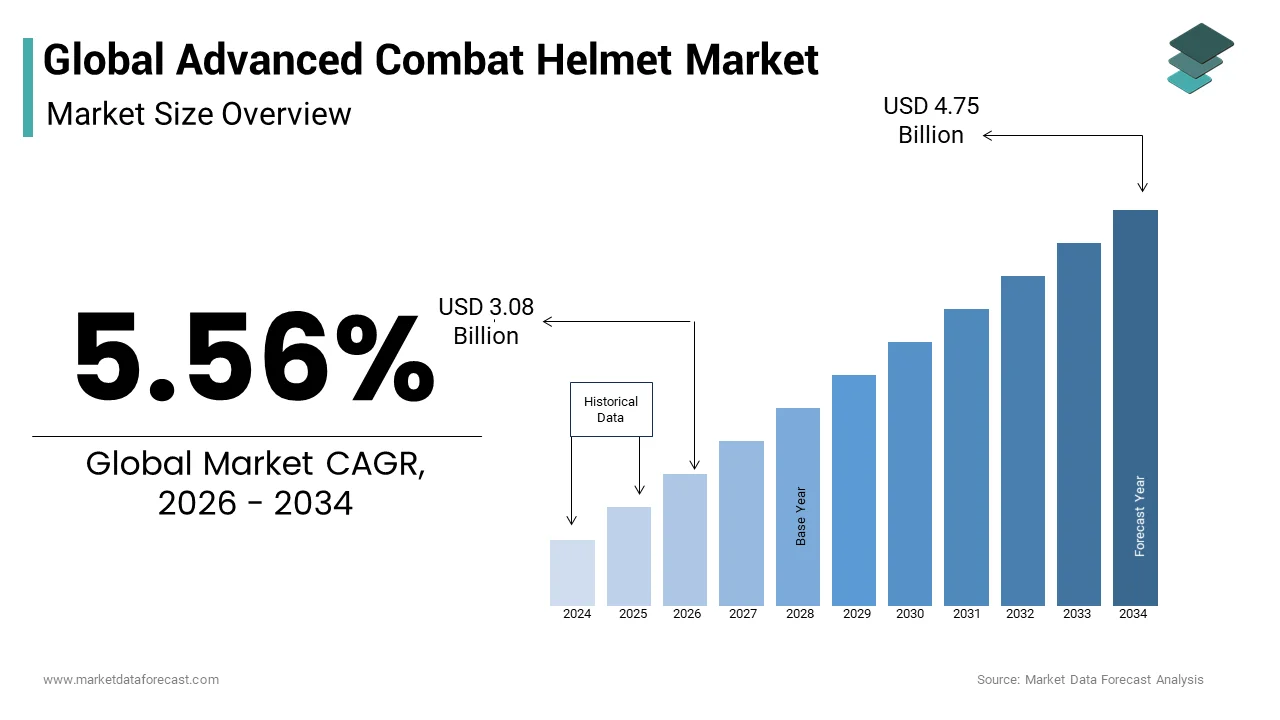
- Market Valuation: Valued at USD 2.92 billion (2024), estimated at USD 3.08 billion (2026), and projected to reach USD 4.75 billion by 2034, registering a CAGR of 5.56% (2026–2034).
- Primary Growth Drivers: Sustained increase in global military expenditure, soldier modernization programs, rising threats from asymmetric warfare and urban combat, and the demand for lightweight cranial protection.
Key Market Segment Metrics (2026–2034)
| Category | Leading Segment (2025 Position) | Fastest-Growing Segment |
|---|---|---|
| By Material Type | Ballistic Materials (holding 44.6% market share due to superior kinetic energy dissipation) | Thermoplastics (projected at a CAGR of 6.5% for lighter weight and enhanced mobility) |
| By Application | Protection / Ballistic Protection (accounting for 32.1% share against lethal threats and shrapnel) | Visual Assistance (projected at a CAGR of 8.2% via augmented reality and night vision integration) |
| By End-User | Military & Defense (accounting for 52.1% market share driven by frontline modernization programs) | Law Enforcement Agencies (projected at a CAGR of 7.6% due to tactical unit deployments) |
| By Region | North America (holding 35.3% share backed by high defense budgets and early technology adoption) | Asia-Pacific (growing rapidly due to regional border tensions and military modernization) |
Major Market Players & Market Structure
Market Structure: Concentrated landscape dominated by established defense contractors and advanced material science companies competing on ballistic resilience, weight reduction, and digital ecosystem integration.
Key Companies: Survitec Group, Morgan Advanced Material PLC, BAE Systems, Gentex Corporation, Avon Protection plc, 3M Company, Ceradyne Inc., DuPont, Point Blank Enterprises Inc., Eagle Industries, Honeywell International Inc., MKU Limited, and ArmorSource LLC.
Global Advanced Combat Helmet Market Size
The global advanced combat helmet market size was valued at USD 2.92 billion in 2024 and is anticipated to reach USD 3.08 billion in 2026 to USD 4.75 billion by 2034, growing at a CAGR of 5.56% during the forecast period from 2026 to 2034.
The advanced combat helmet is focused on the development and deployment of next generation head protection systems designed to safeguard military personnel against ballistic threats blunt force trauma and fragmentation. These helmets utilize high performance materials to provide superior protection, while significantly reducing weight compared to legacy steel or basic Kevlar designs. As per data from the United States Department of Defense, head injuries account for approximately 20% of all combat related casualties highlighting the urgent need for improved cranial protection. Furthermore, the rising incidence of asymmetric warfare and urban combat scenarios has necessitated helmets that offer multi threat protection without compromising mobility or comfort.
MARKET DRIVERS
Increasing Global Military Expenditure And Modernization Programs
The sustained increase in global military expenditure and the implementation of comprehensive soldier modernization programs is leveraging the growth of the advanced combat helmet market. Nations are prioritizing the enhancement of individual soldier survivability as a key component of overall combat effectiveness leading to substantial investments in next generation protective equipment. A significant portion of this budget is directed towards replacing outdated personal protective equipment with lighter and more durable alternatives. For instance, the United States Army’s Integrated Head Protection System program aims to equip its entire force with advanced helmets that offer improved ballistic protection and modularity. Furthermore, countries in the Asia Pacific region, such as India and China are expanding their defense capabilities in response to regional tensions driving demand for indigenous and imported helmet technologies.
Rising Threat Levels From Asymmetric Warfare And Urban Combat
The escalating threat levels associated with asymmetric warfare and urban combat operations that offer comprehensive protection against diverse ballistic and blast hazards is another factor boosting the growth of the advanced combat helmet market. Modern conflicts increasingly take place in densely populated areas, where soldiers face threats from improvised explosive devices small arms fire and shrapnel from multiple directions. Data from military medical journals indicates that traumatic brain injury remains a leading cause of disability among veterans necessitating helmets with enhanced energy absorption capabilities. The proliferation of high velocity rifles and advanced ammunition types further compels militaries to upgrade from legacy helmets to those certified against higher threat levels, such as the National Institute of Justice Level IIIA standard. The frequency of ambushes and roadside bombings in regions like the Middle East and Africa has led to a reassessment of personal protective equipment requirements. Manufacturers are developing helmets with extended coverage areas, including rear and side protection to mitigate these specific risks.
MARKET RESTRAINTS
High Production Costs Of Advanced Composite Materials
The prohibitive cost of producing advanced composite materials with limited defense budgets is solely hindering the growth of the advanced combat helmet market. Materials, such as ultra high molecular weight polyethylene and specialized aramid fibers require complex manufacturing processes and precise quality control measures, which significantly increase unit prices compared to traditional steel or basic nylon helmets. For developing nations, maintaining large standing armies the expense of equipping every soldier with premium helmets poses a significant financial burden. Many low income countries allocate less than 2% of their national budget to defense limiting their ability to procure expensive individual protective gear, as per study. Furthermore, the volatility in global oil prices affects the cost of precursor chemicals used in polymer production leading to unpredictable pricing structures. Some military forces opt to retain older helmet models due to budget constraints despite the availability of superior technologies.
Technical Limitations In Weight Reduction And Thermal Comfort
Technical limitations regarding weight reduction and thermal comfort are another factor hampering the growth of the advanced combat helmet market. While manufacturers strive to reduce weight using lightweight composites, the addition of modular accessories, such as night vision mounts communication headsets and ballistic visors often negates these savings leading to increased neck strain and fatigue. The heat retention within the helmet shell can raise local temperatures by up to 5 degrees Celsius above ambient conditions causing excessive sweating and reduced cognitive performance in hot climates, as per the study. Furthermore, achieving a balance between ballistic protection and ventilation remains a complex engineering challenge as increased airflow can compromise structural integrity. These physiological constraints limit the practical usability of advanced helmets in extreme environments and necessitate ongoing research into innovative cooling technologies and ergonomic designs, which are not yet widely available or affordable.
MARKET OPPORTUNITIES
Integration Of Augmented Reality And Sensor Technologies
The integration of augmented reality displays and advanced sensor technologies by enhancing situational awareness and decision making capabilities on the battlefield, which is attributed to create new opportunities for the growth of the advanced combat helmet market. Modern military doctrines emphasize network centric warfare where individual soldiers act as nodes in a larger digital ecosystem requiring helmets that serve as platforms for heads up displays and real time data transmission. Initiatives, such as the Integrated Visual Augmentation System aim to provide soldiers with thermal imaging navigation and targeting information directly in their field of view. Manufacturers who develop helmets with standardized interfaces for mounting sensors and displays can capture significant value beyond basic protection. Furthermore, the use of biometric sensors to monitor soldier health status offers opportunities for predictive maintenance and medical intervention. Collaborations between helmet manufacturers and tech companies are accelerating the development of smart helmets that combine ballistic protection with digital connectivity. This convergence of physical protection and digital enhancement creates new revenue streams and strengthens the strategic importance of advanced combat helmets in future warfare.
Expansion Into Law Enforcement And Special Operations Units
The expansion of advanced combat helmet applications into law enforcement agencies and special operations units, as these sectors increasingly face militarized threats is another attribute to fuel the growth of the advanced combat helmet market. Police tactical teams and counter terrorism units require protection levels comparable to military standards due to the prevalence of high caliber weapons and explosive devices in criminal activities. Unlike standard patrol helmets, advanced combat helmets offer superior ballistic resistance and modularity for communication and vision systems essential for coordinated raids. Police departments have begun adopting military grade helmets for their special response teams. This cross-sector adoption allows manufacturers to diversify their customer base beyond traditional defense contracts. Furthermore, the increasing privatization of security services in high risk regions creates additional demand for premium protective equipment.
MARKET CHALLENGES
Supply Chain Vulnerabilities For Critical Raw Materials
The supply chain vulnerabilities for raw materials, such as aramid fibers and ultra high molecular weight polyethylene is a great challenge for the growth of the advanced combat helmet market. The production of these high-performance polymers is concentrated among a few global suppliers making the industry susceptible to disruptions caused by geopolitical tensions trade restrictions or natural disasters. The supply chain for specialized chemical precursors is highly complex and often relies on single source providers in specific regions. Key materials have increased by 20% in recent years due to logistical hurdles and heightened demand from other sectors, such as automotive and aerospace. Furthermore, export controls on dual use technologies can restrict access to advanced materials for certain manufacturers limiting their production capacity. Many helmet manufacturers lack diversified sourcing strategies leaving them exposed to price volatility and shortages. This dependency undermines the ability to meet sudden surges in demand during conflict escalations and complicates long term planning. Ensuring supply chain resilience requires significant investment in alternative material research and strategic stockpiling which adds to operational costs and complexity.
Stringent Regulatory Compliance And Certification Standards
Navigating stringent regulatory compliance and certification standards, as requirements vary significantly across different countries and military branches is also a huge challenge for the growth of the advanced combat helmet market. Each nation maintains its own testing protocols for ballistic resistance impact absorption and environmental durability creating a fragmented landscape that increases development time and costs. Data from compliance consultants indicates that obtaining multi-national certification can delay product launches by up to 18 months and incur costs exceeding 500000 USD per model. Furthermore, frequent updates to safety standards necessitate continuous redesign and retesting of existing products straining research and development resources. As per industry surveys smaller manufacturers often struggle to keep pace with evolving regulations leading to market consolidation favoring larger entities with dedicated compliance departments. This regulatory burden acts as a barrier to entry for innovative startups and limits the diversity of solutions available to end users.
REPORT COVERAGE
| REPORT METRIC | DETAILS |
| Market Size Available | 2025 to 2034 |
| Base Year | 2025 |
| Forecast Period | 2026 to 2034 |
| CAGR | 5.56% |
| Segments Covered | By Material Type, Technology Integration, End-User, Application, and Region |
|
Various Analyses Covered | Global, Regional & Country Level Analysis, Segment-Level Analysis, DROC, PESTLE Analysis, Porter’s Five Forces Analysis, Competitive Landscape, Analyst Overview on Investment Opportunities |
| Regions Covered | North America, Europe, APAC, Latin America, Middle East & Africa |
|
Market Leaders Profiled | Survitec Group, Morgan Advanced Material PLC, BAE Systems, Ceradyne Inc., DuPont, Point Blank Enterprises Inc., Eagle Industries, Honeywell International Inc., MKU Limited, and ArmorSource LLC. |
SEGMENTAL ANALYSIS
By Material Insights
The ballistic materials segment was the largest by holding 44.6% of the advanced combat helmet market share in 2025 due to their superior ability to absorb and dissipate kinetic energy from high velocity projectiles and fragmentation. Materials are required to meet stringent Level IIIA standards to ensure soldier survivability in modern combat zones where small arms fire is prevalent. The need to reduce traumatic brain injuries, which account for a significant portion of combat casualties is also fuelling the growth of the segment. As per reports, helmets made with these materials can withstand multiple hits from 9 millimeter and .44 magnum rounds without penetration. Furthermore, the versatility of ballistic composites allows for modular attachments without compromising structural integrity making them the preferred choice for integrated head protection systems.
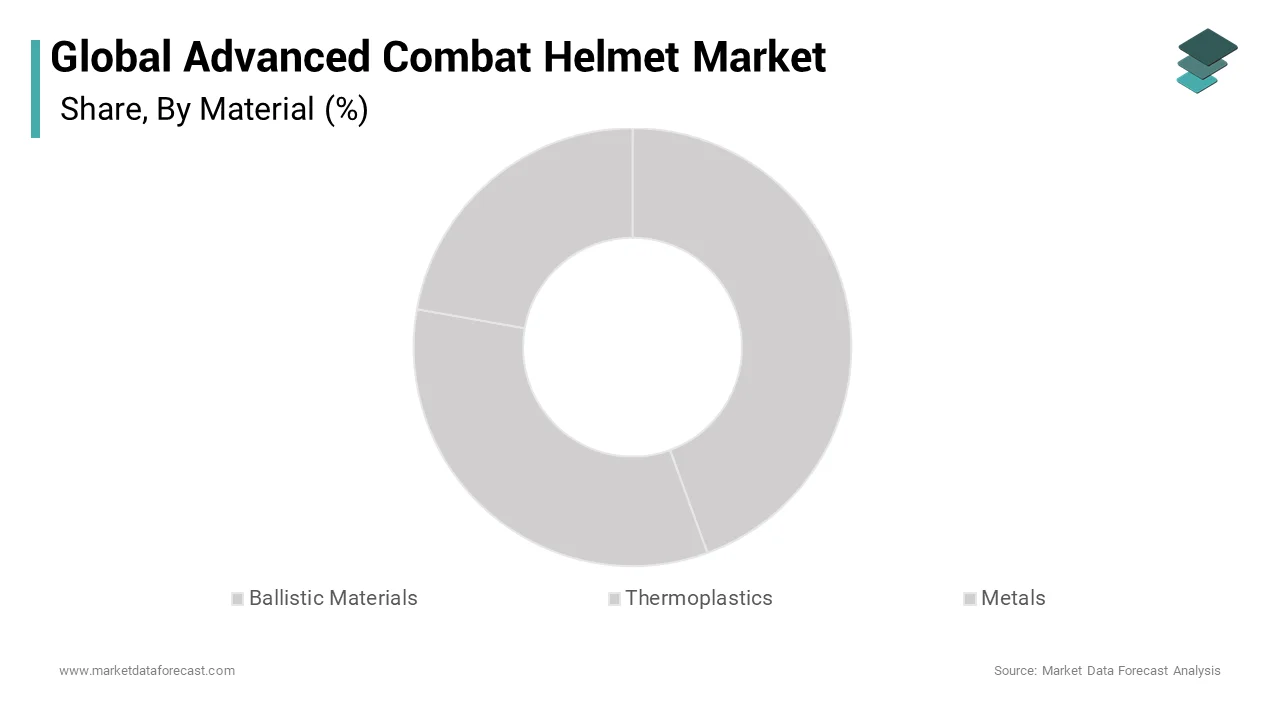
The thermoplastic materials segment is esteemed to witness a fastest CAGR of 6.5% during the forecast period owing to the demand for lighter weight helmets that enhance soldier mobility and reduce fatigue during prolonged operations. Thermoplastics, such as polycarbonate and advanced polymer blends offer excellent impact resistance and can be molded into complex shapes more efficiently than woven ballistic fabrics. The manufacturing process for thermoplastics is also more scalable and cost effective allowing for faster production rates to meet surging global demand. Furthermore, advancements in nanotechnology have improved the thermal stability and scratch resistance of these materials addressing previous limitations. The integration of carbon fiber reinforcements into thermoplastic matrices has significantly enhanced their ballistic performance.
By Application Insights
The protection segment was accounted in holding 32.1% of the advanced combat helmet market share in 2025 due to its fundamental role in ensuring soldier survivability against lethal threats. The primary function of any combat helmet is to shield the head from ballistic impacts shrapnel and blunt force trauma, which remain the leading causes of death and disability in modern warfare. Data from military medical records indicates that the use of advanced helmets has reduced fatal head injuries by over 50% compared to previous generations of gear. The continuous upgrades in ballistic standards requiring helmets to protect against increasingly powerful ammunition types. The standardization agreements member nations are mandated to equip troops with helmets that meet specific protection thresholds. Furthermore, the rising incidence of asymmetric warfare in urban environments exposes soldiers to multidirectional threats necessitating helmets with extended coverage areas.
The visual assistance segment is likely to witness a fastest CAGR of 8.2% during the forecast period owing to the integration of augmented reality and night vision technologies. Modern battlefield scenarios require soldiers to process vast amounts of information rapidly making heads up displays and thermal imaging essential tools for situational awareness. The Integrated Visual Augmentation System is being deployed to provide real time tactical data navigation and targeting information directly in the soldier’s field of view. The ability to see through smoke darkness and obstacles gives troops a significant tactical advantage reducing friendly fire incidents and improving mission success rates. Furthermore, training simulations using visual assistance technologies are becoming standard practice enhancing soldier readiness.
By End User Insights
The military segment was the largest by accounting for 52.1% of the advanced combat helmet market share in 2025. National defense budgets prioritize the protection of frontline troops who face the highest risk of ballistic and blast injuries necessitating the most advanced helmet technologies available. Data from the Department of Defense in the United States indicates that programs such as the Integrated Head Protection System aim to replace millions of legacy helmets with next generation models offering superior protection and modularity. The sheer volume of personnel in standing armies across major powers like China, India, and Russia creates a consistent and substantial demand for replacement and upgrade cycles. Military contracts often span multiple years ensuring steady revenue streams for manufacturers. Furthermore, the rigorous testing and certification requirements for military gear drive innovation and quality standards that subsequently influence other sectors.
The law enforcement segment is likely to witness a fastest CAGR of 7.6% from 2026 to 2034 with the increasing militarization of police tactics and rising threats from organized crime and terrorism. Police tactical units and special response teams increasingly operate in high-risk environments that resemble combat zones requiring protection levels comparable to military standards. The number of specialized tactical teams in the United States has grown significantly over the past decade reflecting the need for advanced protective gear. Unlike standard patrol helmets, advanced combat helmets offer superior ballistic resistance and modularity for communication and vision systems essential for coordinated raids. Several European and Asian police departments have begun adopting military grade helmets for their special response teams. Furthermore, the increasing privatization of security services in high risk regions creates additional demand for premium protective equipment.
REGIONAL ANALYSIS
North America Market Analysis
North America was the largest contributor of the global advanced combat helmet market by holding 35.3% of the share in 2025 due to its substantial defense budget and early adoption of advanced technologies. The extensive modernization programs led by the United States and Canada aimed at enhancing soldier survivability. The Integrated Head Protection System program represents a multi-billion dollar initiative to equip troops with next generation helmets featuring improved ballistic protection and integrated electronics. The presence of major helmet manufacturers and research institutions in the United States fosters innovation and rapid deployment of new materials. As per industry reports the focus on reducing traumatic brain injuries has driven the adoption of helmets with enhanced suspension systems and impact absorption capabilities. Furthermore, strong collaboration between government agencies and private sector companies accelerates the development of smart helmets with augmented reality features.
Europe Market Analysis
Europe advanced combat helmet market held 25.3% of the share in 2025 owing to the heightened geopolitical tensions and increased defense spending among NATO member states. Several member states have launched joint projects to develop lightweight and modular helmet systems that enhance interoperability. Similarly, Germany and France are focusing on indigenous production capabilities to reduce dependency on external suppliers. European military expenditures have risen consistently encouraging the adoption of state of the art protective gear. The emphasis on soldier-centric design and ergonomic comfort is particularly strong in this region driving innovation in helmet fit and ventilation systems. Furthermore, strict regulatory standards ensure high quality and reliability of products supplied to European armed forces.
Asia Pacific Market Analysis
Asia Pacific advanced combat helmet market is estimated to witness a fastest CAGR from 2026 to 2034 with the rapid military modernization and rising regional security concerns. The large standing armies in countries, such as China, India, and South Korea, which are actively upgrading their personal protective equipment. Ongoing procurement programs for thousands of new helmets to replace outdated steel models with lightweight composite alternatives. Similarly, China is investing heavily in indigenous research and development to produce high performance ballistic materials. As per industry analysis the prevalence of border disputes and maritime tensions has accelerated the need for enhanced soldier protection. Furthermore, the growing law enforcement sector in emerging economies is contributing to market expansion as police forces adopt tactical gear for counter terrorism operations. The presence of local manufacturing hubs in countries like Japan and South Korea facilitates cost effective production and export opportunities.
Latin America Market Analysis
Latin America advanced combat helmet market growth is driven by the gradual modernization efforts and increasing focus on internal security. The selective procurement of advanced helmets for elite units involved in high risk operations. Similarly, Colombia and Mexico are investing in protective gear for their military and police forces engaged in counter narcotics missions. The threat level from improvised explosive devices and ambushes has driven demand for helmets with enhanced side and rear protection. While mass replacement of legacy gear is slow due to financial limitations the niche demand for high performance helmets remains strong. International collaborations and aid programs sometimes facilitate access to advanced technologies.
The Middle East And Africa Market Analysis
The Middle East and Africa advanced combat helmet market growth is driven by the ongoing conflicts and the need for robust personal protection in hostile environments. The prevalence of armed conflict in several countries necessitates reliable and durable protective equipment for military and peacekeeping forces. Nations rely more on international aid and donor funded programs to acquire basic protective gear. The harsh climatic conditions in the region drive demand for helmets with superior ventilation and heat resistance properties. Furthermore, the rise of private military contractors operating in the region contributes to market demand for high quality equipment.
COMPETITIVE LANDSCAPE
The competition in the Advanced Combat Helmet Market is characterized by the presence of established defense contractors and specialized material science companies who strive to differentiate themselves through technological innovation and superior performance metrics. Major players leverage their extensive research and development capabilities to introduce lightweight composite materials that offer enhanced ballistic protection without compromising comfort or mobility. Competitive dynamics are driven by long term government contracts and the need for continuous product upgrades to counter emerging threats. Companies compete on the basis of durability weight reduction and integration capabilities with other soldier systems. Strategic alliances with technology providers for augmented reality and communication modules are becoming increasingly common. This intense rivalry fosters rapid advancements in helmet design and functionality benefiting military and law enforcement agencies globally as they seek to maximize soldier survivability and operational effectiveness in complex combat environments.
KEY MARKET PLAYERS
The Advanced Combat Helmet Market is concentrated with well-established players. Key players in the Advanced Combat Helmet Market include
- Survitec Group
- Morgan Advanced Material PLC
- BAE Systems
- Gentex Corporation
- Avon Protection plc
- 3M Company
- Ceradyne Inc.
- DuPont
- Point Blank Enterprises Inc.
- Eagle Industries
- Honeywell International Inc.
- MKU Limited
- ArmorSource LLC.
Top Players In The Global Market
- Gentex Corporation is a leading provider of advanced head protection systems and integrated soldier solutions with a strong focus on innovation in ballistic materials. The company supplies high performance helmets to various military forces globally leveraging its expertise in composite manufacturing and ergonomic design. Recent actions include the development of next generation helmet shells that offer improved weight distribution and enhanced modularity for attaching communication and vision devices. Gentex has also expanded its production capabilities to meet increasing demand from international defense contracts. These initiatives demonstrate a commitment to enhancing soldier survivability and operational efficiency, while strengthening its position as a key supplier of critical protective equipment in the global defense sector through continuous technological advancement and strategic capacity expansion.
- Avon Protection plc contributes significantly to the global advanced combat helmet market by offering a comprehensive range of respiratory and head protection solutions for military and law enforcement applications. The company is renowned for its robust helmet designs that integrate seamlessly with gas masks and other personal protective equipment. Recently, Avon Protection has strengthened its market position by securing major contracts with NATO member states for the supply of upgraded helmet systems featuring improved ballistic resistance and comfort. The company has also invested in research and development to create lighter and more durable materials. These efforts ensure that Avon remains a trusted partner for defense forces worldwide by delivering reliable and innovative protection solutions that meet the evolving demands of modern battlefield environments and operational requirements.
- 3M Company plays a pivotal role in the global advanced combat helmet market through its advanced materials division which produces high performance fibers and composites used in helmet construction. The company’s expertise in ultra high molecular weight polyethylene and aramid technologies enables the creation of lightweight yet highly protective helmet shells. Recent actions include collaborations with helmet manufacturers to integrate 3M materials into next generation designs that offer superior energy absorption and multi threat protection. 3M has also focused on sustainability by developing eco friendly manufacturing processes for its ballistic materials.
Major Strategies Used By Key Players
Key players in the Advanced Combat Helmet Market primarily focus on product innovation and strategic partnerships to maintain their competitive edge. Companies invest heavily in research and development to create lighter and stronger materials such as advanced composites and thermoplastics that enhance soldier mobility and protection. Collaborations with government agencies and military bodies facilitate the adoption of new technologies and ensure compliance with stringent safety standards. Additionally, manufacturers emphasize modular design principles allowing for the integration of communication and visual assistance devices. Expanding production capacities and optimizing supply chains further strengthen market presence. These strategies enable companies to address the evolving needs of modern warfare while ensuring reliability and performance in critical defensive applications.
MARKET SEGMENTATION
This research report on the global advanced combat helmet market has been segmented and sub-segmented based on the application,and region.
By Material Type
- Ballistic Materials
- Thermoplastics
- Metals
By Technology Integration
- Integrated Communication Helmets
- Modular Helmets
- Smart Helmets
By End-User
- Military & Defense
- Law Enforcement Agencies
- Private Security Services
By Application
- Ballistic Protection
- Blunt Force Protection
- Fragmentation Protection
- Communication
- Visual Assistance
By Region
- North America
- Europe
- Asia-Pacific
- Latin America
- The Middle East and Africa