- Product Description Description
- Table of Contents TOC
- List of Table & Figure LOT
- Get Free Sample PDF Sample PDF
Market Size, 2025
$11.23 BnMarket Estimate, 2026
$11.59 BnMarket Forecast, 2034
$14.91 BnCAGR, 2026–2034
3.20%Executive Summary: Global Aerospace Bearings Market
- Market Scope: Overview of the global aerospace bearings market examining bearing types, material classifications, critical aircraft applications, regional dynamics, and competitive industry leadership.
- Market Valuation: Valued at USD 11.23 billion in 2025, reaching USD 11.59 billion in 2026, and projected to scale up to USD 14.91 billion by 2034, registering a steady CAGR of 3.2% (2026–2034).
- Primary Growth Drivers: Expanding commercial air travel demand, advancements in military and space programs, strong emphasis on fuel efficiency, and the adoption of lightweight materials (such as composites) to reduce operating costs.
Key Market Segment Metrics (2026–2034)
| Category | Leading Segment Position | Core Focus / Alternative Segment |
|---|---|---|
| By Bearing Type | Ball Bearings (dominating due to versatility, high-speed performance, compact design, and weight-constraint compliance) | Roller Bearings, Thrust Bearings, Plain Bearings, and Others |
| By Material Type | Metal Bearings (leading due to high durability, strength, established supply chains, and high-load capacity) | Composite Bearings and Ceramic Bearings (e.g., ceramic hybrid solutions) |
| By Application | Engine Bearings (holding major market share by supporting rotating components under extreme conditions) | Landing Gear, Flight Controls, Airframe, and Others |
| By Region | North America (dominant due to a strong aerospace manufacturing base, major OEMs, and large commercial/military fleets) | Europe, Asia-Pacific, Latin America, and Middle East & Africa |
Major Market Players & Market Structure
Market Structure: Highly specialized and competitive global landscape populated by leading precision-engineering firms and bearing manufacturers investing heavily in advanced materials, durability, and lightweight innovations.
Key Companies: SKF Group, Timken Company, NTN Corporation, Schaeffler Group, RBC Bearings Incorporated, JTEKT Corporation, NSK Ltd., Aurora Bearing Company, GGB Bearing Technology, MinebeaMitsumi Inc., AST Bearings LLC, New Hampshire Ball Bearings, Inc., National Precision Bearing Group, and THK Co., Ltd.
 Download Free Sample Report
Global Aerospace Bearings Market Size
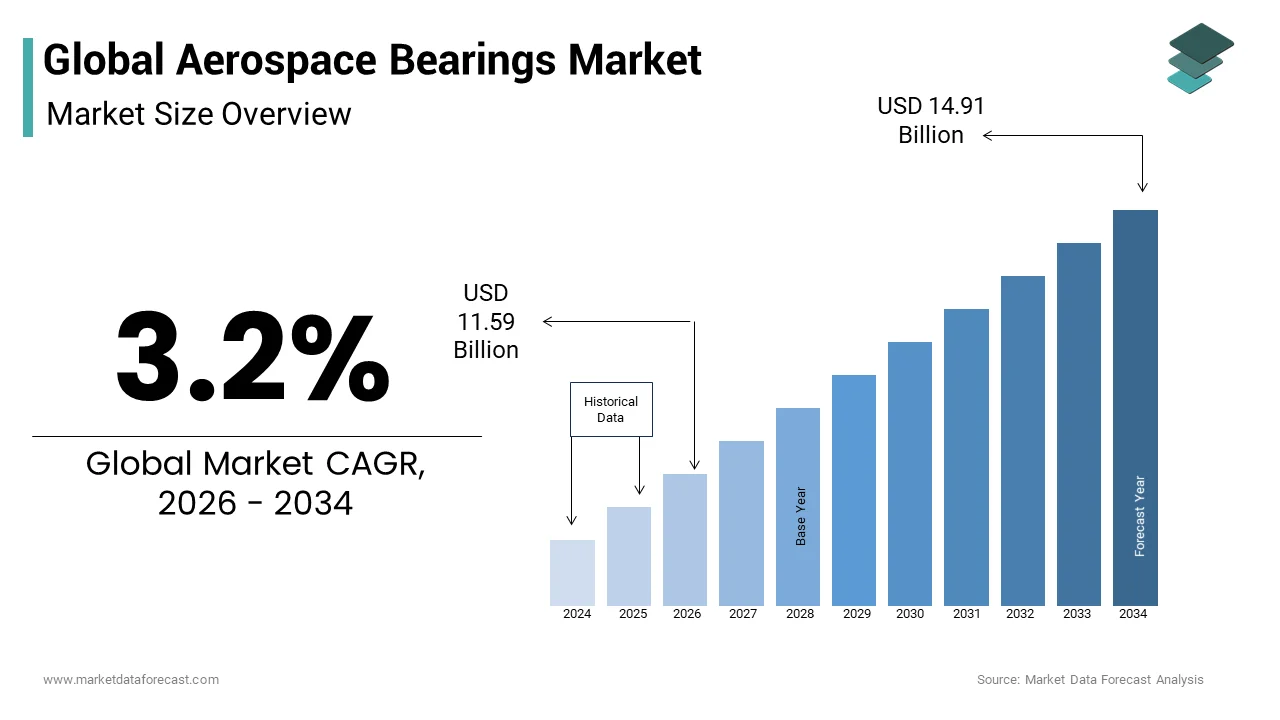
The global aerospace bearings market size was valued at USD 11.23 billion in 2025 and is anticipated to reach a valuation of USD 11.59 billion in 2026 and USD 14.91 billion by 2034, growing at a CAGR of 3.2% from 2026 to 2034.
MARKET OVERVIEW
Aerospace bearings are specialized, high-precision mechanical parts used in aircraft, spacecraft, and defense systems to reduce friction and support rotating or sliding parts. These critical elements facilitate smooth rotational motion while managing substantial loads and high temperatures, ensuring structural integrity and flight safety. As per the International Air Transport Association, scheduled passenger numbers reached 4.287 billion in 2023, reflecting a robust recovery in commercial aviation activities that directly influences component demand. As per the Air Transport Action Group, 1,138 airlines operated a fleet of 29,039 commercial aircraft in service worldwide in 2023, necessitating continuous maintenance and replacement cycles for bearing assemblies. According to studies, modern aerospace applications require bearings capable of operating at rotational speeds exceeding 100000 revolutions per minute while enduring temperature variations from minus 55 degrees Celsius to over 300 degrees Celsius. As per Boeing, the global commercial airplane fleet is projected to grow 3.2% annually through 2043, driving sustained requirement for high performance bearing solutions. The integration of advanced materials such as ceramic hybrids and specialized steel alloys has enhanced durability metrics significantly. According to Eurocontrol, the European aviation network handled 10.2 million flights in 2023, underscoring regional operational intensity. These bearings must meet stringent certification standards set by regulatory bodies, ensuring zero failure tolerance during critical flight phases. The market evolution correlates directly with technological advancements in aircraft design and increasing focus on fuel efficiency through weight reduction initiatives.
MARKET DRIVERS
Rising Global Aircraft Production Volumes Drive Component Demand
The escalation in commercial aircraft manufacturing is a factor driving the Aerospace Bearings Market. This growth is due to the direct correlation between new unit deliveries and component procurement. Airbus delivered 735 commercial aircraft in 2023, according to company financial disclosures, representing a significant increase from previous years and establishing a strong baseline for bearing consumption. Each modern narrow body aircraft requires approximately 1500 to 2000 precision bearings across various subsystems, including turbine engines, auxiliary power units, and actuation mechanisms. According to sources, Boeing reported an order backlog of over 5600 aircraft as of early 2024, indicating sustained production momentum for the next decade. This production surge necessitates a proportional rise in bearing supply chains to support assembly lines globally. As per Embraer, India will require at least 500 regional jets over the next 20 years, further amplifying regional demand dynamics. Manufacturing expansions in Asia Pacific regions contribute substantially to this growth trajectory, with new facilities coming online in China and Japan. According to the Aerospace Industries Association, US aerospace and defense exports reached 135.9 billion dollars in 2023, demonstrating robust international trade flows that sustain component markets. The trend toward single aisle aircraft, which constitute nearly 70 per cent of global deliveries, intensifies the need for standardized high volume bearing solutions. These production metrics directly translate into procurement contracts for bearing manufacturers who must scale operations to meet just in time delivery requirements imposed by original equipment manufacturers.
Increasing Focus on Fuel Efficiency and Weight Reduction Initiatives
The imperative for enhanced fuel efficiency propels innovation in bearing technology, which in turn boosts the expansion of the aerospace bearing market. This evolution helps airlines minimise operational costs and comply with environmental regulations. As per the International Civil Aviation Organization, member states adopted a global aspirational goal of a 2% annual average improvement in fuel efficiency for global aviation, forcing manufacturers to adopt lighter and more efficient components. Advanced ceramic bearings offer weight reductions of up to 40 per cent compared to traditional steel variants, according to material science studies published by the American Society for Metals. This weight saving translates directly into fuel savings estimated at 0.5 per cent per aircraft annually, which accumulates to substantial cost reductions over fleet lifetimes. According to market industry outlooks, future programs including the Boeing 777X are expected to feature 30% more composite content than their predecessors, requiring compatible bearing solutions that can handle different thermal expansion rates. The adoption of hybrid bearings combining ceramic balls with steel races reduces friction coefficients by 20 percent enhancing overall mechanical efficiency. As per the European Environment Agency, aviation accounts for 3.8 per cent of total EU greenhouse gas emissions, prompting aggressive decarbonization strategies. According to sources, Air France is targeting new-generation, more fuel-efficient aircraft to account for 70% of its fleet by 2030, creating immediate demand for upgraded bearing technologies. These regulatory and economic pressures drive continuous research into nanocoatings and surface treatments that extend bearing life while reducing mass. The relationship between weight reduction and bearing design is critical, as every kilogram saved in rotating components contributes to lower thrust requirements and reduced carbon footprints.
MARKET RESTRAINTS
Stringent Certification and Regulatory Compliance Requirements
Rigorous certification protocols imposed by aviation authorities hinder the growth of the aerospace bearing market. This extends development timelines and increases entry barriers for new market participants. The Federal Aviation Administration requires an average of 5 to 7 years for full certification of new bearing designs intended for critical flight applications, according to industry compliance audits. This prolonged validation process involves thousands of hours of testing under simulated extreme conditions, including vibration fatigue and thermal cycling. As per sources, the European Union Aviation Safety Agency mandates that each bearing batch undergoes 100% inspection using non-destructive testing methods, which increases production costs by approximately 25%. Small and medium-sized enterprises often struggle to meet these financial burdens, as initial certification expenses can exceed 2 million dollars per product line. According to the National Transportation Safety Board, investigation reports indicate that 15% of mechanical failures in general aviation are linked to component defects, highlighting the zero-tolerance policy for quality lapses. The complexity of maintaining traceability for raw materials sourced from multiple global suppliers adds another layer of administrative burden. Manufacturers must document every processing step from melting to final grinding to satisfy audit requirements. These regulatory hurdles limit the number of qualified suppliers globally, with only 12 companies holding full certification for main engine bearings. The constant evolution of safety standards means that previously approved designs may require revalidation, adding recurring costs to operational budgets.
High Raw Material Volatility and Supply Chain Disruptions
Fluctuations in the prices of speciality steels and rare earth elements create substantial cost unpredictability for manufacturers in the aerospace bearings market. This affects profit margins and pricing stability. According to research, the price of vacuum melted bearing steel increased by 35% between 2020 and 2023, driven by global raw material and processing cost spikes. This volatility stems from geopolitical tensions and export restrictions on key materials such as molybdenum and chromium, which are essential for high-temperature resistance. As per the United States Geological Survey, China has the world's largest reserves of rare earths with nearly 44 million metric tons, while its separation and processing capacity is estimated by alternative authorities to exceed 80%. The semiconductor shortage demonstrated how interconnected supply networks are when logistics bottlenecks delayed bearing deliveries by an average of 12 weeks in 2022. According to surveys, aerospace manufacturers operate on thin margins, with typical net profits ranging from 8 to 12%, meaning that raw material spikes cannot always be passed to customers due to long-term fixed-price contracts. As per the International Air Transport Association, fuel is forecast to account for 31.4% of global airline operating expenses in 2026, creating pressure to keep component prices stable. Disruptions in mining operations due to environmental regulations in Australia and Canada further constrain supply availability. Manufacturers must maintain larger inventory buffers, which ties up capital and increases storage costs. The reliance on single-source suppliers for certain superalloys exacerbates risk exposure during global crises.
MARKET OPPORTUNITIES
Expansion of Urban Air Mobility and Electric Vertical Takeoff Platforms
The emergence of urban air mobility unlocks new potential for the Aerospace Bearings Market. This is because new aircraft categories require specialised, lightweight, and low-noise components. According to research, the global urban air mobility landscape is projected to grow to a substantial level by 2040, driven by demand for air taxis and cargo drones in congested metropolitan areas. These electric vertical takeoff and landing vehicles operate at higher rotational speeds than conventional helicopters, necessitating bearings with superior dynamic load ratings. As per studies, eVTOL manufacturer Vertical Aerospace has secured about 1,500 pre-orders for its aircraft, while Joby Aviation and Archer Aviation lead with distinct high-volume fleet options. Each eVTOL prototype utilizes approximately 800 precision bearings optimized for electric motor applications where electromagnetic interference must be minimized. The Federal Aviation Administration has established a new certification framework for powered lift aircraft, accelerating the regulatory pathway for these innovators. As per the Vertical Flight Society, the organization tracks over 1,100 electric vertical takeoff and landing aircraft concepts from more than 450 designers in its World eVTOL Aircraft Directory. These aircraft require bearings that operate silently to meet urban noise ordinances, which drives innovation in polymer-coated and magnetic levitation technologies. The shift toward distributed electric propulsion means that each aircraft may have 6 to 12 independent rotors, multiplying the bearing count per unit. Early partnerships between bearing manufacturers and eVTOL startups are securing exclusive supply agreements that guarantee long-term revenue streams. This nascent segment offers higher growth potential than mature commercial aviation markets due to its greenfield status.
Integration of Smart Sensors and Predictive Maintenance Technologies
The incorporation of Internet of Things sensors into bearing assemblies creates new value propositions for the aerospace bearings market. This integration drives value by enabling real-time health monitoring and predictive maintenance capabilities. According to studies, Deloitte reports that predictive maintenance can reduce equipment downtime by up to 50% and lower maintenance costs by 25% to 30%. Smart bearings equipped with vibration, temperature, and acoustic sensors generate continuous data streams that allow operators to anticipate failures before they occur. As per research, the global market for industrial IoT sensors provides a robust ecosystem for aerospace integration across connected networks. Airlines lose an average of 150 minutes per aircraft annually due to unexpected mechanical issues, as per IATA operational benchmarks, making predictive insights highly valuable. These intelligent components facilitate condition-based maintenance rather than fixed-interval replacements, optimising spare parts inventory and labour allocation. According to sources, an evaluation by Honeywell Aerospace notes that a narrow-body aircraft can generate as much as 844 terabytes of data during 12 hours of flight operation. The ability to transmit bearing health data to ground stations enables mechanics to prepare replacement parts before the aircraft lands. This technology aligns with the Industry 4.0 paradigm where digital twins simulate bearing wear patterns under various flight profiles. Manufacturers offering smart bearing solutions can command premium pricing due to the added software and analytics services. The transition from passive components to active data generators transforms the business model from transactional sales to service-based subscriptions.
MARKET CHALLENGES
Complexity of Manufacturing High Precision Tolerances
Achieving the micron-level tolerances required for aerospace bearings is a formidable technical challenge for the global market. This demanding precision directly limits production scalability and increases defect rates. According to engineering guidelines, standard aerospace bearings must maintain extreme dimensional stability and sub-micron form tolerances, demanding ultra-precise grinding machines that cost upwards of 1 million dollars each and require specialised operator training. The rejection rate for first-pass production can reach 15 per cent due to microscopic imperfections that are invisible to the naked eye but catastrophic under load. As per sources, thermal distortion during heat treatment processes accounts for 40% of dimensional deviations in large diameter bearings. Maintaining consistent quality across batches becomes increasingly difficult as order volumes rise, leading to potential supply bottlenecks. The shortage of skilled machinists capable of operating computer numerical control grinding equipment exacerbates this issue. According to research, the overall US manufacturing sector could face a deficit of 2.1 million unfilled jobs by 2030 due to a widening skills gap. Environmental controls in manufacturing facilities must remain stable within 1 degree Celsius to prevent thermal expansion errors during measurement. The investment required for clean room environments and vibration isolated foundations adds substantial capital expenditure requirements. Any deviation in raw material grain structure can lead to premature fatigue failure, necessitating rigorous incoming quality control. These manufacturing complexities create high barriers to entry and limit the pool of qualified suppliers globally.
Intense Competition from Established Global Players
A few major players dominate the highly consolidated aerospace bearings market. As a result, smaller suppliers face a challenging and fiercely competitive operating environment. According to studies, a nucleus of vertically integrated global suppliers, including SKF, Schaeffler, NSK, Timken, NTN, and JTEKT, collectively command an estimated 55% to 60% of global bearing revenues. These incumbents benefit from economies of scale, long-standing relationships with original equipment manufacturers, and extensive patent portfolios that protect proprietary designs. New entrants face significant difficulties in breaking into supply chains, as aerospace contracts typically span 10 to 15 years with high switching costs. Boeing and Airbus prefer to qualify fewer suppliers to simplify logistics and quality assurance processes, limiting opportunities for niche players. As per sources, leading firms invest heavily in R&D to drive material science innovations. According to research, major bearing corporations file thousands of technology patents internationally. Price competition remains fierce in the aftermarket segment where independent repair shops seek lower cost alternatives. However, original equipment segments remain insulated due to strict qualification requirements. The dominance of European and Japanese firms in high end ceramic bearings creates regional imbalances in technology access. Smaller manufacturers often resort to competing in lower tier general aviation markets where margins are thinner. This consolidated landscape discourages innovation from startups who lack the financial resources to compete in prolonged certification battles.
REPORT COVERAGE
| REPORT METRIC | DETAILS |
| Market Size Available | 2025 to 2034 |
| Base Year | 2025 |
| Forecast Period | 2026 to 2034 |
| CAGR | 3.2% |
| Segments Covered | By Bearing, Material Type, Application, and Region. |
| Various Analyses Covered | Global, Regional & Country Level Analysis, Segment-Level Analysis, DROC, PESTLE Analysis, Porter’s Five Forces Analysis, Competitive Landscape, Analyst Overview of Investment Opportunities |
| Regions Covered | North America, Europe, APAC, Latin America, Middle East & Africa |
| Market Leaders Profiled | SKF Group, Timken Company, NTN Corporation, Schaeffler Group, RBC Bearings Incorporated, JTEKT Corporation, NSK Ltd., Aurora Bearing Company, GGB Bearing Technology, MinebeaMitsumi Inc., AST Bearings LLC, New Hampshire Ball Bearings, Inc., National Precision Bearing Group, THK Co., Ltd., and Others. |
SEGMENTAL ANALYSIS
By Bearing Insights
Ball Bearings
The ball bearings segment remained the largest in 2025 and occupied a commanding share of the Aerospace Bearings Market. Its versatility and ability to handle both radial and axial loads efficiently in compact designs contributed to the prominence of this segment. Its dominance is driven by widespread adoption across non-critical aircraft systems where high speed and low friction are paramount.
The extensive application of ball bearings in auxiliary power units, cabin fans, and actuation systems strengthens their market leadership through volume-driven demand. According to sources, rotating components in commercial airframes rely extensively on precision rolling element technologies to manage axial and radial load distributions across standard flight environments. This ubiquity ensures a steady aftermarket revenue stream as these components require regular maintenance every 5000 flight hours. As per studies, thousands of precision rotative parts are routinely replaced during scheduled commercial aircraft maintenance checks to secure structural airframe integrity. Their ability to operate effectively at speeds up to 50000 revolutions per minute makes them indispensable for high frequency applications such as environmental control systems. The modular nature of these bearings allows for quick swaps during line maintenance, reducing aircraft ground time by an average of 45 minutes per incident. This operational efficiency drives airlines to prefer designs that maximize ball bearing usage. The standardisation of sizes across different aircraft models further simplifies inventory management for maintenance providers. Consequently, the sheer volume of installations required for each new aircraft delivery sustains the segment's dominant position despite the emergence of specialised alternatives for extreme conditions.
The economic advantage of producing ball bearings at scale provides a significant competitive edge that reinforces their market dominance through lower unit costs. According to research, mass production scalability and optimized raw material sourcing help lower the unit production costs of specialized industrial elements for high-volume OEMs. This cost efficiency is crucial for manufacturers operating on tight margins where component pricing directly impacts final aircraft valuation. According to surveys, worldwide production capacity for high-grade rolling element components yields billions of units annually to support diversified industrial, automotive, and logistics networks. Large scale automation in grinding and assembly processes allows for consistent quality control with defect rates below 0.1 percent. The availability of multiple qualified suppliers prevents monopoly pricing and keeps procurement costs stable for airlines. Maintenance, repair, and overhaul facilities prefer ball bearings due to their predictable wear patterns and established refurbishment protocols. The ability to source these components from diverse geographic regions mitigates supply chain risks associated with geopolitical tensions. These economic factors collectively sustain the segment's leadership by aligning with the industry's continuous pressure to reduce operational expenditures.
Ceramic Bearings
The ceramic bearings segment is expected to exhibit a noteworthy CAGR of 9.8% between 2026 and 2034, owing to the urgent need for weight reduction and high-temperature performance in next-generation aircraft.
The exceptional ability of ceramic materials to withstand extreme temperatures without deformation drives their rapid adoption in turbine engines and exhaust systems. According to sources, silicon nitride components preserve their structural integrity at temperatures up to 1,000 degrees Celsius, outperforming standard steel alloys under high thermal fatigue. This thermal resilience allows engineers to design engines with higher compression ratios and improved fuel efficiency by reducing the need for heavy cooling systems. As per research, integrating advanced hybrid ceramic components into high-pressure compressional subsystems yields substantial weight reduction advantages relative to traditional steel configurations. This stability prevents seizure and extends service intervals significantly. The integration of these materials enables engines to run hotter and more efficiently, meeting stringent emissions standards set by the International Civil Aviation Organisation. Airlines are increasingly specifying ceramic components in new orders to achieve fuel savings per flight hour. The growing prevalence of geared turbofan architectures, which operate at higher internal temperatures, further accelerates the demand for thermally stable ceramic solutions.
The inherent chemical inertness and hardness of ceramic materials provide unparalleled durability that reduces maintenance frequency and extends component lifespan in harsh operational environments. Timken Company studies demonstrate that hybrid ceramic bearings offer a service life that is 3 to 5 times longer than conventional steel bearings in corrosive atmospheric conditions. This extended longevity is particularly valuable for maritime based aircraft and those operating in tropical climates where salt and humidity accelerate metal degradation. According to studies, introducing corrosion-resistant materials into marine aviation assets mitigates component degradation and reduces long-term structural maintenance interventions. Silicon carbide ceramics possess a hardness rating of 9 on the Mohs scale, making them highly resistant to abrasive wear from dust and debris ingestion. The reduction in lubricant dependency also contributes to weight savings and simplified maintenance procedures. Also, the ability of ceramics to maintain structural integrity under high vibrational loads makes them ideal for helicopter rotor systems and unmanned aerial vehicles. Manufacturers are investing heavily in hot isostatic pressing technologies to eliminate microscopic pores in ceramic structures, further enhancing their reliability. These performance advantages drive rapid specification changes in new aircraft programs prioritizing long term operational efficiency over initial acquisition costs.
By Application Insights
Engines
In 2025, the engine segment held the majority share in the Aerospace Bearings Market because of the critical nature of propulsion systems and the high density of precision bearings required for turbine and compressor assemblies.
The central function of bearings in maintaining rotor alignment and minimizing friction within jet engines propels their substantial market share through high value procurement contracts. According to sources, each modern high-bypass turbofan engine utilizes a core set of specialized main shaft bearings to withstand intensive operational forces at extreme rotational speeds. These components must endure extreme centrifugal forces and thermal gradients, making them some of the most expensive and technically demanding parts in the aircraft. As per studies, overall aircraft maintenance represents 10 to 15 percent of total airline operating costs, with engine overhauls claiming the single largest portion of that maintenance budget. Failure of a single main shaft bearing can result in catastrophic engine shutdown, necessitating rigorous quality standards and premium pricing. The trend toward larger diameter fans in ultra high bypass engines increases the load bearing requirements, driving demand for larger and more robust bearing assemblies. Engine manufacturers often engage in long-term exclusive partnerships with bearing suppliers to ensure consistent quality and supply security. The aftermarket for engine bearings is particularly lucrative as these components have defined replacement intervals based on flight cycles. The continuous development of more powerful and efficient engines directly translates into increased complexity and value for the bearing systems they employ.
The rigorous maintenance schedules imposed on aircraft engines create a consistent and high volume aftermarket demand for replacement bearings that sustains market leadership. According to research, regular intervals for inside engine diagnostic overviews utilize advanced borescope gear to systematically detect microscopic mechanical alterations. As per studies, a notable percentage of total workshop overhauls necessitate full teardowns and reconstruction of internal rotational parts due to heavy cyclic operational fatigue. The regular turnover ensures a steady revenue stream independent of new aircraft production cycles. Older aircraft models require more frequent bearing replacements as their components reach the end of their designed service life. The increasing age of the global fleet, with many aircraft exceeding 15 years of operation, amplifies the need for refurbished and new replacement bearings. Original equipment manufacturers are expanding their service networks to capture this lucrative aftermarket opportunity by offering certified replacement parts. The inability to substitute engine bearings with lower quality alternatives due to safety regulations protects profit margins for established suppliers. This combination of mandatory maintenance and high-value transactions cements the engine segment's dominant position.
Flight Controls
The flight control segment is predicted to witness the highest CAGR of 8.5% over the forecast period due to the increasing electrification of actuation systems and the rise of fly-by-wire technologies.
The shift from hydraulic to electric actuation in flight control surfaces drives rapid demand for specialized compact and high precision bearings. According to sources, the Airbus A350 XWB incorporates a sophisticated combination of electro-hydraulic and electro-hydrostatic systems alongside localized electrical actuators to manage key airframe surfaces. Each electromechanical actuator requires multiple miniature bearings capable of handling high dynamic loads in confined spaces. As per studies, replacing central power-by-pipe setups with distributed power-by-wire flight control architectures significantly trims the deadweight of internal airframe routing systems. The weight-saving incentive prompts manufacturers to redesign control surfaces with integrated electric motors that rely heavily on advanced bearing technologies. The precision required for these bearings is extremely high, as they must ensure smooth and jitter-free movement of control surfaces to maintain flight stability. The elimination of hydraulic fluid also reduces maintenance complexity and environmental hazards, making electric systems increasingly attractive to airlines. Newer aircraft designs incorporate more independent control surfaces such as active winglets and morphing tails, which further increase the number of actuators and bearings per aircraft. The reliability of these bearings is critical, as failure could lead to loss of control, necessitating redundant designs that double the component count. This technological transition represents a fundamental shift in aircraft architecture that favours bearing suppliers with expertise in miniaturisation and electric motor integration.
The widespread adoption of fly-by-wire systems, which replace mechanical linkages with electronic signals, necessitates precise and responsive bearing solutions for control surface actuators. According to research, the majority of advanced mainline passenger jets utilize sophisticated digital fly-by-wire architectures to govern primary and secondary movable airframe structures. These systems rely on actuators that must respond within milliseconds to pilot inputs, demanding bearings with minimal backlash and high stiffness. As per studies, the density and line count of flight control automation software continue to multiply, requiring highly responsive mechanical endpoints to convert electronic commands safely. Bearings used in these applications must maintain consistent performance across a wide range of temperatures and vibrations to ensure signal accuracy. The trend toward more autonomous flight features such as auto land and envelope protection increases the reliance on precise mechanical actuation. Manufacturers are developing specialised bearings with integrated sensors to provide feedback on position and load to the flight control computer. This integration of mechanical and digital systems creates a new class of smart components that command higher prices. The growing sophistication of flight control laws drives continuous innovation in bearing design to meet evolving performance thresholds. This synergy between software advancement and mechanical precision fuels the rapid expansion of the flight control bearing segment.
By Material Insights
Metal Bearings
The metal bearings segment retained the lead in the aerospace bearings market and captured a significant share in 2025. This leading position of the segment was attributed to its proven reliability, high load-carrying capacity, and established manufacturing infrastructure that supports mass production for commercial aviation.
The unparalleled ability of speciality steel alloys to withstand extreme static and dynamic loads ensures their continued dominance in critical structural applications. According to metallurgy and materials science standards, vacuum melted and degassed bearing steels are engineered to withstand extreme rolling contact fatigue and heavy dynamic stresses inside structural airframe components. The structural configuration of principal undercarriage elements must absorb severe impact energy levels that multiply static load equivalents upon touchdown. The metallurgical consistency of these alloys allows for predictable performance under varying operational conditions, reducing the risk of unexpected failures. Manufacturers have decades of empirical data on metal bearing behavior enabling accurate life prediction models that satisfy regulatory requirements. The ability to heat treat steel to specific hardness levels allows engineers to tailor bearing properties for specific applications such as soft races for shock absorption. The widespread availability of raw materials and established recycling processes further support the economic viability of metal bearings. Airlines and lessors prefer metal components due to their well-understood failure modes and established refurbishment pathways. This track record of safety and performance makes metal bearings the default choice for high-risk applications where failure is not an option.
The mature global supply chain for metal bearing production provides cost advantages and supply security that reinforce their market leadership through economies of scale. According to sources, specialized steel factories generate millions of metric tons of high-grade carbon and alloy structural products to supply general machinery networks. This vast production base allows for competitive pricing and short lead times compared to emerging materials like ceramics or composites. Major bearing manufacturers have invested billions in dedicated forging and grinding facilities optimised for steel processing, creating high barriers to entry for alternative materials. As per studies, standard steel bearing manufacturing costs scale highly efficiently compared to lower-volume alternative ceramic or advanced composite variants. The existing qualification frameworks for metal bearings are well defined, reducing the time and cost required for new product approvals. Suppliers have long-standing relationships with raw material producers, ensuring consistent quality and traceability from mine to finished component. The ability to source steel from multiple geographic regions mitigates supply chain risks and prevents bottlenecks. Maintenance, repair, and overhaul facilities are equipped with tools and expertise specifically for metal bearing inspection and repair. The familiarity of engineers and technicians with metal properties simplifies design and maintenance procedures. This entrenched infrastructure creates a self reinforcing cycle where the ease of sourcing and processing metal sustains its dominant market position despite the emergence of advanced alternatives.
Ceramic Bearings
The ceramic bearings segment is estimated to register the fastest CAGR of 10.2% from 2026 to 2034. This quick surge is propelled by their unique properties that enable significant weight savings and performance enhancements in next generation aircraft.
The significantly lower density of ceramic materials compared to steel drives their rapid adoption as airlines prioritise weight reduction to improve fuel economy. According to research, minimizing deadweight on a commercial jet linearly dampens operational fuel burn rates and slashes ongoing carbon outputs over full fleet service periods. Silicon nitride ceramics have a density of 3.2 grams per cubic centimeter which is 60 per cent lower than typical bearing steel, allowing for substantial mass reduction in rotating assemblies. As per sources, substituting rolling elements with hybrid ceramic configurations effectively drops total rotative mass within auxiliary transmission and gearbox networks. This weight saving contributes directly to meeting the stringent fuel efficiency targets set by the International Civil Aviation Organization. Ceramic bearings enable this goal by allowing designers to use smaller and lighter housing structures due to the reduced centrifugal forces. The cumulative effect of using ceramic bearings across multiple systems can save hundreds of kilograms per aircraft. Airlines are increasingly willing to pay a premium for these components due to the long-term operational cost benefits. The regulatory pressure to reduce carbon emissions further accelerates the shift toward lightweight materials. This economic and environmental imperative makes ceramic bearings a strategic priority for aircraft manufacturers seeking to enhance the competitiveness of their products.
The exceptional hardness and chemical inertness of ceramic materials provide superior resistance to wear and corrosion that extends service life and reduces maintenance costs. According to research, advanced silicon-based ceramics provide exceptional wear and friction reductions under heavily contaminated or boundary-lubricated working environments. This durability is particularly beneficial in applications where exposure to moisture, salt, or chemical agents is common, such as in naval aviation or cargo operations. The resistance allows for longer intervals between inspections and replacements, lowering the total cost of ownership for operators. The smooth surface finish of ceramic balls also reduces friction and heat generation, leading to lower lubrication requirements. This reduction in lubricant usage minimises the risk of oil leaks and contamination in sensitive areas. Manufacturers are developing hybrid designs that combine ceramic balls with steel races to optimise cost and performance. The growing awareness of these benefits among maintenance providers is driving specification changes in new aircraft programs. The ability of ceramics to maintain performance in harsh conditions makes them ideal for expanding into new operational environments. This combination of durability and low maintenance fuels the rapid growth of the ceramic bearing segment.
REGIONAL ANALYSIS
North America Market Analysis
North America maintained dominance in the global aerospace bearings market and accounted for a substantial share in 2025. This region dominated the global landscape because of robust domestic manufacturing capabilities and a dense concentration of original equipment manufacturers. The region benefits from the presence of industry giants such as Boeing and Lockheed Martin, which drive consistent demand for high-precision components. According to the Aerospace Industries Association, the United States aerospace and defense industry generated over 955 billion dollars in sales in 2023, underscoring the massive scale of industrial activity that supports bearing consumption. This economic magnitude ensures steady procurement cycles for both new production and aftermarket services. As per the Federal Aviation Administration, the agency manages an average of 44,360 daily flights, creating substantial wear and tear on existing fleets that necessitates regular bearing replacements. The strong emphasis on defense spending further bolsters the market as military aircraft require specialized bearings capable of withstanding extreme operational stresses. The Department of Defence allocated 842 billion dollars for national security in 2024, with a significant portion directed toward aviation modernisation programs. These investments stimulate innovation in bearing technologies, particularly for stealth and supersonic applications. The region also leads in research and development initiatives, with universities and private firms collaborating on advanced material solutions. The established supply chain infrastructure allows for rapid prototyping and certification of new bearing designs. This combination of commercial vitality and defense prowess solidifies North America as the primary hub for aerospace bearing technology and consumption.
Europe Market Analysis
Europe was the next prominent region in the aerospace bearings market and captured a significant share in 2025. The European market revealed advanced engineering prowess and a strong focus on sustainable aviation technologies. Moreover, the region is home to Airbus which serves as a major anchor for bearing demand across its extensive production network in France Germany and Spain. According to Eurocontrol, European airspace recorded 10.2 million flights in 2023, reflecting high operational intensity that drives maintenance and replacement activities for bearing assemblies. This traffic volume ensures a vibrant aftermarket sector where precision and reliability are paramount. The European Union Aviation Safety Agency enforces stringent quality standards that push manufacturers toward innovative materials such as ceramics and composites to meet environmental goals. As per the European Green Deal, aviation emissions must be reduced by 55 per cent by 2030 compared to 1990 levels, prompting airlines to adopt lighter and more efficient bearing solutions. Companies like SKF and Schaeffler lead global innovation in this space, leveraging their deep technical expertise to develop next-generation products. The region also benefits from strong government support for aerospace research through programs like Clean Sky, which fund projects aimed at reducing noise and fuel consumption. The presence of numerous small and medium sized enterprises specializing in niche bearing applications adds depth to the supply chain. This ecosystem of regulatory pressure, technological leadership, and operational density sustains Europe's prominent market position.
Asia Pacific Market Analysis
Asia Pacific is emerging as the fastest growing region in the aerospace bearings market due to rapid expansion in commercial aviation and increasing defense budgets across key nations. China and India are leading this growth trajectory with ambitious plans to expand their domestic aircraft manufacturing capabilities. According to regional transport authority reviews, China's civil aviation network added hundreds of advanced commercial aircraft to its domestic fleet during its rapid post-pandemic capacity recovery phase. This aggressive fleet expansion creates a lucrative opportunity for bearing suppliers to establish long-term partnerships with local original equipment manufacturers. The Indian Ministry of Civil Aviation projects that passenger traffic will reach 300 million annually by 2030, necessitating substantial infrastructure and fleet upgrades. As per studies, long-term commercial aerospace forecasts project that the Asia-Pacific territory will absorb a dominant share of worldwide aircraft deliveries over the next two decades. Governments in the region are investing heavily in indigenous defence programs such as the Tejas fighter jet in India and the C919 airliner in China, which require localised supply chains for critical components. The rising middle class and increasing disposable income are driving leisure travel, further stimulating airline growth. Manufacturers are setting up production facilities in the region to reduce logistics costs and cater to local content requirements. This dynamic environment positions Asia Pacific as a critical growth engine for the global aerospace bearings industry.
Latin America Market Analysis
The Latin American aerospace bearings market is a developing sector with significant expansion potential. It is known for gradual recovery in commercial aviation and an increasing focus on regional connectivity. Brazil stands out as the primary hub due to the presence of Embraer, a leading manufacturer of regional jets and executive aircraft. According to the International Air Transport Association, air passenger traffic in Latin America grew by 17 percent in 2023, signaling a strong post-pandemic rebound that stimulates maintenance and overhaul activities. This recovery drives demand for replacement bearings as airlines return older aircraft to service to meet surging travel needs. As per studies, Brazilian planemaker Embraer delivered 181 aircraft in 2023, contributing directly to the consumption of precision bearings in new units. The region faces challenges related to economic volatility and currency fluctuations, which can impact procurement budgets for airlines and maintenance providers. However, the strategic importance of air transport in connecting remote areas ensures sustained government support for aviation infrastructure. Countries like Mexico and Colombia are expanding their airport capacities to handle increased cargo and passenger volumes. The growing interest in sustainable aviation fuels and efficient aircraft models is prompting airlines to upgrade their fleets with newer technologies that incorporate advanced bearing systems. This gradual modernisation process offers steady opportunities for bearing suppliers willing to navigate the region's unique economic dynamics.
Middle East & Africa Market Analysis
The Middle East and Africa region is anticipated to expand in the aerospace bearings market from 2026 to 2034 owing to the strategic hub status of Gulf carriers and gradual infrastructure development in African nations. In addition, the Middle East is home to some of the world's largest airlines, including Emirates, Qatar Airways and Etihad, which operate extensive wide-body fleets requiring high-performance bearings. According to the General Civil Aviation Authority of the United Arab Emirates, Dubai International Airport handled 87 million passengers in 2023, reinforcing its role as a global transit hub that demands rigorous maintenance standards. This high utilisation rate accelerates wear on critical components such as engine and landing gear bearings, necessitating frequent replacements. The African aviation sector is experiencing steady growth, with initiatives like the Single African Air Transport Market aiming to liberalise air travel across the continent. Saudi Arabia is investing heavily in its aviation sector through projects like NEOM and the expansion of Riyadh Airport, which will create significant demand for aerospace parts. The harsh climatic conditions in the region, including high temperatures and sand exposure, require bearings with superior corrosion and abrasion resistance. This environmental factor drives preference for specialised materials such as ceramics and coated metals. The region's focus on becoming a global logistics hub further stimulates cargo aviation growth, which relies on durable and reliable bearing solutions for heavy lift operations.
COMPETITIVE LANDSCAPE
The competition in the Aerospace Bearings Market is characterized by high barriers to entry and a consolidated landscape dominated by a few multinational corporations with deep technical expertise. These incumbent players benefit from long standing relationships with original equipment manufacturers and stringent certification requirements that protect their market positions. The industry sees intense rivalry in terms of technological innovation as companies strive to develop lighter stronger and more durable bearing solutions. Price competition is moderate in the original equipment segment due to the critical nature of the components but more pronounced in the aftermarket where multiple suppliers compete for maintenance contracts. New entrants face significant challenges due to the high capital investment required for precision manufacturing equipment and the lengthy certification processes imposed by regulatory bodies. However the emergence of urban air mobility and electric aviation presents opportunities for agile startups to introduce novel bearing designs tailored to these new platforms. Established firms are responding by acquiring innovative startups or launching internal incubators to stay ahead of technological curves. The competitive dynamics are further influenced by geopolitical factors as countries seek to localize supply chains for national security reasons. This environment fosters a culture of continuous improvement and strategic partnership among key participants.
KEY MARKET PLAYERS
These are the market players that are dominating the global aerospace bearing market.
- SKF Group
- Timken Company
- NTN Corporation
- Schaeffler Group
- RBC Bearings Incorporated
- JTEKT Corporation
- NSK Ltd.
- Aurora Bearing Company
- GGB Bearing Technology
- MinebeaMitsumi Inc
- AST Bearings LLC
- New Hampshire Ball Bearings, Inc.
- National Precision Bearing Group
- THK Co., Ltd
Top Players In The Market
- SKF Group stands as a premier innovator in the aerospace bearings sector leveraging its extensive research and development capabilities to deliver high performance solutions. The company focuses heavily on hybrid ceramic bearings and smart sensor integrated products that enhance operational efficiency and predictive maintenance capabilities. SKF recently expanded its production facility to increase capacity for aerospace grade bearings ensuring it can meet rising global demand. The company collaborates closely with major engine manufacturers to co develop customized bearing solutions that optimize fuel efficiency and reduce weight. Its commitment to sustainability is evident in its initiatives to produce carbon neutral bearings by 2030 aligning with industry decarbonization goals. SKF also provides comprehensive lifecycle services including condition monitoring and refurbishment which strengthen customer loyalty and recurring revenue streams. By integrating digital tools into its service offerings SKF enables airlines to minimize downtime and extend component life. The companys global footprint allows it to support customers in all major aviation hubs ensuring timely delivery and technical support. Its continuous investment in material science ensures it remains at the forefront of technological advancements in the aerospace sector.
- Timken Company is a leading provider of engineered bearings and power transmission products with a strong reputation for durability and precision in aerospace applications. The company specializes in tapered roller bearings and spherical bearings that are critical for landing gear and flight control systems. Timken has recently invested in advanced heat treatment technologies to enhance the fatigue life of its aerospace bearings meeting the rigorous demands of modern aircraft. The company actively participates in industry consortia to shape future standards for bearing performance and reliability. Its strategic partnerships with defense contractors ensure a steady flow of orders for military aviation programs which require highly specialized components. Timken also focuses on lightweight designs that contribute to overall aircraft weight reduction supporting airline efforts to improve fuel economy. The companys global manufacturing network includes dedicated aerospace facilities that adhere to strict quality control protocols. By offering tailored engineering support Timken helps customers optimize bearing selection for specific applications reducing total cost of ownership. Its emphasis on innovation and customer collaboration solidifies its position as a trusted partner in the aerospace supply chain.
- NSK Ltd is a global leader in bearing technology known for its precision engineering and commitment to quality in the aerospace sector. The company offers a wide range of ball and roller bearings designed to withstand extreme temperatures and high speeds encountered in jet engines. NSK has recently launched new series of super precision bearings specifically developed for next generation electric vertical takeoff and landing aircraft addressing emerging market needs. The company invests significantly in automation and robotics to ensure consistent quality and high production efficiency. NSK collaborates with academic institutions to explore new materials and coatings that enhance bearing performance in harsh environments. Its global service network provides rapid response to customer needs ensuring minimal disruption to airline operations. The company also focuses on environmental sustainability by developing eco friendly manufacturing processes and recyclable bearing materials. NSKs strong presence in Asia Pacific allows it to capitalize on the regions rapid aviation growth while maintaining strong relationships with Western manufacturers. Its dedication to technological excellence and customer satisfaction drives its continued success in the competitive aerospace bearings market.
Top Strategies Used By Key Market Participants
Key players in the Aerospace Bearings Market primarily focus on strategic collaborations and joint ventures to accelerate innovation and expand their technological capabilities. Companies frequently partner with original equipment manufacturers to co develop customized bearing solutions that meet specific performance requirements for new aircraft models. Another prevalent strategy is the expansion of production facilities in emerging markets particularly in Asia Pacific to reduce logistics costs and cater to local content mandates. Investment in research and development remains a core priority with firms allocating substantial resources to advance material science such as ceramics and composites. Digital transformation is also a key strategy as companies integrate Internet of Things sensors into bearings to offer predictive maintenance services. Mergers and acquisitions are utilized to acquire niche technologies or enter new geographic markets quickly. Sustainability initiatives are increasingly central to corporate strategies with firms committing to carbon neutral production processes. These approaches collectively enable companies to maintain competitive advantages and respond effectively to evolving market demands.
MARKET SEGMENTATION
This research report on the global aerospace bearing market is segmented and sub-segmented into the following categories.
By Bearing
- Ball Bearings
- Roller Bearings
- Thrust Bearings
- Plain Bearings
- Others
By Material Type
- Metal Bearings
- Composite Bearings
- Ceramic Bearings
By Application
- Engines
- Landing Gear
- Flight Controls
- Airframe
- Others
By Region
- North America
- Europe
- Asia Pacific
- Latin America
- Middle East & Africa