Africa Aviation MRO Market Size, Share, Trends, COVID-19 Impact & Growth Analysis Report – Segmented By Industry Type (Commercial Aviation, Military Aviation), Type, End-User & Country (South Africa, Nigeria, Rest of Africa) - Industry Analysis From 2024 to 2033
Africa Aviation MRO Market Size
The Africa Aviation MRO Market is estimated to grow from USD 1.74 billion in 2024 to USD 2.62 billion in 2033, representing a CAGR of 4.65%.
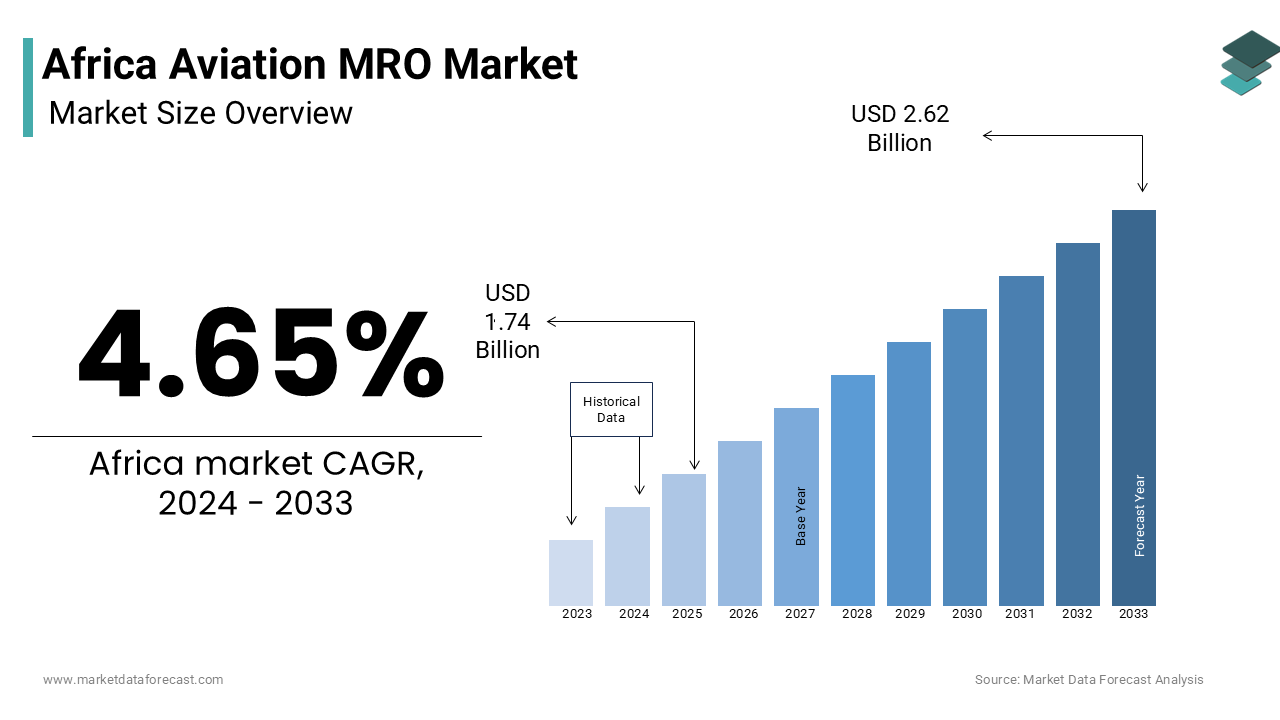
Aviation MRO (Maintenance, Repair, and Overhaul) refers to a network of technical services ensuring airworthiness, safety, and regulatory compliance for commercial, cargo, and government aircraft across the continent. The demand for reliable and certified maintenance infrastructure is intensifying. Also, only limited share of African airlines currently conduct routine heavy maintenance on the continent, with the majority relying on facilities in Europe, the Middle East, or Asia. This dependency underscores a critical gap in regional technical capacity and certification standards, particularly for narrow-body and regional jet fleets.
MARKET DRIVERS
Expansion of Commercial Air Travel and Fleet Modernization
The steady growth of intra-African air connectivity is a primary driver of MRO demand. Airlines such as Ethiopian Airlines, RwandAir, and Kenya Airways are expanding their fleets with modern narrow-body aircraft like the Boeing 737 MAX and Airbus A320neo, which require specialized maintenance protocols. Ethiopian Airlines alone operates a fleet of over 130 aircraft, the largest in Africa, necessitating advanced MRO capabilities. According to the airline’s 2023 sustainability report, its maintenance division at Addis Ababa Bole International Airport conducts several C-checks annually, serving both domestic and third-party carriers. This fleet expansion, coupled with the African Union’s push for regional integration under SAATM, is accelerating investment in indigenous maintenance hubs.
Rising Demand for Third-Party MRO Services from Independent Operators
Independent airlines and private jet operators are increasingly outsourcing maintenance to specialized MRO providers due to high capital and certification costs. In South Africa, there has been an increase in third-party contracts, driven by demand for engine overhauls and avionics upgrades. Additionally, the growth of VIP and medevac aviation in countries like Angola and the DRC has created niche demand for precision maintenance. According to the South African Civil Aviation Authority (SACAA), the number of Part-145 certified MRO facilities in the country rose, reflecting expanding service capacity and regulatory alignment.
MARKET RESTRAINTS
Shortage of Certified Technicians and Training Infrastructure
A critical constraint in the Africa aviation MRO market is the acute shortage of EASA Part-66 or ICAO-compliant certified engineers and technicians. Africa produces fewer licensed aircraft maintenance engineers annually, insufficient to meet current demand. In Nigeria, only limited number of MRO personnel at major airports hold internationally recognized certifications. This skills deficit leads to extended turnaround times and forces airlines to outsource work abroad. The absence of standardized training curricula and accredited institutions limits workforce scalability. Many African countries lack a single ICAO-certified aviation maintenance training academy, undermining regional self-reliance and safety oversight.
Limited Availability of OEM-Approved Spare Parts and Supply Chain Delays
The inefficiency of spare parts logistics severely hampers MRO operations across Africa. Moreover, average lead times for OEM-sourced components in sub-Saharan Africa exceed 45 days, compared to 10–15 days in Europe. This delay is exacerbated by customs bottlenecks, lack of bonded warehouses, and limited local inventory. Also, some of MRO facilities in Addis Ababa maintain a 90-day buffer stock of critical components. This dependency on overseas suppliers increases downtime and operational costs, discouraging airlines from using African MRO providers for heavy checks.
MARKET OPPORTUNITIES
Development of Regional MRO Hubs Under SAATM Framework
The African Union’s Single African Air Transport Market (SAATM) presents a transformative opportunity to consolidate MRO capabilities into strategic regional hubs. South Africa, and Kenya have been identified as preferred locations for Tier-1 MRO centers due to existing infrastructure and airline connectivity. Ethiopian Airlines Engineering has already invested in expanding its facility. Similarly, the Kenyan government is actively promoting Wilson Airport as a dedicated MRO zone, offering tax incentives and fast-track customs. These hubs aim to reduce Africa’s reliance on foreign maintenance, potentially saving airlines millions annually in logistics and downtime costs.
Adoption of Digital MRO and Predictive Maintenance Technologies
Digital transformation offers a leapfrog opportunity for African MRO providers to enhance efficiency and competitiveness. Predictive maintenance systems using AI and IoT sensors can reduce unscheduled repairs. Also, digital MRO platforms can cut aircraft downtime by through real-time engine health monitoring. Companies like Aero Africa in Uganda are piloting blockchain-based maintenance logs to improve traceability and compliance. Additionally, remote technical support via augmented reality (AR) glasses allows African technicians to receive real-time guidance from OEM experts, reducing dependency on expatriate engineers. These innovations are lowering entry barriers and enabling smaller MRO firms to deliver high-standard services with reduced capital investment.
MARKET CHALLENGES
Fragmented Regulatory Framework and Certification Disparities
The lack of harmonized aviation safety regulations across African states undermines MRO standardization and cross-border service acceptance. According to ICAO’s 2023 Universal Safety Oversight Audit, only some of 54 African countries meet critical safety indicators, creating a patchwork of certification validity. An MRO approval in Ghana may not be recognized in Tanzania or Zambia, forcing airlines to repeat inspections. The African Civil Aviation Commission (AFCAC) acknowledges that this fragmentation increases compliance costs and discourages foreign investment. An IATA survey found that a portion of African carriers delayed MRO contracts due to uncertainty over regulatory reciprocity, highlighting a systemic barrier to market integration and operational efficiency.
High Capital Intensity and Limited Access to Financing
Establishing a certified MRO facility requires significant investment in tooling, hangar space, and OEM licensing, with entry costs exceeding USD 50 million for a full-service center. Small and medium providers struggle to obtain loans due to perceived risk and lack of collateral. The absence of dedicated aviation financing mechanisms limits technological upgrades and capacity building.
SEGMENTAL ANALYSIS
By Industry Insights
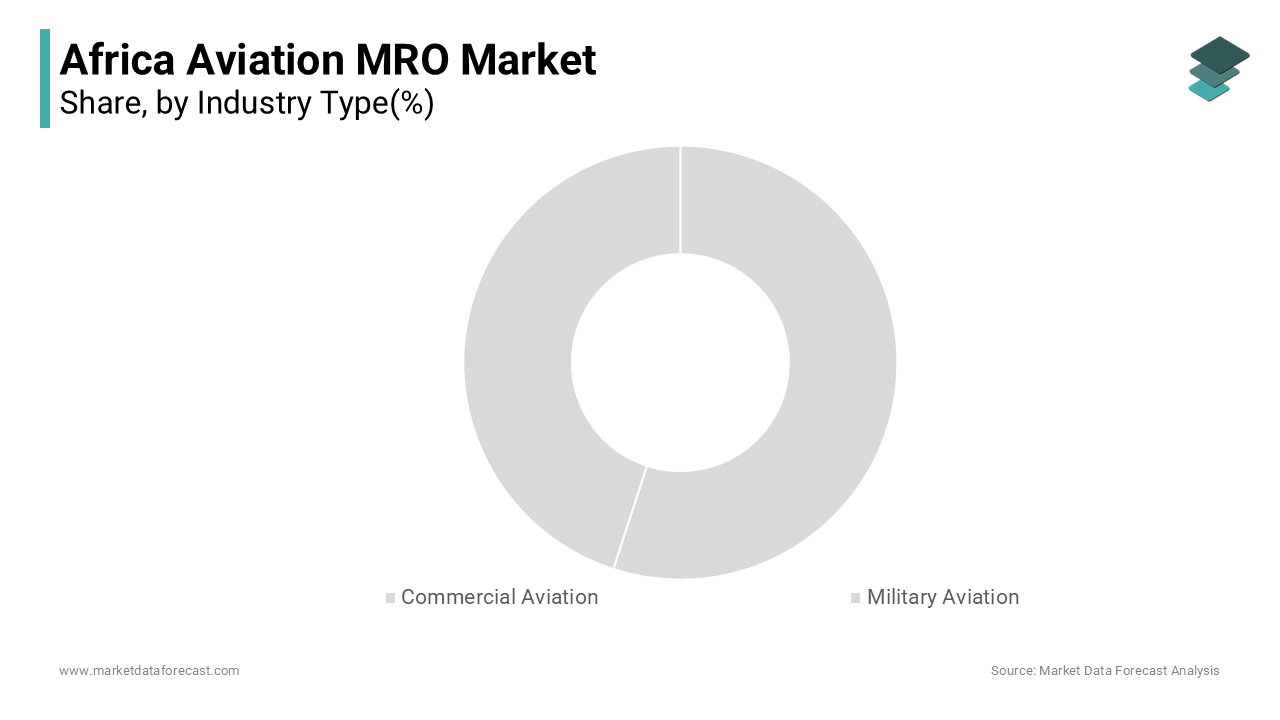
The commercial aviation segment dominated the Africa aviation MRO market by accounting for 63.5% of total revenue in 2024. This lead position is due to the continent’s expanding passenger air travel network and growing fleet of commercial aircraft. Ethiopian Airlines, Africa’s largest carrier, operates a notable number of aircraft and conducts heavy maintenance checks annually. The rise of low-cost carriers such as Jambojet and FlySafair has further increased demand for routine and line maintenance services. With intra-African passenger traffic projected to reach a significant level by 2035, the need for certified, scalable MRO infrastructure is intensifying across major airline hubs. The modernization of regional fleets with fuel-efficient narrow-body aircraft requiring advanced maintenance is a key driver of this segment’s dominance. These next-generation aircraft incorporate fly-by-wire systems, composite materials, and digital avionics, necessitating upgraded tooling and technician training. In South Africa, firms have invested in composite repair bays to service components, reflecting a broader industry shift. The concentration of commercial fleets in countries like Kenya, Egypt, and Nigeria further consolidates demand, making commercial aviation the cornerstone of MRO activity across the continent.
The cargo aviation segment is emerging as the fastest-growing industry segment and is projected to grow at a CAGR of 11.8% from 2025 to 2033. This acceleration is driven by the rapid expansion of e-commerce, pharmaceutical logistics, and cross-border trade under the African Continental Free Trade Area (AfCFTA). As per the United Nations Economic Commission for Africa (UNECA), intra-African trade is expected to increase substantially by 2030, creating demand for dedicated freighter aircraft and associated maintenance. Ethiopian Airlines Cargo, Africa’s largest cargo carrier, operates a fleet of freighters and conducts a notable number of heavy checks annually, establishing a benchmark for dedicated cargo MRO services. A further critical factor fueling growth is the rise of dedicated cargo terminals and freight-focused airlines. Similarly, DHL Express operates a regional hub in Ghana, requiring continuous maintenance for its Boeing 757 freighters. According to IATA, air cargo volumes in Africa grew in 2023, outpacing global averages, driven by high-value shipments such as vaccines, electronics, and perishables. These developments are creating specialized demand for freighter modifications, cargo door repairs, and weight-and-balance certification, positioning cargo aviation as a high-potential niche within the broader MRO landscape.
By End User Insights
The airlines segment held the largest share of the Africa aviation MRO market at 68.4% of total spending in 2024. This dominance is rooted in the operational necessity for airlines to maintain fleet airworthiness, comply with safety regulations, and minimize aircraft downtime. Major carriers such as Ethiopian Airlines, South African Airways, and Royal Air Maroc conduct thousands of line and base maintenance events annually, often through in-house engineering divisions. The growing fleet size and operational intensity across African carriers is a primary driver of this segment’s growth. According to IATA, Africa’s commercial fleet is expected to grow significantly by 2035, requiring proportionate MRO investment. Airlines are increasingly investing in predictive maintenance and digital logbooks to optimize turnaround times. Kenya Airways, for example, partnered with Airbus in 2023 to implement Skywise analytics, reducing unscheduled maintenance. Additionally, with rising fuel and leasing costs, airlines are under pressure to extend aircraft service life through rigorous maintenance, further increasing their reliance on both internal and third-party MRO providers to ensure operational continuity and regulatory compliance.
The leasing companies segment is projected to grow at the fastest CAGR of 13.2% between during the forecast period. This surge is driven by the increasing reliance of African airlines on leased aircraft due to limited capital and foreign exchange constraints. As per AFRAA, a high percentage of active commercial aircraft in sub-Saharan Africa are leased, up from 60% in 2018, creating a direct demand for MRO services governed by lease return conditions. These contracts often require strict adherence to maintenance check schedules, engine performance standards, and component overhauls before redelivery, compelling lessees to use certified MRO providers. A different key factor accelerating growth is the entry of global lessors into African markets. These firms are imposing stringent maintenance clauses to protect asset value. Additionally, lessors are incentivizing the use of EASA- or FAA-certified facilities, pushing African MRO providers to upgrade standards. This dynamic is transforming leasing companies into influential stakeholders in MRO decision-making, driving demand for transparent, auditable, and internationally compliant maintenance services.
By Type Insights
The MRO services segment commanded the Africa aviation MRO market by capturing substantial share of total revenue in 2024. This prominence is attributed to the labor-intensive and regulatory-driven nature of aircraft maintenance, where hands-on inspections, repairs, and overhauls constitute the bulk of expenditure. Line maintenance, engine overhauls, component repairs, and structural checks are essential for fleet operations, particularly in countries with aging aircraft fleets. In Nigeria, the Federal Airports Authority points out that majority of MRO spending is allocated to labor and service contracts, underscoring the dominance of human expertise and technical execution over capital equipment or software solutions. The high frequency of scheduled and unscheduled maintenance events is a major factor reinforcing this segment’s dominance. According to IATA, a typical narrow-body aircraft undergoes a C-check every 18–24 months, requiring 4,000–6,000 man-hours of labor. In South Africa, SACAA-certified facilities are highly acting. Additionally, the scarcity of automated repair systems means most tasks—from avionics calibration to landing gear overhaul—are performed manually by certified technicians. The reliance on OEM-approved procedures and physical inspections further entrenches service-based spending. Until automation and digitalization scale across the continent, MRO services will remain the cornerstone of aviation maintenance economics.
The MRO software segment is experiencing the fastest growth and is projected to grow at a CAGR of 14.6% from 2025 to 2033. This surge is driven by the adoption of predictive analytics, digital maintenance logs, and fleet management platforms that enhance operational efficiency. Ethiopian Airlines implemented GE Aviation’s TRAXX system in 2023, reducing aircraft ground time through real-time work order tracking. These digital tools are becoming essential for compliance, cost control, and lease management. A further catalyst is the push for regulatory digitization and paperless operations. As per ICAO’s No Country Left Behind initiative, African states are modernizing their civil aviation databases, requiring MRO providers to integrate with national digital oversight platforms. Additionally, leasing companies now require digital audit trails for lease returns, accelerating software adoption. Startups like AeroCloud in Nairobi are offering affordable SaaS solutions tailored to African MRO firms, enabling even small operators to access cloud-based compliance and inventory management, driving rapid market penetration
REGIONAL ANALYSIS
South Africa occupied a leading position in the Middle East and Africa aviation MRO market by accounting for 26.6% of regional revenue in 2024. The country hosts the most advanced aerospace engineering infrastructure on the continent, with SACAA-certified facilities capable of heavy checks on Airbus A320 and Boeing 737 families. Denel Aviation and Aerosud Holding provide specialized services in engine overhaul, composite repair, and avionics, serving both domestic and international clients.
Ethiopia stands as the epicenter of commercial aviation MRO in East Africa, the continent’s largest MRO provider, operates a facility in Addis Ababa capable of C- and D-checks on narrow-body and regional jets. The center serves many airlines from several African countries. The government’s Vision 2030 strategy designates aviation as a strategic sector, with plans to expand the MRO hub into a pan-African center.
Egypt plays a pivotal role in North Africa’s aviation maintenance landscape, representing a notable share of MEA demand and serving as a gateway for Middle Eastern and European MRO providers. EgyptAir Maintenance & Engineering performs a significant number of C-checks annually and has EASA Part-145 certification, enabling it to service international carriers. The New Administrative Capital includes a dedicated aviation technology zone, attracting foreign investment. The country’s strategic location and bilingual workforce make it a preferred hub for cross-regional maintenance logistics.
Kenya holds a strategic position as East Africa’s emerging MRO hub. Wilson Airport in Nairobi hosts many certified MRO firms, including Kenya Airways Engineering and African Aviation Services. The country’s participation in SAATM and proximity to regional markets enhances its appeal. The government is developing a dedicated MRO park near Jomo Kenyatta International Airport, offering tax incentives to attract foreign operators, signaling a long-term commitment to aviation industrialization.
Nigeria remains a high-potential market. The country’s large fleet and air traffic volume drive demand, with several MRO providers operating in Lagos and Abuja. However, recent investments in EASA-aligned facilities indicate progress. The government’s National Aviation Policy emphasizes local MRO development, with plans to establish an aviation technology park in Abuja, aiming to reduce foreign dependency and capture more value from the continent’s growing air transport sector.
KEY MARKET PLAYERS AND COMPETITIVE LANDSCAPE
The key players in the Africa Aviation MRO Market include GE Aviation, Ethiopian Airlines MRO Services, MTU Aero Engines AG, Collins Aerospace (Raytheon Technologies), Lufthansa Technik AG, South African Airways Technical (SAAT), AAR Corp., Safran Aircraft Engines (Safran Group), Turkish Technic Inc., Air France Industries KLM Engineering & Maintenance, EgyptAir Maintenance & Engineering, Rolls-Royce Holdings plc, Kenya Airways Technical Services, ST Engineering Aerospace Ltd., and SIA Engineering Company Limited.
The competition in the Africa aviation MRO market is evolving from fragmented, domestically focused operations to a more structured, regionally integrated landscape driven by safety imperatives and economic opportunity. While national carriers dominate through in-house engineering divisions, private firms and joint ventures are emerging as specialized competitors. The market is characterized by disparities in certification, technical capability, and infrastructure, creating both barriers and opportunities. Leading hubs in Ethiopia, South Africa, and Kenya are setting new benchmarks in service quality, while others struggle with regulatory compliance and skilled labor shortages. The race to attract third-party work, reduce foreign dependency, and meet lease return standards is intensifying, positioning MRO as a strategic pillar in Africa’s broader aviation and industrial development agenda.
Top Players in the Africa Aviation MRO Market
Ethiopian Airlines Engineering
Ethiopian Airlines Engineering is the largest indigenous MRO provider in Africa, operating a state-of-the-art facility in Addis Ababa that conducts heavy maintenance on narrow-body, regional jets, and cargo aircraft. The division serves over 30 third-party airlines across Africa and the Middle East, offering C- and D-checks, engine overhauls, and component repairs. In recent years, it has strengthened its position by obtaining EASA Part-145 certification and expanding its composite and avionics repair capabilities. Drawing from its growing expertise, the company has established technical partnerships with Asian carriers and MRO firms in India and Thailand, sharing best practices in cost-efficient maintenance. Its participation in IATA’s Asia-Pacific MRO forums has facilitated knowledge exchange, enabling it to align with global standards while promoting African self-reliance in aviation maintenance.
Denel Aviation (South Africa)
Denel Aviation, a leading aerospace engineering firm based in Centurion, South Africa, provides advanced MRO services for military and commercial aircraft, including engine maintenance, structural repairs, and avionics upgrades. The company supports regional operators with specialized capabilities in legacy and modern aircraft platforms, including the Fokker 50 and Dornier 228. It has recently invested in digital diagnostics and non-destructive testing (NDT) infrastructure to enhance precision and turnaround times. Leveraging its technical expertise, Denel has engaged in collaborative training programs with MRO providers in Malaysia and Indonesia, particularly in rotary-wing maintenance. These engagements have enabled technology transfer and benchmarking against Asia-Pacific standards, strengthening its reputation as a high-integrity provider capable of meeting international regulatory expectations.
Kenya Airways Engineering
Kenya Airways Engineering offers comprehensive line and base maintenance services at Jomo Kenyatta International Airport, catering to its fleet and regional airline clients. The facility is certified by the Kenya Civil Aviation Authority and adheres to ICAO-compliant standards, performing A-, C-, and D-checks on Boeing 737 variants. The company has recently upgraded its digital maintenance tracking system using cloud-based platforms developed in collaboration with Singaporean tech firms, improving compliance and audit readiness. It has also initiated technician exchange programs with Jetstar Engineering in Australia and Garuda Maintenance Facility in Indonesia to enhance skills in fuel-efficient aircraft maintenance. By integrating Asia-Pacific operational models, Kenya Airways Engineering is positioning itself as a modern, scalable MRO provider aligned with evolving global aviation safety and efficiency benchmarks.
Top Strategies Used by the Key Market Participants
Key players in the Africa aviation MRO market are focusing on regulatory alignment, workforce development, and technological modernization to strengthen their competitiveness. Companies are pursuing EASA and ICAO certification to gain international recognition and attract third-party contracts. Strategic investments in digital maintenance platforms, predictive analytics, and electronic logbooks are enhancing service precision and compliance. Partnerships with OEMs and foreign MRO providers facilitate knowledge transfer and technical upgrades. Firms are also expanding training academies to address the shortage of certified engineers. Additionally, governments and private operators are collaborating to establish dedicated aviation parks with tax incentives, aiming to transform Africa into a self-sufficient, export-capable MRO destination within the global air transport ecosystem.
RECENT MARKET DEVELOPMENTS
- In February 2023, Ethiopian Airlines Engineering launched a new composite repair center in Addis Ababa, enhancing its capability to service Airbus A350 and Boeing 787 components and reducing reliance on overseas facilities.
- In May 2023, Denel Aviation partnered with a Malaysian MRO firm to conduct joint training programs for South African technicians on advanced avionics systems used in regional jets.
- In September 2023, Kenya Airways Engineering implemented a cloud-based maintenance management system developed in collaboration with a Singaporean aviation tech provider to improve real-time compliance tracking.
- In January 2024, Ethiopian Airlines Engineering signed a technical support agreement with an Indian low-cost carrier to provide heavy maintenance services for its Boeing 737 fleet, expanding its footprint in the Asia-Pacific region.
- In March 2024, Denel Aviation completed the upgrade of its engine test cell facility in Centurion, enabling full performance validation for CFM56 engines and increasing turnaround efficiency by 25%.
MARKET SEGMENTATION
This research report on the Africa Aviation MRO Marketis segmented and sub-segmented into the following categories.
By Industry Type
- Commercial Aviation
- Military Aviation
By Type
- Engine MRO
- Components and Modifications MRO
- Interior MRO
- Airframe MRO
- Field Maintenance
By End-User
- Airlines
- Leasing Companies
By Country
- South Africa
- Nigeria
- Rest of Africa
Frequently Asked Questions
What is driving the growth of the Africa Aviation MRO Market?
Growth is fueled by the rising number of commercial aircraft, expanding airline fleets, regulatory requirements for airworthiness, and increasing demand for safe and efficient air travel across Africa.
What are the major challenges faced by the Africa Aviation MRO Market?
Key challenges include limited local MRO infrastructure, high operational costs, shortage of skilled technicians, dependency on OEMs for spare parts, and strict international compliance requirements.
What is the future outlook for the Africa Aviation MRO Market?
The market is expected to grow significantly as African airlines expand fleets, adopt predictive maintenance software, and collaborate with global MRO providers to meet rising demand.
What are the key technological trends shaping the Africa Aviation MRO Market?
The market is witnessing the adoption of predictive maintenance tools, AI-driven analytics, digital logbooks, and paperless compliance systems to reduce downtime and enhance efficiency.
Access the study in MULTIPLE FORMATS
Purchase options starting from
$ 1200
Didn’t find what you’re looking for?
TALK TO OUR ANALYST TEAM
Need something within your budget?
NO WORRIES! WE GOT YOU COVERED!
Call us on: +1 888 702 9696 (U.S Toll Free)
Write to us: sales@marketdataforecast.com