- Product Description Description
- Table of Contents TOC
- List of Table & Figure LOT
- Get Free Sample PDF Sample PDF
Market Size, 2025
$18.92 BnMarket Estimate, 2026
$23.89 BnMarket Forecast, 2034
$154.19 BnCAGR, 2026–2034
26.25%Africa Carbon Market Size
The Africa carbon market size was valued at USD 18.92 billion in 2026 and is anticipated to reach USD 23.89 billion in 2026 from USD 154.19 billion by 2034, growing at a CAGR of 26.25% during the forecast period from 2026 to 2034.
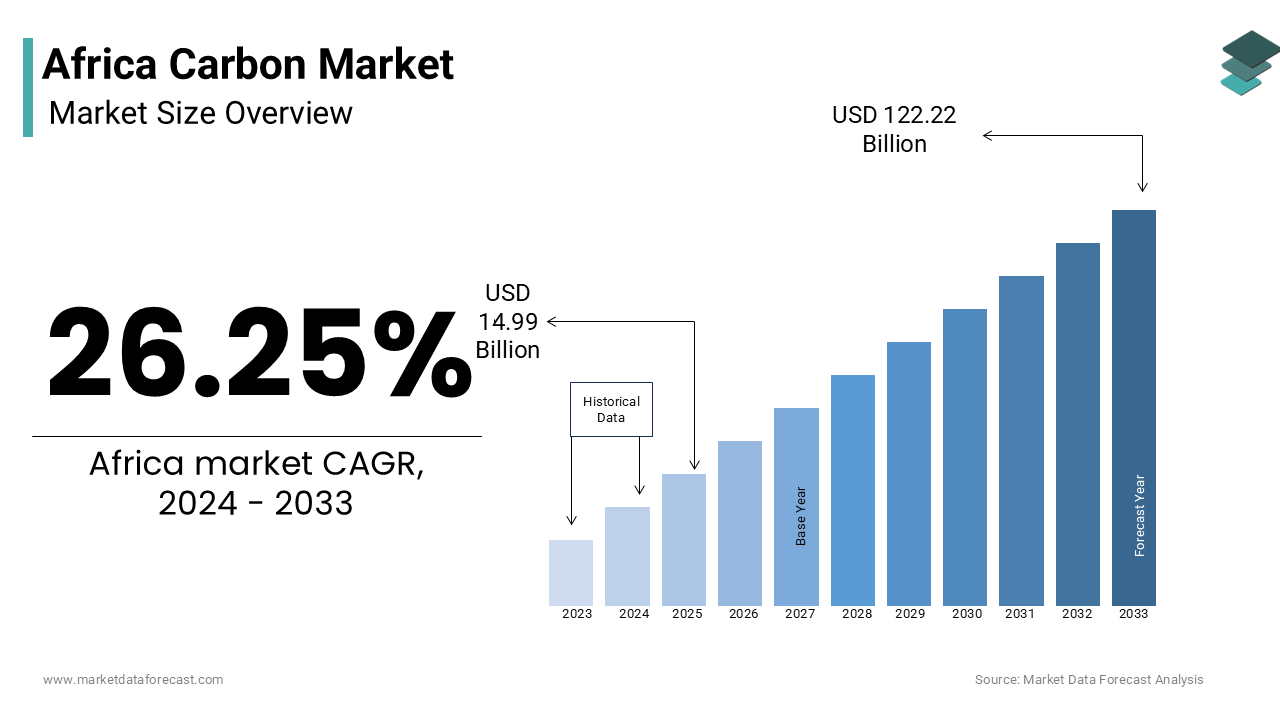
The carbon market covers mechanisms through which greenhouse gas emission reductions are quantified, verified, and traded as carbon credits, primarily generated from nature-based and clean energy projects across the continent. As of 2024, Africa accounts for less than 4% of global carbon credit supply despite hosting over 17% of the world’s landmass suitable for carbon sequestration, according to the World Bank’s State and Trends of Carbon Pricing report. The continent’s carbon potential is anchored in vast forest ecosystems, including the Congo Basin, the second-largest tropical rainforest, which stores an estimated 60 billion metric tons of carbon, as per the Central African Forest Commission. Additionally, over 600 million people in Sub-Saharan Africa rely on subsistence agriculture and biomass energy, creating opportunities for low-carbon development projects. With increasing global demand for high-integrity offsets, Africa is emerging as a critical frontier for climate finance and sustainable development linkages.
MARKET DRIVERS
Expansion of Renewable Energy Projects in Off-Grid Regions
The proliferation of decentralized renewable energy systems is a key driver of Africa’s carbon market, as clean power initiatives generate verifiable emission reductions eligible for credit issuance. As of 2023, over 110 million people in Africa gained access to electricity through off-grid solar solutions, according to the International Energy Agency, many of which are registered under carbon programs like the Gold Standard or Verified Carbon Standard. These projects not only displace kerosene and diesel use but also qualify for carbon financing, which subsidizes affordability and accelerates deployment.
Growing International Demand for High-Integrity Nature-Based Credits
Global corporations seeking to meet net-zero commitments are increasingly sourcing carbon credits from African conservation and reforestation initiatives, drawn by their high ecological and social co-benefits. According to the Integrity Council for the Voluntary Carbon Market, projects in Africa exhibit above-average permanence and biodiversity metrics compared to other regions. The Kasigau Corridor REDD+ project in Kenya, for instance, has protected 200,000 acres of dryland forest, sequestering over 1.4 million tons of CO₂ annually while supporting 120,000 local residents through employment and education programs, as audited by Verra. Similarly, the Lower Zambezi REDD+ initiative in Zambia safeguards 1.2 million hectares of forest, generating 10 million carbon credits since 2018. With over 70% of corporate buyers now prioritizing community co-benefits in their procurement, as per Ecosystem Marketplace, Africa’s nature-based projects are gaining preferential access to premium international markets.
MARKET RESTRAINTS
Limited Institutional Capacity for Carbon Project Certification
The scarcity of local expertise and regulatory infrastructure required to develop, verify, and register carbon projects is a critical barrier to the growth of Africa’s carbon market. According to the United Nations Environment Programme (UNEP), only a limited share of Africa’s eligible land-based carbon projects have completed the full validation process under international standards. This bottleneck stems from a shortage of accredited verifiers, inconsistent national monitoring frameworks, and protracted approval timelines often exceeding 18 months for REDD+ initiatives, as per the Forest Carbon Partnership Facility. In countries like Cameroon and the Democratic Republic of the Congo, weak land tenure systems complicate ownership claims, deterring investors.
Fragmented Policy Frameworks and Lack of Harmonized Regulation
The absence of unified carbon governance across African nations hampers cross-border project scalability and investor confidence. This regulatory asymmetry creates uncertainty for developers navigating diverse approval processes, tax regimes, and revenue-sharing models. For example, while Ghana has implemented a national carbon registry and pricing mechanism, neighboring Togo lacks a legal framework for carbon rights, inhibiting regional project integration. The World Bank highlights that inconsistent rules on credit ownership, whether vested in governments, communities, or private entities have led to disputes in a portion of completed transactions in West Africa. Without harmonization, the continent struggles to present a cohesive, investable carbon market landscape.
MARKET OPPORTUNITIES
Integration of Carbon Finance into Agricultural Resilience Programs
Africa’s agrarian economies present a transformative opportunity for carbon market expansion through climate-smart agriculture (CSA) initiatives. According to the Food and Agriculture Organization (FAO), sustainable land management practices such as agroforestry, conservation tillage, and methane-reducing livestock feeding could generate a large number of carbon credits annually across the continent. In Ethiopia, the Humbo Assisted Regeneration Project has restored 2,700 hectares of degraded land, sequestering 800,000 tons of CO₂ while improving soil fertility for 60,000 farmers, as verified by the World Agroforestry Centre. Similarly, the Sustainable Agriculture Carbon Program in Malawi has enrolled 450,000 smallholders in carbon farming, linking yield improvements with credit issuance. With 65% of Africa’s workforce engaged in agriculture, as per the African Development Bank, integrating carbon finance into rural development can simultaneously enhance food security and climate resilience.
Emergence of Regional Carbon Market Platforms and Exchanges
The development of localized carbon trading platforms is unlocking new liquidity and transparency in Africa’s carbon economy. The African Carbon Markets Initiative (ACMI), launched by the African Union and the UN Economic Commission for Africa, is committed to generating millions of carbon credits annually, aiming to channel a substantial amount of revenue to local communities. Countries like Rwanda and Nigeria are establishing national carbon exchanges to facilitate domestic and cross-border transactions. Additionally, blockchain-based registries such as those piloted in Kenya are enhancing traceability and reducing fraud. These institutional advancements are reducing dependency on external markets and enabling African nations to retain greater value from their carbon assets.
MARKET CHALLENGES
Risk of Carbon Colonialism and Inequitable Benefit Sharing
A growing concern in Africa’s carbon market is the potential for “carbon colonialism,” where foreign entities acquire large tracts of land for offset projects while marginalizing local communities. Also, a large share of large-scale carbon projects have faced allegations of land dispossession or restricted access to natural resources for indigenous populations. In some cases, lesser credit revenue reaches local stakeholders, despite their role in project implementation. The Oakland Institute documented instances in Uganda where communities were displaced to make way for commercial tree plantations under carbon programs. Without enforceable benefit-sharing agreements and free, prior, and informed consent (FPIC) protocols, such practices risk undermining social equity and long-term project sustainability, threatening the ethical foundation of the carbon market.
Vulnerability of Carbon Stocks to Climate-Induced Reversals
The integrity of Africa’s carbon credits is increasingly threatened by climate change itself, as rising temperatures, prolonged droughts, and wildfires jeopardize the permanence of sequestered carbon. According to the Intergovernmental Panel on Climate Change (IPCC), the Sahel region has experienced a reduction in rainfall since the 1970s, increasing the risk of desertification in carbon-rich savannas. Moreover, wildfires in the Democratic Republic of the Congo’s peatlands, home to billions of tons of stored carbon, equivalent to three years of the UK’s total emissions, as estimated by the Global Carbon Project. Similarly, prolonged droughts in East Africa have led to increased deforestation for fuelwood, undermining reforestation efforts. These environmental feedback loops challenge the long-term credibility of nature-based offsets and necessitate robust risk buffers and insurance mechanisms within carbon accounting frameworks.
SEGMENTAL ANALYSIS
By Type of Project Insights
The renewable energy segment remained the prominent project type in the Africa carbon market by accounting for 66.3% of total carbon credit generation in 2024. This dominance is primarily driven by the continent’s vast potential for off-grid solar, wind, and small-scale hydro projects, particularly in regions with limited grid access. As of 2023, over 110 million people in Sub-Saharan Africa gained electricity through decentralized solar systems, many of which are registered under carbon offset programs, as documented by the International Energy Agency. In Kenya, the Lake Turkana Wind Power project Africa’s largest wind farm avoids 260,000 metric tons of CO₂ annually and generates over 600,000 carbon credits per year, verified by Verra.
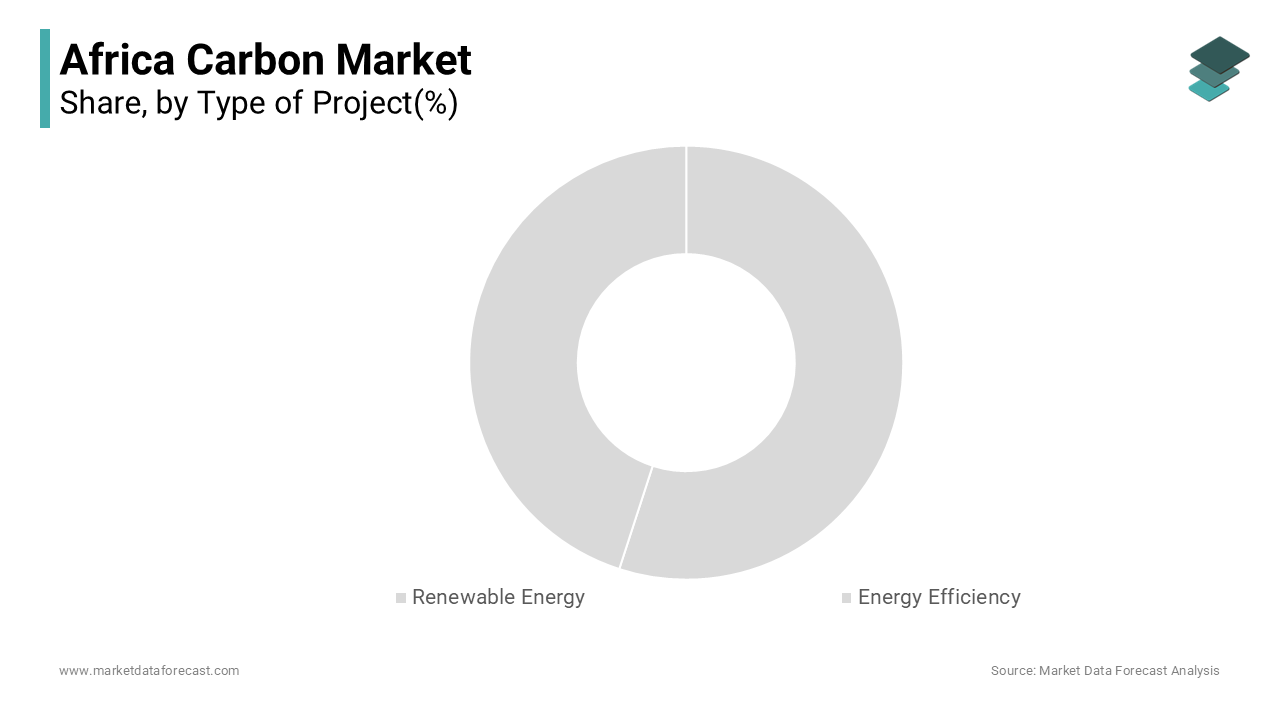
The energy efficiency segment is expanding at a CAGR of 14.6% from 2025 to 2033. It is driven by the widespread adoption of low-carbon technologies in households and industries. A key factor is the replacement of kerosene lamps and traditional cookstoves with energy-efficient alternatives, which significantly reduce black carbon emissions. As per the Global Alliance for Clean Cookstoves, over 580 million Africans still rely on solid biomass for cooking, but clean cookstove projects have already distributed 22 million units across East and West Africa, avoiding 1.8 million tons of CO₂ equivalent annually. In Ghana, the CleanStar initiative has issued over 3 million carbon credits from improved biomass stoves, with verification by Gold Standard. Additionally, industrial energy audits and retrofits in South Africa and Egypt are generating new credit streams, supported by government incentives and international climate funds.
By Application Insights
The power sector accounted for 54.2% of Africa’s carbon credit volume in 2024. This is due to the continent’s reliance on fossil-fuel-based generation and rapid deployment of renewable alternatives. Over 60% of Africa’s electricity is still produced from diesel and heavy fuel oil in off-grid and mini-grid systems, creating high-emission baselines that clean energy projects can displace. In Uganda, the Nyamagasani I Hydroelectric Project generates 120,000 carbon credits annually by replacing diesel generation, as per the Verified Carbon Standard. With over 600 million people lacking reliable electricity, the scalability of solar, wind, and hydro projects ensures the power sector remains the dominant source of carbon offsets.
The transportation sector is growing at a CAGR of 13.9% during the forecast period driven by the electrification of mobility and improvements in fuel efficiency. Urbanization and rising vehicle ownership are increasing emissions, prompting governments to adopt low-carbon transport solutions. In Rwanda, the Kigali Electric Bus Project, launched in 2023, introduced 50 electric buses, avoiding 12,000 tons of CO₂ annually and qualifying for carbon financing under the Climate Action Reserve. Additionally, non-motorized transport infrastructure and ride-sharing platforms are being integrated into carbon accounting frameworks, expanding the sector’s eligibility for credit generation.
REGIONAL ANALYSIS
Tanzania remained the largest contributor to Africa’s carbon market by capturing 22.7% of total credit issuance in 2024. The country’s lead position is anchored in large-scale REDD+ (Reducing Emissions from Deforestation and Forest Degradation) initiatives, particularly in the Eastern Arc Mountains and Miombo woodlands, which sequester vast amounts of carbon. The Kilosa Improved Forest Management Project, covering 380,000 hectares, generates over 8 million carbon credits annually. Additionally, Tanzania hosts several registered clean cookstove projects in East Africa, contributing significantly to emission reductions in rural households. As per the World Resources Institute, community-based forest management covers over 6 million hectares in Tanzania, enabling inclusive benefit-sharing models. These factors, combined with government support for climate finance, position Tanzania as a cornerstone of Africa’s voluntary carbon ecosystem.
Kenya holds a significant share of the Africa carbon market. The country has established itself as a hub for high-integrity carbon projects, blending technological innovation with robust regulatory oversight. Kenya’s carbon market is supported by the Nairobi Securities Exchange’s plans to launch a dedicated carbon trading platform, enhancing market transparency. The Kasigau Corridor REDD+ project, one of the world’s most renowned, has issued over 15 million verified credits since 2011, benefiting 120,000 local residents through healthcare and education programs, as documented by Wildlife Works. Furthermore, Kenya leads in geothermal energy offsets, with the Olkaria plants avoiding over 2 million tons of CO₂ annually. The country’s progressive climate policy and alignment with international standards make it a preferred destination for carbon investment.
Uganda accounts for a notable share of Africa’s carbon credit supply. It is driven by its rich biodiversity and extensive forest conservation programs. The country hosts a large number of registered carbon projects, including the Hoima Community Forestry Initiative. The Mount Elgon REDD+ project alone sequesters 1.2 million tons of CO₂ per year, verified by the Gold Standard. Additionally, Uganda’s decentralized governance model enables community ownership of carbon rights, ensuring equitable revenue distribution. With strong NGO partnerships and donor support, Uganda is emerging as a model for socially inclusive carbon market development.
Ghana is leveraging structured policy frameworks to advance carbon project development. The country’s National Carbon Registry, launched in 2022, provides a transparent platform for project registration and credit tracking, increasing investor confidence. Ghana’s Sustainable Forest Management Project in the Tain II Forest Reserve generates over 2 million carbon credits annually, verified by the Verified Carbon Standard. The government has also integrated carbon finance into its Nationally Determined Contributions (NDCs), with 30% of mitigation targets linked to market mechanisms. As per the World Bank’s Forest Carbon Partnership Facility, Ghana has received $50 million in results-based payments for emission reductions from forest conservation. These institutional advancements, combined with growing private-sector participation, are positioning Ghana as a leader in regulated carbon market development.
COMPETITIVE LANDSCAPE
The Africa carbon market features a fragmented yet rapidly evolving competitive landscape where international project developers, local NGOs, and emerging African-led enterprises vie for project dominance. While global firms bring technical expertise and access to buyers, local organizations possess superior community access and contextual knowledge, creating a dynamic tension between scalability and authenticity. Certification standards like Verra and Gold Standard act as gatekeepers, influencing credibility and market access. Competition is intensifying around project integrity, additionality, and co-benefits, with buyers increasingly scrutinizing social equity and permanence. Regulatory divergence across countries creates both entry barriers and niche opportunities. The rise of regional carbon exchanges and digital verification tools is reshaping competitive advantages, favoring transparency and efficiency. Ultimately, success depends on balancing environmental rigor with inclusive development in a high-potential, high-risk environment.
KEY MARKET PLAYERS
The key players in the Africa carbon market include
- Africa Carbon Markets Initiative (ACMI)
- Gabon
- Ghana
- Tanzania
- Kenya
- Nigeria
- Mozambique
- Rwanda
- KOKO Networks
- BURN Manufacturing
- Powerstove Energy
- Wildlife Works
- South Pole
- Blue Carbon LLC
- AUDA-NEPAD
- World Bank
- Standard Chartered
- Nedbank
- Johannesburg Stock Exchange
- Nairobi Stock Exchange
- Regional Voluntary Carbon Market Company (RVCMC)
Top Players in the Africa Carbon Market
Wildlife Works
Wildlife Works is a pioneering carbon project developer specializing in REDD+ initiatives that integrate forest conservation with community development across East Africa. The company operates the Kasigau Corridor REDD+ Project in Kenya, one of the largest and most verified forest protection programs on the continent, which has sequestered over 18 million tons of CO₂ since inception. It channels carbon revenue into education, healthcare, and sustainable livelihoods for local communities, establishing a replicable model for equitable climate finance. In 2023, Wildlife Works expanded its footprint by launching a new agroforestry initiative in Malawi, partnering with smallholder farmers to generate carbon credits while improving soil health. The company also introduced blockchain-based credit tracking to enhance transparency and buyer confidence. Its focus on high-integrity, community-led projects has positioned it as a benchmark for ethical carbon market practices in Africa.
VERRA
Verra, though not a project operator, plays a central role in shaping the Africa carbon market as the administrator of the Verified Carbon Standard (VCS), the most widely used certification framework for voluntary carbon credits. It has validated over 400 carbon projects across Africa, spanning reforestation, clean cookstoves, and renewable energy, ensuring alignment with rigorous environmental and social criteria. In 2023, Verra launched the Sustainable Development Carbon Registry (SDCR) to improve transparency and prevent double-counting, directly benefiting African project developers seeking international buyers. The organization also revised its REDD+ methodologies to better account for permanence and leakage risks in tropical ecosystems. By collaborating with African governments and NGOs, Verra is strengthening local capacity for project design and verification. Its standardization efforts have become instrumental in building trust and scalability within the continent’s fragmented carbon landscape.
South Pole
South Pole, a global climate solutions provider, has significantly expanded its presence in Africa by developing and financing carbon reduction projects across renewable energy, energy efficiency, and land use. The company supports over 30 African initiatives, including solar mini-grids in Nigeria and improved cookstove distribution in Uganda, helping communities access clean technology while generating tradable carbon credits. In 2023, South Pole partnered with the African Development Bank to launch a $50 million climate resilience fund targeting small-scale projects in West Africa. It also introduced digital monitoring tools using satellite imagery and AI to verify emission reductions in real time. By linking African project developers with corporate buyers in Europe and North America, South Pole is bridging the finance gap and accelerating project scalability. Its end-to-end services—from development to certification—have made it a key enabler of Africa’s carbon market growth.
Top Strategies Used by Key Market Participants
Key players in the Africa carbon market are focusing on community engagement, certification under internationally recognized standards, integration of digital monitoring technologies, expansion of nature-based and clean energy projects, and strategic partnerships with governments and development finance institutions. Developers are prioritizing equitable benefit-sharing models to ensure local buy-in and long-term project sustainability. The use of remote sensing, blockchain, and AI is enhancing transparency and reducing verification costs. Additionally, firms are aligning projects with national climate goals to secure policy support and access results-based financing. These strategies collectively aim to scale high-integrity carbon credits while fostering sustainable development across the continent.
RECENT MARKET DEVELOPMENTS
- In March 2023, Wildlife Works launched a new agroforestry carbon project in Malawi, partnering with 20,000 smallholder farmers to restore degraded land and generate verified emission reductions.
- In June 2023, Verra introduced the Sustainable Development Carbon Registry to enhance transparency and prevent double-counting of carbon credits across African projects.
- In September 2023, South Pole partnered with the African Development Bank to establish a $50 million climate resilience fund supporting small-scale carbon initiatives in West Africa.
- In November 2023, Wildlife Works implemented blockchain-based tracking for its Kenya REDD+ project, improving auditability and attracting premium buyers from Europe.
- In February 2024, South Pole deployed AI-powered satellite monitoring across its Nigerian solar mini-grid portfolio, enabling real-time verification of emission reductions.
MARKET SEGMENTATION
This research report on the Africa carbon market is segmented and sub-segmented into the following categories.
By Type of Project
- Renewable Energy
- Energy Efficiency
By Application
- Power Sector
- TransportationTop of Form
By Country
- South Africa
- Nigeria
- Rest of Africa