- Product Description Description
- Table of Contents TOC
- List of Table & Figure LOT
- Get Free Sample PDF Sample PDF
Market Size, 2025
$887 MnMarket Estimate, 2026
$920 MnMarket Forecast, 2034
$1,233 MnCAGR, 2026–2034
3.72%Africa Cashew Market Size, Growth, Trends & Forecast (2026–2034)
The Africa Cashew market size was valued at USD 887.93 million in 2025, reached USD 920.96 million in 2026, and is projected to expand up to USD 1,233.50 million by 2034, registering a compound annual growth rate (CAGR) of 3.72% during the forecast period from 2026 to 2034. Driven by the global surge in demand for plant-based proteins, structural expansions in domestic processing capacity across West and East Africa, and rising investments in agricultural traceability, the market continues steady regional growth.
Key Executive Metrics (At-a-Glance)
- 2025 Base Valuation: USD 887.93 Million
- 2026 Current Valuation: USD 920.96 Million
- 2034 Forecast Valuation: USD 1,233.50 Million
- Compound Annual Growth Rate (CAGR): 3.72% (2026–2034)
- Regions Covered: Sudan, Egypt, Kenya, Ethiopia, South Africa, and the Rest of Africa
- Leading Producing Country / Market Share: Côte d’Ivoire (Stood as the undisputed leader, contributing 37.5% of regional raw nut production in 2025 and operating over 40 modern processing plants).
- Leading Form Segment: Whole Cashew (Dominated the market by accounting for 42.3% of total consumption value in 2025 due to premium snack preferences and clean-label appeal).
- Fastest-Growing Form Segment: Cashew Paste (Projected to register the highest CAGR of 12.4% fueled by plant-based dairy alternatives and therapeutic food formulations).
- Leading Application Segment: Snacks & Bars (Captured 35.7% of total consumption volume in 2025, driven by ready-to-eat nutritious snack consumption among urban middle classes).
- Fastest-Growing Application Segment: Beverages (Emerging as the fastest-growing application, projected to grow at a CAGR of 13.8% backed by the plant-based milk market).
- Leading Distribution Channel: Supermarkets (Commanded 58.4% of total retail sales value in 2025 through standardized private-label ranges and formal retail expansion).
- Fastest-Growing Distribution Channel: Online Store (Projected to experience the fastest growth at a CAGR of 16.3% driven by smartphone penetration, digital payments, and D2C brands).
Core Market Drivers
- Rising Global Demand for Plant-Based Proteins: Escalating international preference for nutrient-dense snacks, tree nuts, and health-conscious diets across North America and Europe.
- Expansion of Domestic Processing Capacity: Strategic government policies and private sector investments in West and East Africa shifting focus from raw nut exports to local value addition and agro-industrial employment.
Primary Market Restraints & Challenges
- Agronomic & Infrastructure Bottlenecks: Reliance on low-productivity, disease-vulnerable traditional tree varieties combined with inadequate post-harvest drying and storage facilities.
- Market Volatility & Labor Skills Shortage: Income instability resulting from heavy reliance on international price fluctuations alongside a shortage of certified technical processing machine operators.
Africa Cashew Market Segmentation Highlights
| Segment Category | Largest / Dominant Segment | Fastest-Growing Segment |
|---|---|---|
| By Form | Whole Cashew (42.3% share in 2025) | Cashew Paste (CAGR of 12.4%) |
| By Application | Snacks & Bars (35.7% volume share in 2025) | Beverages (CAGR of 13.8%) |
| By Distribution Channel | Supermarkets (58.4% retail sales in 2025) | Online Store (CAGR of 16.3%) |
Major Industry Players Profiled
Key operators and agribusiness leaders driving the Africa cashew market include Olam International (Olam Agri), Touton, Wilmar International, Asian Trading International, Ivory Coast Cajou, and Ekow West Africa Limited.
Africa Cashew Market Size
The Africa Cashew market size was valued at USD 887.93 million in 2025, and is expected to reach USD 1,233.50 million in 2034 from USD 920.96 million in 2026, at a CAGR of 3.72%.
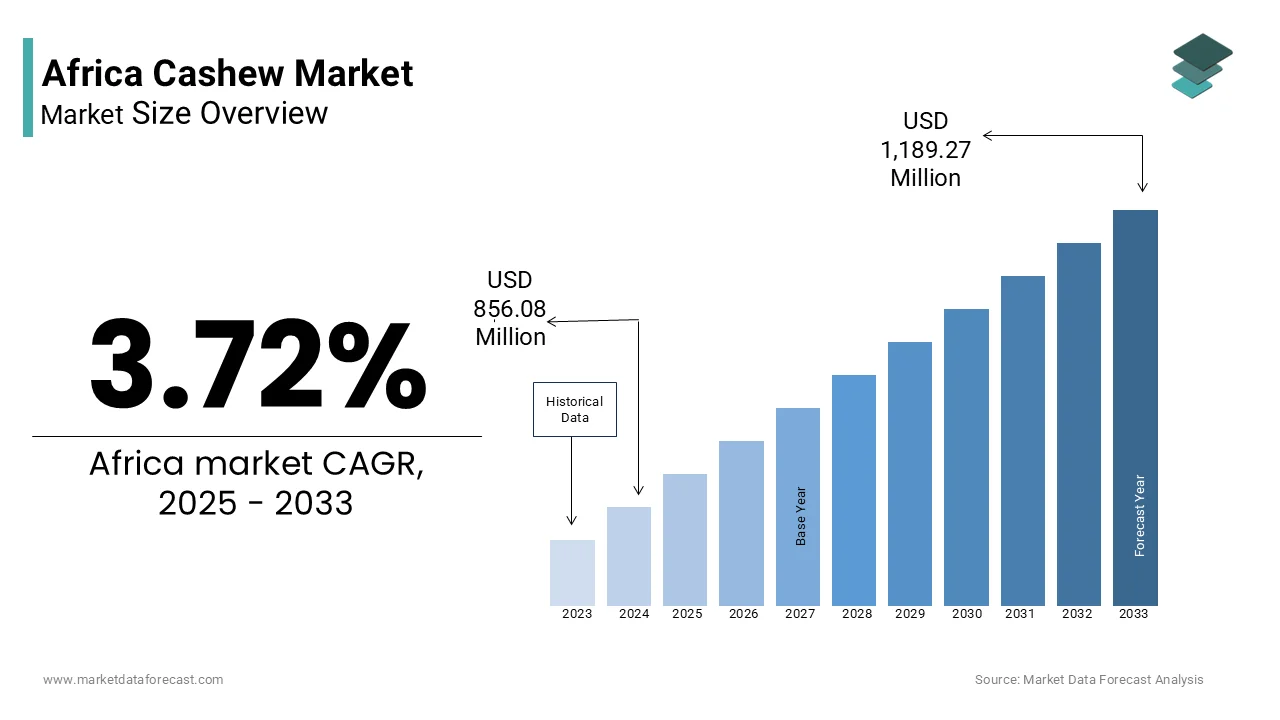
Cashew is playing a pivotal role in rural livelihoods and export economies. West and East Africa collectively contribute over 60% of global raw cashew nut production, with countries such as Côte d’Ivoire, Tanzania, and Nigeria at the forefront. Despite being the largest producer region, Africa processes less than 30% of its total output, relying heavily on raw nut exports. As per the Food and Agriculture Organization (FAO), approximately 2.8 million smallholder farming households in West Africa depend directly on cashew cultivation. The sector is increasingly shaped by efforts to boost domestic processing capacity, improve yield through agronomic interventions, and align with international food safety standards, positioning cashew as a strategic crop for agro-industrial development.
MARKET DRIVERS
Rising Global Demand for Plant-Based Proteins and Healthy Snacks
The surge in international consumer preference for plant-based proteins and nutrient-dense snacks has significantly elevated demand for cashew nuts, directly benefiting African producers. Cashews are rich in unsaturated fats, magnesium, and protein, making them a staple in health-conscious diets across North America and Europe. According to the International Nut and Dried Fruit Council (INC), global tree nut consumption grew at a compound annual rate of 3.7% between 2018 and 2023, with cashews accounting for nearly 15% of total nut trade volume. The United States imported over 180,000 metric tons of shelled cashews in 2023, a 12% increase from 2020 levels, as reported by the USDA. This sustained demand incentivizes African exporting nations to scale production and improve quality grading to meet premium market requirements.
Expansion of Domestic Processing Capacity in Producing Countries
Several African nations are prioritizing local cashew processing to capture greater value from their raw production. Historically, over 80% of raw cashew nuts harvested in Africa were exported unprocessed, primarily to India and Vietnam. However, governments in Côte d’Ivoire, Ghana, and Tanzania have implemented industrial policies to attract investment in processing infrastructure. As per the African Cashew Alliance (ACA), processing capacity in West Africa increased by 45% between 2020 and 2023, with Côte d’Ivoire alone operating over 30 modern processing plants by 2025. This shift has created over 50,000 direct jobs in the sector, as per the International Labour Organization (ILO) in its 2023 assessment of agro-industrial employment in West Africa, enhancing economic returns and reducing dependency on raw commodity exports.
MARKET RESTRAINTS
Limited Access to High-Yielding and Disease-Resistant Cashew Varieties
The widespread use of low-productivity, traditional cashew tree varieties that are vulnerable to pests and climatic stress is a critical constraint in the Africa cashew market. Most smallholder farms in Mozambique, Guinea-Bissau, and Benin rely on seed-propagated trees, which yield between 200–400 kg per hectare, significantly below the 2,000 kg potential of grafted, high-yielding clones. As per the World Agroforestry Centre (ICRAF), less than 15% of cashew farms in West Africa use improved planting materials. This genetic gap results in inconsistent nut quality and volume, undermining competitiveness. Additionally, the absence of certified nurseries and extension services delays the dissemination of resilient varieties, limiting yield improvements despite growing demand and investment in the sector.
Inadequate Post-Harvest Infrastructure and Storage Facilities
Post-harvest losses remain a major impediment to market efficiency, with inadequate drying, storage, and transportation infrastructure leading to contamination and spoilage. According to the United Nations Economic Commission for Africa (UNECA), up to 25% of raw cashew nuts in Mali and Burkina Faso suffer quality degradation before reaching collection centers due to improper drying and exposure to aflatoxins. The absence of hermetic storage units and moisture-controlled warehouses exacerbates the issue, particularly during rainy seasons. As per a 2022 study by the African Development Bank (AfDB), only 38% of cashew collection points in Nigeria are equipped with basic drying racks, severely affecting export eligibility. These deficiencies increase rejection rates at ports and reduce farmers’ income, constraining sectoral growth.
MARKET OPPORTUNITIES
Integration of Digital Platforms for Farmer Market Access and Traceability
Digital transformation presents a transformative opportunity for the Africa cashew market by enabling direct linkages between smallholder producers and international buyers. Mobile-based agritech platforms such as AgriNet in Ghana and eKilimo in Tanzania are facilitating real-time price dissemination, digital aggregation, and blockchain-enabled traceability. As per the International Finance Corporation (IFC), over 120,000 cashew farmers in West Africa were enrolled in digital procurement systems by 2023, resulting in a 20% reduction in transaction costs and improved price transparency. These platforms also support certification tracking for organic and fair-trade cashews, enhancing access to premium European markets. Scaling such innovations can streamline supply chains, reduce middlemen exploitation, and ensure equitable value distribution across the cashew ecosystem.
Development of Cashew-Based By-Product Industries
The underutilization of cashew apple and shell liquid offers a significant opportunity for value addition and circular economy development. While only the kernel is widely commercialized, the cashew apple—abundant in vitamin C and polyphenols—can be processed into juices, wines, and biofuels. In Tanzania, pilot projects supported by the African Union’s Rural Economy Transformation Program have demonstrated that cashew apple utilization can increase farmgate revenue by up to 30%. As per the Technical Centre for Agricultural and Rural Cooperation (CTA), less than 10% of cashew apples in Africa are currently processed. Similarly, cashew nut shell liquid (CNSL), a by-product with industrial applications in resins and coatings, remains largely untapped. Expanding by-product processing can diversify income streams and improve environmental sustainability.
MARKET CHALLENGES
Price Volatility Due to Dependence on International Markets
African cashew producers face significant income instability due to their reliance on global price fluctuations and concentrated export destinations. The average farmgate price for raw cashew nuts in Benin dropped by 18% between 2022 and 2023, as per the Common Fund for Commodities (CFC), following oversupply in Vietnam and reduced Chinese demand. This volatility is exacerbated by weak domestic demand and limited regional trade integration. Farmers often sell immediately after harvest at depressed prices due to lack of storage, missing later market upticks. The absence of futures markets or price stabilization mechanisms leaves producers vulnerable, discouraging long-term investment in orchard development and quality improvement, ultimately undermining sector resilience.
Skilled Labor Shortage in Cashew Processing Units
Many African cashew factories operate below optimal efficiency due to a shortage of trained technicians and machine operators. Manual shelling and drying processes require precision to avoid kernel breakage, yet formal vocational training in cashew processing remains scarce. As per the International Labour Organization (ILO), over 60% of workers in Ghanaian processing plants in 2023 had no formal technical certification, leading to average kernel breakage rates exceeding 40%, well above the international benchmark of 25%. This inefficiency reduces export value and increases production costs. Establishing specialized training institutes and public-private partnerships for skill development is critical to improving productivity and ensuring the sustainability of Africa’s emerging cashew processing industry.
REPORT COVERAGE
| REPORT METRIC | DETAILS |
| Market Size Available | 2025 to 2034 |
| Base Year | 2025 |
| Forecast Period | 2026 to 2034 |
| CAGR | 3.72% |
| Segments Covered | By Form, Application, Distribution Channel, and Region. |
| Various Analyses Covered | Global, Regional and Country Level Analysis; Segment-Level Analysis; DROC; PESTLE Analysis; Porter’s Five Forces Analysis; Competitive Landscape; Analyst Overview of Investment Opportunities |
| Regions Covered | Sudan, Egypt, Kenya, Ethiopia, South Africa, and the rest of Africa |
| Market Leaders Profiled | Olam International, Touton, Wilmar International, Asian Trading International, Ivory Coast Cajou, and Others. |
SEGMENTAL ANALYSIS
By Form Insights
The whole cashew segment dominated the Africa cashew market by accounting for a 42.3% of total consumption value in 2025. This growth of segment is because of its widespread use in both domestic culinary applications and as a primary export format to international food manufacturers. Whole cashews are preferred in premium snack markets due to their intact appearance and versatility. As per the USDA Foreign Agricultural Service, over 75% of packaged gourmet nut products in Europe and North America utilize whole kernels, reinforcing demand for this form. Additionally, minimal processing requirements make whole cashews more accessible for small-scale packers in urban markets across Nigeria and South Africa, where demand for ready-to-eat health foods is rising. Their alignment with clean-label and minimally processed food trends is a pivotal driver behind the dominance of whole cashews. Consumers in urban African centers and global markets increasingly favor natural snacks without additives. Furthermore, whole cashews fetch a price premium, up to 30% higher than broken kernels, as verified by export price data from the Ghana Export Promotion Authority. This economic incentive motivates processors to prioritize whole kernel recovery, reinforcing its market leadership through both consumer preference and profitability.
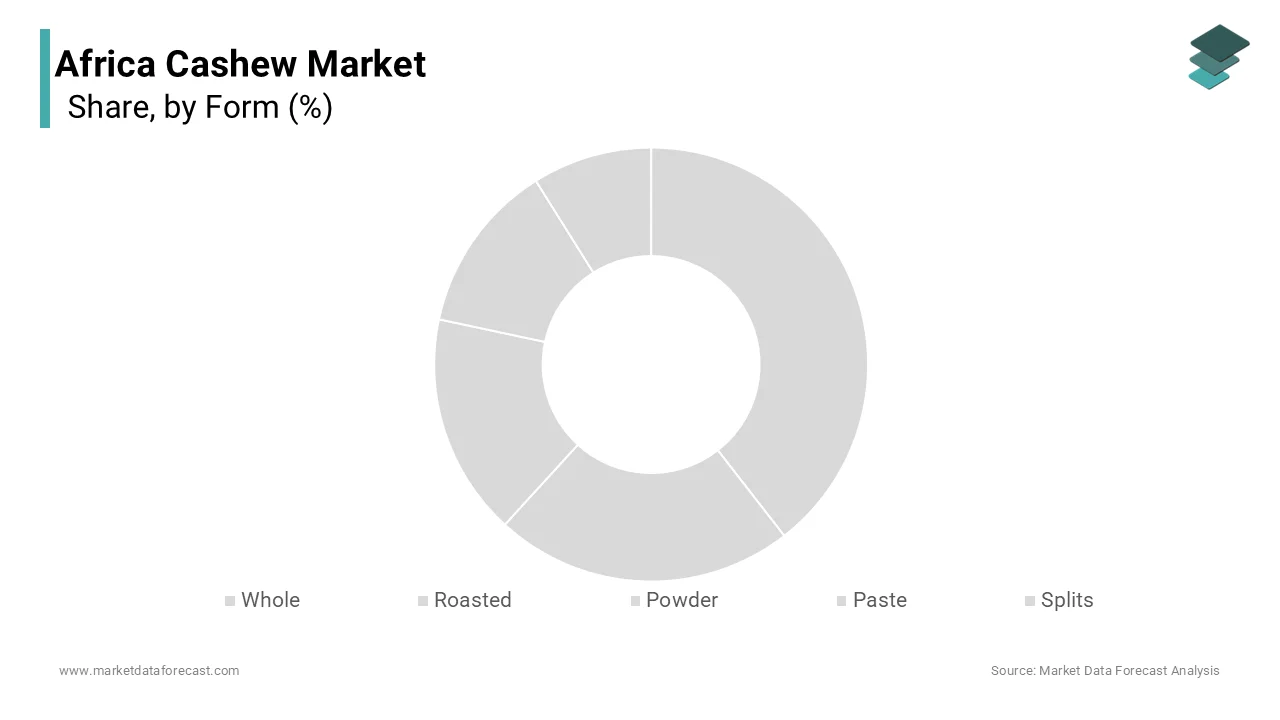
The cashew paste segment is projected to register the highest CAGR of 12.4% between 2026 and 2034. This rapid expansion is fueled by increasing demand for plant-based alternatives in dairy and meat industries. Cashew paste serves as a foundational ingredient in vegan cheeses, spreads, and dairy-free creams, particularly in South Africa and Kenya, where plant-forward diets are gaining traction. This shift is supported by rising lactose intolerance awareness and ethical consumerism. A further critical factor accelerating the growth of cashew paste is its adoption in infant and clinical nutrition formulations. As per UNICEF’s 2022 nutrition supply chain assessment, fortified nut pastes are increasingly incorporated into ready-to-use therapeutic foods (RUTFs) for malnourished children in East Africa. Organizations such as Valid International have piloted cashew-based RUTF in Ethiopia, leveraging local sourcing to reduce import dependency. Moreover, the industrial scalability of paste production, requiring less precision than whole kernel sorting, enables small processors in Tanzania and Mozambique to enter high-value markets with lower capital investment, fostering inclusive sectoral growth and innovation.
By Application Insights
The snacks & bars segment led the Africa cashew market by application by capturing 35.7% of total consumption volume in 2025. This dominance is credited to the rising popularity of ready-to-eat (RTE) nutritious snacks among Africa’s expanding urban middle class. Cashews are a preferred ingredient in energy bars and trail mixes due to their high caloric density, protein content, and palatability. In South Africa, retail sales of nut-based snack bars reached ZAR 1.2 billion in 2023, a 14% increase from 2021, according to Statista’s South African Food & Drink Report. The proliferation of health-conscious consumerism in metropolitan areas is a key driver of this segment’s growth. As per a 2023 World Bank Living Standards Measurement Study, over 40% of urban consumers in Kenya and Nigeria now prioritize nutrient-dense snacks over traditional fried alternatives. This behavioral shift is amplified by aggressive marketing from brands like NuPasta and Zest, which position cashew-enriched bars as fitness-friendly options. Besides, partnerships between African food startups and global nutrition firms, such as the 2022 collaboration between Nairobi-based Kuli Kuli and DSM, are expanding product innovation and shelf visibility, further entrenching cashews in the functional snack ecosystem.
The beverages segment is emerging as the fastest-growing application and is projected to grow at a CAGR of 13.8% from 2026 to 2034. This surge is driven by the rising popularity of plant-based milk alternatives, particularly in urban centers with growing vegan and lactose-intolerant populations. Cashew milk, known for its creamy texture and low allergenicity, is increasingly replacing dairy in cafes and households across Kenya and South Africa. As per Kantar Worldpanel, plant-based milk sales in major South African retailers grew by 22% in 2023, with cashew variants accounting for 15% of the category. A different factor propelling beverage segment growth is local innovation in traditional drink formulations. In Côte d’Ivoire and Ghana, startups like Noya’s Farm and Coco & Cashew are blending cashew milk with hibiscus, ginger, and baobab to create culturally resonant, functional beverages. These products tap into both domestic demand and export potential in the diaspora market. Additionally, as per the African Development Bank’s 2023 Agri-Processing Investment Report, cashew milk production generates three times more revenue per ton of raw nut than kernel export, incentivizing processors to diversify into liquid formats and capture higher margins.
By Distribution Channel Insights
The supermarkets segment commanded the Africa cashew distribution channel by accounting for 58.4% of total retail sales value in 2025. This dominance is anchored in the rapid expansion of formal retail infrastructure in major African cities and the growing consumer preference for standardized, branded, and hygienically packaged products. Chains such as Shoprite, Game, and Carrefour have expanded their private-label nut ranges, including vacuum-packed cashews, across South Africa, Kenya, and Egypt. These retailers offer controlled storage conditions, ensuring product freshness and quality compliance. The rising penetration of organized retail in high-income urban corridors is a major factor behind supermarket dominance. According to the African Development Bank’s 2023 Urban Retail Index, formal supermarket coverage in cities like Nairobi, Addis Ababa, and Cape Town increased by 37% between 2019 and 2023. Additionally, consumer trust in supermarket quality assurance is reinforced by third-party certifications, over 70% of cashew packages in South African supermarkets now carry ISO 22000 or HACCP labels, as per the Southern African Bureau of Standards. This confidence, combined with loyalty programs and bulk promotions, sustains supermarkets as the primary gateway for premium cashew products.
The online store segment is experiencing the fastest growth, with a projected CAGR of 16.3% during the forecast period. This surge is driven by increasing smartphone penetration and digital payment adoption, particularly among younger, urban consumers. Platforms such as Jumia, Takealot, and Kilimall now feature dedicated gourmet food sections, offering branded and artisanal cashew products with doorstep delivery. In Kenya, e-commerce food sales grew by 41% in 2023, with nuts and dried fruits among the top-selling categories, according to the Kenya National Bureau of Statistics. An additional catalyst for online channel growth is the rise of direct-to-consumer (D2C) cashew brands leveraging social media marketing. Startups like NutriAfrica and CashewWell use Instagram and WhatsApp to target health-conscious millennials, offering subscription models and customized packs. As per a 2023 Ipsos survey, 52% of consumers in Lagos and Johannesburg prefer purchasing specialty nuts online due to wider variety and competitive pricing. Additionally, cross-border e-commerce enables African producers to export directly to diaspora communities in Europe and North America, bypassing traditional trade barriers and enhancing profitability.
REGIONAL ANALYSIS
Côte d’Ivoire stood as the undisputed leader in the Middle East and Africa cashew market by contributing 37.5% of regional raw nut production in 2025. The country has consolidated its position as the world’s largest raw cashew producer, surpassing Vietnam, with an output exceeding 800,000 metric tons. Government initiatives such as the National Cashew Strategy have incentivized smallholder planting and attracted foreign investment in processing. As per the Ivorian Ministry of Agriculture, over 40 modern processing plants were operational by 2025, increasing domestic shelling capacity to 200,000 tons annually. This vertical integration effort is reducing export dependency on raw nuts and enhancing foreign exchange earnings.
Tanzania holds a pivotal role in the MEA cashew landscape. The country produced approximately 280,000 metric tons in 2023, according to the National Bureau of Statistics (Tanzania). Recent policy reforms, including the lifting of raw nut export bans and tax incentives for processors, have revitalized the sector. The Southern Agricultural Growth Corridor of Tanzania (SAGCOT) has facilitated public-private partnerships, leading to the establishment of agro-processing zones in Mtwara and Lindi. As per the African Cashew Alliance, these developments have increased local processing rates from 10% in 2020 to nearly 30% in 2023, signaling a strategic shift toward value addition.
Nigeria emerges as a key player in domestic consumption and regional trade. The country’s large population and growing middle class drive demand for processed cashew products. As per the National Bureau of Statistics (Nigeria), imports of shelled cashews rose by 25% between 2021 and 2023 to meet urban consumer demand. Local brands like NutriJoy and Golden Nuts are expanding production of roasted and flavored variants. Additionally, the Nigerian government’s Anchor Borrowers’ Programme has begun integrating cashew into its agro-financing model, aiming to boost smallholder productivity and reduce reliance on imports.
Ghana maintains a strong presence in both production and processing. The country produced 220,000 metric tons in 2023, as reported by the Ghana Cocoa Board (COCOBOD), which also oversees cashew development. Ghana’s emphasis on certified organic and fair-trade cashews has secured premium access to European markets. As per the Ghana Export Promotion Authority, over 45% of its cashew exports in 2023 were certified organic, commanding price premiums of up to 20%. The country also hosts the annual Africa Cashew Conference, reinforcing its role as a knowledge and trade hub for the sector.
South Africa distinguishes itself as the region’s primary market for value-added cashew products. The country serves as a high-end consumption hub, with demand driven by health-conscious urban populations and a robust food manufacturing industry. As per Stats SA, retail sales of packaged nuts and seeds reached ZAR 2.1 billion in 2023, with cashews among the fastest-growing categories. South African brands like Woolworths and Rawsome are pioneering organic, flavored, and functional cashew snacks. Additionally, the country’s advanced cold chain and e-commerce infrastructure enable efficient distribution, positioning it as a gateway for premium cashew product innovation in Africa.
COMPETITIVE LANDSCAPE
The competition in the Africa cashew market is evolving from a commodity-driven export model to a value-focused, integrated industry. While traditional exporters focus on raw nut shipments, a new cohort of processors and agri-tech firms are differentiating through quality, certification, and innovation. Multinational agribusinesses compete with local cooperatives and national associations, each leveraging distinct advantages in sourcing, processing, or branding. The race to add value domestically has intensified, with countries like Ghana and Côte d’Ivoire investing in industrial zones and export incentives. Access to finance, technology, and skilled labor determines competitive edge. As global demand for sustainable and traceable nuts grows, African players are repositioning from raw suppliers to strategic partners in international food supply chains.
KEY MARKET PLAYERS
Olam International, Touton, Wilmar International, Asian Trading International, Ivory Coast Cajou are key players in the Africa cashew market.
TOP PLAYERS IN THE MARKET
- Olam Agri has established a robust presence across the African cashew value chain, operating in key producing nations such as Nigeria, Tanzania, and Côte d’Ivoire. The company engages directly with over 150,000 smallholder farmers through its outgrower schemes, providing improved seedlings, agronomic training, and guaranteed off-take agreements. In recent years, Olam has expanded its processing footprint by commissioning modern shelling facilities in Benin and Ghana, enhancing local value addition. The company also exports high-grade cashew kernels to Asia-Pacific markets, particularly India and Vietnam, where demand for raw materials in snack manufacturing remains strong. Olam Agri’s integration of digital traceability systems ensures compliance with food safety standards, strengthening its position as a reliable supplier in global supply chains.
- Ekow West Africa Limited, headquartered in Ghana, is a leading indigenous cashew processor and exporter with growing influence across West Africa. The company sources raw nuts from smallholder networks in Ghana, Côte d’Ivoire, and Burkina Faso, emphasizing fair pricing and sustainable practices. In 2023, Ekow launched a farmer digital enrollment platform to streamline procurement and improve transparency. It has strengthened its Asia-Pacific outreach by exporting premium-grade kernels to Japan and South Korea, where demand for organic and non-GMO nuts is rising. The company also partnered with Japanese food manufacturers to co-develop customized roasting profiles, enhancing product differentiation. By investing in quality control and export certification, Ekow West Africa is positioning itself as a niche supplier of specialty cashews in high-value Asian markets.
- While not a single corporate entity, the Cashew Millers Association of Nigeria (CEMAN) represents a consolidated force of over 40 processing firms that collectively shape Nigeria’s role in the global cashew sector. CEMAN has driven policy advocacy to restrict raw nut exports and promote domestic processing, aligning with national industrial goals. Its members have recently invested in automated shelling and grading technologies to improve kernel recovery and consistency. CEMAN has also facilitated export missions to Southeast Asia, forging supply agreements with snack producers in Thailand and Malaysia. By standardizing quality benchmarks and promoting Nigerian cashews as a premium product, the association is enhancing market access and building long-term partnerships in the Asia-Pacific region, particularly in emerging health food markets.
TOP STRATEGIES USED BY KEY MARKET PLAYERS
Key players in the Africa cashew market are deploying vertical integration to strengthen control over supply chains, from farm sourcing to export logistics. Companies are investing in direct farmer engagement through contract farming and input support to ensure consistent raw material supply. Strategic expansion of processing infrastructure enhances value addition and reduces reliance on raw nut exports. Partnerships with international food brands enable access to premium markets in Asia-Pacific and Europe. Digital tools are being adopted for traceability, quality assurance, and price transparency. Additionally, firms are focusing on certification—such as organic, fair trade, and ISO—to meet stringent import standards. These strategies collectively improve competitiveness, build brand equity, and increase resilience in volatile global markets.
RECENT HAPPENINGS IN THE MARKET
- In February 2023, Olam Agri launched a digital farmer registration system in Nigeria, enabling real-time monitoring of cashew procurement and improving supply chain transparency.
- In June 2023, Ekow West Africa Limited inaugurated a new solar-powered processing plant in Ghana, increasing shelling capacity and reducing energy costs.
- In September 2023, CEMAN signed a trade agreement with a Malaysian food manufacturer to supply 5,000 metric tons of shelled cashews annually.
- In January 2025, Olam Agri partnered with the International Finance Corporation to secure financing for smallholder cashew farmers in Tanzania.
- In March 2025, Ekow West Africa Limited obtained JAS organic certification, allowing direct exports of cashew kernels to the Japanese market.
MARKET SEGMENTATION
This research report on the Africa cashew market is segmented and sub-segmented into the following categories.
By Form
- Whole
- Roasted
- Powder
- Paste
- Splits
By Application
- Dairy Products
- Bakery Products
- Snacks & Bars
- Confectionaries
- Cereals
- Desserts
- Beverages
- Cosmetic Products
- Others
By Distribution Channel
- Retailers
- Supermarkets
- Online Store
By Region
- Sudan
- Egypt
- Kenya
- Ethiopia
- South Africa
- Rest of Africa