- Product Description Description
- Table of Contents TOC
- List of Table & Figure LOT
- Get Free Sample PDF Sample PDF
Market Size, 2025
$1.96 BnMarket Estimate, 2026
$2.13 BnMarket Forecast, 2034
$4.19 BnCAGR, 2026–2034
5.38%Africa Data Center Market Size
The size of the Africa data center market was valued at USD 1.96 billion in 2025. This market is expected to grow at a CAGR of 5.38% from 2026 to 2034 and be worth USD 4.19 billion by 2034 from USD 2.13 billion in 2026.
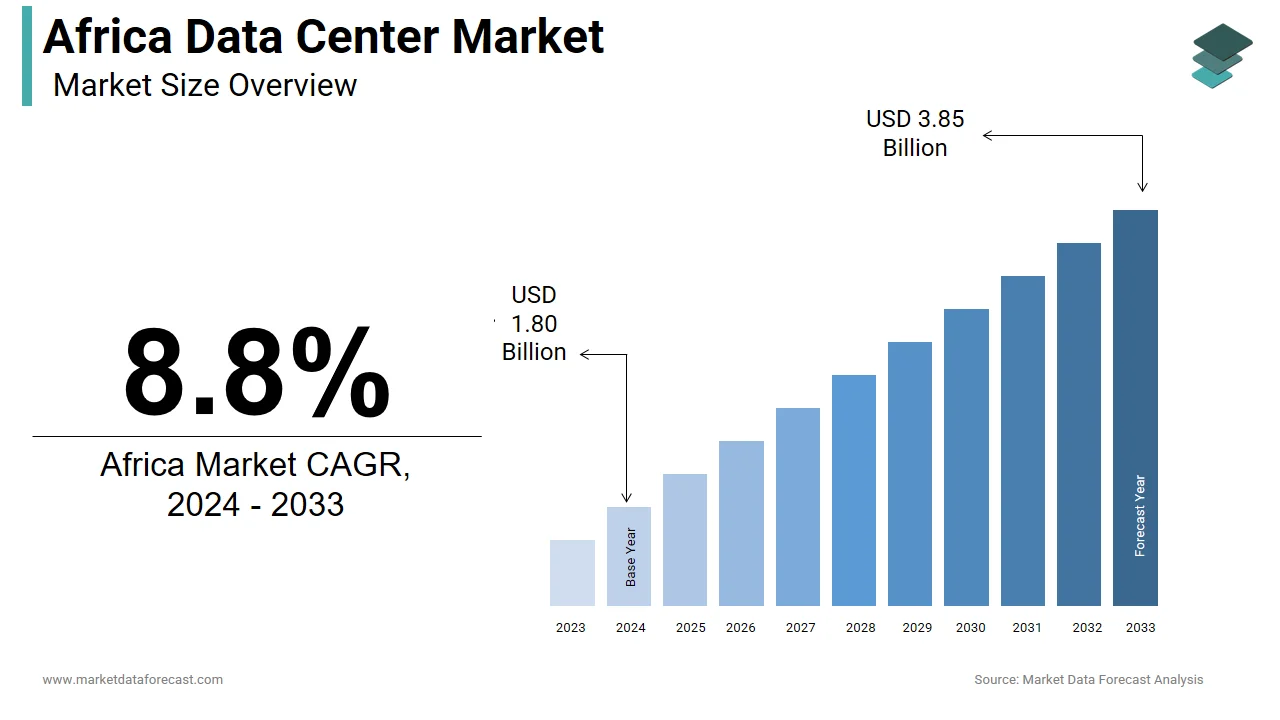
A data center includes a wide range of facilities, including hyperscale, enterprise, and edge data centers, each catering to specific operational needs across industries.
South Africa remains the most developed hub. Nigeria, Kenya, and Egypt are also emerging as key markets due to rising mobile broadband usage and government-led digital transformation initiatives.
In terms of infrastructure, undersea cable projects such as 2Africa and Equiano have significantly enhanced international bandwidth, improving connectivity and reducing latency. Apart from these, renewable energy integration into data center operations is gaining traction, with companies like Teraco incorporating solar power in their facilities. These developments reflect a broader trend toward sustainability and energy efficiency across the African data center landscape.
MARKET DRIVERS
Expansion of Digital Economy and Internet Penetration
The rapid expansion of the digital economy, supported by increasing internet penetration and smartphone adoption is one of the primary drivers fueling the growth of the Africa data center market. According to the International Telecommunication Union (ITU), internet usage in Africa rose from 2.1% in 2005 to over 30% in 2023, indicating a significant shift towards digital engagement. This rise is further accelerated by the proliferation of affordable smartphones and mobile data plans, particularly in countries like Nigeria, Kenya, and Ghana.
As more individuals and businesses go online, there is a corresponding surge in demand for localized data storage and processing capabilities. This expanding user base fuels the need for regional data centers that can provide low-latency services and comply with evolving data localization laws.
Moreover, the growth of digital banking, e-commerce, and remote work practices has heightened reliance on cloud-based infrastructure. Startups and enterprises increasingly depend on colocation services and managed hosting solutions, prompting major players like Amazon Web Services (AWS) and Microsoft Azure to expand their presence in the region. As per McKinsey, Africa's digital economy could contribute up to $300 billion to the continent's GDP by 2030, reinforcing the strategic importance of data centers in supporting this digital transition.
Government Initiatives and Policy Reforms
Government-led policy reforms and digital infrastructure development programs are playing a pivotal role in advancing the Africa data center market. Across several nations, regulatory bodies have introduced favorable policies aimed at attracting foreign investment, streamlining licensing procedures, and promoting technology innovation. For example, the South African government launched the National Development Plan 2030, which emphasizes the creation of a digitally inclusive society and supports large-scale ICT infrastructure projects.
In East Africa, Kenya’s National Broadband Strategy aims to achieve universal broadband access by 2027, directly influencing the demand for supporting data infrastructure. Similarly, Egypt has implemented tax incentives and land allocation policies to attract global cloud service providers, contributing to the establishment of new hyperscale facilities.
Besides, the African Continental Free Trade Area (AfCFTA) agreement is fostering cross-border digital trade, necessitating reliable data exchange platforms and secure data management systems. These coordinated efforts by national and continental authorities are instrumental in shaping a conducive environment for sustainable data center development across Africa.
MARKET RESTRAINTS
High Capital Expenditure and Operational Costs
The high capital expenditure (CAPEX) associated with building and maintaining data infrastructure is one major restraint affecting the growth of the Africa data center market. Establishing a Tier III or Tier IV data center requires significant upfront investment in real estate, cooling systems, uninterruptible power supplies (UPS), and fiber optic connectivity.
Operational costs further escalate due to unreliable grid electricity, compelling operators to rely heavily on diesel generators. As per the BloombergNEF, diesel accounts for nearly 40% of total operating expenses in Nigerian data centers, making them among the most expensive to run globally.
Moreover, the lack of standardized regulations across African countries increases compliance complexity and raises entry barriers for international investors. Inconsistencies in taxation, import duties on IT equipment, and permitting processes add layers of uncertainty. These challenges have resulted in slower deployment cycles and limited scalability for smaller operators.
Limited Skilled Workforce and Technical Expertise
The shortage of skilled professionals capable of managing complex data infrastructure is another critical challenge impeding the Africa data center market. Despite growing demand for digital services, there remains a significant gap in technical expertise related to data center design, operations, cybersecurity, and maintenance.
This shortage is particularly pronounced in Central and West Africa, where formal training programs in data center engineering and cloud technologies are scarce. According to a 2024 report by the International Finance Corporation (IFC), less than 10% of higher education institutions in sub-Saharan Africa offer specialized courses in data center management or information and communication technology (ICT) infrastructure. Consequently, many firms must recruit expatriate talent or invest in extensive employee training, both of which increase operational overheads.
Furthermore, the absence of structured certification frameworks compounds the issue. While organizations like Cisco Networking Academy and Huawei’s Seeds for the Future program are making strides in skill development, the pace remains insufficient to meet industry demands.
MARKET OPPORTUNITIES
Rise of Edge Computing and 5G Deployment
The rollout of 5G networks and the increasing adoption of edge computing represent a significant opportunity for the Africa data center market. With 5G promising ultra-low latency and high-speed connectivity, there is a growing necessity for localized data processing capabilities closer to end-users. This paradigm shift is driving the development of edge data centers, particularly in urban centers and industrial zones where real-time applications such as smart manufacturing, autonomous vehicles, and augmented reality are gaining traction.
These advancements are encouraging telecom operators and cloud service providers to invest in distributed data infrastructure that supports edge computing models. For instance, MTN Group has announced plans to deploy edge nodes across its network in partnership with AWS and Microsoft Azure.
Moreover, the demand for real-time analytics in sectors such as healthcare, logistics, and finance is accelerating the need for localized data handling. This presents a unique window for data center operators to capitalize on hybrid architectures that combine centralized cloud resources with decentralized edge nodes, enhancing performance and reducing latency for end-users.
Renewable Energy Integration and Sustainability Trends
Sustainability is becoming a central theme in the evolution of the Africa data center market, offering opportunities for innovation and long-term operational efficiency. As global pressure mounts to reduce carbon footprints, data center developers in Africa are exploring renewable energy sources such as solar, wind, and hydroelectric power to meet energy demands sustainably. Given the continent’s abundant sunlight and untapped wind potential, integrating clean energy into data center operations is not only environmentally responsible but also economically viable.
South Africa’s Teraco Data Environments, for example, has incorporated solar farms into its facility designs, reducing dependency on fossil fuels. According to the Council for Scientific and Industrial Research (CSIR), South Africa receives an average of 2,500 hours of sunshine annually, making it one of the best regions globally for solar power generation. Similarly, Kenya’s Lake Turkana Wind Power project, the largest wind farm in Africa, offers a replicable model for powering data infrastructure in remote locations.
Moreover, green certifications such as Uptime Institute’s Tier Standards and Leadership in Energy and Environmental Design (LEED) are gaining traction among African developers seeking to attract global clients.
MARKET CHALLENGES
Inadequate Power Infrastructure and Grid Reliability
The inadequacy of power infrastructure and inconsistent grid reliability is a persistent challenge facing the Africa data center market. Across much of the continent, electricity supply remains unstable, characterized by frequent outages and insufficient generation capacity. According to the World Bank's 2023 Africa’s Pulse report, nearly 600 million people in Africa still lack access to electricity, while those connected often experience intermittent supply.
In countries like Nigeria and Ghana, data center operators must rely on costly backup power solutions such as diesel generators and battery storage systems to ensure uninterrupted operations. Even in relatively stable environments like South Africa, rolling blackouts (load-shedding) have disrupted operations, prompting calls for alternative energy strategies.
Efforts to modernize the grid are underway, but progress remains slow. The African Development Bank estimates that the continent requires over $40 billion annually in energy investments to meet its development goals. Without substantial improvements in grid stability and investment in renewable alternatives, the risk of power disruptions will continue to deter large-scale data center investments in many parts of Africa.
Regulatory Fragmentation and Policy Uncertainty
Regulatory fragmentation across African countries poses a significant challenge to the uniform development of the data center market. Each country operates under distinct legal frameworks governing data privacy, cross-border data flows, taxation, and infrastructure licensing, complicating compliance for multinational operators. This inconsistency creates legal ambiguity, especially for cloud service providers and foreign investors seeking clarity on data sovereignty requirements. In Nigeria, for example, the Nigeria Data Protection Regulation (NDPR) mandates local data storage for certain categories of personal data, whereas other jurisdictions lack such clear directives. As per the United Nations Conference on Trade and Development (UNCTAD), this regulatory diversity increases the cost of doing business and discourages cross-border digital investments.
Further, policy reversals and sudden changes in taxation regimes further complicate the investment climate. Such unpredictability deters long-term capital commitments and delays the construction of critical digital infrastructure.
REPORT COVERAGE
| REPORT METRIC | DETAILS |
| Market Size Available | 2025 to 2034 |
| Base Year | 2025 |
| Forecast Period | 2026 to 2034 |
| Segments Covered | By Data Center Size, Tier Type, Absorption, and Region. |
| Various Analyses Covered | Global, Regional, and Country-Level Analysis, Segment-Level Analysis, Drivers, Restraints, Opportunities, Challenges; PESTLE Analysis; Porter’s Five Forces Analysis, Competitive Landscape, Analyst Overview of Investment Opportunities |
| Countries Covered | Sudan, Egypt, Kenya, Ethiopia, Ghana, South Africa, Rest of Africa |
| Market Leaders Profiled | Business Connexion (Pty) Ltd, Digital Realty Trust Inc., Equinix Inc., Teraco Data Environments (Digital Realty), Vantage Data Centers LLC, and others. |
SEGMENTAL ANALYSIS
By Data Center Size Insights
The large data center segment commanded the Africa data center market by contributing a 36.7% of total revenue in 2024. The growing need for localized infrastructure that supports hybrid IT environments is one key driver behind the dominance of large data center segment. Enterprises in countries like South Africa and Kenya are increasingly opting for colocation services within large facilities to manage data compliance and reduce latency.
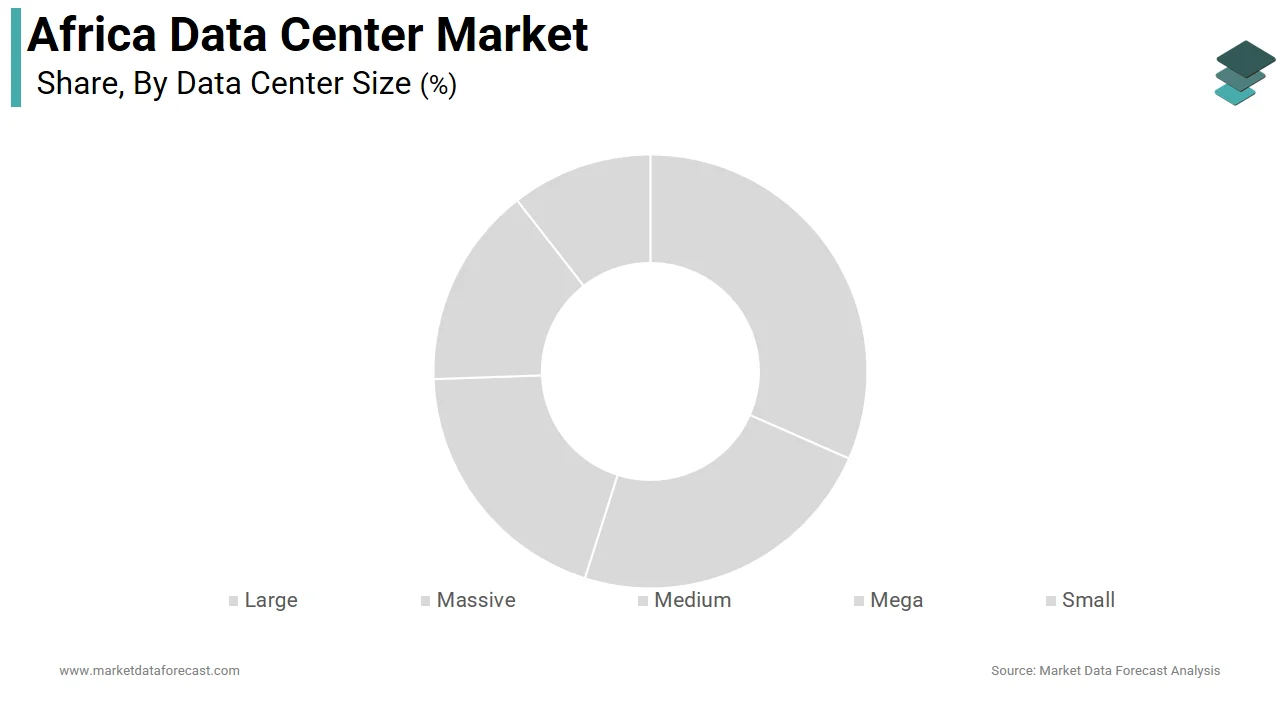
These facilities typically range between 10,000 to 50,000 square feet and serve a wide array of industries including banking, telecom, government, and cloud services.
Also, the rise of regional digital transformation initiatives is another factor drive this growth. Governments across the continent are mandating local data storage for public sector operations, increasing demand for large-scale facilities. For instance, Nigeria’s National Identity Management Authority (NIMC) operates from a large data center to manage over 100 million citizen records. Such regulatory shifts have made large data centers an essential component of national digital infrastructure.
Mega data centers segment (those exceeding 50,000 square feet) is projected to grow at the fastest rate in the Africa data center market, with a CAGR of 15.2% from 2025 to 2033. Hyperscale investments from global tech giants such as Microsoft, Google, and Amazon Web Services (AWS), which are establishing or expanding their presence in the region is rapidly expansing the growth of mega data centers segment. Further, the surge in demand for cloud computing and AI-driven applications is another key growth factor of this segment. Similarly, Google's Equiano subsea cable has enabled increased internet capacity, encouraging further investment in large-scale infrastructure. Apart from these, improvements in power infrastructure and fiber connectivity in urban hubs like Johannesburg and Nairobi are enabling scalable operations. Renewable energy integration is also playing a role; Teraco’s Isando campus in South Africa, for example, uses solar-powered cooling systems.
By Tier Type Insights
The tier 3 data centers segment represented the stringest type in the Africa data center market by holding a share of 52.3% in 2024. The rising demand for high-availability infrastructure among enterprise clients. Banks such as Standard Bank and MTN Group rely on Tier 3 facilities to support real-time transactions and mobile money platforms is propelling the growth of tier 3 data centers segmnet. These facilities offer concurrent maintainability, allowing for equipment upgrades and maintenance without service interruption, making them ideal for mission-critical operations across finance, telecom, and healthcare sectors.
An additional factor is the regulatory push for improved data resilience. Many African governments are enforcing stricter compliance standards for critical infrastructure providers. These regulations have accelerated the migration of older Tier 1 and Tier 2 centers toward Tier 3 certification, strengthening the segment’s dominance in the regional market.
The Tier 4 data centers segment is experiencing the fastest growth in the Africa data center market by registering a CAGR of 17.8% during the forecast period. The entry of global hyperscalers into the African market is a primary catalyst for the growth of Tier 4 data centers segment. Companies like Microsoft Azure and Oracle Cloud Infrastructure are constructing Tier 4-certified data centers in strategic locations to ensure maximum redundancy and uptime. These ultra-secure, fault-tolerant facilities are attracting significant investment due to the increasing reliance on cloud-based services and artificial intelligence across various sectors.
In addition, cybersecurity concerns are pushing organizations to adopt Tier 4 infrastructure. With cyberattacks on African institutions rising by over 60% in 2023, as reported by Kaspersky, there is a growing emphasis on deploying hardened, secure data environments.
By Absorption Insights
The non-utilized data center segment secured the largest portion of the Africa data center market with 55% of total available space in 2024. The cautious approach adopted by enterprises when migrating workloads to third-party infrastructure is a key reason for this imbalance. This includes facilities built with excess capacity to accommodate future expansion but currently operating below full occupancy.
Many firms, particularly in the public sector, are still in transition phases, preferring to gradually shift from legacy systems. A further aspect is the mismatch between supply and demand in certain regions. Countries like Ghana and Ethiopia have seen rapid construction of new facilities outpacing immediate demand. Until more businesses recognize the advantages of shared infrastructure, non-utilized centers will continue to dominate the landscape.
The utilized data center segment is growing at the fastest pace in the Africa data center market with a CAGR of 14.5% from 2025 to 2033. The progress of this segment reflects the increasing adoption of cloud services, remote work trends, and the digitization of traditional industries is accelerating the development of utilized data cenetrs segment.
Moreover, the surge in fintech and e-commerce activity across the continent also contribute to the growth of this segment. Startups and SMEs are rapidly moving their operations online, requiring scalable and secure hosting solutions. As reported by Disrupt Africa, over 1,200 fintech startups were active in Africa by mid-2024, many of which rely on managed data center services to process transactions and store customer data securely.
Besides, the expansion of multinational corporations into African markets is boosting utilization rates. Companies like Uber, Jumia, and Netflix are leveraging local data centers to improve performance and comply with data localization laws.
COUNTRY LEVEL ANALYSIS
South Africa Data Center Market Insights
South Africa maintained the leading position in the Africa data center market by accounting for 42.4% of total revenue in 2024. It is home to the most mature digital ecosystem on the continent, supported by stable governance, well-developed telecommunications infrastructure, and a growing cloud services industry. A major driving factor is the country’s early adoption of international-standard data center certifications. The presence of global hyperscalers such as AWS, Microsoft Azure, and Oracle further strengthens the market. Moreover, regulatory clarity around data privacy and cross-border data flows has attracted foreign investment. The Protection of Personal Information Act (POPIA) aligns closely with GDPR, giving multinational firms confidence in storing data locally.
Nigeria Data Center Market Insights
Nigeria is the fastest-growing in the Africa data center market. Despite infrastructural challenges, it is one of the fastest-growing markets due to rapid digital transformation, a booming startup ecosystem, and increasing government focus on ICT development. A key drivers is the country’s explosive growth in internet users. This digital boom has spurred demand for local data storage and processing capabilities. The Nigerian Communications Commission (NCC) has been actively promoting broadband expansion under the National Broadband Plan, aiming to achieve 70% penetration by 2025. Moreover, the Central Bank of Nigeria’s (CBN) push for financial inclusion has boosted the fintech sector, which heavily relies on cloud and data center infrastructure. These developments are fueling demand for scalable and secure data hosting solutions across the country.
Kenya Data Center Market Insights
Kenya holds a significant position in the Africa data center market. Known as the Silicon Savannah of Africa, Kenya is a regional leader in ICT innovation and digital services, supported by a young, tech-savvy population and proactive policy reforms. A major growth driver is the rapid expansion of mobile internet usage. Mobile money platforms like M-Pesa have created a robust digital transaction ecosystem, increasing demand for secure and scalable data infrastructure. Furthermore, Kenya has invested heavily in submarine cable connectivity, including the Eastern Africa Submarine Cable System (EASSy) and the TEAMS cable, enhancing international bandwidth and reducing latency. These factors are positioning Kenya as a key player in the regional data center landscape.
Egypt Data Center Market Insights
Egypt plays a vital role in the Africa data center market. Positioned at the crossroads of Africa, Europe, and the Middle East, Egypt is emerging as a strategic hub for international data traffic and digital infrastructure. A key driver is the government’s aggressive push for digital transformation. Under the Egypt Vision 2030 strategy, the Ministry of Communications has allocated substantial funds for ICT infrastructure development, including the establishment of new data parks and smart cities like New Administrative Capital. These initiatives are attracting global players like Huawei and AWS to set up regional operations. Further, Egypt’s participation in undersea cable projects such as Blue, Hawara, and SAIL is significantly improving international connectivity. These developments are fueling sustained growth in the Egyptian data center sector.
Rest of Africa Insights
The "Rest of Africa" category, encompassing countries like Ghana, Morocco, Ethiopia, Tanzania, and Uganda, collectively contributes a notable share of total revenue in the Africa data center market, as per Xalam Analytics. While individually smaller than South Africa or Nigeria, these nations are showing strong potential due to increasing digital adoption and supportive government policies. One notable growth driver is the rising investment in education and digital literacy programs. For instance, Rwanda has launched the Smart Rwanda Master Plan, aiming to build a knowledge-based economy by 2027. Morocco is another standout, with its national broadband plan targeting universal access by 2025. With increasing regional collaboration and private-sector engagement, the Rest of Africa segment is poised for substantial long-term growth.
COMPETITIVE LANDSCAPE
The competition in the Africa data center market is intensifying as both global hyperscalers and regional players expand their footprints to capture growing demand. While international giants like Amazon Web Services and Microsoft Azure bring advanced technologies and deep capital resources, local champions such as Teraco and Rack Centre leverage their domain expertise and regulatory familiarity to maintain strong positions. New entrants are emerging with specialized offerings, particularly in edge computing and green infrastructure, further diversifying the competitive landscape. The market is witnessing increased collaboration between private firms and governments to build scalable, compliant, and sustainable data ecosystems. As digital adoption accelerates across fintech, e-commerce, and public services, competition is shifting from mere capacity expansion to value-added services, innovation in design, and environmental responsibility. This evolving dynamic is shaping a more mature and competitive market environment across the continent.
KEY MARKET PLAYERS
Some of the noteworthy companies in the Africa data center market profiled in this report are
- Business Connexion (Pty) Ltd
- Digital Realty Trust Inc.
- Equinix Inc.
- Teraco Data Environments (Digital Realty)
- Vantage Data Centers LLC
TOP LEADING PLAYERS IN THE MARKET
- Teraco is a leading data center provider across Africa, with a strong presence in South Africa, Kenya, and Nigeria. The company has played a pivotal role in developing carrier-neutral colocation facilities that support major cloud providers, telecom operators, and enterprises. Teraco’s focus on sustainability, security, and scalability has made it a preferred partner for global hyperscalers looking to establish a footprint in the region.
- Based in Nigeria, Rack Centre is West Africa’s first Tier III-certified data center and a key enabler of digital transformation in the region. It offers enterprise-grade infrastructure with high availability and compliance standards. The company supports critical sectors such as finance, telecommunications, and government through secure and resilient data hosting solutions.
- AWS is a dominant global player expanding rapidly in Africa. Through its regional zones in Cape Town, AWS provides scalable cloud services that power startups, enterprises, and public sector organizations. Its investment in local infrastructure and partnerships has significantly influenced the growth trajectory of the African data center market.
TOP STRATEGIES USED BY KEY MARKET PARTICIPANTS
Expansion through Strategic Partnerships Leading players are forming strategic alliances with local telecom providers, cloud service companies, and government agencies to enhance their operational reach and offer integrated solutions tailored to regional needs.
Investment in Sustainable Infrastructure To align with global ESG goals and reduce operating costs, key players are increasingly investing in energy-efficient designs, renewable energy integration, and green building certifications for new and existing facilities.
Development of Edge and Hyperscale Facilities With growing demand for low-latency services and large-scale computing, companies are deploying both edge data centers closer to end-users and hyperscale facilities to support cloud-heavy applications and AI-driven workloads.
RECENT MARKET DEVELOPMENTS
- In August 2024, Microsoft announced the expansion of its Azure data center region in Johannesburg, reinforcing its commitment to supporting enterprise and government clients across Africa with enhanced cloud capabilities.
- In June 2024, Teraco launched a new phase of development at its Isando campus in South Africa, introducing additional modular space and improved connectivity options to meet rising demand from hyperscalers and financial institutions.
- In March 2024, Rack Centre entered into a strategic partnership with Oracle Cloud Infrastructure to offer hybrid cloud solutions tailored for Nigerian enterprises, strengthening its position as a key enabler of digital transformation in West Africa.
- In October 2023, AWS expanded its network of Points of Presence (PoPs) across multiple African countries, improving latency and performance for local users while enabling better integration with its global cloud infrastructure.
- In December 2023, Liquid Intelligent Technologies completed the acquisition of a majority stake in Helios Towers’ data center business, enhancing its portfolio of digital infrastructure assets and accelerating its growth strategy across East and Central Africa.
MARKET SEGMENTATION
This Africa data center market research report is segmented and sub-segmented into the following categories.
By Data Center Size
- Large
- Massive
- Medium
- Mega
- Small
By Tier Type
- Tier 1 and 2
- Tier 3
- Tier 4
By Absorption
- Non-Utilized
- Utilized
By Country
- Sudan
- Egypt
- Kenya
- Ethiopia
- Ghana
- South Africa
- Rest of Africa