- Product Description Description
- Table of Contents TOC
- List of Table & Figure LOT
- Get Free Sample PDF Sample PDF
Market Size, 2025
$7.12 BnMarket Estimate, 2026
$7.56 BnMarket Forecast, 2034
$12.27 BnCAGR, 2026–2034
6.24%Africa Diesel Generator Market Size
The Africa diesel generator market size was valued at USD 7.12 billion in 2025 and is anticipated to reach USD 7.56 billion in 2026 from USD 12.27 billion by 2034, growing at a CAGR of 6.24% during the forecast period from 2026 to 2034.

A diesel generator refers to the diesel-powered electricity generation systems across residential, commercial, industrial, and institutional sectors. These generators serve as primary or backup power sources in response to the continent’s persistent energy deficits and unreliable grid infrastructure. According to the International Energy Agency (IEA), over 600 million people in sub-Saharan Africa lacked access to electricity in 2023, compelling widespread reliance on decentralized power solutions. The sector is further shaped by the absence of consistent fuel supply chains, evolving emissions regulations, and increasing competition from hybrid and solar-battery systems, positioning diesel generators within a rapidly transforming energy landscape.
MARKET DRIVERS
Persistent Grid Instability and Insufficient Power Infrastructure
Chronic power shortages and frequent blackouts remain a primary catalyst for diesel generator adoption across Africa. As per the World Bank’s 2023 Energy Progress Report, the average sub-Saharan African country experiences 107 hours of power outages annually, with some industrial zones in Nigeria facing over 200 hours. This unreliability disrupts manufacturing, healthcare, and telecommunications, forcing businesses to deploy diesel generators as operational safeguards. In South Africa, Eskom’s load-shedding crisis led to an increase in generator sales between 2021 and 2023, according to the South African Photovoltaic Industry Association (SAPVIA). Hospitals, data centers, and mining operations increasingly rely on diesel units to maintain uninterrupted operations, embedding these systems into critical infrastructure despite rising fuel costs.
Expansion of Off-Grid Industrial and Mining Activities
Remote industrial and extractive operations in Africa, particularly in mining and oil & gas, depend heavily on diesel generators due to their geographical isolation from national grids. According to the African Development Bank (AfDB), a significant share of active mining sites in Zambia, Mali, and Guinea operate off-grid, relying on diesel-based power systems for processing, ventilation, and logistics. In 2023, Barrick Gold’s Kibali mine in the Democratic Republic of the Congo operated a 55 MW diesel hybrid plant, one of the largest in Central Africa. The portability, scalability, and rapid deployment of diesel generators make them indispensable in such environments. As exploration expands into underdeveloped regions, the demand for robust, mobile power solutions continues to rise, reinforcing the sector’s strategic relevance.
MARKET RESTRAINTS
Volatility in Diesel Fuel Supply and Pricing
The economic viability of diesel generators is significantly undermined by inconsistent fuel availability and price fluctuations across Africa. According to the African Energy Chamber, diesel prices in Nigeria surged by 65% between 2022 and 2023 following the removal of fuel subsidies, directly increasing generator operating costs. In Kenya, fuel makes dominant share of total generator lifecycle expenses. Additionally, supply chain disruptions in landlocked nations delay fuel deliveries, leading to operational downtime. These challenges deter long-term investment in diesel-dependent systems, especially for small and medium enterprises that lack financial buffers to absorb energy cost volatility.
Increasing Regulatory Pressure on Carbon Emissions
Environmental regulations targeting fossil fuel use are emerging as a growing constraint on diesel generator deployment. As per the United Nations Environment Programme (UNEP), many African countries have incorporated generator emission limits into their national climate action plans under the Paris Agreement. Rwanda and Kenya now enforce Euro 3 emission standards for new generator sets, restricting the import of older, high-pollution models. In 2023, the Nigerian government proposed a carbon tax on diesel consumption, which could increase generator operating costs by up to 20%, according to the Nigerian National Petroleum Company (NNPC). These policies incentivize a shift toward cleaner alternatives, reducing the long-term attractiveness of diesel-based power, particularly in urban and environmentally sensitive zones.
MARKET OPPORTUNITIES
Integration of Hybrid Power Systems with Renewable Energy
A transformative opportunity lies in the integration of diesel generators with solar photovoltaic and battery storage systems to create hybrid power solutions. According to the International Renewable Energy Agency (IRENA), hybrid systems can reduce diesel consumption by 40–70% in off-grid applications. In Namibia, the Rosh Pinah zinc mine reduced its diesel use after installing a 5 MW solar-battery-diesel hybrid plant in 2023. Companies like Aggreko and Wärtsilä are deploying containerized hybrid units across East and West Africa, offering scalable, fuel-efficient power for telecom towers and rural clinics. These systems combine the reliability of diesel with the sustainability of renewables, extending generator relevance in a decarbonizing energy market while lowering operational costs.
Growth in Modular and Containerized Generator Solutions
The demand for prefabricated, mobile power units is creating new market avenues for diesel generator manufacturers. Containerized generators, pre-assembled in ISO containers, offer rapid deployment, noise reduction, and enhanced safety, making them ideal for emergency response and temporary infrastructure. In 2023, telecom operations deployed containerized generators across Tanzania and Malawi to support 4G network expansion. These modular systems reduce installation time by up to 60% compared to traditional setups, offering a compelling value proposition for sectors requiring agile, scalable power solutions in remote or unstable environments.
MARKET CHALLENGES
Proliferation of Substandard and Counterfeit Generator Units
The widespread availability of low-quality, unregulated diesel generators undermines system reliability and safety across Africa. According to the Standards Organization of Nigeria (SON), more than half of generator units tested in Lagos markets in 2023 failed basic safety and performance benchmarks, including fuel efficiency and emission control. These substandard units, often imported from informal channels, suffer from high breakdown rates and pose fire and health risks. In Kenya, the Energy Regulatory Commission pointed out an increase in generator-related accidents between 2021 and 2023, largely attributed to uncertified models. The lack of enforcement and consumer awareness perpetuates the dominance of inferior products, eroding trust in the market and discouraging investment in legitimate, high-performance systems.
Shortage of Skilled Technicians for Maintenance and Repair
The effective operation of diesel generators requires regular maintenance and technical expertise, yet Africa faces a critical shortage of trained service personnel. As per the International Labour Organization (ILO), fewer number of generator technicians in Ethiopia, Uganda, and Angola hold formal certification in engine diagnostics and repair. This skills gap leads to improper servicing, reduced equipment lifespan, and increased downtime. The absence of standardized training programs and manufacturer-backed service networks limits after-sales support, particularly in rural areas, constraining the long-term sustainability of diesel power infrastructure.
SEGMENTAL ANALYSIS
By Ratings Insights
The 0–75 kVA segment dominated the Africa diesel generator market by capturing a 53.5% of total unit sales in 2024. This dominance is primarily driven by widespread demand from small and medium enterprises (SMEs), residential users, and telecom microsites that require compact, affordable, and easily deployable power solutions. In Nigeria, most of SMEs rely on sub-75 kVA units for daily operations due to persistent grid outages. These generators are favored for their portability, lower fuel consumption, and compatibility with urban infrastructure constraints, making them ideal for densely populated areas like Lagos and Nairobi. The proliferation of informal sector businesses that operate without grid connectivity is a key factor reinforcing the dominance of this segment. In Kenya, the there was an annual increase in sub-75 kVA generator imports between 2021 and 2023, largely attributed to expanding retail and hospitality microbusinesses. Additionally, manufacturers such as Cummins and Honda have localized assembly in East and West Africa to reduce costs, enhancing affordability and after-sales service accessibility, which further entrenches the segment’s market position.
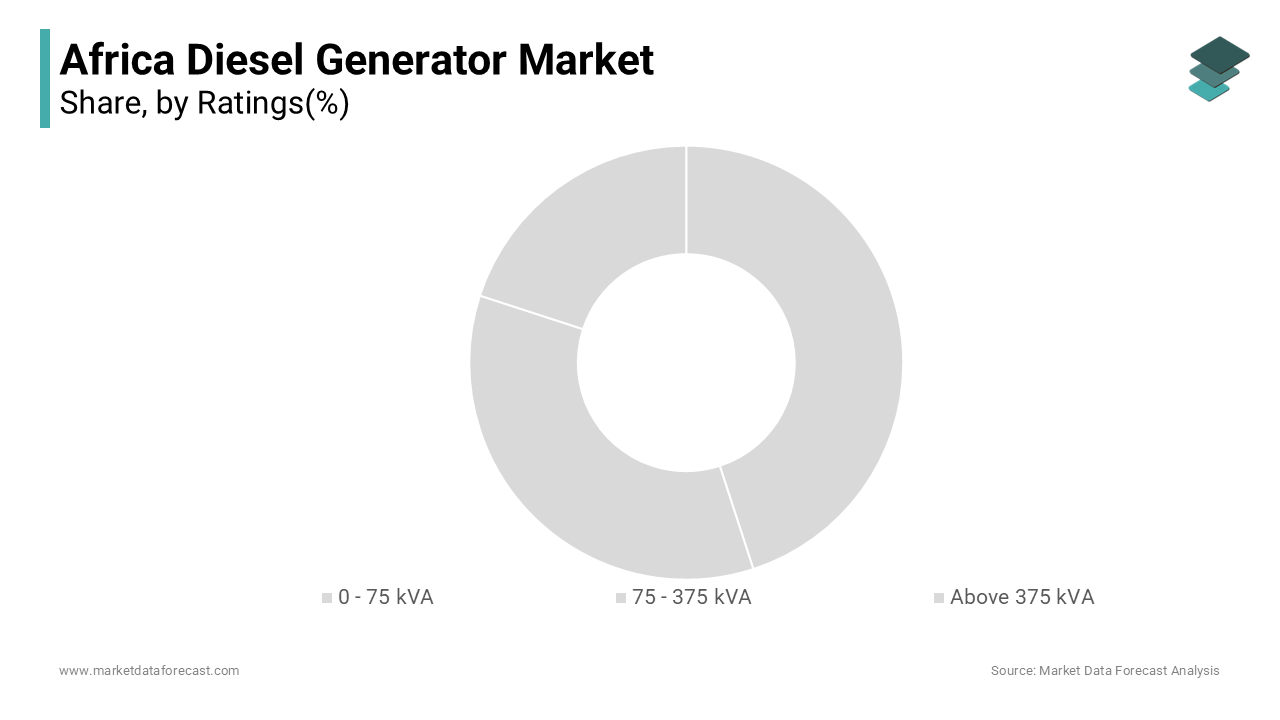
The Above 375 kVA segment is projected to register the highest CAGR of 11.6% from 2025 to 2033. This accelerated growth is fueled by rising investments in large-scale infrastructure, including mining, data centers, and industrial parks, which demand high-capacity, continuous power supply. In South Africa, where load-shedding has intensified, enterprises such as MTN and Bidvest installed multi-megawatt diesel backup systems exceeding 500 kVA to sustain operations during prolonged blackouts. The segment is also gaining traction in energy-intensive sectors like cement production and oil refining, where uninterrupted power is critical. A further driver is the increasing adoption of diesel generators as primary power sources in off-grid industrial zones. Also, in the Democratic Republic of the Congo, major mining operations in the Copperbelt region are expanding their on-site diesel fleets to exceed 100 MW capacity. These developments reflect a strategic shift toward self-sufficient energy systems, positioning large-rated generators as essential infrastructure assets.
By Application Insights
The backup power segment held the largest share of the Africa diesel generator at 65.3% of total installations in 2024. This dominance is rooted in the continent’s reliance on generators as secondary power sources during grid failures rather than as primary energy systems. In urban centers like Johannesburg, Cairo, and Nairobi, businesses, hospitals, and telecommunications networks deploy diesel units exclusively for emergency power continuity. The institutional dependence on uninterrupted power for critical services is a major driver of this segment’s position. Telecom operators such as Airtel and Safaricom maintain diesel-powered base stations across East Africa, with most configured for backup mode. Additionally, financial institutions and data centers mandate N+1 redundancy, requiring automatic transfer switches and on-site diesel units. The predictability of grid failure patterns has institutionalized backup power as a standard operational requirement, ensuring sustained demand across sectors.
The prime power segment is emerging as the fastest-growing application and is projected to grow at a CAGR of 10.9% during the forecast period. This growth is driven by the absence of grid infrastructure in remote and rural regions, where diesel generators serve as the sole source of electricity. In Chad, only limited share of the rural population has access to the national grid, compelling communities and local enterprises to rely on diesel-based mini-grids. Similarly, in northern Nigeria and South Sudan, decentralized diesel systems power schools, clinics, and irrigation pumps. A different factor accelerating prime power adoption is the expansion of off-grid industrial and agricultural projects. These units support milling, cold storage, and packaging, enabling rural value addition. Additionally, governments and development agencies are deploying containerized diesel plants to power newly established special economic zones (SEZs) in Mozambique and Senegal. Unlike backup systems, prime power units operate continuously, requiring higher durability and fuel efficiency, which is driving demand for advanced, Tier-3 emission-compliant models in underserved regions.
REGIONAL ANALYSIS
South Africa occupied a central position in the Middle East and Africa diesel generator market by accounting for 24.1% of regional demand value in 2024. The country’s prolonged and institutionalized load-shedding crisis has transformed diesel generators from emergency assets into operational necessities across industries. Eskom’s grid instability led to over 200 days of power cuts in 2023, prompting businesses to invest in high-capacity backup systems. Mining, manufacturing, and data centers are the largest adopters, with companies like Anglo American and Naspers deploying multi-megawatt diesel fleets.
Nigeria stands as a dominant force in unit volume demand. With grid electricity reaching only half of the population and frequent outages affecting urban centers, diesel generators are ubiquitous across households, SMEs, and commercial complexes. The informal sector’s reliance on decentralized power has created a massive aftermarket for fuel, maintenance, and spare parts. Additionally, the government’s push for industrialization under the Nigerian Industrial Revolution Plan has spurred demand for larger units in new manufacturing clusters.
Egypt holds a strategic position in North Africa’s diesel generator landscape. Rapid urbanization and industrial expansion, particularly in the New Administrative Capital and Suez Canal Economic Zone, are driving demand for reliable off-grid power. The country experienced an increase in generator imports between 2022 and 2023. Critical infrastructure projects, including desalination plants and 5G telecom networks, rely on diesel units due to grid strain. Moreover, frequent voltage fluctuations damage sensitive equipment, making automatic backup systems essential for hospitals and data centers.
Kenya plays a pivotal role in East Africa’s power resilience market. The country’s growing technology and financial sectors are major consumers, with a significant portion of commercial buildings in Nairobi equipped with diesel backup systems, as per the Energy and Petroleum Regulatory Authority (EPRA). The rollout of 4G and 5G networks has increased the number of telecom towers requiring continuous power. Additionally, Kenya’s geothermal and wind farms use diesel generators as spinning reserve during low-generation periods, integrating them into hybrid energy strategies, as noted by the Kenya Electricity Generating Company (KenGen).
Ethiopia is emerging as a high-potential market. The country’s industrialization drive, particularly in textile and agro-processing zones, has outpaced grid development. Also, private investors are installing dedicated diesel plants, while development partners are funding hybrid systems that combine diesel with solar, ensuring uninterrupted production in off-grid industrial corridors.
COMPETITIVE LANDSCAPE
The competition in the Africa diesel generator market is intensifying as global manufacturers, regional distributors, and emerging local assemblers vie for dominance across diverse operational landscapes. While multinational firms leverage brand reputation, technological superiority, and service networks, regional players compete on cost and proximity to end-users. The market is fragmented by application, with distinct requirements for SMEs, telecom towers, and industrial plants shaping product differentiation. Innovation is increasingly focused on fuel efficiency, emissions compliance, and hybrid integration, driven by rising operational costs and environmental concerns. After-sales service, spare parts availability, and financing models have become critical competitive levers. As energy transition pressures grow, the race is on to redefine diesel generators not as standalone solutions but as flexible components within integrated, future-ready power ecosystems.
KEY MARKET PLAYERS
The key players in the Africa Diesel Generator Market include
- Cummins Inc.
- Caterpillar Inc.
- Kohler Co.
- Mitsubishi Heavy Industries Ltd.
- Generac Power Systems Inc.
- Wärtsilä Corporation
- Atlas Copco AB
- FG Wilson (a Caterpillar brand)
- Doosan Portable Power
- Perkins Engines Company Limited
- Himoinsa S.L. (a Yanmar Company)
- Kirloskar Oil Engines Ltd.
- Sterling and Wilson Pvt. Ltd.
- MTU Onsite Energy (Rolls-Royce Power Systems)
- Jubaili Bros.
Top Players in the Africa Diesel Generator Market
Cummins Inc.
Cummins Inc. maintains a dominant presence across the Africa diesel generator market through an extensive distribution and service network spanning over 30 countries. The company supplies a full range of generator sets from 5 kVA to over 2 MW, tailored for backup, prime, and continuous power applications in sectors such as healthcare, mining, and telecommunications. In recent years, Cummins has strengthened its position by establishing localized assembly plants in Nigeria and Kenya, reducing lead times and enhancing after-sales support. The company has also launched digital remote monitoring systems like PowerCommand, enabling predictive maintenance for critical installations. While deeply entrenched in Africa, Cummins leverages its global expertise from the Asia-Pacific region, where it has pioneered hybrid power solutions in markets like India and the Philippines, transferring technological innovations to African operations to improve efficiency and emissions compliance
Aggreko plc
Aggreko plc operates as a leading provider of temporary and modular power solutions across Africa, delivering diesel generator fleets for short-term and long-term energy needs. The company supports large-scale infrastructure projects, mining operations, and emergency response initiatives with scalable, containerized power units. In 2023, Aggreko deployed over 200 MW of diesel-based power across Nigeria, South Africa, and Mozambique, often integrating its systems with solar and battery storage. The company has enhanced its service model by introducing remote diagnostics and fuel management platforms, improving operational efficiency. Drawing from its strong Asia-Pacific footprint—where it has executed major power projects in Indonesia and Australia Aggreko applies advanced fleet optimization strategies in Africa. Its experience in managing complex energy logistics in remote Asian islands directly informs its deployment strategies in Africa’s off-grid industrial zones
Wärtsilä Corporation
Wärtsilä Corporation has established a strategic footprint in Africa by supplying high-efficiency, low-emission diesel generator engines for both standalone power plants and hybrid systems. The company’s solutions are deployed in countries such as Ghana, Uganda, and Namibia, where grid instability and off-grid industrialization drive demand for reliable power. Wärtsilä has introduced flexible power plants that combine diesel engines with energy storage, enabling faster response times and reduced fuel consumption. In 2023, it commissioned a 50 MW diesel-battery hybrid plant in Namibia, setting a benchmark for integrated power solutions. The company’s expertise in Asia-Pacific markets—particularly in balancing grid fluctuations in the Philippines and Indonesia—has informed its adaptive control systems used in African deployments. This cross-regional knowledge transfer strengthens Wärtsilä’s ability to deliver resilient, future-ready power infrastructure in Africa.
Top Strategies Used by the Key Market Participants
Key players in the Africa diesel generator market are adopting strategies centered on localization, technological integration, and service differentiation. Companies are establishing regional manufacturing and assembly units to reduce costs and improve delivery speed. There is a growing emphasis on hybridization, integrating diesel generators with solar PV and battery storage to enhance fuel efficiency and meet sustainability goals. Firms are also deploying IoT-enabled monitoring systems for remote diagnostics and predictive maintenance, ensuring higher uptime. Strategic partnerships with local distributors and governments enable deeper market penetration. Additionally, companies are investing in training programs to build technical service networks, addressing the shortage of skilled technicians and strengthening customer trust in product reliability across diverse operational environments.
RECENT MARKET DEVELOPMENTS
- In January 2023, Cummins Inc. launched a digital remote monitoring platform in South Africa, enabling real-time performance tracking and predictive maintenance for commercial and industrial generator users.
- In May 2023, Aggreko deployed a 45 MW temporary diesel power plant in Lagos to support critical infrastructure during Nigeria’s peak load-shedding period, reinforcing its role in emergency power supply.
- In August 2023, Wärtsilä commissioned a hybrid diesel-battery power plant in Windhoek, integrating 30 MW of diesel generation with 15 MW of battery storage to enhance grid stability.
- In November 2023, Cummins inaugurated a new assembly facility in Nairobi, expanding its East African footprint and reducing delivery timelines for customers in Kenya, Uganda, and Rwanda.
- In February 2024, Aggreko partnered with a Ghanaian mining company to install a modular, fuel-optimized diesel power system capable of reducing fuel consumption by 18% through smart load management.
MARKET SEGMENTATION
This research report on the Africa Diesel Generator Market is segmented and sub-segmented into the following categories.
By Ratings
- 0 - 75 kVA
- 75 - 375 kVA
- Above 375 kVA
By Application
- Prime
- Power
- Backup Power
- Peak Shaving
By Country
- South Africa
- Nigeria
- Rest of Africa