- Product Description Description
- Table of Contents TOC
- List of Table & Figure LOT
- Get Free Sample PDF Sample PDF
Market Size, 2025
$15.69 BnMarket Estimate, 2026
$16.58 BnMarket Forecast, 2034
$25.73 BnCAGR, 2026–2034
5.65%African Fertilizers Market Size, Share & Growth Analysis (2026–2034)
The African fertilizers market was valued at USD 15.69 billion in 2025, reaching USD 16.58 billion in 2026, and is projected to expand to USD 25.73 billion by 2034, registering a compound annual growth rate (CAGR) of 5.65% during the forecast period from 2026 to 2034.
- Market Scope: Comprehensive regional assessment spanning product types, application modes, crop categories, physical forms, and major country markets across South Africa, Nigeria, Kenya, Morocco, Egypt, Sudan, and the Rest of Africa.
- Primary Growth Drivers: Escalating government support through active fertilizer subsidy schemes, rising food security initiatives, and growing adoption of precision farming and soil health management.
Key Market Segment Metrics
| Category | Leading Segment | Fastest-Growing / Promising Segment |
|---|---|---|
| By Type | Straight Fertilizers in Conventional Form (Contributed 42.8% market share in 2024, driven by urea and DAP use for staple cereals) | Specialty Complex Fertilizers (Registering a CAGR of 12.8%, fueled by demand for customized, balanced, and micronutrient blends) |
| By Application Mode | Soil Application (Captured 65.5% of total usage in 2024, anchored by manual broadcasting across smallholder farming networks) | Fertigation (Growing at a CAGR of 14.3%, backed by expanding greenhouse infrastructure and precision water management) |
| By Crop Type | Field Crops (Accounted for 58.6% consumption in 2024, prioritized by staple food security and government voucher systems) | Horticultural Crops (Registering a CAGR of 13.7%, driven by high-value fresh produce exports and intensive nutrient input needs) |
Major Market Players & Industry Landscape
Competitive Structure: A dynamic ecosystem balancing global agro-chemical giants, regional phosphate extractors, and local blending entities competing via localized formulations, public-private partnerships, and digital agronomic services.
Leading Companies: OCP Group, Yara International ASA, Omnia Fertilizer, ICL Group Ltd, Foskor, Haifa Group, K+S Aktiengesellschaft, Kynoch Fertilizer, and UPL Limited.
Africa Fertilizers Market Size
The African fertilizers market was valued at USD 15.69 billion in 2025 and is anticipated to reach USD 16.58 billion in 2026 and USD 25.73 billion by 2034, growing at a CAGR of 5.65% during the forecast period from 2026 to 2034.
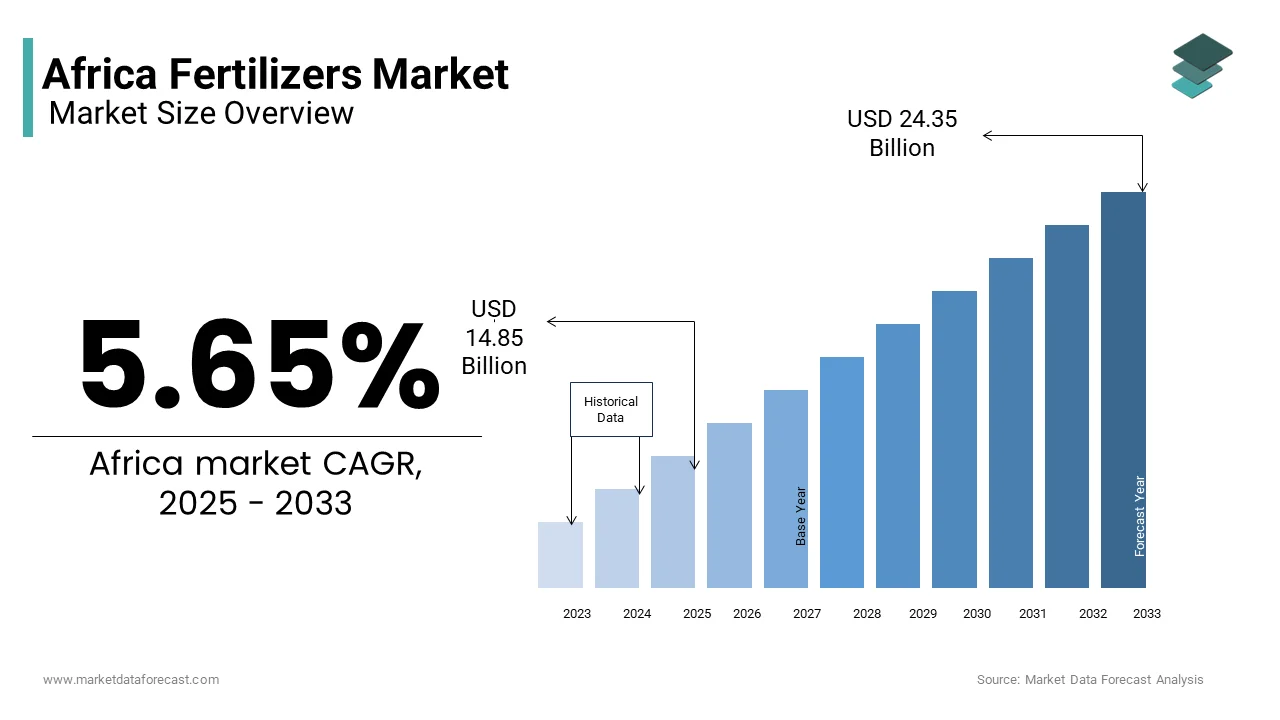
Fertilizers are nutrient-based products used to enhance soil fertility and improve agricultural yields across the continent. As agriculture remains a cornerstone of many African economies, the demand for fertilizers—both organic and inorganic—is growing steadily. The market includes major nutrients such as nitrogen (N), phosphorus (P), and potassium (K), along with secondary and micronutrients essential for sustainable crop production.
According to the Food and Agriculture Organization (FAO), Africa uses significantly less fertilizer per hectare compared to other continents, highlighting vast growth potential. However, increasing awareness about modern farming techniques, coupled with government initiatives promoting food security, is driving gradual adoption. The Comprehensive Africa Agriculture Development Programme (CAADP) under the African Union has emphasized boosting productivity through improved input use, including fertilizers.
Moreover, the rise in population and urbanization is intensifying pressure on food systems, prompting both public and private sector investments in agritech innovations. Local manufacturing capacity remains limited, leading to heavy reliance on imports. However, recent developments in phosphate mining in Morocco and Tanzania are reshaping regional dynamics.
MARKET DRIVERS
Increasing Government Support and Subsidy Programs
The increasing support from national governments through subsidy programs aimed at enhancing agricultural productivity is one of the primary drivers of the African fertilizers market. Many African countries have implemented policies that provide farmers with subsidized access to fertilizers to encourage higher crop yields and ensure food security.
According to the International Fertilizer Association (IFA), over 30 African nations have active fertilizer subsidy schemes, benefiting millions of smallholder farmers who otherwise cannot afford commercial inputs. For instance, in Nigeria, the government launched the National Fertilizer Quality Control Scheme to regulate and distribute subsidized fertilizers more efficiently. Similarly, Ethiopia's Agricultural Transformation Agency has been instrumental in improving access to blended fertilizers tailored to local soil conditions.
Moreover, organizations like AGRA (Alliance for a Green Revolution in Africa) have partnered with governments to improve supply chain efficiency and promote the use of quality-assured fertilizers.
Growing Adoption of Precision Farming and Soil Health Management
The growing adoption of precision farming techniques and increased focus on soil health management are other significant drivers of the African fertilizers market. As traditional farming practices face challenges such as declining soil fertility and erratic weather patterns, there is a shift toward data-driven approaches that optimize nutrient application based on specific field requirements.
According to the FAO, soil degradation affects over 65% of arable land in sub-Saharan Africa, making targeted fertilizer use critical for restoring productivity. Governments and research institutions are promoting soil testing services to guide the appropriate use of macro and micronutrients. In Kenya, for example, the Ministry of Agriculture has established mobile soil testing units to assist smallholder farmers in determining optimal fertilizer blends.
Moreover, digital platforms such as Hello Tractor and WeFarm are integrating agronomic advice with fertilizer recommendations, helping farmers make informed decisions. These advancements are gradually transforming fertilizer usage patterns across the continent.
MARKET RESTRAINTS
Limited Access to Finance and Distribution Challenges
The limited access to finance for smallholder farmers, who constitute the majority of agricultural producers, is a major restraint affecting the African fertilizers market. Without sufficient credit or financial support, many farmers struggle to afford high-quality fertilizers, particularly during planting seasons when liquidity is often constrained.
According to the African Development Bank (AfDB), less than 25% of smallholder farmers in sub-Saharan Africa have access to formal credit, limiting their ability to invest in productivity-enhancing inputs. This financial gap is further exacerbated by weak rural banking infrastructure and a lack of collateral among small-scale producers. Besides, poor transportation networks and logistical inefficiencies hinder the timely delivery of fertilizers to remote farming areas. These structural barriers constrain market penetration and impede the large-scale adoption of fertilizers across the continent.
High Import Dependency and Price Volatility
The region’s heavy reliance on imported fertilizers, which exposes it to global price volatility and supply chain disruptions, is another critical challenge facing the African fertilizers market. Despite recent developments in domestic phosphate extraction, most African countries depend on external suppliers for nitrogenous and potassic fertilizers.
As reported by the International Fertilizer Association (IFA), over 80% of fertilizers used in sub-Saharan Africa are imported primarily from Europe, the Middle East, and Asia. This dependence makes local markets vulnerable to fluctuations in international commodity prices, freight costs, and geopolitical tensions affecting supply routes.
Furthermore, currency devaluations in countries like Ghana and Zambia have made imported fertilizers increasingly expensive for local buyers. According to the United Nations Conference on Trade and Development (UNCTAD), imported fertilizer prices rose by more than 50% in some African markets between 2021 and 2023, straining household budgets and discouraging usage.
MARKET OPPORTUNITY
Expansion of Local Fertilizer Production and Blending Facilities
The expansion of local fertilizer production and blending facilities, driven by regional resource availability and government incentives, is a major opportunity emerging in the African fertilizers market. Countries rich in phosphate deposits, such as Morocco, Tunisia, and Senegal, are investing in processing plants to convert raw materials into finished products suited for African soils.
According to the Moroccan Office of Phosphates (OCP Group), Morocco alone accounts for over 70% of global phosphate rock reserves, positioning it as a key supplier for both domestic and regional markets. The company has established blending units across West and East Africa to produce customized fertilizers that address specific soil deficiencies.
In addition, Tanzania and Ethiopia are developing localized manufacturing capabilities to reduce import dependence. As per the African Fertilizer and Agribusiness Partnership (AFAP), the establishment of mini-blending plants in rural areas is improving accessibility and affordability for smallholder farmers, fostering sustainable market growth.
Rise of Organic and Bio-Based Fertilizers
The increasing interest in sustainable agriculture and environmental conservation is creating new opportunities for organic and bio-based fertilizers in the African fertilizers market. As concerns over chemical runoff, soil degradation, and health impacts grow, stakeholders are exploring eco-friendly alternatives that enhance soil microbiology and long-term fertility.
According to the FAO, organic farming is gaining traction in countries like Uganda, Kenya, and South Africa, where certification systems and export markets for organic produce are expanding. This trend is encouraging the development and adoption of compost-based and microbial fertilizers that align with regenerative agriculture principles.
Furthermore, research institutions and tech startups are introducing bio-stimulants and bio-fertilizers derived from legumes, seaweed, and beneficial bacteria. As noted by the Alliance for a Green Revolution in Africa (AGRA), bio-fertilizers can fix atmospheric nitrogen naturally, reducing dependency on synthetic inputs while maintaining yield levels.
MARKET CHALLENGES
Lack of Farmer Awareness and Extension Services
The lack of farmer awareness regarding proper fertilizer application methods and the benefits of balanced nutrient use is one of the major challenges confronting the African fertilizers market. Many smallholder farmers continue to rely on outdated practices, leading to inefficient use, over-application, or underutilization of fertilizers.
According to the International Institute of Tropical Agriculture (IITA), a significant proportion of farmers in West and Central Africa apply fertilizers without soil testing or expert guidance, resulting in suboptimal yields and environmental damage. Limited access to extension services further exacerbates this knowledge gap, especially in rural communities.
Moreover, the absence of structured training programs and advisory networks hinders the dissemination of best practices in nutrient management. Strengthening extension systems is therefore critical for improving fertilizer efficiency and maximizing returns on investment.
Regulatory Fragmentation and Quality Control Issues
Regulatory fragmentation across African countries poses a significant challenge to the harmonization and standardization of fertilizer products. Each nation operates under different regulatory frameworks governing importation, formulation, labeling, and quality assurance, complicating compliance for manufacturers and distributors.
As noted by the African Fertilizer Regulatory Forum (AFRF), inconsistent enforcement of quality standards has led to the proliferation of counterfeit or substandard fertilizers, undermining farmer confidence and reducing return on investment. In some cases, adulterated or improperly labeled products have caused crop failures and financial losses for smallholders.
Efforts to establish regional guidelines through bodies like the African Union and COMESA have made progress, but implementation remains uneven. According to the Food and Agriculture Organization (FAO), regional cooperation is essential to streamline certification processes and enhance market transparency.
REPORT COVERAGE
| REPORT METRIC | DETAILS |
| Market Size Available | 2025 to 2034 |
| Base Year | 2025 |
| Forecast Period | 2026 to 2034 |
| CAGR | 5.65% |
| Segments Covered | By Type, Application, Crop, Form, nd Region |
| Various Analyses Covered | Global, Regional, and Country-Level Analysis; Segment-Level Analysis; DROC; PESTLE Analysis; Porter’s Five Forces Analysis; Competitive Landscape; Analyst Overview of Investment Opportunities |
| Regions Covered | Sudan, Egypt, Kenya, Ethiopia, South Africa, Rest of Africa |
| Market Leaders Profiled | Foskor, Gavilon South Africa (MacroSource, LLC), Haifa Group, ICL Group Ltd, K+S Aktiengesellschaft, Kynoch Fertilizer, UPL Limited, Yara International ASA. |
SEGMENTAL ANALYSIS
By Type Insights
The straight fertilizers in conventional form segment held the largest share of the African fertilizers market and contributed 42.8% in 2024. The heavy reliance on urea and diammonium phosphate (DAP) among smallholder farmers, particularly for cereal crops like maize, rice, and wheat, is one key driver of the growth of straight fertilizers in the conventional form segment. These fertilizers supply a single primary nutrient—such as nitrogen (N), phosphorus (P), or potassium (K)—and are widely used due to their affordability and ease of application in staple crop production. According to the Food and Agriculture Organization (FAO), maize alone accounts for over 30% of total fertilizer consumption in sub-Saharan Africa, making straight fertilizers indispensable for staple food production. In addition, government subsidy programs across countries such as Nigeria, Ethiopia, and Kenya focus predominantly on distributing straight fertilizers to rural farmers.
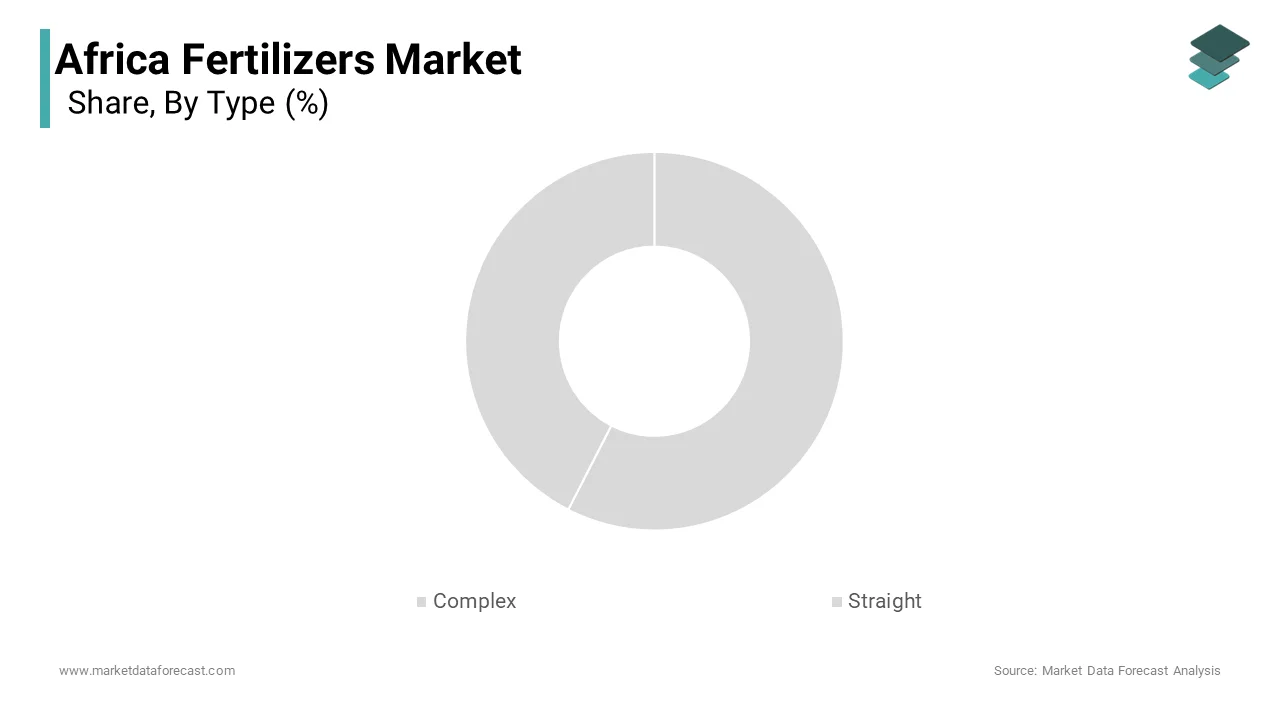
The complex fertilizers in specialty form segment is growing at the fastest rate in the African fertilizers market and is registering a CAGR of 12.8%. A major factor driving this expansion is the rising adoption of blended and micronutrient-enriched fertilizers, which combine multiple nutrients in a single granule for improved efficiency. This growth is attributed to increasing awareness about balanced plant nutrition and the need for customized nutrient solutions tailored to specific soil conditions. Moreover, specialty formulations such as controlled-release and water-soluble fertilizers are gaining traction in high-value horticulture and export-oriented farming. As per the African Fertilizer and Agribusiness Partnership (AFAP), specialty fertilizers enhance yield quality and reduce environmental impact, aligning with sustainable agriculture goals.
By Application Mode Insights
The soil application mode segment dominated the African fertilizers market by capturing 65.5% of total usage in 2024. A key reason for the dominance of the soil application mode segment is the predominance of smallholder farming systems that rely on manual broadcasting or row placement techniques. This traditional method remains the most prevalent due to its compatibility with existing farming practices, widespread use of granular and powdered fertilizers, and minimal requirement for specialized equipment. According to the International Institute of Tropical Agriculture (IITA), over 80% of fertilizers applied in West Africa are directly incorporated into the soil, particularly for staple crops such as maize, cassava, and sorghum. Besides, limited access to irrigation infrastructure and mechanized farming tools restricts the adoption of more advanced methods like fertigation and foliar sprays. As per the Food and Agriculture Organization (FAO), only a small fraction of cultivated land in sub-Saharan Africa utilizes drip irrigation, limiting the scalability of liquid-based fertilizer applications.
The fertigation application mode segment is emerging as the fastest-growing segment in the African fertilizers market and is recording a CAGR of 14.3% in the future. A major factor behind the rapid growth of the fertigation application mode segment is the expansion of greenhouse and commercial farming operations in countries like Kenya, South Africa, and Morocco, where high-value crops such as tomatoes, peppers, and flowers require intensive nutrient management. Fertigation involves delivering fertilizers through irrigation systems, enabling precise nutrient control and improved water-use efficiency—key advantages in water-scarce regions. According to the World Bank, investment in precision agriculture technologies has risen sharply, supported by private sector involvement and donor-funded initiatives promoting resource-efficient farming. Furthermore, government-backed irrigation schemes and agri-tech startups are introducing affordable drip irrigation kits tailored for small-scale farmers.
By Crop Insights
The field crops segment commanded the African fertilizers market by accounting for 58.6% of total consumption in 2024. The continued emphasis on boosting grain yields to meet rising food demand is one of the major drivers of the forage field crops segment. This includes staple grains such as maize, wheat, rice, and millet, which form the backbone of food security and agricultural economies across the continent. Besides, government-led initiatives such as the National Agricultural Input Voucher System in Malawi and the Growth Enhancement Support Scheme in Nigeria prioritize field crop production by subsidizing fertilizer distribution.
The horticultural crops segment is experiencing the fastest growth in the African fertilizers market and registering a CAGR of 13.7%. A key factor fueling the expansion of the horticultural crops segment is the increasing investment in high-value horticulture, particularly in East and Southern Africa, where exports of fresh produce to Europe and the Middle East have expanded significantly. This surge is driven by the rising production of fruits, vegetables, and tubers for both domestic consumption and export markets. According to the African Development Bank (AfDB), Kenya’s horticulture sector alone contributes over $1 billion annually in foreign exchange earnings, necessitating enhanced nutrient management strategies. Moreover, horticultural crops typically require more intensive nutrient inputs compared to cereals, leading to higher fertilizer application rates.
COUNTRY ANALYSIS
South Africa Fertilizers Market Analysis
South Africa maintained the leading position in the African fertilizers market by capturing 22.2% of total revenue in 2024. It boasts one of the most developed agricultural sectors on the continent, characterized by large-scale commercial farms, well-established supply chains, and integrated agribusiness models. A major growth driver is the country’s diversified cropping system, which includes maize, wheat, sugarcane, and high-value export crops such as citrus and grapes. Also, South Africa hosts several fertilizer manufacturing and blending facilities, including those operated by OCP Group and Omnia Fertilizer, reducing dependency on imports. As per the Department of Agriculture, Land Reform, and Rural Development, government initiatives supporting conservation agriculture and precision nutrient management are enhancing fertilizer efficiency, strengthening the country’s role as a regional leader in the sector.
Nigeria Fertilizers Market Analysis
Nigeria is the fastest-growing player in the African fertilizers market. A key driver is the National Fertilizer Quality Control Scheme launched by the Nigerian government, aimed at curbing adulteration and ensuring the timely availability of quality fertilizers to farmers. Despite infrastructural challenges, it is the fastest-growing market due to strong policy support, expanding population-driven food demand, and ongoing reforms in input distribution. Additionally, Nigeria's large base of smallholder farmers represents a significant consumer base for subsidized fertilizer programs. These developments are propelling Nigeria’s position in the regional fertilizers landscape.
Kenya Fertilizers Market Analysis
Kenya occupies a prominent position in the African fertilizer market. It serves as a regional hub for fertilizer blending and distribution, particularly in East Africa, due to its strategic location and well-developed logistics network. A notable growth driver is the widespread adoption of blended fertilizers tailored to local soil conditions, supported by government and donor-backed initiatives. According to the Kenya Agricultural and Livestock Research Organization (KALRO), blended fertilizers have been instrumental in improving maize yields in various agroecological zones, encouraging farmer adoption. Moreover, Kenya is witnessing a rise in specialty fertilizer use for horticulture, tea, and coffee—major export commodities. As per the United Nations Conference on Trade and Development (UNCTAD), Kenya’s floriculture industry alone consumes significant volumes of water-soluble and micronutrient-enriched fertilizers, reflecting evolving market dynamics.
Morocco Fertilizers Market Analysis
Morocco plays a strategic role in the African fertilizers market. Unlike other African nations that primarily consume fertilizers, Morocco is a leading producer and exporter, leveraging its vast phosphate reserves to drive regional and global trade. A major growth factor is the dominance of the Office Chérifien des Phosphates (OCP Group). Furthermore, Morocco has been expanding its partnerships with African governments to support food security initiatives.
Rest of Africa
The “Rest of Africa” category, encompassing countries like Ghana, Tanzania, Uganda, Ethiopia, and Zambia, collectively contributes notably to total revenue. While individually smaller than Nigeria or South Africa, these nations exhibit strong potential due to increasing agricultural investments and supportive policy frameworks. A notable growth driver is the expansion of national fertilizer subsidy programs and public-private partnerships. For example, Ethiopia’s Agricultural Transformation Agency has successfully scaled up the use of blended fertilizers, while Ghana’s Planting for Food and Jobs initiative has boosted demand for both straight and complex formulations. Tanzania is also advancing rapidly with its efforts to develop local phosphate resources, aiming to establish a domestic fertilizer industry.
COMPETITIVE LANDSCAPE
The competition in the African fertilizers market is intensifying as multinational corporations, regional manufacturers, and government-backed entities vie for influence in a rapidly evolving sector. While global giants like OCP Group and Yara International maintain strong footholds through large-scale production and distribution networks, regional players such as Omnia Fertilizer and local cooperatives are gaining traction by offering cost-effective and context-specific solutions. The market is also witnessing increased collaboration between international donors and domestic institutions to expand access to fertilizers in underserved areas. Innovation is shifting toward blended and specialty fertilizers that cater to varying soil types and cropping systems, making formulation adaptability a critical differentiator. Additionally, rising demand for sustainable and eco-friendly fertilizers is attracting new entrants into the space, further diversifying the competitive landscape. As governments prioritize food security and agricultural modernization, competition is expected to evolve beyond product sales toward comprehensive value chains, including logistics, agronomy services, and digital farm management integration.
KEY MARKET PLAYERS
These are the market players that are dominating the African fertilizers market.
- Foskor
- Gavilon South Africa (MacroSource, LLC)
- Haifa Group
- Omnia Fertilizer (South Africa)
- Yara International (Norway)
- OCP Group (Morocco)
- ICL Group Ltd
- KK+Aktiengesellschaft Kynoch Fertilizer
- UPL Limited
- Yara International ASA.
Top Players In The Market
- OCP Group is a global leader in phosphate production and a dominant player in the African fertilizers market. The company plays a pivotal role in supplying phosphate-based fertilizers to African farmers through localized blending facilities and tailored nutrient solutions. Its extensive distribution network and strategic partnerships with governments support food security initiatives across sub-Saharan Africa.
- Yara International is a leading global supplier of crop nutrition solutions and has a strong presence in the African fertilizers market. The company focuses on sustainable agriculture by offering customized fertilizer blends and digital farming tools that enhance nutrient efficiency. Yara’s investments in logistics, farmer training, and soil health programs contribute significantly to improving agricultural productivity in key African markets.
- Omnia Fertilizer is a major regional player specializing in the manufacturing and distribution of nitrogen and phosphate-based fertilizers. The company supports diverse agricultural sectors across Southern Africa and beyond by providing high-quality products and agronomic services. Omnia's commitment to innovation and sustainability strengthens its position as a reliable partner in the African agri-input supply chain.
Top Strategies Used By Key Market Participants
Localized Blending and Customized Formulations
Leading players are investing in mini-blending plants across African countries to produce region-specific fertilizer formulations that match local soil conditions and crop requirements. This approach enhances product relevance and improves adoption among smallholder farmers who depend on tailored nutrient solutions.
Public-Private Partnerships and Government Collaborations
Major companies are engaging in public-private partnerships to align their operations with national agricultural policies and subsidy programs. These collaborations help streamline fertilizer distribution, improve accessibility, and ensure compliance with regulatory standards while expanding market reach.
Farmer Education and Digital Extension Services
To build trust and encourage proper usage, key players are deploying mobile advisory services, field demonstrations, and digital platforms that provide real-time agronomic advice. These initiatives empower farmers with knowledge of efficient fertilizer application, enhancing productivity and fostering long-term brand loyalty.
RECENT MARKET NEWS
- In May 202, OCP Group launched a new mini-blending facility in Ghana, aimed at producing locally adapted fertilizers tailored to West African soil conditions, strengthening its regional supply chain and market penetration.
- In July 2024, Yara International expanded its digital farming initiative in Kenya, introducing an AI-powered app that provides real-time fertilizer recommendations based on soil data and weather patterns, enhancing farmer engagement and input efficiency.
- In March 2024, Omnia Fertilizer partnered with the South African Department of Agriculture to train over 5,000 smallholder farmers on best practices in nutrient management, reinforcing its commitment to sustainable agriculture and long-term market growth.
- In September 2023, ICL Group established a joint venture with a Tanzanian agribusiness firm to explore phosphate extraction and develop affordable fertilizer blends, aiming to reduce import dependency and serve East African markets more effectively.
- In February 2024, Nutrien Ltd., one of the world’s largest fertilizer producers, announced a collaboration with AGRA to support fertilizer importation and distribution logistics in Nigeria, ensuring the timely availability of essential nutrients during peak planting seasons.
MARKET SEGMENTATION
This research report on the African fertilizers market is segmented and sub-segmented into the following categories.
By Type
- Complex
- Straight
Micronutrients
- Boron
- Copper
- Iron
- Manganese
- Molybdenum
- Zinc
- Others
Nitrogenous
- Ammonium Nitrate
- Urea
- Others
Phosphatic
- DAP
- MAP
- SSP
- TSP
Potassic
- MoP
- SoP
Secondary Macronutrients
- Calcium
- Magnesium
- Sulfur
By Form
- Conventiona
- Specialtyty
- CRF
- Liquid Fertilizer
- SRF
- Water Soluble
By Application Mode
- Fertigation
- Foliar
- Soil
By Crop Type
- Field Crops
- Horticultural Crops
- Turf & Ornamental
By Country
- Sudan
- Egypt
- Kenya
- Ethiopia
- South Africa
- Rest of Africa