Africa Green Cement Market Research Report By Product Type (Fly ash-based green cement , limestone-based green cement) and Country (India, China, Japan, South Korea, Australia, New Zealand, Thailand, Malaysia, Vietnam, Philippines, Indonesia, Singapore and Rest of APAC) - Industry Analysis (2026 to 2034).
Market Size, 2025
$2,058.86 MnMarket Estimate, 2026
$2,248.48 MnMarket Forecast, 2034
$4,549.76 MnCAGR, 2026–2034
9.21%Africa Green Cement Market Size
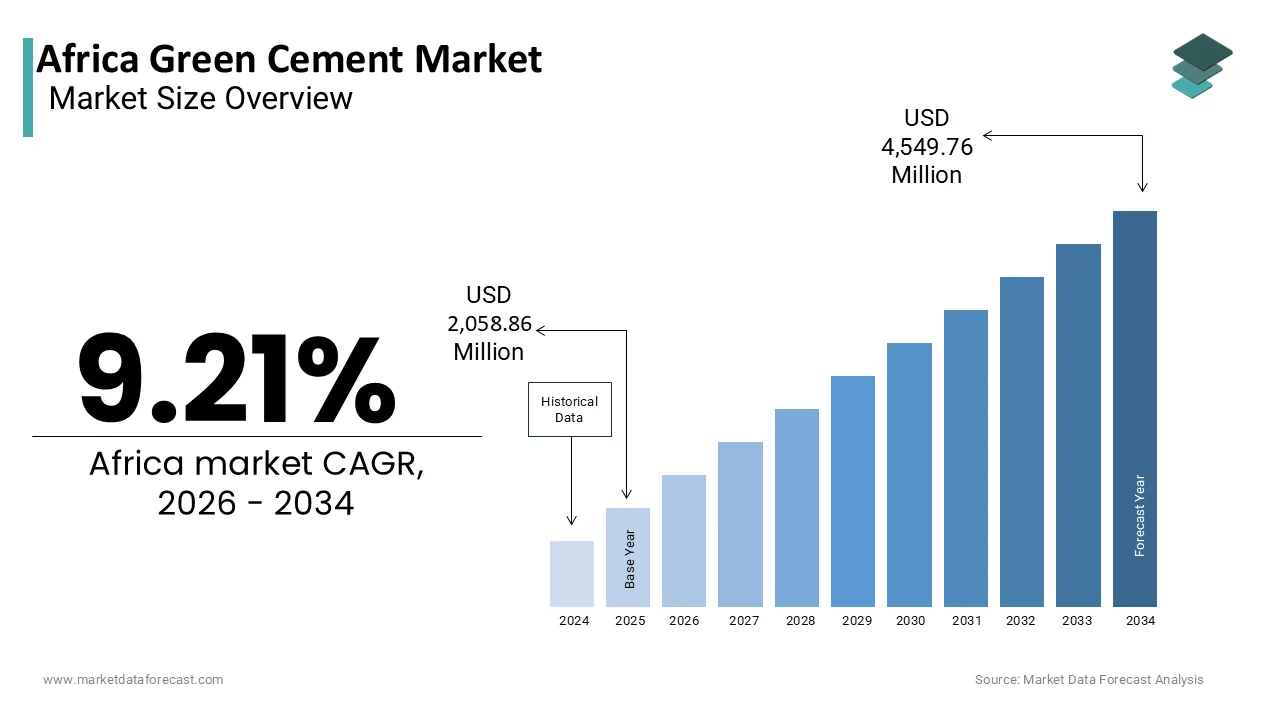
The Africa green cement market was valued at USD 2,058.86 million in 2025, is estimated to reach USD 2,248.48 million in 2026, and is projected to reach USD 4,549.76 million by 2034, growing at a CAGR of 9.21% from 2026 to 2034.
Green cement is a sustainable construction material that is designed to reduce carbon emissions and environmental impact compared to conventional Portland cement. This cement includes alternative binders such as fly ash, slag-based blends, calcined clays, and other industrial by-products that lower energy consumption and CO₂ emissions during production.
Africa's expanding urbanization and infrastructure development have increased demand for construction materials, prompting governments and private stakeholders to explore environmentally responsible solutions. According to the United Nations Environment Programme (UNEP), cement production in Sub-Saharan Africa has nearly doubled over the past decade, raising concerns about its ecological footprint and long-term sustainability.
Besides, international climate agreements such as the Paris Agreement have encouraged African countries to adopt cleaner manufacturing practices. As per the African Development Bank, several regional governments are integrating green building codes into national policies, promoting the use of low-carbon materials like green cement in public and private construction projects.
Moreover, multinational corporations and local manufacturers are investing in research and pilot facilities to develop cost-effective green cement technologies suited to African climatic and structural requirements.
MARKET DRIVERS
Government Policies Promoting Sustainable Construction
The implementation of government policies aimed at reducing carbon emissions and encouraging sustainable construction practices is one of the primary drivers of the African green cement market. Many African countries have committed to lowering their greenhouse gas emissions under international agreements such as the Paris Agreement, prompting regulatory shifts that favor low-carbon building materials.
According to the African Union Commission, many African nations have integrated green building guidelines into their national development strategies as part of broader climate action plans. For instance, Kenya’s Ministry of Environment and Forestry introduced mandatory provisions for green building certifications in 2023, requiring new public infrastructure projects to incorporate eco-friendly materials, including green cement.
In addition, South Africa has been proactive in promoting sustainable construction through its Green Building Council, which mandates reduced embodied carbon in new developments.
Rising Demand for Affordable and Energy-Efficient Housing
The increasing demand for affordable, energy-efficient housing solutions, particularly in rapidly urbanizing areas where traditional construction methods are costly and environmentally burdensome, is another key driver of the African green cement market. Governments and private developers are seeking cost-effective yet sustainable materials to meet the growing need for residential infrastructure.
As per the United Nations Human Settlements Programme (UN-Habitat), Africa will require over 100 million new housing units by 2050 to accommodate its expanding population, particularly in countries like Nigeria, Ethiopia, and Tanzania. This surge in demand has prompted the exploration of green cement alternatives that offer comparable strength at lower production costs and reduced environmental impact.
For example, the Nigerian Federal Ministry of Works launched the National Housing Policy in 2023, emphasizing the use of locally sourced, low-carbon materials, including green cement, in mass housing projects. Green cement also supports passive cooling and insulation properties, making it well-suited for tropical climates where air conditioning reliance is high.
MARKET RESTRAINTS
High Initial Costs and Limited Awareness Among Stakeholders
The relatively high initial investment required for green cement production and the limited awareness among stakeholders regarding its long-term benefitsarea major restraints affecting the growth of theAfricana green cement market. While green cement reduces carbon emissions and can be cost-effective over time, the upfront capital needed for setting up specialized production lines or retrofitting existing plants remains a barrier for many local manufacturers.
Moreover, there is a lack of widespread knowledge among contractors, architects, and policymakers about the performance and economic viability of green cement. This knowledge gap results in a continued preference for conventional cement despite its higher environmental footprint
Inadequate Supply Chain and Raw Material Constraints
The inadequate supply chain infrastructure and limited availability of raw materials essential for producing alternative cement types are another significant challenge facing the Africa green cement market. Unlike traditional cement, which primarily relies on limestone, green cement formulations often depend on industrial by-products such as fly ash, slag, and calcined clay all of which may not be readily available or consistently supplied across African markets.
According to the United Nations Industrial Development Organization (UNIDO), only 12% of coal-fired power plants in Africa operate at full capacity, limiting the availability of fly ash, a key ingredient in fly ash-based green cement. Countries like Kenya and South Africa have better access due to larger thermal power outputs, but many others face shortages. Also, logistics bottlenecks hinder the efficient transportation of these materials.
MARKET OPPORTUNITIES
Expansion of Green Building Certification Programs
The expansion of green building certification programs, which encourage the use of sustainable materials in new construction projects, ts is a significant opportunity for the Africa green cement market. These certification frameworks, such as the Leadership in Energy and Environmental Design (LEED) and the Building Research Establishment Environmental Assessment Method (BREEAM), provide incentives for developers to incorporate low-carbon materials like green cement into their designs.
According to the Green Building Council of South Africa (GBCSA), the number of certified green buildings in the country increased by 25% between 2022 and 2023, with similar trends emerging in Kenya, Nigeria, and Morocco. These certified structures often require a minimum percentage of green materials in their construction, directly boosting demand for alternative cements. Furthermore, multinational corporations operating in Africa are increasingly committing to sustainability goals, influencing their real estate and facility investments.
Growth of Circular Economy Initiatives in Urban Centres
The rise of circular economy initiatives in African cities presents a strong opportunity for the green cement market by promoting resource efficiency and waste valorization. These initiatives focus on repurposing industrial by-products such as fly ash, slag, and construction demolition waste into valuable inputs for green cement production, reducing dependency on virgin raw materials.
According to the Ellen MacArthur Foundation, several African municipalities have launched circular economy pilot projects in collaboration with private sector partners. Similarly, Cape Town’s Green Economy Strategy includes provisions for using secondary materials in cementitious applications, aiming to divert thousands of tons of industrial waste from landfills annually. Also, startups and research institutions are exploring innovative ways to utilize agricultural waste, such as rice husk ash, in green cement blends.
MARKET CHALLENGES
Technical Limitations and Performance Standards
The technical limitations associated with certain alternative cement formulations, particularly concerning early strength development, curing conditions, and durability in varying climatic conditions, are one of the foremost challenges confronting the Africa green cement market. Unlike traditional Portland cement, some green cement variants exhibit slower hydration rates and lower compressive strength unless carefully engineered and blended with supplementary materials.
According to the International Union of Laboratories and Experts in Construction Materials (RILEM), achieving optimal performance in green cement mixtures often requires precise formulation, extended curing times, and sometimes additional chemical additives, factors that increase complexity and cost for local producers unfamiliar with advanced concrete technology.
Moreover, the lack of standardized testing protocols tailored to African conditions hinders widespread acceptance of green cement in critical infrastructure projects. To address this issue, several universities and research institutes are conducting localized studies to refine green cement compositions suitable for regional applications.
Resistance from Traditional Cement Producers
Resistance from established traditional cement producers poses a significant obstacle to the expansion of the Africa green cement market. These large-scale manufacturers, who dominate the industry, often perceive green cement as a threat to their existing business models and profitability, leading to reluctance in supporting or adopting alternative technologies.
Transitioning to green cement would require retooling, workforce retraining, and changes in sourcing strategies, steps that entail considerable risk and financial outlay.
Moreover, lobbying efforts by traditional players have influenced regulatory timelines and delayed the enforcement of stricter emission standards that could accelerate green cement adoption. While some progressive companies are beginning to diversify their product portfolios, the overall industry resistance continues to slow the pace of innovation and market transformation.
REPORT COVERAGE
| REPORT METRIC | DETAILS |
| Market Size Available | 2025 to 2033 |
| Base Year | 2025 |
| Forecast Period | 2026 to 2034 |
| Segments Covered | By Product Type and Country. |
| Various Analyses Covered | Global, Regional & Country Level Analysis, Segment-Level Analysis; DROC, PESTLE Analysis, Porter's Five Forces Analysis, Competitive Landscape, Analyst Overview of Investment Opportunities |
| Country Covered | China, India, Japan, South Korea, Australia, New Zealand, Thailand, Indonesia, Philippines, Vietnam, Singapore, Rest of APAC. |
| Market Leader Profiled | Afrisam, CEMEX S.A.B. de C.V., CIMPOR Côte d'Ivoire (Cimpor Global Holdings BV) |
SEGMENTAL ANALYSIS
By Product Type Insights
The Fly ash-based green cement segment was the largest category in the Africa green cement market with 35.5% of total share in 2025. The growing utilization of fly ash in construction projects across countries like South Africa, Kenya, and Nigeria, where coal-fired power plants generate significant volumes of the material, is one key driver ofthe fly-based green cement segment. This dominance is primarily attributed to the widespread availability of fly ash a by-product of coal combustion, and its compatibility with conventional cement blending technologies. In addition, government initiatives promoting circular economy practices have encouraged the use of industrial waste in construction materials. Moreover, fly ash-based cement offers cost advantages compared to traditional Portland cement due to lower energy requirements during processing.
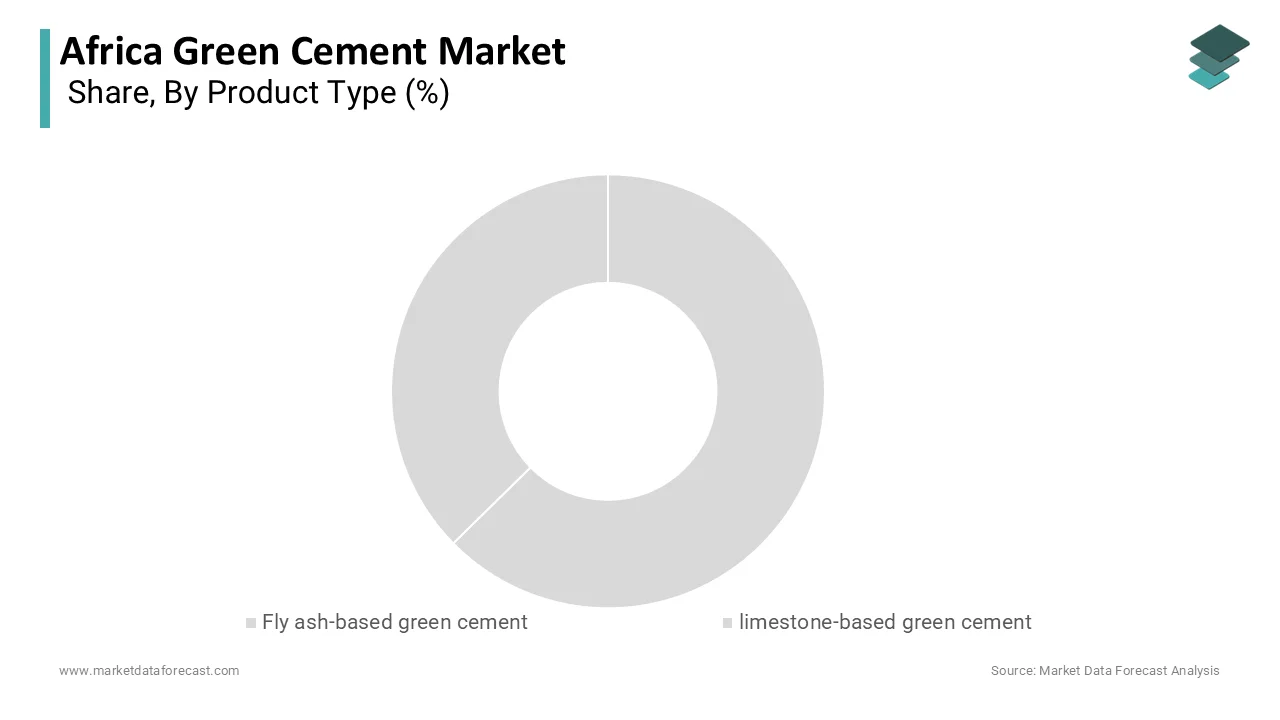
The limestone-based green cement segment is projected to grow at the fastest CAGR of 11.6%. One major factor contributing to this growth is the development of Limestone Calcined Clay Cement (LC3), which combines calcined clay and limestone to replace up to 50% of traditional clinker. This rapid expansion ofthe segment is driven by increasing research into low-carbon alternatives that maintain structural integrity while reducing clinker content in cement formulations. As per the LC3 Project led by MIT and EPFL, this formulation reduces CO₂ emissions by nearly 30% compared to standard cement and is well-suited to tropical climates found in many African countries. Kenya has been at the forefront of LC3 adoption. The Kenyan Industrial Research and Development Institute (KIRDI) launched pilot production units in 2023, supported by funding from the United Nations Development Programme (UNDP). These efforts aim to scale up production for use in affordable housing and rural infrastructure projects. Furthermore, limestone deposits are abundant across East and Southern Africa, making raw material sourcing more economical and sustainable.
COUNTRY LEVEL ANALYSIS
South Africa led the Africa green cement market with an estimated 28% share in 2025 and is driven by its mature construction sector, strong regulatory framework, and progressive climate policies. As one of the most industrialized nations on the continent, the country has integrated sustainability into national development plans, encouraging the use of eco-friendly building materials. Additionally, Eskom, South Africa’s primary electricity provider, generates large volumes of fly ash from coal-fired power plants. With continued investment in green infrastructure and urban renewal programs, South Africa remains a pivotal market for green cement producers seeking long-term growth opportunities in Africa.
Nigeria is a significant regional green cement market, which is driven by rapid urbanization, housing shortages, and increasing awareness around sustainable construction practices. With a population exceeding 220 million and a growing middle class, the demand for affordable yet environmentally responsible building materials has intensified.
As per the Nigerian Federal Ministry of Works and Housing, the country requires over 17 million new housing units to address current deficits. In response, the National Housing Policy introduced in 2023 encourages the use of alternative materials including green cement, to enhance affordability and sustainability. Moreover, Lagos State has emerged as a hub for green construction initiatives. Despite challenges such as inconsistent power supply and limited access to financing for small-scale producers, Nigeria’s expanding real estate sector and supportive policy environment present substantial opportunities for green cement adoption.
Kenya is emerging as a key player due to its progressive environmental policies, active participation in global climate agreements, and growing investments in sustainable infrastructure. A major milestone was the launch of the first commercial LC3 production unit by the Kenya Industrial Research and Development Institute (KIRDI) in collaboration with international partners. Supported by the United Nations Development Programme (UNDP), this initiative aims to scale up production for use in public infrastructure and rural housing. Also, Nairobi serves as a regional headquarters for multinational firms committing to net-zero goals, further boosting demand for certified green building materials. With government backing and academic research driving innovation, Kenya is positioned as a leader in green cement adoption in East Africa.
Egypt commands a notable share of theAfricana green cement market, benefiting from its strategic location, stable economic environment, and government-led sustainability initiatives aimed at modernizing the construction industry. According to Egypt’s Ministry of Housing, Utilities and Urban Communities, the country plans to build over 500,000 new housing units by 2025, with a focus on energy-efficient and environmentally friendly materials. Industrial by-products such as fly ash and slag are increasingly being integrated into cement blends. Moreover, Egypt serves as a regional distribution hub for green cement exports to North Africa and the Middle East, enhancing its strategic importance in the market. With continued support for industrial modernization and sustainable urban planning, Egypt remains a vital contributor to the evolving green cement landscape.
The remaining African countries collectively account for a considerable share of the regional green cement market, with notable contributions from Ghana, Tanzania, Ethiopia, Morocco, and Algeria. Each of these nations presents unique growth dynamics based on infrastructure development, regulatory support, and resource availability. Morocco benefits from a thriving construction sector, particularly in green real estate developments. Ethiopia has seen a surge in green cement usage due to large-scale infrastructure projects under its Growth and Transformation Plan. Algeria, rich in limestone resources, is exploring calcined clay-based cement alternatives to reduce reliance on imported materials. Meanwhile, Ghana’s push for circular economy initiatives has led to increased use of fly ash and slag in cement production.
KEY MARKET PLAYERS AND COMPETITIVE LANDSCAPE
Overview of Competition in the African Green Cement Market is
- AfriSam
- CEMEX S.A.B. de C.V.
- CIMPOR Côte d'Ivoire (Cimpor Global Holdings BV)
- Lafarge (Holcim)
- Suez Cement (Heidelberg Cement Group)
The competition in the Africa green cement market is shaped by a mix of multinational corporations, regional leaders, and emerging local producers striving to capture a share of a rapidly evolving but still nascent segment. While traditional cement manufacturers dominate the overall market, a shift toward sustainability is prompting many to diversify their portfolios and integrate green alternatives into mainstream offerings.
Multinational players like Holcim and Cemex bring technological expertise, global sustainability commitments, and strong brand recognition to the table, giving them an edge in policy-driven and urban construction sectors. However, domestic producers such as Dangote Cement and smaller startups are leveraging localized knowledge, supply chain efficiency, and cost advantages to build competitive positions in both public and private construction projects.
Consumer awareness about green building materials remains uneven, creating opportunities for early adopters to educate stakeholders and establish market leadership. At the same time, financial constraints, regulatory inconsistencies, and limited raw material availability present barriers that shape competitive dynamics differently across countries.
As governments intensify pressure for carbon reduction and investors show greater interest in green infrastructure, the battle for market dominance is expected to intensify, with innovation, pricing strategies, and alignment with circular economy principles playing decisive roles.
Top Players in the Market
Holcim Ltd (LafargeHolcim)
Holcim is a global leader in sustainable building materials and plays a pivotal role in the Africa green cement market through its regional subsidiaries, including Lafarge Africa and PPC Cement. The company has been at the forefront of developing low-carbon cement solutions such as ECOPact and MULTICEM, which incorporate industrial by-products to reduce environmental impact.
In Africa, Holcim supports local green construction initiatives, partners with governments on sustainable housing projects, and invests in research to adapt green cement technologies to regional conditions. Its commitment to circular economy principles and carbon neutrality makes it a key driver of eco-conscious development across the continent.
Dangote Cement Plc
Dangote Cement is the largest cement producer in Africa and has increasingly integrated green practices into its operations. The company has invested in alternative fuel sources for kiln operations and is exploring blended cements that use fly ash and slag to lower emissions.
Through its vast distribution network and influence in West and East African markets, Dangote Cement is shaping industry standards by promoting more sustainable production methods. While traditionally focused on conventional cement, the company is gradually shifting toward greener alternatives to align with global sustainability expectations and evolving consumer demand.
Cemex S.A.B. de C.V.
Cemex has a growing presence in the Africa green cement market through strategic partnerships and localized production units. Known for its global innovation in sustainable construction, the company brings advanced green cement formulations and carbon reduction technologies to African markets.
Cemex’s emphasis on digital tools, smart logistics, and customer education enhances its relevance in regions seeking scalable green infrastructure solutions. Its initiatives in waste valorization and alternative binders contribute to broader efforts to decarbonize the African construction sector.
Top Strategies Used by Key Market Participants
One major strategy employed by key players in the Africa green cement market is product diversification and formulation innovation, allowing companies to offer a range of eco-friendly cement types tailored to different applications and regulatory requirements. This includes developing blended cements using fly ash, slag, and calcined clay to meet performance standards while reducing carbon footprint.
Another widely adopted approach is strategic partnerships with governments and international development agencies, enabling firms to align with national climate goals, gain access to funding, and participate in large-scale green infrastructure projects that prioritize sustainable materials.
Lastly, capacity building and local manufacturing investments have become essential for long-term competitiveness. Companies are setting up or upgrading plants within African countries to ensure cost-effective production, compliance with regional standards, and faster response to market demands, reinforcing their presence in the evolving green construction landscape.
RECENT HAPPENINGS IN THE MARKET
In February 2023, Holcim launched a new green cement production line at its Nigerian plant, aiming to increase the supply of low-carbon cement blends tailored to the West African construction market and support national sustainability goals.
In August 2023, Dangote Cement announced a partnership with a European technology firm to co-develop calcined clay-based cement, targeting affordable housing projects across Kenya and Tanzania w,h wheredemand for eco-friendly materials is rising.
In January 2025, Cemex expanded its technical advisory services in South Africa, offering free consultations to architects and engineers on the optimal use of green cement in high-performance building applications.
In May 2025, PPC Cement introduced a mobile training unit that travels across rural areas in Zambia and Malawi, educating contractors and builders on green cement benefits and application techniques to drive grassroots adoption.
In September 2025, BUA Cement initiated a joint venture with a Nigerian renewable energy company to power part of its cement plant with biomass, reinforcing its corporate commitment to green manufacturing and positioning itself as a leader in sustainable production.
MARKET SEGMENTATION
This research report on the Africa Green Cement Market has been segmented and sub-segmented into the following.
By Product Type
- Fly ash-based green cement
- limestone-based green cement
By Country
- China
- India
- Japan
- South Korea
- Australia
- New Zealand
- Thailand
- Indonesia
- Philippines
- Vietnam
- Singapore
- Rest of APAC
Frequently Asked Questions
What are the major drivers of the green cement market in Africa?
Key drivers include rising environmental regulations, growing awareness of sustainable construction, urbanization, infrastructure development, and government initiatives promoting eco-friendly materials.
Which countries in Africa are leading in green cement adoption?
South Africa, Egypt, Morocco, Nigeria, and Kenya are among the front-runners in adopting green cement technologies due to their large construction sectors and environmental goals.
What are the main types of green cement available in the African market?
Common types include fly ash-based cement, slag-based cement, geopolymer cement, and limestone calcined clay cement (LC3).
Access the study in MULTIPLE FORMATS
Purchase options starting from
$ 2000
Didn’t find what you’re looking for?
TALK TO OUR ANALYST TEAM
Need something within your budget?
NO WORRIES! WE GOT YOU COVERED!
Call us on: +1 888 702 9696 (U.S Toll Free)
Write to us: sales@marketdataforecast.com