- Product Description Description
- Table of Contents TOC
- List of Table & Figure LOT
- Get Free Sample PDF Sample PDF
Market Size, 2025
$2.22 BnMarket Estimate, 2026
$2.35 BnMarket Forecast, 2034
$3.72 BnCAGR, 2026–2034
5.9%Executive Summary: Africa Lead Acid Battery Market
- Market Scope: Regional energy and transportation infrastructure assessment covering technology types (basic vs. advanced lead acid), product types (stationary vs. motive), construction methods (flooded vs. VRLA), end-users (transportation, commercial, residential), and extensive country-level adoption across Africa (Nigeria, South Africa, Egypt, Kenya, and others).
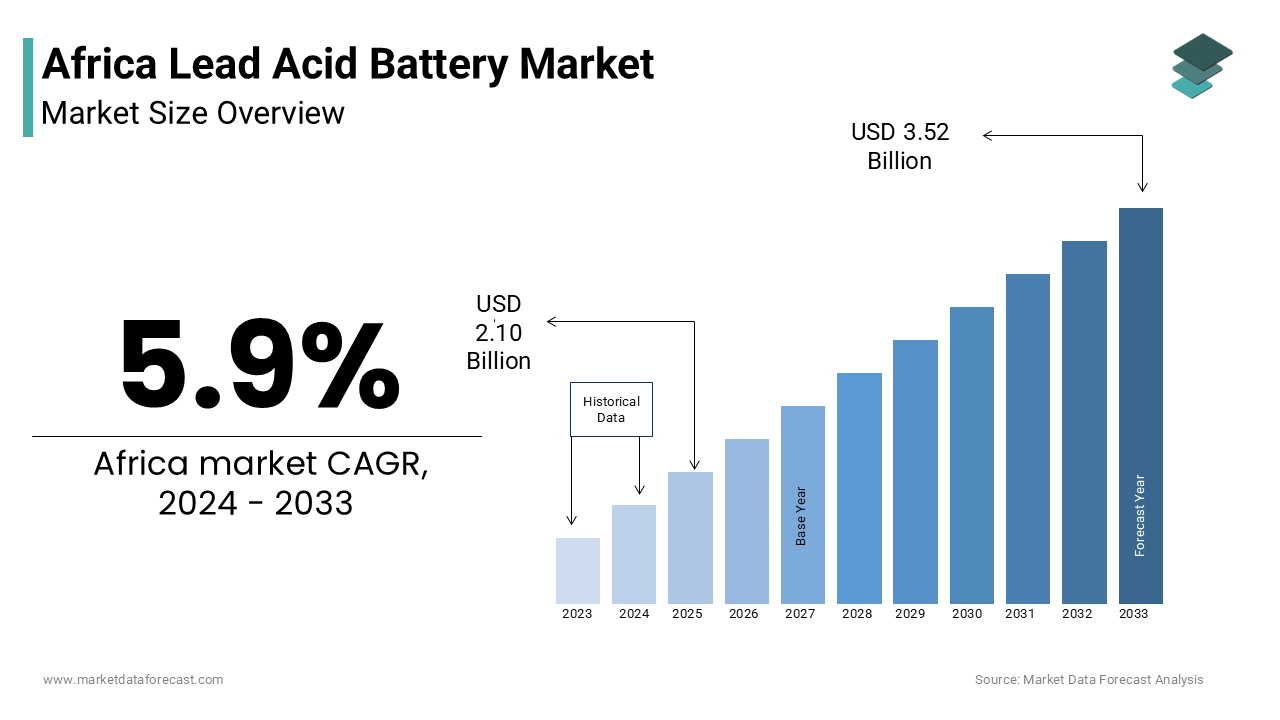
- Market Valuation: Valued at USD 2.22 billion in 2025, estimated at USD 2.35 billion in 2026, and projected to reach USD 3.72 billion by 2034, growing at a solid CAGR of 5.9% (2026–2034).
- Primary Growth Drivers: Persistent electricity shortages and inconsistent grids driving off-grid/backup power systems (solar home systems and telecom towers), and a rapidly expanding automotive sector requiring vehicle starter batteries.
Key Market Segment Metrics (2026–2034)
| Category | Leading Segment (2024/2025 Position) | Fastest-Growing Segment |
|---|---|---|
| By Technology | Basic Lead Acid (holding ~67.3% share due to cost-effectiveness and widespread automotive use) | Advanced Lead Acid (~7.2% CAGR, driven by maintenance-free telecom and renewable setups) |
| By Type | Stationary Lead Acid (capturing ~59.5% share for telecom, UPS, and utility backup) | Motive Lead Acid (~6.8% CAGR, fueled by industrial warehousing and forklift modernization) |
| By Construction Method | Flooded Lead Acid (holding ~63% share due to robust starting power and affordability) | VRLA (Valve-Regulated Lead Acid, registering ~7.5% CAGR for solar and confined-space backup) |
| By End-User | Transportation (~36% share, anchored by internal combustion engine vehicles and used imports) | Commercial and Residential (~8.1% CAGR, driven by solar home systems and inverter backups) |
| By Country / Region | Nigeria (leading with ~22% share due to massive population and grid blackouts) | Kenya and Egypt (expanding rapidly via rural solar adoption and industrial economic zones) |
Major Market Players & Market Structure
Market Structure: Fragmented yet competitive landscape featuring a mix of global industry leaders bringing technological expertise and regional manufacturers winning on local pricing and supply networks.
Key Companies: Exide Technologies, East Penn Manufacturing, EnerSys, GS Yuasa Corporation, Clarios, Amara Raja Batteries, and Mutlu Battery.
Africa Lead Acid Battery Market Size
The Africa lead acid battery market size was valued at USD 2.22 billion in 2025 and is anticipated to reach USD 2.35 billion in 2026 from USD 3.72 billion by 2034, growing at a CAGR of 5.9% during the forecast period from 2026 to 2034.
Lead acid battery is a critical component of the continent’s energy and transportation infrastructure, serving as a primary power source for automotive applications, industrial equipment, telecommunications, and off-grid energy storage systems. Despite advancements in alternative chemistries like lithium-ion, lead acid batteries remain dominant due to their cost-effectiveness, recyclability, and established manufacturing and distribution networks.
Africa's growing reliance on uninterrupted power supply solutions has significantly boosted demand for lead acid batteries, particularly in regions with inconsistent electricity grids. According to the International Energy Agency (IEA), nearly 60% of the population in Sub-Saharan Africa lacks access to reliable electricity, prompting widespread adoption of backup power systems powered by these batteries.
Moreover, the expanding automotive industry, especially in countries such as South Africa, Nigeria, and Egypt, is contributing to increased consumption of starter batteries for vehicles. As per the African Development Bank, vehicle production in Africa grew by 4.7% in 2023, reinforcing the need for robust and affordable battery technologies that support both original equipment manufacturers and the aftermarket.
Industrialization efforts across the continent are also fueling demand for motive power applications, including forklifts and material handling equipment, which predominantly rely on flooded lead acid batteries for their high energy density and durability. In addition, the proliferation of solar-based home systems and telecom towers, particularly in remote areas has strengthened the relevance of sealed lead acid batteries in decentralized energy networks.
MARKET DRIVERS
Rising Demand for Automotive Applications
The growing demand from the automotive sector, particularly for internal combustion engine (ICE) vehicles, is one of the key drivers of the Africa lead acid battery market. As urbanization accelerates and disposable incomes rise, vehicle ownership rates are increasing across major African economies. According to the International Organization of Motor Vehicle Manufacturers (OICA), Africa produced over 1.3 million vehicles in 2023, marking a steady recovery in regional auto manufacturing capacity.
Countries such as South Africa, Egypt, and Morocco serve as key automotive hubs, with significant investments in assembly plants by global automakers like Renault, Toyota, and Volkswagen.
Beyond OEM requirements, the aftermarket segment is also expanding. A large proportion of vehicles in use across Africa consists of used imports, particularly from Japan and Europe, which necessitate regular battery replacements. Given the dominance of ICE vehicles in the region and limited adoption of electric mobility alternatives, lead acid batteries continue to play a central role in the automotive ecosystem, ensuring sustained market growth.
Expansion of Off-Grid and Backup Power Systems
The increasing deployment of off-grid and backup power systems, driven by persistent electricity shortages and unreliable grid infrastructure, is another major driver of the Africa lead acid battery market. According to the World Bank, approximately 600 million people in Sub-Saharan Africa lack consistent access to electricity, compelling businesses, households, and institutions to rely on alternative energy storage solutions.
Lead acid batteries are widely used in conjunction with diesel generators, solar panels, and uninterruptible power supply (UPS) systems to provide stable electricity for homes, commercial buildings, and telecom towers.
In particular, the telecom sector has been a strong adopter of lead acid batteries. This trend is strengthening the role of lead acid batteries in powering Africa’s energy transition.
Environmental and Regulatory Concerns
The growing concern over environmental pollution and regulatory scrutiny surrounding lead extraction, battery production, and end-of-life disposal is a significant restraint affecting the Africa lead acid battery market. Lead acid batteries contain toxic materials that pose serious risks to human health and ecosystems if not properly managed. According to the World Health Organization (WHO), exposure to lead can cause severe neurological and developmental impairments, particularly in children.
Despite their high recyclability rate—estimated at over 90% in developed markets—recycling practices in many African countries remain informal and unsafe. As per the United Nations Environment Programme (UNEP), in several African nations, unregulated smelting operations release hazardous emissions into the air and contaminate soil and water sources.
Regulatory bodies are increasingly enforcing stricter compliance measures. The Nigerian Federal Ministry of Environment introduced new guidelines in 2023 for battery collection and recycling, mandating formalized waste management procedures. Similarly, South Africa’s Department of Forestry, Fisheries, and the Environment has tightened controls on informal recycling activities.
These developments are increasing costs and limiting market expansion.
MARKET RESTRAINTS
Competition from Alternative Battery Technologies
The Africa lead acid battery market faces increasing pressure from emerging battery technologies such as lithium-ion, nickel-cadmium, and sodium-ion, which offer higher energy densities, longer lifespans, and reduced maintenance needs. As per BloombergNEF, the cost of lithium-ion batteries has declined by more than 80% since 2010, making them more accessible even in developing economies.
Electric mobility initiatives, though still nascent in Africa, are gradually gaining traction. Countries like Kenya, Rwanda, and South Africa have begun promoting electric motorcycles and buses, which predominantly use lithium-ion technology. As per the estimations by the Kenyan Ministry of Transport, over 10,000 electric motorbikes were deployed in Nairobi alone in 2023, signaling a shift away from traditional lead acid-powered vehicles.
Apart from these, solar home system providers are increasingly adopting lithium-based storage solutions due to their compact size and superior performance in deep-cycle applications.
MARKET OPPORTUNITIES
Growth in Solar-Powered Lighting and Home Systems
The expanding adoption of solar-powered lighting and home systems, particularly in off-grid and rural communities, is a significant opportunity in the Africa lead acid battery market. With millions lacking access to centralized electricity, decentralized solar solutions have emerged as a viable alternative, relying heavily on lead acid batteries for energy storage. These systems typically include small photovoltaic panels, charge controllers, and sealed lead acid (SLA) or valve-regulated lead acid (VRLA) batteries to store energy for nighttime usage.
Governments and international organizations are actively supporting this transition. Besides, microfinance and pay-as-you-go (PAYG) models have made solar home systems more accessible to low-income households. Companies like d.light and Bboxx have leveraged these financing mechanisms to deploy thousands of battery-backed solar units across Kenya, Tanzania, and Nigeria. As solar electrification expands, the demand for compatible and cost-effective battery storage will continue to drive growth in the lead acid battery segment, offering manufacturers a sustainable avenue for expansion.
Increasing Use in Industrial and Telecom Applications
The industrial and telecommunications sectors present a substantial growth opportunity for the Africa lead acid battery market, driven by the need for reliable backup power solutions in data centers, manufacturing plants, and communication towers. To ensure uninterrupted service delivery, telecom operators extensively rely on hybrid power systems integrating diesel generators and lead acid batteries.
In the industrial sector, lead acid batteries are crucial for material handling equipment such as forklifts and automated guided vehicles (AGVs).
Furthermore, the rise of e-commerce and cold chain logistics is driving investment in industrial refrigeration and automation, where deep-cycle lead acid batteries provide dependable energy storage.
MARKET CHALLENGES
Limited Availability of Raw Materials and Recycling Infrastructure
The scarcity of raw materials and inadequate recycling infrastructure, which hampers local production capabilities and increases dependency on imports, is a pressing challenge in the Africa lead acid battery market. Lead, the primary component of these batteries, is often sourced from outside the continent, exposing manufacturers to global price fluctuations and supply chain disruptions.
According to the United States Geological Survey (USGS), Africa accounts for less than 5% of global lead production, with only a few active mines in countries like Zambia and Namibia. This limited domestic supply forces battery producers to import refined lead, increasing input costs and reducing profit margins.
Moreover, the recycling ecosystem remains largely informal, with unregulated smelters operating in unsafe conditions. As per the United Nations Industrial Development Organization (UNIDO), in Nigeria and Ghana, over 70% of lead acid battery recycling occurs through unlicensed workshops, leading to environmental degradation and health hazards.
Establishing formalized recycling channels requires significant investment in processing facilities and regulatory enforcement, which many African governments struggle to fund.
High Logistics and Distribution Costs
Transportation and distribution inefficiencies pose a major challenge to the growth of the Africa lead acid battery market, particularly in landlocked and rural regions. Due to the heavy weight and hazardous nature of lead acid batteries, logistics costs can account for a significant portion of total expenses, limiting accessibility for smaller consumers and enterprises.
According to the World Bank’s Logistics Performance Index (LPI) 2023, many African countries rank poorly in terms of customs efficiency, infrastructure quality, and shipment reliability. For instance, delays at ports and border crossings can extend delivery times by weeks, disrupting supply chains and increasing inventory holding costs.
Inland distribution is equally problematic. Poor road conditions, inadequate warehousing, and limited cold-chain logistics make it difficult for manufacturers and distributors to maintain product integrity and meet customer demand efficiently. As per the estimates that African Development Bank, logistics costs in Sub-Saharan Africa are nearly twice those in developed economies, further complicating market expansion efforts. To mitigate these issues, some companies are exploring localized production and strategic partnerships with regional distributors.
SEGMENTAL ANALYSIS
By Technology Insights
The basic lead acid battery segment dominated the Africa lead acid battery market with an estimated 67.3% share in 2024. This dominance is primarily attributed to Its widespread use in automotive applications, particularly in internal combustion engine vehicles and entry-level industrial equipment where cost-effectiveness and availability are critical, is primarily attributed attributednance of basic lead acid battery segment. Moreover, the affordability of basic flooded lead acid batteries compared to more advanced variants is also a key driver of the growth of basic lead acthe id battery segment. In addition, the continued reliance on conventional vehicles, especially used imports, fuels demand for starter batteries based on traditional technology. Furthermore, rural electrification programs often opt for basic lead acid units due to their ease of servicing and compatibility with locally available repair infrastructure. These factors collectively reinforce the dominance of the basic lead acid battery segment across the continent.
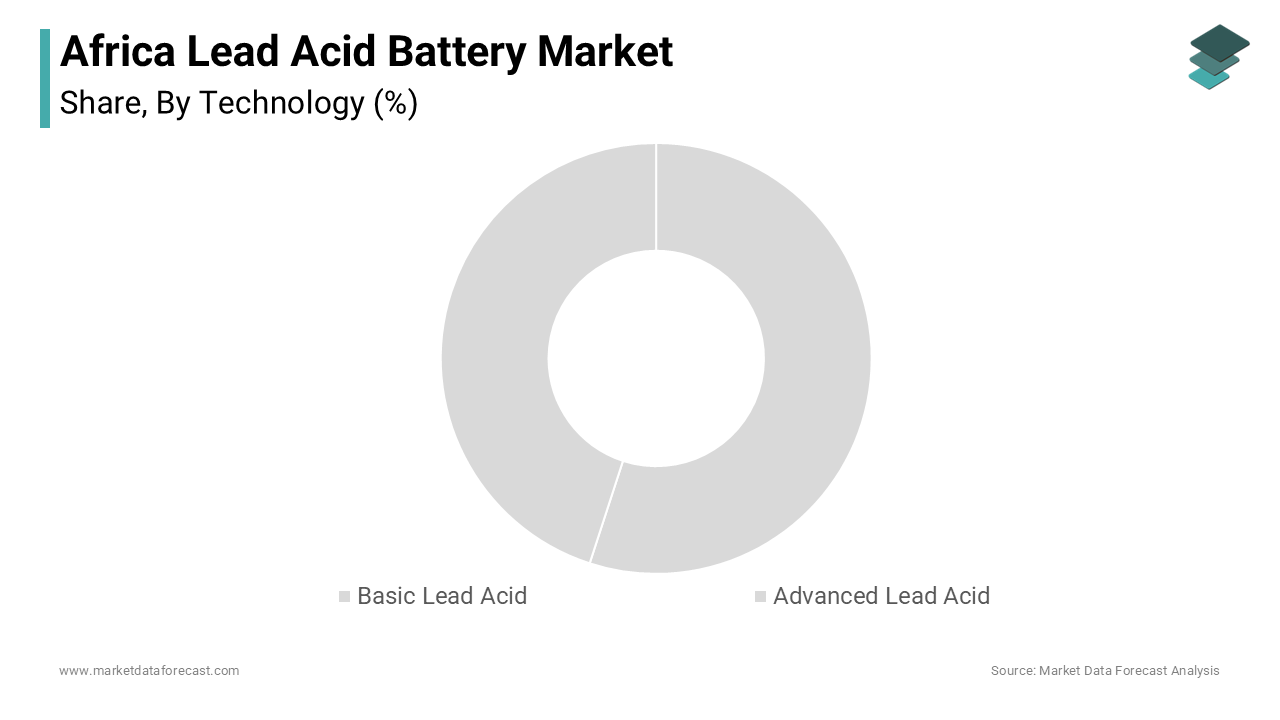
The advanced lead acid battery segment is projected to grow at the fastest CAGR of approximately 7.2%. The increasing demand for sealed and maintenance-free solutions in high-performance applications such as telecom backup, renewable energy systems, and motive power is rapidly expanding the development of advanced lead acid battery segment. Further, the growing deployment of valve-regulated lead acid (VRLA) batteries in off-grid solar installations also contributes to the expansion of this segment. As per the International Renewable Energy Agency (IRENA), over 50% of newly installed solar home systems in East Africa in 2023 utilized VRLA batteries for their spill-proof design and deep-cycle capabilities.
Moreover, the telecom sector’s shift toward compact and reliable backup power solutions has accelerated adoption of advanced lead acid technology.
By Type Insights
The stationary lead acid battery segment led the Africa lead acid battery market by capturing 59.5% in 2024. The rapid expansion of telecom infrastructure across Sub-Saharan Africa is one major driver of the growth of stationary lead acid battery segment. This segment includes batteries used for uninterruptible power supply (UPS), telecommunications, utility backup, and renewable energy storage that are increasingly vital in regions with unreliable grid access. In countries like Nigeria and Ethiopia, over 80% of rural towers operate off-grid, necessitating dependable battery backup.
Another key factor is the proliferation of solar-powered mini-grids and home systems is another a key factor propelling this segment. Apart from these, data centers and industrial facilities are adopting UPS systems powered by stationary lead acid batteries to protect against power fluctuations.
The motive lead acid battery segment is expected to grow at the highest CAGR of 6.8% during the forecast period. The expansion of manufacturing and warehousing activities in countries like Egypt, Kenya, and South Africa is one significant growth driver of motive lead acid battery segment. Motive batteries are primarily used in electric forklifts, pallet trucks, automated guided vehicles (AGVs), and other material handling equipment, reflecting broader trends in industrialization and logistics modernization across Africa.
Besides, the rise of e-commerce and cold chain logistics is fueling demand for battery-powered handling equipment. Furthermore, government initiatives promoting green industrial parks and export-oriented production zones are encouraging businesses to adopt electric material handling equipment over diesel-powered alternatives.
By Construction Method Insights
The flooded lead acid battery segment commanded the Africa lead acid battery market by holding 63% in 2024. Its extensive use in automotive starting applications is one of the primary drivers of the dominance of flooded lead acid battery segment. This construction method remains dominant due to its low cost, high tolerance to overcharging, and suitability for applications where regular maintenance is feasible. Moreover, the aftermarket replacement demand remains robust due to the large fleet of older vehicles requiring routine battery changes.
Moreover, flooded batteries are widely used in generator sets and backup power systems for homes and small businesses. The African Development Bank notes that in 2023, over 1.2 million diesel generators were sold across the continent, primarily in urban and semi-urban areas facing inconsistent electricity supply.
Rural electrification initiatives also favor flooded batteries due to their simplicity and ease of local servicing. Many off-grid solar installations in remote communities rely on flooded lead acid technology because of readily available maintenance expertise and spare parts.
These factors collectively ensure the continued dominance of the flooded battery segment in the African market landscape.
The VRLA segment is projected to register the highest CAGR of 7.5% over the next decade. The expanding deployment of off-grid solar systems in rural Africa is a key growth aspect for the VRLA segment. Unlike traditional flooded batteries, VRLA units are sealed, require minimal maintenance, and can be installed in confined spaces, making them ideal for modern applications such as telecom backup, UPS systems, and solar home storage.
In addition, the telecom industry is rapidly shifting towards VRLA batteries for base station power backup.
Furthermore, data centers and commercial buildings are increasingly relying on VRLA batteries for emergency power supply due to their compact size and compatibility with modular UPS systems.
By End-User Insights
The transportation sector represents the largest end-user segment in the Africa lead acid battery market, accounting for approximately 36% of total demand in 2023. This dominance stems from the overwhelming reliance on internal combustion engine (ICE) vehicles, both new and used, which depend on lead acid batteries for ignition and electrical functions.
A key driver of this segment’s leadership is the continued growth in vehicle ownership across the continent. According to the International Transport Forum, the number of registered motor vehicles in Africa surpassed 70 million in 2023, with South Africa, Nigeria, and Kenya leading in terms of fleet expansion. Each new vehicle requires a 12-volt battery, and the aftermarket replacement cycle further sustains demand.
Further, the importation of used vehicles from Japan, Europe, and the Middle East continues to surge.
Public transport systems, including minibuses and taxis, also rely heavily on lead acid batteries.
The commercial and residential segment is anticipated to grow at the fastest CAGR of 8.1% from 2025 to 2033. The widespread deployment of solar home systems (SHS) in off-grid and peri-urban areas is propelling the swift development of commercial and residential segment. This segment encompasses batteries used in home inverters, solar lighting systems, and small-scale business backup power setups—areas experiencing rapid adoption due to persistent electricity shortages.
Apart from these, rising consumer awareness about power reliability has spurred demand for inverter-based home backup systems.
Commercial enterprises such as retail shops, clinics, and SMEs are also investing in backup power to sustain operations. As per the East African Association of Small Businesses, more than 40% of surveyed enterprises in Kenya and Tanzania had installed battery-supported UPS systems by mid-2023 to prevent revenue losses from power disruptions.
REGIONAL ANALYSIS
Nigeria Lead Acid Battery Market Insights
Nigeria spearheaded the Africa lead acid battery market with an estimated 22% share in 2024 and is driven by its large population, high vehicle ownership rates, and persistent electricity supply issues. As Africa’s most populous nation, Nigeria faces chronic power shortages, prompting widespread reliance on generators and inverter-based backup systems powered by lead acid batteries.
According to the Nigerian Electricity Regulatory Commission (NERC), national grid instability resulted in an average of 14 hours of blackout per week in 2023, reinforcing the need for residential and commercial backup power solutions.
Vehicle ownership is also on the rise. Besides, informal recycling workshops dominate the battery waste stream, though recent regulatory reforms aim to formalize collection and processing.
South Africa Lead Acid Battery Market Insights
South Africa remains a significant player in the regional lead acid battery market which is supported by its mature automotive industry, industrial base, and relatively developed energy infrastructure. Despite having better grid reliability than many African nations, the country still experiences load-shedding, driving demand for backup power systems.
Moreover, the aftermarket remains strong due to the large number of used vehicles circulating in the economy.
Industrial applications also contribute significantly. According to the Department of Mineral Resources and Energy, mining companies like AngloGold Ashanti and Sibanye Stillwater utilize thousands of lead acid batteries for motive power and backup systems in underground operations.
Recycling practices in South Africa are more formalized compared to other African countries. With strong regulatory oversight and a structured industrial ecosystem, South Africa remains a key growth hub for lead acid battery suppliers in Africa.
Egypt Lead Acid Battery Market Insights
Egypt commands a notable share of the Africa lead acid battery market. It is benefiting from its strategic location, stable economic environment, and government-led electrification initiatives. The country’s focus on improving power supply and expanding industrial capacity has bolstered demand for both automotive and stationary batteries.
The Egyptian Electricity Transmission Company also launched several battery-based energy storage pilot projects to enhance grid stability.
Automotive production is another key contributor. The General Authority for Investment and Free Zones (GAFI) reported that over $7.5 billion was invested in manufacturing and logistics in 2023, particularly in the Suez Canal Economic Zone, where lead acid batteries are extensively used in vehicle assembly and industrial equipment.
Further, Egypt serves as a regional distribution hub for battery exports to North Africa and the Middle East, enhancing its strategic importance in the market.
Kenya Lead Acid Battery Market Insights
Kenya is emerging as a key player in the Africa lead acid battery market due to its growing economy, expanding construction sector, and government initiatives aimed at improving energy access and transportation infrastructure.
As per the Kenya National Bureau of Statistics, GDP growth reached 4.8% in 2023, with the transport and logistics sectors showing strong performance. The country is also a leader in off-grid solar adoption. The World Bank’s Lighting Africa initiative notes that over 1.2 million solar home systems were deployed in Kenya in 2023, many of which included sealed lead acid batteries for nighttime usage.
Apart from these, the telecom sector is expanding rapidly. With ongoing investments in smart cities and rural electrification, Kenya is positioned for sustained growth in the lead acid battery market.
Rest of Africa Lead Acid Battery Market Insights
The remaining African countries collectively account for considerable portion of the regional lead acid battery market, with notable contributions from Algeria, Morocco, Ghana, Tanzania, and Ethiopia. Each of these nations presents unique growth dynamics based on infrastructure development, mining expansion, and agricultural modernization. Morocco benefits from a thriving industrial sector, particularly in automotive and textile manufacturing, which drives consistent battery demand. Ethiopia has seen a surge in battery usage due to large-scale irrigation projects under its Agricultural Transformation Agency. Algeria, rich in hydrocarbon resources, relies heavily on lead acid batteries for oilfield dewatering and refining operations. Meanwhile, Ghana’s mining boom has led to increased deployment of motive power batteries, particularly in gold and manganese extraction sites.
COMPETITIVE LANDSCAPE
The competition in the Africa lead acid battery market is characterized by a mix of global leaders, regional manufacturers, and numerous independent suppliers vying for dominance in a rapidly evolving but highly fragmented landscape. International companies bring technological expertise, brand recognition, and structured recycling programs, allowing them to capture premium segments in countries like South Africa and Egypt. However, domestic and regional producers often gain an edge through competitive pricing, proximity to customers, and familiarity with local regulatory environments.
End-users, including automotive workshops, telecom operators, and industrial firms, are becoming more discerning, seeking not only performance but also durability, ease of servicing, and compliance with environmental standards. This shift is influencing strategic moves, with companies emphasizing after-sales support, product longevity, and sustainability to build lasting relationships.
Despite logistical and regulatory challenges, the increasing need for reliable energy storage systems ensures sustained interest from both established and emerging players looking to capitalize on opportunities across diverse economic zones in Africa.
KEY MARKET PLAYERS
Key market players in the Africa lead-acid battery market include
- Exide Technologies
- East Penn Manufacturing
- EnerSys
- GS Yuasa Corporation
- Clarios
- Amara Raja Batteries
- Mutlu Battery
Top Players in the Africa Lead Acid Battery Market
Exide Technologies
Exide is a globally recognized leader in energy storage solutions and holds a strong presence in the Africa lead acid battery market. The company offers a wide range of automotive, industrial, and motive power batteries tailored to meet diverse energy needs across the continent. In Africa, Exide has built a reputation for reliability and durability, particularly in automotive applications where consistent performance under challenging conditions is essential.
Through localized manufacturing partnerships and extensive distribution networks, Exide ensures accessibility across key markets such as Nigeria, Kenya, and South Africa. Its commitment to quality and after-sales service has made it a preferred brand among consumers and businesses alike.
East Penn Manufacturing
East Penn is a major U.S.-based manufacturer known for its high-quality lead acid batteries and sustainable production practices. While primarily focused on North America, the company indirectly influences the Africa lead acid battery market through strategic exports and collaborations with regional distributors.
The company’s emphasis on innovation and environmental responsibility aligns with growing global concerns about battery recycling and waste management—issues that are increasingly relevant in African markets.
By supplying advanced battery technologies and supporting recycling initiatives, East Penn contributes to setting higher industry standards even beyond its direct market reach.
BAE Batteries (South Africa)
BAE Batteries is a leading regional player in the Africa lead acid battery market, particularly dominant in Southern Africa. With a focus on both automotive and industrial applications, the company provides cost-effective and durable battery solutions suited to local operating conditions.
BAE has strengthened its position by investing in local production capabilities and building strong relationships with vehicle manufacturers and aftermarket distributors. Its ability to offer tailored products and reliable support services makes it a trusted name across multiple sectors including transport, mining, and telecommunications.
With a deep understanding of regional demand patterns and logistics, BAE remains a key contributor to the growth and development of the African battery ecosystem.
Top Strategies Used by Key Market Participants
One major strategy employed by key players in the Africa lead acid battery market is localized production and supply chain optimization. Companies are increasingly establishing or expanding manufacturing and assembly units within the continent to reduce import costs, shorten delivery times, and comply with regional regulations while catering to specific customer demands.
Another widely adopted approach is strategic partnerships with local distributors and vehicle manufacturers, which allows global brands to strengthen their market reach and better understand regional requirements. These collaborations help secure long-term contracts and ensure integration into original equipment specifications.
Lastly, product innovation tailored to African conditions, such as maintenance-free and deep-cycle batteries, has become essential for differentiation. Companies are investing in R&D to develop durable, cost-effective models that perform reliably in high-temperature environments and off-grid settings where traditional power sources are inconsistent or unavailable.
RECENT MARKET DEVELOPMENTS
- In March 2023, Exide Technologies expanded its distribution network in Nigeria by partnering with a leading automotive parts retailer to enhance retail visibility and improve access to replacement batteries in urban and rural areas.
- In July 2023, BAE Batteries launched a new line of sealed lead acid batteries designed specifically for solar home systems, targeting off-grid communities in Kenya and Tanzania where reliable energy storage is crucial for daily use.
- In January 2024, Clarios, a global leader in battery technology, initiated a technical training program in Ghana aimed at improving after-sales service and repair capabilities for mechanics and technicians working with lead acid batteries.
- In May 2024, Trojan Battery Company entered into a joint venture with a local Egyptian firm to establish a dedicated battery assembly facility in Cairo, focusing on stationary power applications for utilities and telecom infrastructure.
- In September 2024, NorthStar Battery Company introduced a formalized battery recycling initiative in South Africa, collaborating with government agencies and waste management firms to promote responsible disposal and collection of spent lead acid units.
MARKET SEGMENTATION
This research report on the Africa lead acid battery market is segmented and sub-segmented into the following categories.
By Technology
- Basic Lead Acid
- Advanced Lead Acid
By Type
- Stationary
- Motive
By Construction Method
- Flooded
- Valve Regulated Lead Acid (VRLA)
By End-User
- Transportation
- Commercial & Residential
By Country
- South Africa
- Nigeria
- Rest of Africa