- Product Description Description
- Table of Contents TOC
- List of Table & Figure LOT
- Get Free Sample PDF Sample PDF
Market Size, 2025
$2.61 BnMarket Estimate, 2026
$2.70 BnMarket Forecast, 2034
$3.53 BnCAGR, 2026–2034
3.43%Africa Lubricants Market Size, Share & Growth Analysis (2026–2034)
- Market Overview: Comprehensive analysis of the African lubricants market covering industrial, automotive, marine, and energy sector applications, alongside regional growth dynamics across North, South, and East Africa.
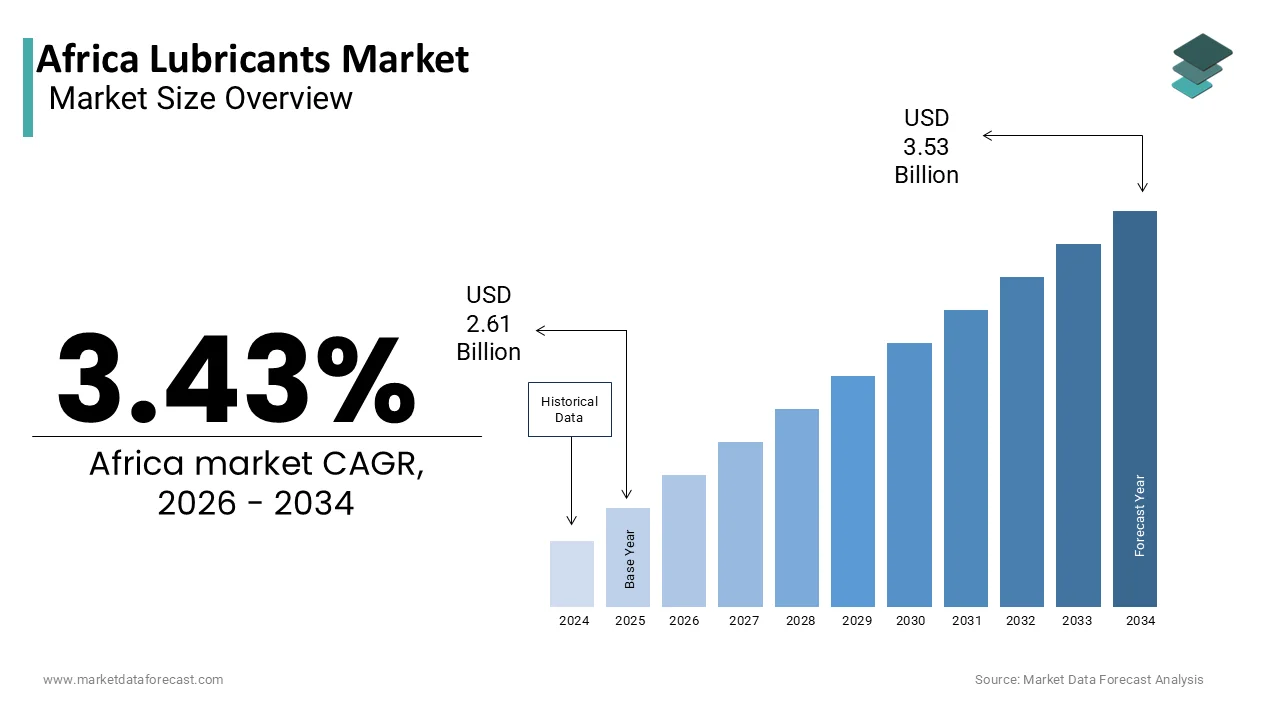
- Market Valuation: Valued at USD 2.61 billion in 2025, estimated at USD 2.70 billion in 2026, and projected to reach USD 3.53 billion by 2034, registering a steady CAGR of 3.43% from 2026 to 2034.
- Key Growth Drivers: Rising vehicle ownership, expanding manufacturing bases, accelerated mining activities, and increasing power generation investments addressing infrastructure development across key African nations.
Key Africa Lubricants Market Segment Metrics (2026–2034)
| Category | Leading Segment (2025 Position) | Fastest-Growing Segment |
|---|---|---|
| By End User | Automotive (accounted for 42.5% market share in 2025) | Power Generation (projected to register the highest CAGR of 7.8%) |
| By Product Type | Engine Oils (captured an estimated 38% share in 2025) | Metalworking Fluids (anticipated to grow at the fastest CAGR of 6.9%) |
| By Country | South Africa (spearheaded the market with a 27.5% share in 2025) | Emerging markets like Kenya, Ethiopia, and Nigeria |
Top Industry Players & Competitive Landscape
Market Structure: Highly fragmented competitive landscape featuring global energy majors, regional blenders, and independent players competing through localized production facilities, strategic OEM partnerships, and eco-friendly product innovations.
Key Companies: Royal Dutch Shell Plc, TotalEnergies SE, BP Plc (Castrol), Engen Petroleum Ltd., Centlube, ExxonMobil Corporation, Chevron Corporation, Fuchs Petrolub AG, Sinopec Limited, and PetroChina Company Limited.
Africa Lubricants Market Size
The africa lubricants market was valued at USD 2.61 billion in 2025, is estimated to reach USD 2.70 billion in 2026, and is projected to reach USD 3.53 billion by 2034, growing at a CAGR of 3.43% from 2026 to 2034.
Lubricants are a diverse range of petroleum-based and synthetic fluids used across industrial, automotive, marine, and energy sectors to reduce friction and enhance equipment efficiency. As African economies increasingly prioritize industrialization and infrastructure development, the demand for high-performance lubricants has seen steady growth. The market is primarily driven by rising vehicle ownership, expanding manufacturing bases, and increased mining activities across key regions such as North Africa, Southern Africa, and East Africa.
Besides, according to the International Energy Agency, diesel and gasoline consumption have been on an upward trend, indirectly boosting the need for engine oils and related products.
South Africa remains the largest consumer of lubricants on the continent, followed closely by Nigeria and Egypt. As per Global Lubes, South Africa’s lubricant consumption stood at over 400 million liters in 2023, reflecting its mature industrial and automotive landscape. Meanwhile, emerging markets like Kenya and Ethiopia are witnessing rapid urbanization and fleet expansion, contributing to regional growth dynamics.
MARKET DRIVERS
Expansion of the Automotive Industry in Africa
The growth of the automotive sector is a significant driver of theAfricana lubricants market. Vehicle production and sales have witnessed gradual increases across several African countries, particularly in South Africa, Morocco, and Egypt. According to the International Organization of Motor Vehicle Manufacturers, Africa produced over 1.2 million vehicles in 2023, marking a 6% increase from the previous year. This rise directly correlates with higher demand for engine oils, gear oils, and other automotive lubricants. Besides, foreign automakers such as Renault, Toyota, and Hyundai continue to expand their presence in Africa, establishing new assembly plants in countries like Kenya and Nigeria. This localization of production enhances the long-term demand for both OEM (original equipment manufacturer) and aftermarket lubricants.
Growth in Industrial and Manufacturing Activities
Industrialization efforts across Africa have led to a surge in manufacturing output, which in turn is driving the demand for industrial lubricants. Countries like Ethiopia, Tanzania, and Ghana have recorded double-digit growth in manufacturing value added (MVA) over the past five years, according to World Bank data.
Moreover, as per the African Development Bank, manufacturing activity in Nigeria expanded by 3.8% in Q4 of 2023, reversing a multi-quarter slowdown. This resurgence supports increased usage of industrial machinery, which requires regular lubrication to ensure operational efficiency and longevity.
In addition, the expansion of cement production, particularly in East Africa, is contributing to the lubricants market. For instance, Dangote Cement, one of the largest producers in Africa, operates multiple plants across Nigeria, Ethiopia, and Zambia. These trends illustrate how industrial growth is shaping the lubricants market.
MARKET RESTRAINTS
Limited Refining Capacity and Dependence on Imports
The continent’s limited refining capacity, resulting in a heavy reliance on imported finished lubricants and base oils, is a key challenge impeding tAfricanica lubricants market. Despite Africa’s vast crude oil reserves, only a small fraction of its refining capacity operates efficiently. According to the U.S. Energy Information Administration (EIA), African refineries operated at just 55% of their installed capacity in 2023, with many facilities outdated or poorly maintained.
Nigeria, for example, imports over 90% of its refined petroleum products, including lubricants, despite being a major crude oil exporter. As per the Nigerian Upstream Petroleum Regulatory Authority (NUPRC), in 2023, the country spent more than $3 billion on importing refined fuels and lube products, highlighting inefficiencies in local refining capabilities.
Similarly, in East Africa, nations like Uganda and Kenya rely heavily on imports from Europe and Asia for high-quality lubricants. This dependency not only exposes the market to global price volatility but also creates supply chain vulnerabilities, especially during geopolitical disruptions or freight bottlenecks.
Economic Instability and Currency Volatility
Economic instability across several African nations presents a substantial restraint on the lubricants market. High inflation rates, currency depreciation, and fluctuating GDP growth create an unpredictable business environment that discourages investment in industrial operations and automotive maintenance. According to the International Monetary Fund (IMF), inflation in sub-Saharan Africa averaged 11.3% in 2023, with countries like Zimbabwe and Sudan experiencing inflation rates exceeding 100%.
Currency devaluation is another pressing issue.
In Southern Africa, Zambia faced similar challenges, with the kwacha losing nearly 25% of its value against the dollar in the same period. Such economic pressures force businesses and consumers to delay vehicle maintenance or opt for lower-cost, often inferior lubricants, negatively affecting market quality and volume growth. These macroeconomic hurdles are constraining the overall growth trajectory of the African lubricants market.
MARKET OPPORTUNITIES
Increasing Renewable Energy Projects and Equipment Demand
Africa’s push toward renewable energy sources presents a notable opportunity for the lubricants market. Governments across the continent are investing in wind, solar, and hydroelectric power generation to meet rising energy demands and reduce reliance on fossil fuels. According to the International Renewable Energy Agency (IRENA), Africa added over 5 GW of renewable energy capacity in 2023, bringing the total to more than 55 GW.
Wind farms require specialized lubricants for gearboxes and turbines, which operate under high mechanical stress and temperature fluctuations. For example, the Lake Turkana Wind Power project in Kenya, the largest wind farm in Africa, utilizes over 365 wind turbines, each requiring consistent lubrication for optimal efficiency.
Hydropower projects, such as Ethiopia’s Grand Renaissance Dam, also contribute to increased demand for industrial-grade lubricants used in turbines, generators, and auxiliary systems. The African Development Bank estimates that hydropower capacity will expand by 20% by 2030, further strengthening the case for lubricant suppliers to tailor offerings for renewable energy applications.
Hence, this shift opens new revenue streams for lubricant manufacturers.
Rise of Mining Activities and Heavy Machinery Deployment
The resurgence of mining operations across Africa is creating a strong demand for high-performance lubricants tailored for extreme operating conditions. According to the Minerals Commission of Ghana, the country’s mining sector contributed over $7 billion in export revenue in 2023, with gold, bauxite, and manganese production reaching record levels. Mining companies such as AngloGold Ashanti and Sibanye Stillwater operate large-scale open-pit and underground mines that utilize extensive fleets of excavators, haul trucks, drills, and crushing equipment that require durable lubricants to function efficiently in harsh environments. Zambia, a leading copper producer in Africa, has also seen renewed investment in mining following improved commodity prices. With governments across the continent promoting resource beneficiation and mineral exports, the mining sector is poised to remain a key growth driver for the lubricants market, encouraging players to innovate in terms of formulation resilience and service delivery models.
MARKET CHALLENGES
Regulatory Fragmentation Across African Markets
The lack of harmonized regulations across different countries is one of the most pressing challenges facing the African lubricants market. Each nation maintains distinct standards for lubricant quality, labeling, import duties, and environmental compliance, complicating market entry and distribution strategies for multinational suppliers.
For instance, South Africa enforces stringent specifications set by the South African Bureau of Standards (SABS), while Nigeria follows the standards of the Nigerian Industrial Standards Quality Inspection Council (NISQIC). This divergence leads to inconsistent product approvals, testing requirements, and certification timelines, increasing operational costs and time-to-market for lubricant producers.
Besides, customs procedures vary widely between countries. As per a 2023 World Bank Logistics Performance Index, cross-border trade in lubricants can take up to two weeks in some African nations due to bureaucratic delays and unclear documentation processes.
Such regulatory fragmentation hinders scalability and discourages foreign direct investment in the sector. It also limits the ability of local blenders to access international best practices and advanced formulation technologies, ultimately affecting product consistency and market competitiveness across the region.
Environmental Concerns and Pressure for Sustainable Lubricants
Environmental concerns are increasingly influencing policy and consumer behavior in the African lubricants market. Traditional mineral-based lubricants pose risks of soil and water contamination when improperly disposed of, prompting calls for stricter environmental regulations. According to the African Environment Outlook published by the United Nations Environment Programme (UNEP), only 15% of used lubricants in Africa are properly collected and recycled, with the majority ending up in landfills or water bodies.
Countries like Kenya and South Africa have introduced extended producer responsibility (EPR) laws requiring lubricant manufacturers to manage waste oil collection and recycling. Moreover, global pressure to adopt greener alternatives is pushing the market toward bio-based and synthetic lubricants. However, the higher cost and limited availability of eco-friendly lubricants remain barriers to widespread adoption.
REPORT COVERAGE
| REPORT METRIC | DETAILS |
| Market Size Available | 2025 to 2034 |
| Base Year | 2025 |
| Forecast Period | 2026 to 2034 |
| Segments Covered | By End User, Product Type, and Country. |
| Various Analyses Covered | Global, Regional & Country Level Analysis, Segment-Level Analysis; DROC, PESTLE Analysis, Porter's Five Forces Analysis, Competitive Landscape, Analyst Overview of Investment Opportunities |
| Country Covered | China, India, Japan, South Korea, Australia, New Zealand, Thailand, Indonesia, Philippines, Vietnam, Singapore, Rest of APAC. |
| Market Leader Profiled | Royal Dutch Shell Plc, BP Plc (Castrol), Engen Petroleum Ltd. |
SEGMENTAL ANALYSIS
By End User Insights
The automotive segment commandedthe end-user category in the African lubricants market by accounting for 42.5% in 2025. One key driver of this segment’s growth is the rise in passenger car sales, is one key driver of the automotive segment. This dominance ofthe segment is also due to the increasing vehicle ownership across both personal and commercial transport sectors, particularly in urban centers. With a growing middle class and improved road infrastructure, demand for private and public transport continues to expand, directly boosting engine oil consumption. In addition, the heavy reliance on imported used vehicles, especially from Japan and Europe, pe has contributed significantly to ongoing lubricant demand. As per the United Nations Conference on Trade and Development (UNCTAD), in 2023, over 600,000 used vehicles were imported into East and West African markets annually, each requiring regular maintenance and lubrication. These factors strengthen the automotive industry's position as the dominant consumer of lubricants in Africa.
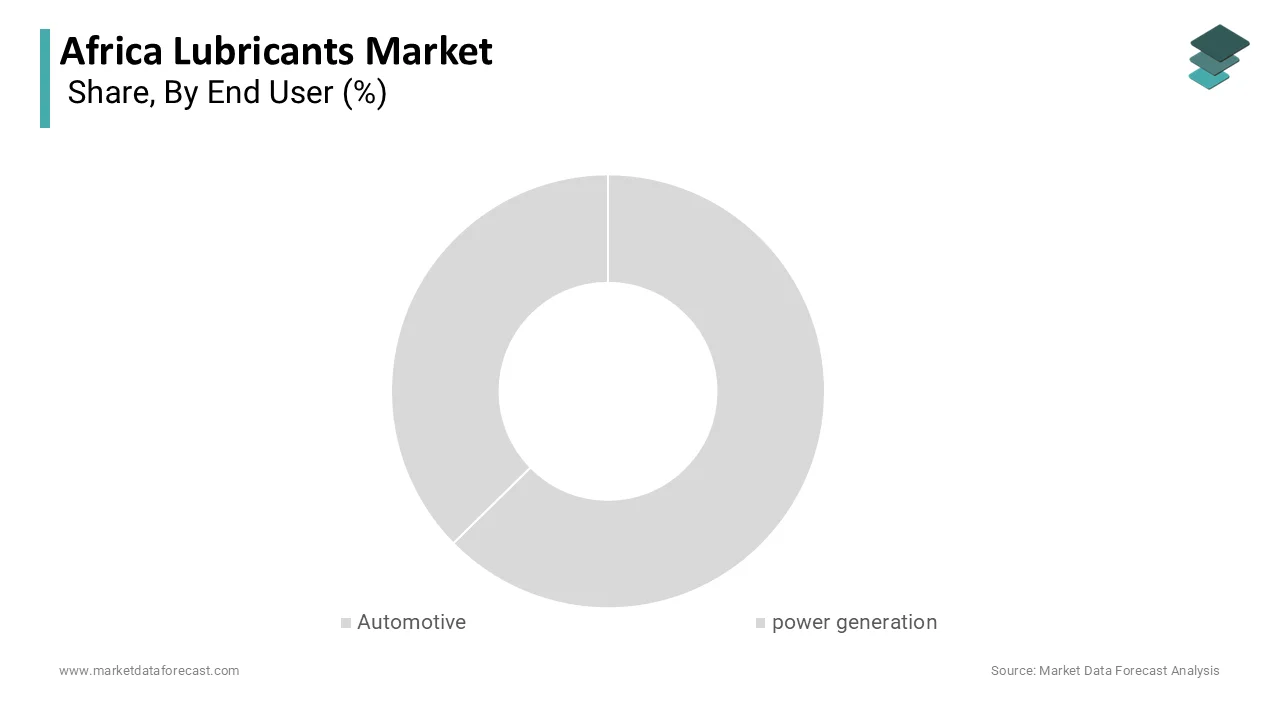
The power generation segment is projected to register the highest CAGR of 7.8% between 2026 and 2034. This rapid expansion of the power generation segment is majorly fuelled by increased investments in both conventional and renewable energy infrastructure, aiming to address chronic electricity shortages across the continent. According to the International Energy Agency (IEA), Africa added over 5 GW of new power generation capacity in 2023, with natural gas, hydroelectric, and solar projects playing pivotal roles. Gas-fired power plants, such as the Azura-Edo Independent Power Project in Nigeria, require specialized turbine oils and compressor fluids, contributing to rising industrial lubricant consumption. Furthermore, the push toward renewable energy sources like wind and solar has amplified demand for high-performance synthetic lubricants. As per the African Development Bank, installed wind power capacity in sub-Saharan Africa surpassed 1.2 GW in 2023, necessitating durable gear oils for turbines operating under extreme conditions. So, the power generation segment will continue to be a major catalyst for lubricant demand growth.
By Product Type Insights
The engine oils segment represented the prominent product type within the African lubricants market by capturing an estimated 38% share in 2025. Their indispensable role in maintaining the performance and longevity of internal combustion engines in both passenger vehicles and commercial fleets is contributing to the growth o he engine oil segment. The widespread use of engine oils aligns with the surge in vehicle registrations across the continent. Moreover, the continued importation of used vehicles, particularly from Japan and Europe, fuels aftermarket demand for engine oils. These trends ensure engine oils remain the most consumed lubricant product type in Africa.
The metalworking fluids segment is anticipated to grow at the fastest CAGR of 6.9% during the forecast period. A key growth factor of the metalworking fluids segment is the resurgence of metal processing activities in countries like Ethiopia, Tanzania, and Ghana. It is reflecting the continent’s expanding manufacturing and metal fabrication industries. These fluids play a critical role in machining, cutting, and forming metals, supporting sectors such as automotive component production, construction materials, and industrial equipment manufacturing. In addition, foreign investment in metal-based industries is gaining momentum.
COUNTRY LEVEL ANALYSIS
South Africa spearheaded the African lubricants market by contributing 27.5% in 2025 due to its well-established industrial base, mature automotive sector, and robust refining capabilities. In addition, Sasol, one of the world’s leading synthetic fuel and lubricant producers, operates multiple blending facilities across the country, ensuring a steady supply of high-quality products. Also, the South African Bureau of Standards (SABS) enforces strict quality regulations, enhancing consumer confidence in locally produced lubricants. Despite economic headwinds, including load-shedding and inflation, South Africa remains the most developed market for lubricants in Africa, offering strong distribution networks and a competitive supplier landscape.
Nigeria is a key regional lubricants market. It is supported by its large population, expanding transport sector, and growing industrial activity. However, the country faces significant challenges in refining capacity, leading to heavy reliance on imports. According to the Nigerian Upstream Petroleum Regulatory Authority (NUPRC), Nigeria imported over $2.5 billion worth of refined petroleum products, including lubricants, in 2023, as domestic refineries operate below capacity. Moreover, multinational players like TotalEnergies and Shell maintain strong footholds in the market, leveraging brand recognition and supply chain efficiency. So, Nigeria is poised for moderate growth in lubricant availability and pricing stability, making it a key market in West Africa due to government efforts to revamp the Port Harcourt Refinery and promote local blending.
Egypt commands a notable share of the African lubricants market,t which is benefiting from its strategic location, relatively stable economy, and growing industrial infrastructure. As per Egypt’s General Authority for Investment and Free Zones (GAFI), the country attracted over $8 billion in industrial sector investments in 2023, including automotive assembly and textile manufacturing, both major consumers of lubricants. Furthermore, Egypt’s Suez Canal Economic Zone (SCZone) has become a hub for lubricant blending and export, attracting international companies looking to serve North Africa and the Middle East. The ongoing infrastructure development and government incentives for industrial expansion keep Egypt a vital player in the regional lubricants landscape.
Kenya is emerging as a key regional hub due to its growing transport sector, expanding logistics network, and improving regulatory environment. The country’s strategic position as an East African trade gateway has led to increased freight movement, boosting demand for heavy-duty engine oils and greases. Also, the government’s focus on infrastructure projects, including the Nairobi Expressway and Lamu Port-South Sudan-Ethiopia Transport (LAPSSET) corridor, has enhanced construction and earthmoving machinery usage, driving industrial lubricant consumption. Local blenders such as KenolKobil and TotalEnergies Kenya are investing in modern storage and packaging facilities to meet rising demand. With favorable macroeconomic policies and a growing middle class, Kenya is positioned for sustained lubricant market growth.
The remaining African countries collectively account for a ddecent portionof the regional lubricants market, with notable contributions from Morocco, Algeria, Ghana, Ethiopia, and Angola. Each of these nations exhibits unique growth dynamics based on industrialization levels, resource extraction activities, and infrastructure development. Morocco, for example, benefits from a thriving automotive sector, with Renault and Stellantis establishing major assembly plants in Tangier. Ethiopia, despite political instability, has made strides in manufacturing and textiles. Algeria, rich in hydrocarbon resources, maintains a self-sufficient refining system, enabling domestic production of base oils and finished lubricants. Meanwhile, Angola is leveraging post-oil slump recovery to invest in agriculture and construction, indirectly boosting lubricant consumption.
COMPETITIVE LANDSCAPE
The competition in the African lubricants market is characterized by a mix of global majors, regional blenders, and emerging independent players vying for market share across diverse economic and regulatory landscapes. While multinational corporations dominate due to their brand strength, advanced formulations, and extensive distribution networks, regional players are increasingly leveraging cost-effective solutions and localized expertise to capture niche markets. The market remains highly fragmented, especially in West and East Africa, where informal channels and unbranded products still hold considerable sway. Consumer awareness about lubricant quality and performance is growing, prompting both international and domestic players to invest in after-sales services, technical support, and training programs to differentiate themselves. Additionally, environmental concerns and the push for sustainable products are influencing competitive strategies, with leading companies emphasizing eco-friendly formulations and responsible waste management practices. As infrastructure development and industrialization progress across the continent, the battle for market leadership is expected to intensify, with innovation, pricing strategies, and supply chain efficiency playing decisive roles in determining winners in this evolving market.
KEY MARKET PLAYERS
Overview of Competition in the African Lubricants Market includes
- Royal Dutch Shell Plc
- BP Plc (Castrol)
- Engen Petroleum Ltd.
- TotalEnergies SE
- Centlube
- ExxonMobil Corporation
- Chevron Corporation
- Fuchs Petrolub AG
- Sinopec Limited
- PetroChina Company Limited
Top Players in the Market
Shell plc
Shell is a dominant player in theAfricana lubricants market, known for its premium product portfolio and strong distribution network across key countries such as Nigeria, South Africa, and Kenya. The company’s commitment to innovation and sustainability has enabled it to maintain brand loyalty among both industrial and automotive consumers. Shell’s localized production facilities and partnerships with major automotive manufacturers enhance its market presence and reinforce its reputation for high-performance lubricants.
TotalEnergies SE
TotalEnergies has a significant footprint in the African lubricants sector, offering a diverse range of products tailored to meet the needs of automotive, industrial, and marine applications. By blending plants in several African countries, the company ensures a consistent supply and quality control. Its focus on technical excellence and customer-centric solutions has helped it build long-term relationships with fleet operators, OEMs, and independent distributors across the continent.
BP plc (Castrol)
Castrol, a subsidiary of BP, plays a pivotal role in shaping the lubricants landscape in Africa through its well-established brand recognition and extensive dealer network. The company emphasizes technological advancement and after-sales support, catering to both consumer and commercial segments. Castrol’s active engagement in training programs and service center development supports its continued influence in the region’s evolving lubricants market.
Top Strategies Used by Key Market Participants
- One major strategy employed by key players is localized production and blending, allowing companies to reduce costs, ensure faster delivery, and comply with regional regulations. By setting up or expanding blending facilities within African countries, firms can better cater to local demand while minimizing dependency on imports.
- Another widely adopted approach is strategic partnerships and joint ventures, particularly with automotive manufacturers and industrial equipment suppliers. These collaborations help lubricant producers integrate their products into OEM specifications and gain access to established distribution networks.
- Lastly, brand awareness and digital marketing initiatives have become essential tools for differentiation in a fragmented market. Companies are investing in consumer education, mobile-based service platforms, and targeted campaigns to build trust and preference for their lubricant brands across diverse customer segments in Africa.
RECENT HAPPENINGS IN THE MARKET
- In May 2023, Shell expanded its lubricants blending facility in Johannesburg, South Africa, aiming to improve supply chain efficiency and meet rising demand from the country’s industrial and transport sectors.
- In September 2023, TotalEnergies launched a new line of bio-based lubricants tailored for African mining and agricultural machinery, aligning with sustainability goals while addressing performance requirements in extreme operating conditions.
- In January 2025, Castrol initiated a partnership with leading truck manufacturers in Kenya to integrate its engine oils into OEM recommendations, enhancing brand visibility and ensuring long-term aftermarket engagement.
- In March 2025, Eni opened a new lubricants packaging plant in Lagos, Nigeria, to strengthen its distribution capabilities and provide locally adapted products that cater to the needs of Nigerian consumers.
- In June 2025, Gulf Oil signed a strategic distribution agreement with a major Kenyan fuel retailer to expand its retail footprint and increase accessibility of its lubricants across East Africa.
MARKET SEGMENTATION
This research report on the African Lubricants Market has been segmented and sub-segmented into the following.
By End User
- Automotive
- power generation
By Product Type
- engine oils
- metalworking fluids
By Country
- China
- India
- Japan
- South Korea
- Australia
- New Zealand
- Thailand
- Indonesia
- Philippines
- Vietnam
- Singapore
- Rest of APAC