- Product Description Description
- Table of Contents TOC
- List of Table & Figure LOT
- Get Free Sample PDF Sample PDF
Africa Medical Devices Market Size
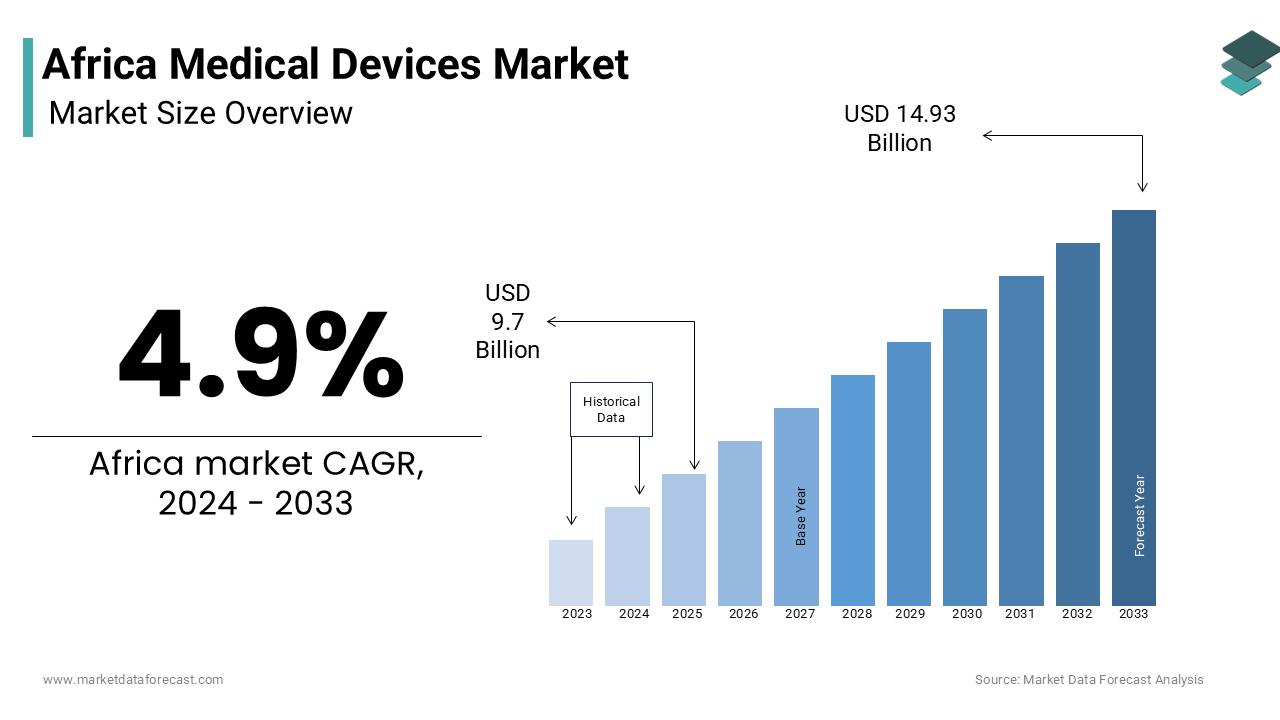
The Africa Medical Devices Market is estimated to grow from USD 9.7 billion in 2024 to USD 14.93 billion in 2033, representing a CAGR of 4.9%.
Medical devices refer to the diagnostic, therapeutic, and monitoring equipment across healthcare facilities on the continent, ranging from basic syringes and ultrasound machines to advanced imaging systems and implantable devices. The continent faces a severe deficit in medical infrastructure. Additionally, the density of healthcare professionals remains critically low, there are fewer than 2.5 skilled health workers per 1,000 people in most African countries, as per the Global Health Observatory. These systemic gaps define the operational and developmental challenges within the medical devices landscape.
MARKET DRIVERS
Rising Burden of Non-Communicable Diseases (NCDs)
The escalating prevalence of non-communicable diseases is a pivotal force driving demand for medical devices across Africa. According to the World Health Organization, NCDs such as cardiovascular diseases, diabetes, and cancer account for 37% of all deaths in Africa, a figure projected to surpass infectious diseases as the leading cause of mortality by 2030. In 2023, over 24 million adults in Africa were living with diabetes, a number expected to double by 2045, as per the International Diabetes Federation. This epidemiological shift necessitates widespread deployment of diagnostic and monitoring devices, including glucometers, ECG machines, and dialysis units. The expansion of chronic disease management programs under national health strategies is further amplifying the need for reliable, scalable medical device infrastructure.
Expansion of Healthcare Infrastructure and Public Health Initiatives
Governments across Africa are undertaking large-scale investments in healthcare infrastructure, directly stimulating demand for medical equipment. Ethiopia, for example, has commissioned several new health posts since 2020, each requiring basic diagnostic tools and treatment devices. Rwanda has increased its number of functional health facilities since 2018, enabling broader access to ultrasound and laboratory devices. These institutional expansions create sustained demand for both primary care and specialized medical technologies.
MARKET RESTRAINTS
Inadequate Regulatory Harmonization and Approval Delays
The lack of standardized regulatory frameworks across countries, leading to protracted approval timelines and inconsistent quality oversight is a major impediment to the medical devices market in Africa. Also, only some of Africa’s 54 nations have fully functional medical device regulatory authorities, while others rely on ad hoc or outdated systems. This fragmentation discourages multinational manufacturers from entering multiple markets and increases the risk of substandard products entering circulation. The East African Community attempted regional harmonization, yet implementation remains uneven, with Kenya and Uganda maintaining separate evaluation protocols. These regulatory inefficiencies delay patient access and deter investment in distribution networks.
Limited Access to Financing and High Import Dependency
The acquisition of medical devices in Africa is severely constrained by financial limitations and reliance on foreign suppliers. Over 90% of advanced medical devices used in Africa are imported, primarily from Europe, China, and the United States. This dependency exposes healthcare systems to currency fluctuations and supply chain disruptions. Furthermore, import duties on medical equipment vary in countries like Tanzania and Angola, increasing final costs. These financial and logistical barriers restrict the availability of critical devices, particularly in rural and underserved regions.
MARKET OPPORTUNITIES
Growth of Local Medical Device Manufacturing and Assembly Hubs
Emerging industrial policies are fostering the development of localized medical device production, presenting a transformative opportunity for the African market. As per the African Union’s Africa Medical Device Manufacturing Strategy, many countries are establishing medical technology parks to support domestic assembly and production. In Egypt, local production of dialysis machines increased between 2021 and 2023 through public-private partnerships. These initiatives reduce import dependency, lower costs, and enhance supply chain resilience, positioning Africa to develop self-sustaining medical device ecosystems.
Integration of Digital Health and Telemedicine Platforms
The proliferation of digital health solutions is creating new pathways for medical device deployment and utilization across Africa. According to the International Telecommunication Union, mobile network coverage now reaches 85% of the African population, enabling the adoption of connected diagnostic tools. Companies like Helium Health and Baobab Circle have deployed cloud-based electronic medical record systems integrated with portable ECG and ultrasound devices, allowing remote diagnostics in rural clinics. Also, telemedicine consultations in Nigeria increased, driven by smartphone penetration and affordable data. These digital platforms not only expand device reach but also improve data accuracy, maintenance tracking, and clinical decision-making, revolutionizing access to medical technology.
MARKET CHALLENGES
Shortage of Technical Personnel for Device Maintenance and Calibration
The effective operation of medical devices across Africa is undermined by a critical shortage of biomedical engineers and technical support staff. According to the World Health Organization, Africa has fewer than 10 biomedical engineers per million people, compared to over 100 in high-income countries. This deficit results in high equipment downtime. In Zambia, low percentage of ventilators were operational during the peak of the pandemic due to inadequate servicing capacity. Training programs remain limited. Without skilled personnel, even donated or newly procured devices fail to deliver sustained clinical impact.
Inconsistent Power Supply and Infrastructure Deficits
The reliability of medical devices in Africa is fundamentally compromised by unstable electricity grids and underdeveloped healthcare infrastructure. According to the International Energy Agency, over 600 million people in Sub-Saharan Africa lack access to electricity. Sensitive equipment such as MRI scanners, incubators, and laboratory analyzers require uninterrupted power. These infrastructural deficiencies necessitate costly adaptations such as solar-powered refrigeration and offline-capable devices, complicating procurement and limiting technological advancement.
SEGMENTAL ANALYSIS
By Type Insights
The diagnostic Imaging segment emerged as the largest type in the Africa medical devices market by capturing an estimated 22.5% share in 2024. This dominance is due to the critical need for early disease detection and the expansion of radiology services across public and private healthcare networks. Despite the continent’s vast population, there are fewer X-ray machines and MRI units deployed across Sub-Saharan Africa. The integration of imaging into national cancer and tuberculosis control programs has further amplified procurement. In Nigeria, it has diagnostic equipment expansion initiatives under its Cancer Control Plan. The expansion of public health screening initiatives requiring imaging modalities is a primary driver of this segment’s growth. Mobile imaging units have been deployed in rural South Africa under the National Cancer Strategy, increasing early diagnosis rates. These systemic dependencies on visual diagnostics ensure that imaging remains central to clinical decision-making and healthcare planning.
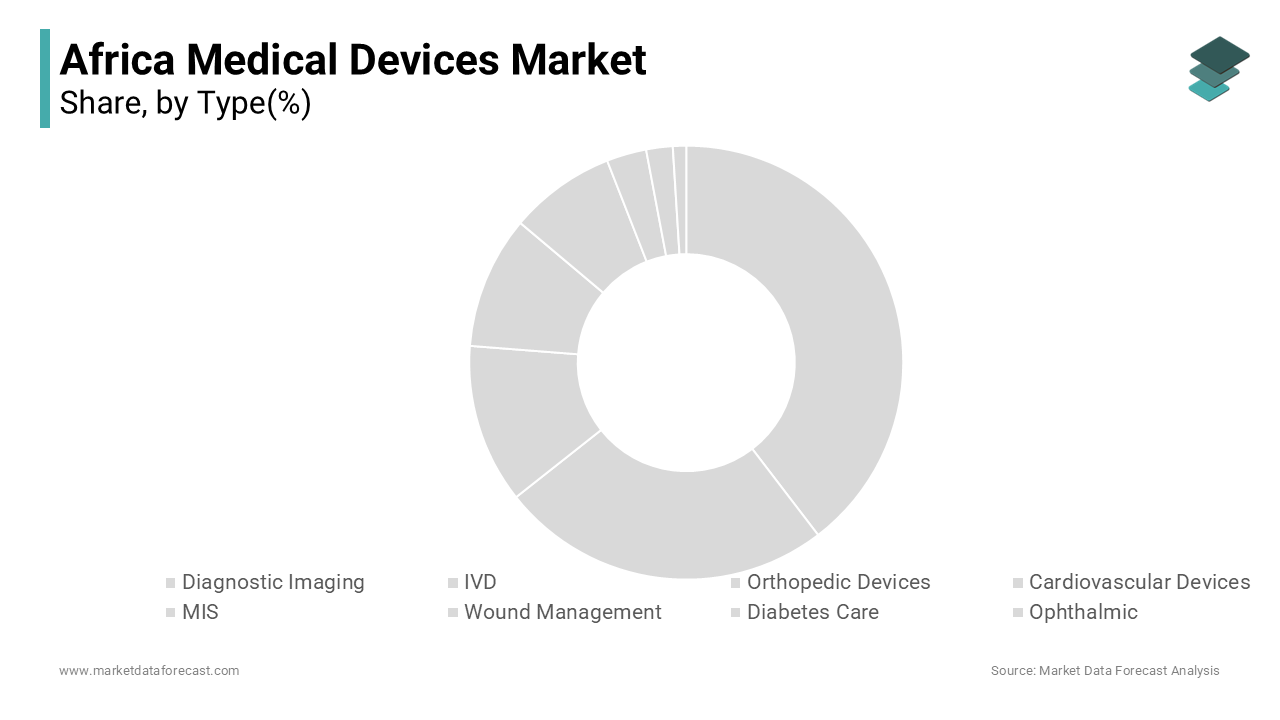
The In Vitro Diagnostics (IVD) segment is the fastest-growing segment and is projected to expand at a CAGR of 13.6% from 2025 to 2033. This surge is propelled by the urgent need for rapid, decentralized testing across infectious and non-communicable diseases. The continent faces a severe shortage of laboratory capacity. The HIV epidemic, with 20.8 million people living with the virus in Eastern and Southern Africa, necessitates continuous viral load and CD4 monitoring, driving demand for point-of-care molecular and immunoassay devices. Malaria and hepatitis testing also contribute significantly to IVD uptake. A key factor behind this accelerated growth is the integration of IVD into national disease surveillance and pandemic preparedness frameworks. According to the World Health Organization, over 120 million rapid diagnostic tests (RDTs) for malaria were distributed across Africa in 2023, primarily in Nigeria, DRC, and Uganda. Furthermore, the Rwanda Biomedical Center introduced AI-powered digital microscopy for TB diagnosis in 2023, improving accuracy and reducing turnaround time. This convergence of public health necessity and technological accessibility positions IVD as the most dynamic segment in the medical devices landscape.
By End-User Insights
The Hospital & Ambulatory Surgical Centers (ASCs) segment led the Africa medical devices market by accounting for a 67.3% of total device utilization in 2024. This dominance is attributable to the concentration of advanced medical equipment in institutional settings, where complex diagnostics, surgeries, and chronic disease management are conducted. Public and private hospitals serve as primary procurement hubs for high-value devices such as ultrasound machines, anesthesia systems, and surgical instruments. In South Africa, public hospitals manage most of all medical imaging equipment, while Egypt operates large number of facilities equipped with centralized biomedical systems. A major driver of this segment’s preeminence is the centralized nature of healthcare delivery and capital-intensive procurement models. As per the World Bank, over 90% of surgical procedures in Africa are performed in hospitals. Additionally, the East, Central and Southern Africa College of Surgeons reports that the number of ASCs in urban centers like Nairobi, Kampala, and Dar es Salaam has increased, enabling outpatient procedures that require specialized instrumentation. These institutional investments, often backed by donor funding or development bank loans, ensure that hospitals remain the primary locus of medical device deployment.
The Clinics segment is the fastest-growing end-user segment and is projected to grow at a CAGR of 11.8% during the forecast period. This acceleration is driven by the proliferation of primary care and specialty clinics in urban and peri-urban areas, which are increasingly equipped with portable and point-of-care devices. The rise of franchise clinic networks such as HealthPlus in Nigeria and Meddy in Egypt has standardized equipment procurement, including digital thermometers, ECG machines, and handheld ultrasound devices. A key factor fueling this growth is the expansion of digital health platforms and telemedicine-integrated clinics. In Rwanda, the government partnered with Babylon Health to deploy AI-assisted diagnostic kiosks in 300 primary clinics, enabling remote consultations and real-time device usage. With rising insurance penetration and demand for preventive care, clinics are evolving into technologically enabled care nodes, driving sustained demand for compact, reliable, and cost-effective medical devices.
REGIONAL ANALYSIS
South Africa stood as the most advanced medical technology market in sub-Saharan Africa by commanding an estimated 24.7% share of the MEA region in 2024. Its well-established healthcare infrastructure, including over 200 private hospitals and a network of public referral centers, supports high demand for advanced diagnostic and therapeutic devices. The country hosts regional distribution hubs for multinational manufacturers such as Siemens Healthineers and GE Healthcare. The MedTech Park initiative in Cape Town aims to boost local manufacturing. Despite fiscal constraints, public-private partnerships and medical device innovation grants are sustaining market momentum.
Egypt holds a dominant position in North Africa’s medical devices landscape. Its strategic location and large population create substantial domestic demand, while government-led industrialization efforts are fostering local assembly. The country imported $1.2 billion in medical devices in 2023, primarily imaging systems, dental units, and cardiovascular implants. The Ministry of Health’s "100 Million Seha" campaign has driven mass procurement of ECG machines and blood pressure monitors for nationwide screening. Additionally, the Suez Canal Economic Zone hosts medical device manufacturing facilities with tax incentives, attracting firms like B. Braun and Fresenius
Nigeria represents the largest emerging medical devices market in West Africa. As Africa’s most populous nation, the demand for basic and mid-tier medical equipment is immense, though largely unmet. The Lagos State Government launched the Primary Healthcare Revitalization Program, equipping clinics with essential diagnostic kits and oxygen concentrators. Rising insurance coverage and the National Health Act’s emphasis on medical infrastructure are gradually improving device accessibility, despite persistent supply chain and regulatory challenges.
Kenya has emerged as a regional innovation hub in East Africa. Its stable regulatory environment and growing private healthcare sector make it a preferred entry point for medical device distributors targeting the East African Community. The country has significant number of registered medical device companies, including local assemblers of syringes and nebulizers. With Nairobi serving as a logistics and innovation nexus, Kenya is positioning itself as a leader in digital diagnostics and point-of-care technology deployment.
Ethiopia is rapidly expanding its healthcare infrastructure. Despite being landlocked, the country’s state-driven health expansion strategy has prioritized medical equipment procurement for its growing network of hospitals and health centers. A significant number of new health facilities were established between 2020 and 2023. With the Addis Ababa MedTech Park under development and plans to localize production of IV sets and surgical gowns, Ethiopia is building a foundation for long-term medical device self-reliance.
KEY MARKET PLAYERS AND COMPETITIVE LANDSCAPE
Medtronic; GE HealthCare; Siemens Healthineers; Philips; Abbott; Johnson & Johnson; Becton, Dickinson and Company (BD); Roche Diagnostics; Stryker; Boston Scientific; Baxter; B. Braun; Cardinal Health; Olympus; Zimmer Biomet; Smith & Nephew; Mindray; Canon Medical Systems; 3M Health Care
Competition in the Africa medical devices market is evolving beyond product availability to encompass service integration, durability, and post-sale support. Multinational corporations such as Siemens Healthineers, GE Healthcare, and Philips dominate high-end segments with advanced imaging and diagnostic systems, often deployed through government tenders and donor-funded programs. Regional distributors and emerging local manufacturers are gaining traction by offering cost-effective, simplified devices tailored to primary care needs. The rise of digital health platforms has intensified competition in point-of-care diagnostics, with startups introducing AI-enabled, portable tools. Regulatory compliance, technical training, and after-sales service networks are becoming critical differentiators. As African governments prioritize health technology localization, competitive advantage is shifting toward companies that combine innovation with on-the-ground infrastructure and capacity-building initiatives across the continent.
Top Players in the Africa Medical Devices Market
Siemens Healthineers has established a significant footprint across Africa by delivering advanced diagnostic and imaging technologies tailored to diverse healthcare environments. The company operates technical training centers in South Africa, Kenya, and Egypt to enhance local capacity in equipment maintenance and clinical application. It also partnered with Ethiopia’s Federal Ministry of Health to equip three regional referral hospitals with digital radiography units. By integrating AI-powered analytics into its imaging platforms, such as the AI-Rad Companion, Siemens is enabling remote diagnostics in underserved areas. Its collaboration with telemedicine providers in Nigeria and Ghana allows real-time image transmission to centralized radiology hubs, improving diagnostic accuracy and turnaround time across decentralized health networks.
GE Healthcare plays a pivotal role in expanding access to essential medical technologies across Africa through innovation and localized service delivery. The company has deployed over 5,000 diagnostic devices including portable ultrasound and ECG systems—across 30 African countries, with a strong focus on maternal and neonatal health. It also introduced the MAC 400 AI-enabled ECG device in Kenya, capable of detecting arrhythmias without specialist input. GE’s partnership with the African Union’s Partnership for African Vaccine Manufacturing includes equipping biologics facilities with cold chain monitoring systems. Additionally, its Edison Digital Infrastructure platform is being piloted in South African hospitals to optimize device utilization and predictive maintenance, enhancing operational efficiency and reducing downtime in resource-constrained settings.
Medtronic has strategically expanded its presence in Africa by focusing on cardiovascular, diabetes, and surgical care solutions adapted to local clinical needs. The company operates training academies in Johannesburg and Nairobi, where healthcare professionals receive hands-on instruction in using implantable devices and minimally invasive surgical tools. It also introduced the MiniMed insulin pump with simplified dosing algorithms for type 1 diabetes patients in urban clinics across Egypt and Tunisia. Through its Global Surgery Initiative, Medtronic supports surgical outreach camps in Nigeria and Ethiopia, providing laparoscopic instruments and sterilization units. These efforts underscore its commitment to improving clinical outcomes while building sustainable device ecosystems in low-resource environments.
Top Strategies Used by Key Market Participants
Key players in the Africa medical devices market are leveraging localized product development, public-private partnerships, digital integration, workforce training, and regional distribution expansion to solidify their positions. Companies are redesigning devices to withstand power fluctuations, high temperatures, and limited maintenance access, ensuring durability in African settings. Collaborations with ministries of health and multilateral agencies facilitate large-scale procurement and donation programs. Digital health integration enables remote monitoring, predictive maintenance, and tele-radiology services, enhancing device utility. Firms are also investing in biomedical technician training to reduce equipment downtime. Additionally, establishing regional warehouses in hubs like Nairobi, Johannesburg, and Dubai improves supply chain responsiveness. These strategies collectively address infrastructure gaps, regulatory complexity, and accessibility challenges, enabling sustainable market penetration and long-term clinical impact.
RECENT MARKET DEVELOPMENTS
- In June 2023, Siemens Healthineers launched the Africa Ready program, introducing low-power, durable MRI and CT systems in Nigeria and Ethiopia, designed to operate in areas with unstable electricity, thereby improving access to advanced diagnostics in underserved regions.
- In September 2023, GE Healthcare deployed the Vscan Air handheld ultrasound device across 500 rural clinics in Malawi and Uganda, enabling frontline health workers to conduct cardiac and obstetric assessments without reliance on centralized hospitals.
- In January 2024, Medtronic partnered with the Rwanda Ministry of Health to distribute 10,000 hypertension monitoring devices to community health centers, integrating remote data transmission to support chronic disease management and reduce cardiovascular mortality.
- In March 2024, Philips inaugurated a biomedical training academy in Nairobi, Kenya, aimed at certifying 500 African technicians annually in medical device maintenance, addressing critical gaps in equipment servicing and reducing device downtime.
- In May 2024, Abbott launched a pan-African initiative to expand access to its Afinion HbA1c point-of-care testing devices in diabetes clinics across Ghana, Senegal, and Tanzania, supporting national screening programs and improving glycemic monitoring in primary care settings.
MARKET SEGMENTATION
This research report on the Africa medical devices market is segmented and sub-segmented into the following categories.
By Type
- Diagnostic Imaging
- IVD
- Orthopedic Devices
- Cardiovascular Devices
- MIS
- Wound Management
- Diabetes Care
- Ophthalmic
- Dental
- Nephrology
- General Surgery
- Others
By End-User
- Hospitals & ASCs
- Clinics
- Others
By Country
- South Africa
- Nigeria
- Rest of Africa