Africa Motorcycle Market Size, Share, Growth, Trends, And Forecast Research Report, Segmented By Motorcycle, Propulsion, Engine Capacity, And Country (Sudan, Egypt, Kenya, Ethiopia, South Africa, Rest of Africa), Industry Analysis From (2026 to 2034)
Market Size, 2025
$4.01 BnMarket Estimate, 2026
$4.25 BnMarket Forecast, 2034
$6.76 BnCAGR, 2026–2034
5.97%Africa Motorcycle Market Size
The Africa motorcycle market size was valued at USD 4.01 billion in 2025 and is anticipated to reach USD 4.25 billion in 2026 to from USD 6.76 billion by 2034, growing at a CAGR of 5.97% during the forecast period from 2026 to 2034.
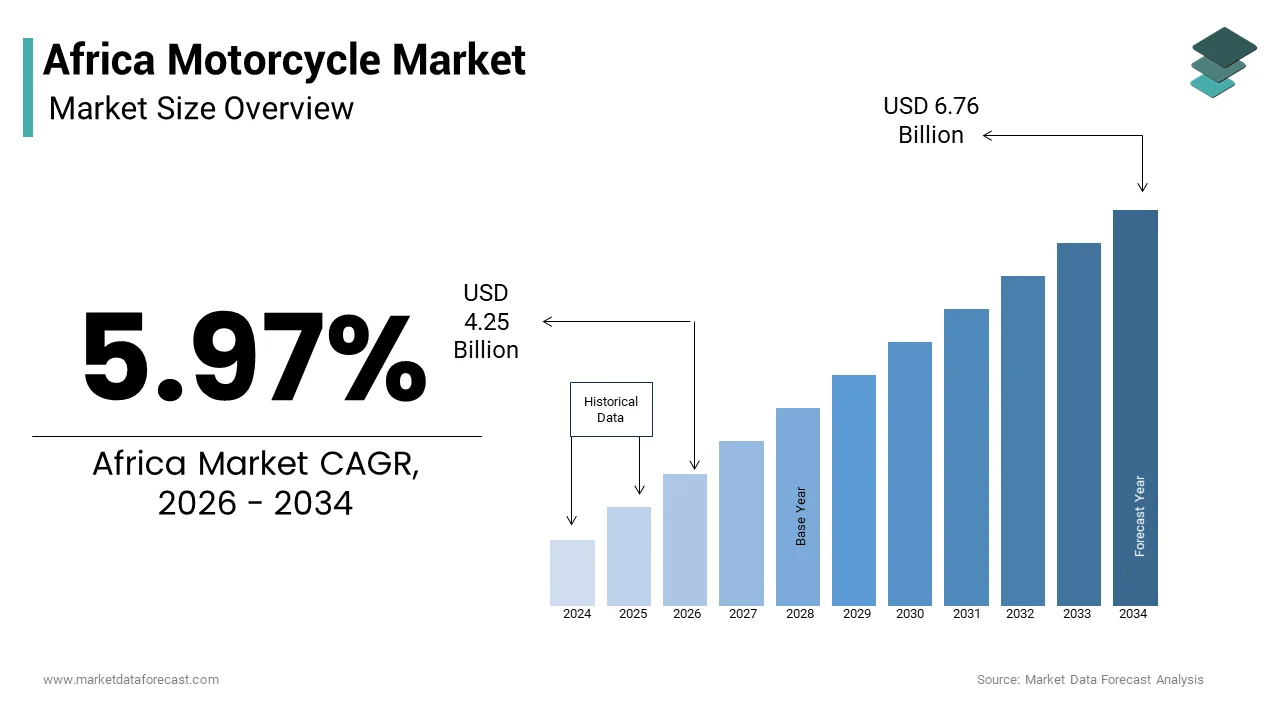
A motorcycle is a two-wheeled vehicle, including scooters, mopeds, and motorbikes, primarily used for personal mobility, commercial transport, and last-mile delivery services. With rapid urbanization, ga growing youth population, and inadequate public transportation systems in many African countries, motorcycles have become an essential mode of transport across both rural and urban settings.
Africa's motorcycle industry is largely driven by demand from emerging economies such as Nigeria, Kenya, Ghana, and Ethiopia, where affordability and maneuverability make motorcycles a preferred choice over cars.
Local assembly plants and import networks play a critical role in supplying affordable models from global manufacturers such as Honda, Yamaha, and Bajaj Auto. As per the United Nations Economic Commission for Africa, motorcycle ownership has increased significantly among micro-entrepreneurs who use them for ride-hailing, food delivery, and small-scale logistics operations.
Moreover, government initiatives aimed at formalizing the transport sector have led to increased licensing and registration of motorcycles, promoting safer and regulated usage. This evolving landscape underscores the motorcycle market’s significance in shaping mobility solutions across the continent.
MARKET DRIVERS
Rising Demand for Affordable and Efficient Personal Transport
The increasing demand for cost-effective and efficient personal transportation options in response to expanding urban populations and inadequate public transit infrastructure is one of the primary drivers of the African motorcycle market. According to the World Bank, over 50% of Africans will reside in urban areas by 2030, intensifying the need for accessible and economical mobility solutions. Motorcycles offer a practical alternative to congested roads and unreliable public transport systems, particularly in major cities like Kampala, Lomé, and Dakar.
Furthermore, the rise of digital ride-hailing platforms such as Uber Moto, Bolt Moto, and local startups like Gokada and Max.ng has spurred vehicle purchases among independent riders seeking flexible income opportunities. These factors collectively reinforce the sustained growth of the African motorcycle market.
Expansion of Commercial and Delivery Services Using Motorcycles
The proliferation of motorcycle-based commercial and delivery services has emerged as a key driver of the African motorcycle market. As per the International Labour Organization, informal transport and delivery sectors employing motorcycles employ over 10 million people across Sub-Saharan Africa, particularly in Nigeria, Kenya, and Uganda. The low operating costs, fuel efficiency, and agility of motorcycles make them ideal for last-mile delivery, courier services, and food distribution in densely populated urban centers.
Companies like Jumia Food, Glovo, and Sendy have integrated motorbike fleets into their logistics operations, boosting demand for new and durable two-wheelers tailored for commercial use.
Apart from these, financial inclusion initiatives have enabled aspiring entrepreneurs to acquire motorcycles through installment-based financing schemes. These developments show the integral role of motorcycles in supporting economic activity and entrepreneurial ventures across the continent.
MARKET RESTRAINTS
Inadequate Road Infrastructure and Traffic Congestion
The poor state of road infrastructure and persistent traffic congestion in major urban centers a significant restraints on the African motorcycle market. According to the World Bank, less than 40% of African roads are paved, limiting accessibility and increasing wear and tear on motorcycles. In countries like Nigeria and Ethiopia, frequent road closures, potholes, and unpaved surfaces reduce riding comfort and vehicle longevity, discouraging potential buyers. Moreover, insufficient investment in dedicated lanes or motorcycle-friendly infrastructure exacerbates safety concerns.
Regulatory Restrictions and Licensing Challenges
Regulatory restrictions and inconsistent licensing requirements pose a major challenge to the African motorcycle market. Many governments have introduced stringent registration policies, mandatory helmet laws, and operator permits to curb misuse and improve road safety. However, enforcement varies widely, leading to confusion among riders and complicating compliance efforts.
These incidents discourage legal ownership and push users toward informal or unregistered operations, limiting official sales data and market transparency.
Besides, access to proper documentation remains a barrier for low-income riders. As per the United Nations Development Programme, approximately 40% of motorcycle operators in West Africa lack valid licenses due to bureaucratic hurdles and high administrative fees. Without streamlined regulatory frameworks and improved governance, these challenges will continue to impede formal market growth and investor confidence.
MARKET OPPORTUNITY
Growing Adoption of Electric Motorcycles and Green Mobility Initiatives
The rising adoption of electric motorcycles and green mobility programs supported by regional governments and international development agencies is a promising opportunity for the African motorcycle market. According to the United Nations Environment Programme, several African cities have pledged to reduce carbon emissions and promote sustainable transport alternatives under the framework of the Paris Agreement.
Countries like Kenya, Rwanda, and Nigeria have introduced pilot projects and tax incentives to encourage the production and sale of electric motorcycles. These vehicles offer reduced fuel costs, lower maintenance needs, and environmental benefits, making them attractive to both individual riders and fleet operators.
Moreover, partnerships between local manufacturers and foreign investors are accelerating the development of e-motorcycle assembly lines within the continent. These trends signal a transformative shift toward cleaner and more sustainable urban mobility.
Expansion of Digital Financing and Leasing Models for Motorcycle Ownership
Digital financing and leasing models are unlocking new opportunities for motorcycle ownership in Africa, enabling broader access to previously underserved consumer segments. According to the African Development Bank, traditional lending barriers such as lack of credit history and collateral have historically limited motorcycle acquisition for millions of young workers and entrepreneurs.
To address this gap, fintech companies and microfinance institutions have launched mobile-based loan platforms that allow individuals to purchase motorcycles through installment payments.
These digital finance tools not only expand consumer access but also create structured pathways for asset ownership, insurance integration, and after-sales service management. This evolution presents a scalable opportunity for market participants aiming to boost sales and financial inclusion simultaneously.
MARKET CHALLENGES
High Cost of Spare Parts and After-Sales Service Limitations
The high cost and limited availability of spare parts and after-sales service infrastructure are a major challenge facing the African motorcycle market. According to the International Trade Centre, imported motorcycle components often face high tariffs, logistical delays, and supply chain inefficiencies, inflating repair costs and discouraging long-term ownership.
In many African countries, authorized service centers are concentrated in major cities, leaving rural and semi-urban areas underserved. Further, the dominance of informal repair workshops—often lacking genuine parts and trained technicians—leads to substandard servicing, compromising vehicle performance and rider safety.
Competition from Alternative Urban Mobility Solutions
The African motorcycle market faces increasing competition from alternative urban mobility solutions such as electric tricycles, mini-buses, ride-sharing apps, and even bicycles. According to McKinsey & Company, the emergence of battery-powered three-wheelers and shared carpool services has begun to erode the dominance of motorbikes in city transport ecosystems.
Cities like Cape Town and Kigali have invested in modern bus rapid transit (BRT) systems and expanded rail connectivity, offering commuters safer and more regulated options. As per the World Bank, Johannesburg’s Rea Vaya BRT system recorded over 100,000 daily passengers in 2023. Apart from these, shifting consumer preferences among younger demographics, a multi-modal transport and app-based services, have diluted traditional motorcycle demand. If left unchecked, these evolving trends could constrain motorcycle market expansion in the long term.
REPORT COVERAGE
| REPORT METRIC | DETAILS |
| Market Size Available | 2025 to 2034 |
| Base Year | 2025 |
| Forecast Period | 2026 to 2034 |
| CAGR | 5.97% |
| Segments Covered | By Motorcycle, Propulsion, Engine Capacity, And Region |
| Various Analyses Covered | Global, Regional, and Country Level Analysis; Segment-Level Analysis; DROC; PESTLE Analysis; Porter’s Five Forces Analysis; Competitive Landscape; Analyst Overview of Investment Opportunities |
| Regions Covered | Sudan, Egypt, Kenya, Ethiopia, South Africa, Rest of Africa |
| Market Leaders Profiled | Honda Motor Co., Ltd. ( Japan), TVS Motor Company Ltd. (India), Bajaj Auto Ltd. (India), Yamaha Motors Co. ( Japan), Suzuki Motor Corporation (Japan), Triumph Motorcycles (U.K.), Bayerische Motoren Werke (BMW) AG (Germany), Harley-Davidson, Inc. (U.S.), Hero MotoCorp Ltd. (India), Kawasaki Motors Corp (Japan). |
SEGMENTAL ANALYSIS
By Motorcycle Insights
The standard motorcycle segment dominated the African motorcycle market by accounting for 48.5% of the total share in 2025. Its suitability for daily commuting and commercial use is one of the key drivers behind the growth of the standard motorcycle segment. These bikes typically range between 100cc and 250cc, offering an optimal balance between performance and cost-effectiveness. Besides, standard motorcycles are preferred by ride-hailing operators, delivery services, and informal transport providers due to their ease of maintenance and availability of spare parts. Moreover, manufacturers such as Bajaj Auto, Yamaha, and Honda have tailored their entry-level models specifically for African markets, ensuring durable builds and localized after-sales support. These factors collectively contribute to the sustained leadership of the standard motorcycle segment in the regional market.
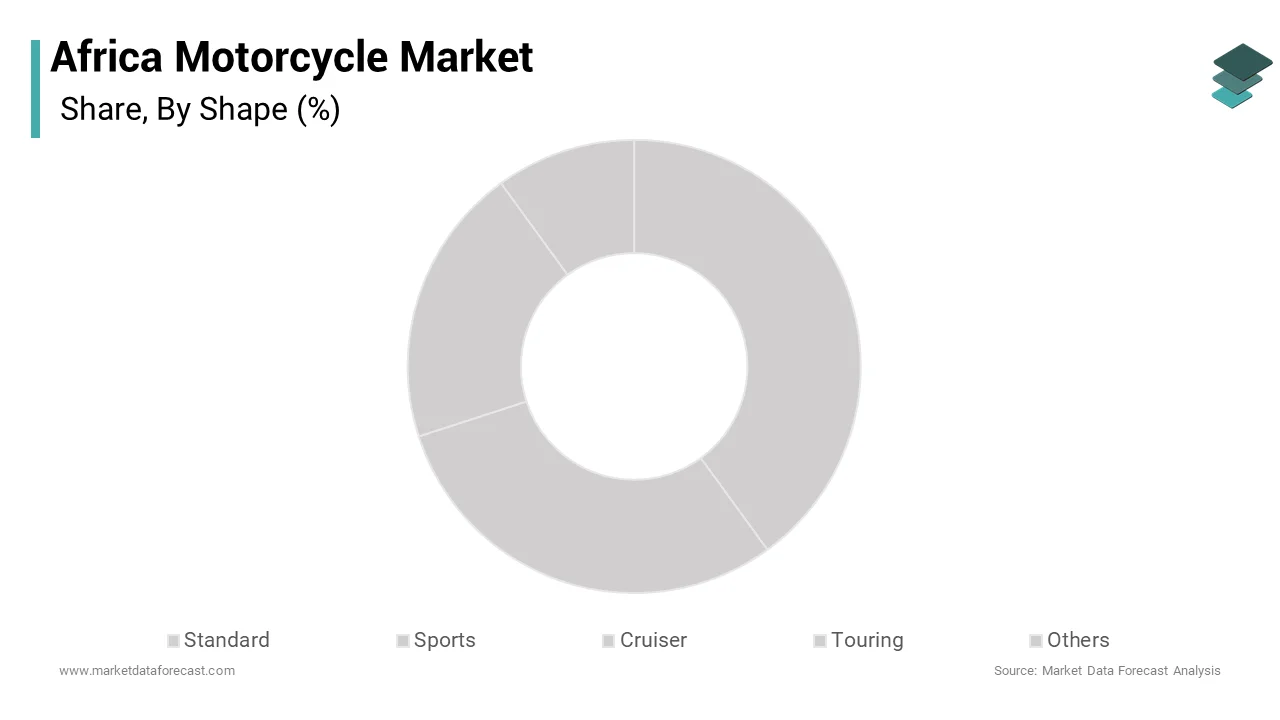
The sports motorcycle segment is emerging as the fastest-growing category within the African motorcycle market, projected to expand at a CAGR of 9.4%. This growth is driven by rising disposable incomes among young professionals, and increasing interest in premium two-wheeler experiences is propelling the rapid expansion of the sports motorcycle segment. The growing influence of youth culture and social media, where sports bikes are increasingly associated with status and lifestyle, is another key factor fuelling this trend.
An additional important driver is the expansion of motorcycle clubs and racing events that promote high-performance biking. Furthermore, automotive financing options and installment-based purchase plans have made higher-end bikes more accessible to middle-class buyers. These developments indicate a clear shift toward aspirational ownership and performance-oriented riding preferences across the continent.nt
By Propulsion Insights
The internal combustion engine (ICE) motorcycle segment holds the largest share of the African motorcycle market, capturing approximately 94% of total sales in 2023. The lack of extensive charging networks required for electric motorcycles is one of the leading drivers of the dominance of the internal combustion engine (ICE) motorcycle segment.
Moreover, consumer familiarity and repair accessibility play a crucial role in sustaining ICE motorcycle demand. In addition, major manufacturers continue to focus on producing fuel-efficient and low-emission ICE models that cater to price-sensitive consumers.
Despite growing interest in sustainability, ICE motorcycles will remain the backbone of the African two-wheeler industry for the foreseeable future due to existing infrastructural limitations and economic realities.
The electric motorcycle segment is the fastest-growing propulsion type in the African motorcycle market, expanding at a CAGR of 34.7%. Government incentives, environmental concerns, and technological advancements that are reshaping urban mobility preferences are fuelling the rapid growth of the electric motorcycle segment.
The increasing number of green mobility initiatives supported by national governments and international development agencies is another primary driver behind the surge in electric motorcycle adoption. According to the United Nations Environment Programme, Kenya, Rwanda, and Nigeria have all launched pilot programs to replace traditional motorbikes with electric variants in ride-hailing and delivery fleets.
A further influential factor is the declining cost of lithium-ion batteries and the rise of local assembly operations. As per Bloomberg New Energy Finance, battery prices have dropped by nearly 70% since 2018, making electric motorcycles more competitive with conventional models. Companies like Opibus in Kenya and Zembo in Uganda have capitalized on this trend by offering affordable e-motorbikes tailored for urban commuters. Further, digital financing platforms are enabling microloans for aspiring electric bike owners.
By Engine Capacity Insights
The up to 200cc engine capacity segment led the African motorcycle market by capturing 52.1% of total sales in 2024. The economic profile of the average motorcycle buyer in Africa is one of the key drivers of the up to 200cc engine capacity segment. Apart from these, regulatory frameworks in several countries encourage the use of smaller-engine motorcycles for safety and traffic management purposes. For instance, in Nairobi and Lagos, city authorities have imposed restrictions on high-capacity bikes in certain zones to reduce congestion and road accidents. Moreover, microfinance institutions and fintech lenders have prioritized financing schemes for smaller-engine motorcycles, enhancing access for first-time buyers.
The 200cc to 400cc engine capacity segment is the fastest-growing in the African motorcycle market, expanding at a CAGR of 10.2% in the future. This reflects shifting consumer preferences toward enhanced performance, comfort, and multi-purpose usage, particularly among professional riders and small business owners, which is propelling the expansion of the 200cc to 400cc engine capacity segment.
The increasing demand for dual-use motorcycles that can serve both personal commuting and commercial applications is another major driver of this segment. The growing popularity of adventure and touring-style bikes in urban and semi-rural regions is an additional contributing factor.
Besides, manufacturers are introducing technologically advanced models equipped with fuel injection, ABS braking systems, and digital dashboards, attracting younger buyers seeking modern features. As per the African Association of Automotive Manufacturers, sales of mid-capacity bikes rose by 18% in 2023, signaling a broader transition toward performance-oriented yet practical motorcycling options.
COUNTRY LEVEL ANALYSIS
Nigeria Motorcycle Market Analysis
Nigeria led the African motorcycle market by accounting for 28.4% of total regional revenue in 2024. A key factor supporting Nigeria’s market leadership is the large-scale importation and distribution network that supplies motorcycles from global brands such as Bajaj Auto, Yamaha, and Honda. Cities like Lagos, Abuja, and Port Harcourt have seen a proliferation of ride-hailing and delivery services, driving demand for affordable and efficient two-wheelers. As per the Nigerian Bureau of Statistics, over 800,000 new motorcycles entered the country in 2023 through official channels, while an additional 200,000 were estimated to be imported informally. Moreover, the government has introduced initiatives aimed at formalizing motorcycle transport services, including mandatory registration and licensing requirements.
Kenya Motorcycle Market Analysis
Kenya is another key player in the African motorcycle market, holding approximately 16% of the total market share in 2023. Nairobi, Mombasa, and Kisumu serve as major hubs for motorcycle-based transport, facilitating employment and last-mile connectivity. One of the key drivers behind Kenya’s market strength is the presence of a robust ecosystem of financiers, insurers, and service providers that support motorcycle ownership. Further, Kenya has emerged as a leader in electric motorcycle adoption, with startups like Opibus pioneering local assembly and fleet electrification projects. According to the United Nations Environment Programme, Nairobi had over 10,000 electric motorbikes in circulation by early 2024, supported by government tax waivers and private investment. Moreover, digital lending platforms such as Twiga Motors and Mottainai Finance have expanded access to motorcycle ownership through mobile-based loan disbursements.
South Africa Motorcycle Market Analysis
South Africa occupied a significant position in the African motorcycle market. Johannesburg, Cape Town, and Durban are key urban centers where motorcycle ownership is influenced by both utility and leisure preferences. A key factor supporting South Africa’s market position is the presence of well-established motorcycle dealerships and finance institutions that facilitate vehicle purchases. As per the South African Association of Vehicle Manufacturers (NAAMSA), motorcycle registrations increased by 8% in 2023, reflecting steady demand across both urban and peri-urban areas. Apart from these, the country benefits from a mature insurance and after-sales service network, ensuring long-term ownership viability. Moreover, South Africa is witnessing growing interest in electric motorcycles, supported by government-backed clean mobility initiatives. These developments show South Africa’s evolving role as a progressive player in the regional motorcycle landscape.
Ghana Motorcycle Market Analysis
Ghana is contributing notably to the total share in 2024. Major cities such as Accra, Kumasi, and Takoradi have seen a surge in motorcycle taxi services, commonly known as “okada,” serving as a vital link in the country’s transport system. One of the key drivers of Ghana’s market growth is the expanding digital economy, which has enabled ride-hailing and delivery startups to integrate motorcycle fleets into their logistics operations. Besides, the government has taken steps to regulate and formalize motorcycle transport services through the introduction of standardized licensing and safety protocols. Moreover, Ghana is exploring opportunities to introduce electric motorcycles to reduce emissions and enhance urban mobility. Also, pilot programs involving e-motorbikes have been launched in select cities, backed by partnerships with local and international investors. These efforts signal a forward-looking approach to sustainable transport development in Ghana.
Kenya Motorcycle Market Analysis
Kenya has a notable share of the African motorcycle market. A key factor influencing Egypt’s market dynamics is the government’s recent policy reforms aimed at modernizing transportation infrastructure and promoting two-wheeler usage. Moreover, Egyptian manufacturers and importers have begun offering competitively priced models suited for local conditions. Moreover, the rise of motorcycle-sharing services and digital payment integration has created new avenues for market expansion. As per the Egyptian Ministry of Transportation, discussions with international electric vehicle firms are underway to explore the feasibility of launching e-motorcycle fleets in major metropolitan areas. These developments suggest a gradual but notable shift in Egypt’s approach to urban mobility and motorcycle adoption.
COMPETITIVE LANDSCAPE
- The African motorcycle market is highly competitive, shaped by a mix of global automotive giants, regional distributors, and emerging local assemblers vying for market share. Established international brands such as Honda, Yamaha, and Bajaj Auto dominate due to their well-known product quality, extensive dealer networks, and strong after-sales support systems. These companies leverage economies of scale to offer competitively priced motorcycles that cater to a broad consumer base.
- However, they face increasing competition from smaller Asian manufacturers and homegrown startups that provide budget-friendly alternatives with locally adapted features. The rise of electric motorcycle producers and digital financing platforms has further diversified the market landscape, introducing new business models focused on affordability, innovation, and sustainability.
- Further, regulatory changes, evolving consumer preferences, and infrastructure limitations influence purchasing behaviors, prompting companies to continuously adapt their strategies. As urbanization accelerates and mobility demands evolve, the battle for dominance in the African motorcycle market intensifies, requiring agility, investment, and a deep understanding of regional dynamics to maintain relevance and growth.
KEY MARKET PLAYERS
These are the market players that are dominating the African motorcycle market
- Honda Motor Co., Ltd. (Japan)
- TVS Motor Company Ltd. (India)
- Bajaj Auto Ltd. (India)
- Yamaha Motors Co. (Japan)
- Suzuki Motor Corporation (Japan)
- Triumph Motorcycles (U.K.)
- Bayerische Motoren Werke (BMW) AG (Germany)
- Harley-Davidson, Inc. (U.S.)
- Hero MotoCorp Ltd. (India)
- Kawasaki Motors Corp (Japan).
Top Players in the Market
- Honda Motor Co., Ltd. maintains a strong presence across multiple African markets, offering a wide range of affordable and durable motorcycles tailored for both personal and commercial use. The company’s extensive distribution network and after-sales service infrastructure have made its models highly accessible to consumers in Nigeria, Kenya, and Ghana. Honda's reputation for reliability and fuel efficiency has solidified its position as a preferred brand among urban commuters and ride-hailing operators.
- Bajaj Auto Limited, an Indian manufacturer, plays a pivotal role in shaping motorcycle ownership trends in Africa. Known for its cost-effective and high-performance models, Bajaj has successfully penetrated key markets such as Ethiopia, Tanzania, and Uganda. The company collaborates with local distributors and financial institutions to facilitate easy access to motorcycle ownership through installment-based payment plans, making it a dominant force in the entry-level segment.
- Yamaha Motor Company contributes significantly to the African motorcycle market by supplying versatile commuter bikes and dual-purpose models suited for rugged terrain. Yamaha’s focus on lightweight yet powerful engines aligns with the transportation needs of African riders. The company also supports training programs for technicians and authorized service centers, enhancing customer satisfaction and long-term brand loyalty across the continent.
Top Strategies Used By Key Market Participants
- One major strategy employed by key players in the African motorcycle market is local assembly and manufacturing partnerships, allowing companies to reduce costs, avoid import tariffs, and improve supply chain efficiency. Several manufacturers have established or expanded production facilities in countries like Nigeria, Kenya, and Ghana to better serve regional demand.
- Another strategic approach is offering flexible financing and leasing options through collaborations with fintech firms and microfinance institutions. By enabling installment-based purchases, companies are making motorcycle ownership more accessible to low- and middle-income earners who form the majority of the consumer base.
- Lastly, leading motorcycle brands are focusing on introducing electric and hybrid variants to align with global sustainability trends and respond to growing environmental concerns. These initiatives include pilot programs, government collaborations, and localized charging infrastructure development aimed at supporting cleaner urban mobility solutions.
RECENT MARKET NEWS
- In February 2024, Honda launched a new line of fuel-efficient commuter bikes designed specifically for African road conditions, targeting urban riders and small business transporters seeking reliable and economical two-wheelers.
- In July 2023, Bajaj Auto partnered with a Nigerian fintech firm to introduce a digital motorcycle financing platform, enabling thousands of aspiring riders to acquire vehicles through mobile-based loan approvals and flexible repayment terms.
- In November 2023, Yamaha expanded its after-sales service network in Kenya by opening ten new authorized service centers, enhancing maintenance accessibility and customer satisfaction in major cities like Nairobi and Mombasa.
- In March 2024, Opibus, a Kenyan electric motorcycle startup, announced the launch of its second assembly plant to scale production capacity and meet rising demand for zero-emission transport solutions in East Africa.
- In September 2023, Suzuki entered into a joint venture with a Ghanaian logistics company to deploy a fleet of mid-sized motorcycles for last-mile delivery services, reinforcing its commitment to commercial mobility applications in West Africa.
MARKET SEGMENTATION
This research report on the African motorcycle market is segmented and sub-segmented into the following categories.
By Motorcycle Type
- Standard
- Sports
- Cruiser
- Touring
- Others
By Propulsion Type
- ICE
- Electric
By Engine Capacity
- Up to 200cc
- 200cc to 400cc
- 400cc to 800cc
- More than 800cc
By Country
- Sudan
- Egypt
- Kenya
- Ethiopia
- South Africa
- Rest of Africa
Frequently Asked Questions
What is the Africa motorcycle market?
The Africa motorcycle market covers the sale and use of two-wheelers across the continent, where motorcycles serve as a major mode of transport for daily commuting, delivery services, and taxi operations.
What factors are driving growth in the Africa motorcycle market?
Growing urban populations, limited public transport options, rising demand for affordable mobility, and the expansion of delivery and motorcycle-taxi services are key growth drivers.
Why are motorcycles important in the Africa motorcycle market?
Motorcycles offer low-cost, flexible mobility and help people navigate congested cities and remote rural areas where larger vehicles struggle to operate.
Which types of motorcycles are popular in the Africa motorcycle market?
Entry-level commuter bikes, durable utility motorcycles, and lightweight scooters dominate due to their affordability, fuel efficiency, and ease of maintenance.
How is commercial use influencing the Africa motorcycle market?
The rise of motorcycle taxis and last-mile delivery services has significantly boosted demand, making commercial use one of the strongest contributors to market expansion.
What challenges does the Africa motorcycle market face?
Road safety issues, inconsistent regulations, limited financing options for buyers, and poor road infrastructure remain major barriers to stable growth.
Are electric motorcycles gaining momentum in the Africa motorcycle market?
Yes while still emerging, electric motorcycles are gaining attention due to lower operating costs and growing interest in sustainable mobility.
Which countries are key contributors to the Africa motorcycle market?
Countries with large populations and active informal transport sectors — such as Nigeria, Kenya, Tanzania, and Ghana — contribute significantly to regional demand.
Who are the main customer groups in the Africa motorcycle market?
Everyday commuters, small business owners, courier services, delivery startups, and motorcycle-taxi riders are the primary users.
What is the future outlook for the Africa motorcycle market?
The market is expected to grow steadily as affordable mobility remains essential, digital delivery platforms expand, and electric two-wheelers gradually enter mainstream use.
Related Reports
Access the study in MULTIPLE FORMATS
Purchase options starting from
$ 1600
Didn’t find what you’re looking for?
TALK TO OUR ANALYST TEAM
Need something within your budget?
NO WORRIES! WE GOT YOU COVERED!
Call us on: +1 888 702 9696 (U.S Toll Free)
Write to us: sales@marketdataforecast.com