- Product Description Description
- Table of Contents TOC
- List of Table & Figure LOT
- Get Free Sample PDF Sample PDF
Market Size, 2025
$87.83 BnMarket Estimate, 2026
$97.42 BnMarket Forecast, 2034
$223.21 BnCAGR, 2026–2034
10.92%Executive Summary: Africa Television Market
- Market Scope: Comprehensive regional analysis of the African television market covering device types, distribution channels, country-level frameworks, and digital streaming shifts.
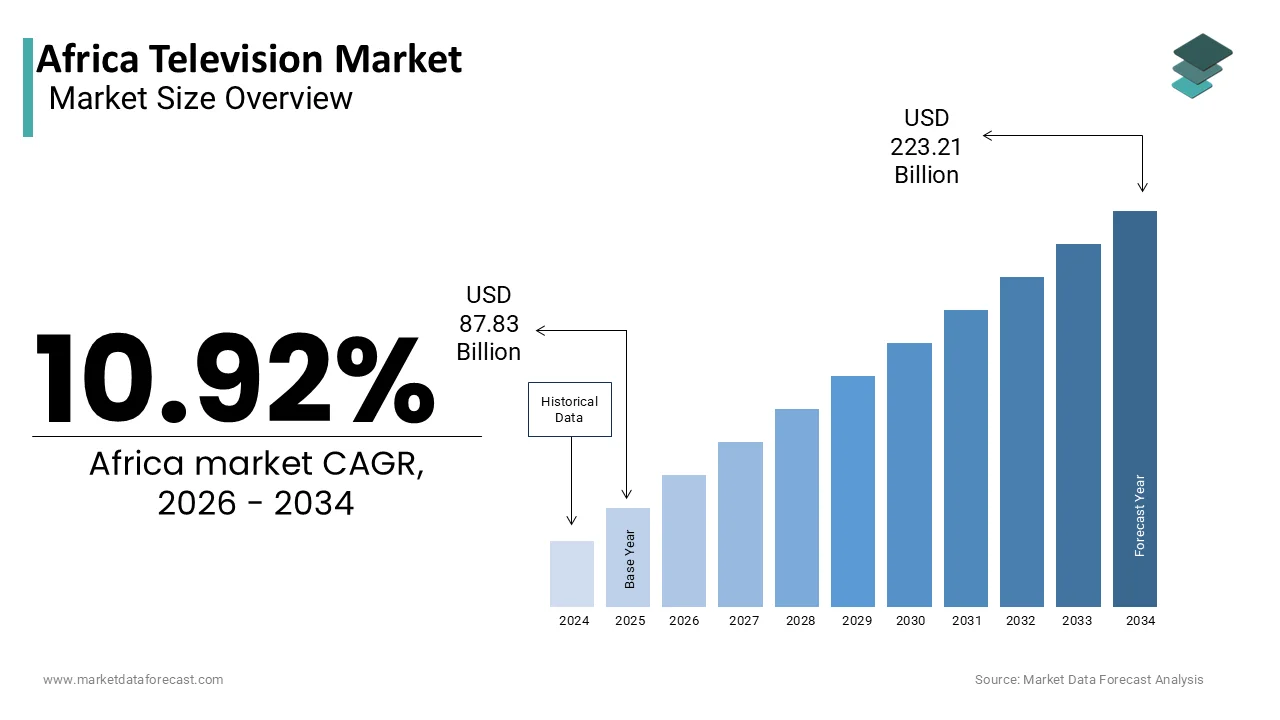
- Market Valuation: Valued at USD 87.83 billion (2025), estimated at USD 97.42 billion (2026), and projected to reach USD 223.21 billion by 2034, registering a CAGR of 10.92% (2026–2034).
- Primary Growth Drivers: Rising disposable incomes, expanding middle class, rapid urbanization, transition to digital terrestrial broadcasting (DTT), and growing demand for smart TVs and OTT streaming platforms.
Key Market Segment Metrics (2026–2034)
| Category | Leading Segment (2025 Position) | Fastest-Growing Segment |
|---|---|---|
| By Type | LCD, LED & Plasma TVs (accounted for approx. 45% of total sales in 2025 due to production affordability and energy efficiency) | Smart TVs (growing at a fast CAGR of 16.3% between 2025 and 2033, driven by internet expansion and on-demand streaming) |
| By Distribution Channel | Offline Distribution Channel (captured 68.5% of total revenue in 2025 via traditional retail networks and dealer post-purchase support) | Online Distribution Channel (registering a CAGR of 19.5% fueled by marketplaces like Jumia, mobile money, and logistics expansion) |
| By Country / Region | South Africa (led with 28.5% market share in 2025 due to early broadcast digitization and high broadband penetration) | Nigeria & Kenya (rapidly expanding markets driven by massive population growth, urban middle-class spending, and mobile-first streaming) |
Major Market Players & Market Structure
Market Structure: Highly dynamic and competitive landscape shaped by a blend of legacy electronics manufacturers, major satellite pay-TV providers, and global digital streaming giants competing intensely on content localization and value pricing.
Key Companies: MultiChoice Group, StarTimes, Hisense South Africa, Samsung Electronics Co. Ltd., Sony Corporation, LG Electronics, Inc., Toshiba Corporation, Haier Electronics Group Co., Ltd., VIZIO, Inc., and Netflix.
Africa Television Market Size
The Africa television market was valued at USD 87.83 billion in 2025, is estimated to reach USD 97.42 billion in 2026, and is projected to reach USD 223.21 billion by 2034, growing at a CAGR of 10.92% from 2026 to 2034.
Television converts visual images and sound into electrical signals, transmits them via radio waves or other means, and then displays them on a screen. This market includes traditional broadcast television, satellite TV, cable services, and increasingly, internet-based streaming platforms that are reshaping content consumption across the continent. As urbanization accelerates and disposable incomes rise in many African economies, television ownership and viewership patterns are evolving rapidly.
Moreover, Sub-Saharan Africa is witnessing a surge in pay-TV adoption, particularly through direct-to-home (DTH) satellite services. Companies like MultiChoice and StarTimes have played a pivotal role in expanding access to premium content in regions where terrestrial broadcasting remains limited.
In addition, mobile television and online streaming platforms such as Netflix, IROKOtv, and Showmax are gaining traction among younger audiences who prefer on-demand viewing experiences. The proliferation of smartphones and improved internet connectivity are further enabling this shift.
Simultaneously, government policies around spectrum allocation and digital migration are influencing how television services are delivered. Countries like Kenya, Nigeria, and South Africa have made notable progress in transitioning from analog to digital broadcasting, enhancing picture quality and channel capacity. These developments indicate a dynamic and evolving television landscape across Africa.
MARKET DRIVERS
Increasing Disposable Income and Urbanization
The rising disposable income among middle-class households, particularly in urban centers, is one of the major drivers of the Africa television market. According to the African Development Bank, Africa’s middle class is projected to grow to nearly 1.1 billion people by 2060, significantly boosting purchasing power for consumer electronics, including televisions. In countries like Ghana, Kenya, and Tanzania, rapid urbanization has led to increased access to formal employment, better housing, and improved living standards, all of which contribute to higher TV ownership rates. As more families move into cities, they seek entertainment and information sources that align with their new lifestyles. Apart from these, local and international brands are offering affordable television sets and flexible payment options, including installment plans and bundled offers with subscription services. Brands such as Hisense, TCL, and Samsung have localized product lines tailored to African markets, making television ownership more accessible. These economic and demographic shifts are fueling sustained demand across the continent.
Expansion of Digital Broadcasting and Satellite TV Services
The expansion of digital broadcasting and satellite television services is another critical driver of the Africa television market. Governments across the continent have been pushing for the transition from analog to digital terrestrial television (DTT), allowing for more efficient use of spectrum, better picture quality, and the ability to offer multiple channels within the same bandwidth. Satellite TV providers such as MultiChoice and StarTimes have capitalized on this transition by offering bundled packages that include sports, news, entertainment, and educational programming.
Furthermore, these companies are investing in high-definition (HD) and ultra-high-definition (UHD) content, attracting premium subscribers. Sports broadcasting, particularly football leagues and international tournaments, remains a strong draw. For example, MultiChoice's exclusive rights to the English Premier League and UEFA Champions League have helped retain millions of paying subscribers across the region. These developments show the growing appeal of modern television services in Africa.
MARKET RESTRAINTS
Economic Volatility and Currency Depreciation
The persistent economic volatility and currency depreciation in several key regions are a major restraint affecting the African television market. Countries like Nigeria, Angola, and Zambia have experienced significant inflationary pressures and foreign exchange shortages, which directly impact consumer purchasing power. According to the World Bank, Nigeria’s inflation rate reached over 25% in mid-202, eroding real incomes and discouraging discretionary spending on televisions and related accessories.
Currency instability also affects import costs, as most televisions and components are sourced from Asia and Europe. When local currencies weaken against the US dollar or euro, the landed cost of TVs increases, making them less affordable for the average consumer. Moreover, fluctuating exchange rates create uncertainty for retailers and distributors, leading to inventory shortages and price volatility.
Power Supply Instability and Limited Electricity Access
The lack of reliable electricity supply, especially in rural and peri-urban areas, is another critical constraint impeding the growth of theAfricana television market. According to the International Energy Agency (IEA), nearly 600 million people in Africa still lack regular access to electricity, severely limiting television usage outside major cities. Even in regions with grid coverage, frequent outages disrupt viewing habits and discourage investment in electronic devices.
In countries like Ethiopia, Malawi, and Burkina Faso, national grids provide intermittent service, forcing households to rely on expensive alternatives such as generators or solar-powered systems. Besides, even in urban centers like Kinshasa and Dakar, scheduled load-shedding remains common, reducing the practical value of owning a television. As per McKinsey, inconsistent power supply has contributed to a lower-than-expected uptake of digital television service, despite available infrastructure.
MARKET OPPORTUNITIES
Growth of Over-the-Top (OTT) Streaming Platforms
The rise of over-the-top (OTT) streaming platforms presents a major opportunity for the African television market, particularly among younger, tech-savvy consumers. With increasing smartphone penetration and mobile broadband availability, platforms such as Netflix, Showmax, IROKOtv, and local services like StarTimes Play and Kwese Free Sports are gaining traction.
This shift is being driven by a growing preference for on-demand, personalized content over traditional linear TV schedules. As per a 2023 survey by Disrupt Africa, over 60% of urban youth in Kenya and Nigeria primarily consume video content via streaming services rather than conventional TV. This trend is prompting broadcasters and telecom operators to integrate OTT offerings into their existing business models.
Moreover, the production of original African content is accelerating, with streaming platforms investing heavily in local storytelling. Netflix, for instance, has funded multiple Nollywood films and series, while regional players like VODACOM and Canal+ are launching homegrown content libraries.
Integration of Smart TVs and Connected Devices
The increasing adoption of smart TVs and connected devices represents a significant growth opportunity for the Africa television market. Unlike traditional television sets, smart TVs offer built-in internet capabilities, allowing users to access streaming services, social media, and interactive applications.
Consumer electronics manufacturers are responding to this demand by introducing affordable smart TV models tailored to African markets. Brands such as Hisense, LG, and Samsung have launched budget-friendly smart TVs with Android-based interfaces and pre-installed local streaming apps.
In addition to smart TVs, streaming dongles and set-top boxes are becoming popular among consumers who prefer to upgrade existing televisions rather than buy new ones. Products like Google Chromecast, Amazon Fire TV Stick, and local variants are widely available and easy to install.
MARKET CHALLENGES
Regulatory Complexity and Content Licensing Issues
Regulatory complexity and content licensing issues pose a major challenge to the Africa television market, particularly for international streaming platforms and satellite broadcasters. Each country operates under different regulatory frameworks governing media ownership, censorship, advertising standards, and data privacy, making compliance cumbersome for multinational operators. According to a 2025 report by Baker McKenzie, only 15 African countries have unified digital media regulations, while others impose restrictive policies on content distribution.
Content licensing is another hurdle, as governments and local producers seek greater control over intellectual property rights and revenue sharing. For instance, some African nations require foreign streaming platforms to partner with domestic studios or host locally relevant content before granting operational licenses. Apart from these, taxation policies vary widely, with some governments imposing levies on digital content consumption.
Competition from Mobile-First Video Consumption
The intensifying competition from mobile-first video consumption is an emerging challenge for the Africa television market. Younger audiences, particularly in urban centers, are increasingly opting for short-form video platforms like YouTube, TikTok, Instagram Reels, and Snapchat over traditional television. This shift is altering advertising dynamics, as brands redirect budgets toward mobile influencers and targeted social media campaigns instead of television commercials. Moreover, mobile networks are rolling out high-speed data plans at competitive prices, further encouraging on-the-go video consumption. Operators like MTN, Safaricom, and Orange are bundling video streaming services with airtime, making mobile viewing more attractive.
REPORT COVERAGE
| REPORT METRIC | DETAILS |
| Market Size Available | 2025 to 2034 |
| Base Year | 2025 |
| Forecast Period | 2026 to 2036 |
| Segments Covered | By Type, Distribution Channel, and Country. |
| Various Analyses Covered | Global, Regional & Country Level Analysis, Segment-Level Analysis; DROC, PESTLE Analysis, Porter's Five Forces Analysis, Competitive Landscape, Analyst Overview of Investment Opportunities |
| Country Covered | China, India, Japan, South Korea, Australia, New Zealand, Thailand, Indonesia, Philippines, Vietnam, Singapore, Rest of APAC. |
| Market Leader Profiled | Samsung Electronics Co. Ltd.; Sony Corp.; LG Electronics, Inc. |
SEGMENTAL ANALYSIS
By Type Insights
The LCD, LED & Plasma TVs segment commanded the Africa television market by accounting for approximately 45% of total sales in 2025. The declining cost of production and widespread availability of LED models across major African markets are one key driver behind the growth of the LCD, LED & Plasma TVs segment. This price accessibility has enabled broader adoption, particularly among middle-income households in urban areas. These televisions have become the dominant type due to their balance of affordability, energy efficiency, and improved picture quality compared to older technologies. Besides, local and international electronics brands such as Hisense, Samsung, and TCL have localized manufacturing or assembly operations in countries like Nigeria, Kenya, and South Africa. These strategies have significantly expanded market penetration and reinforced the segment’s leadership position.
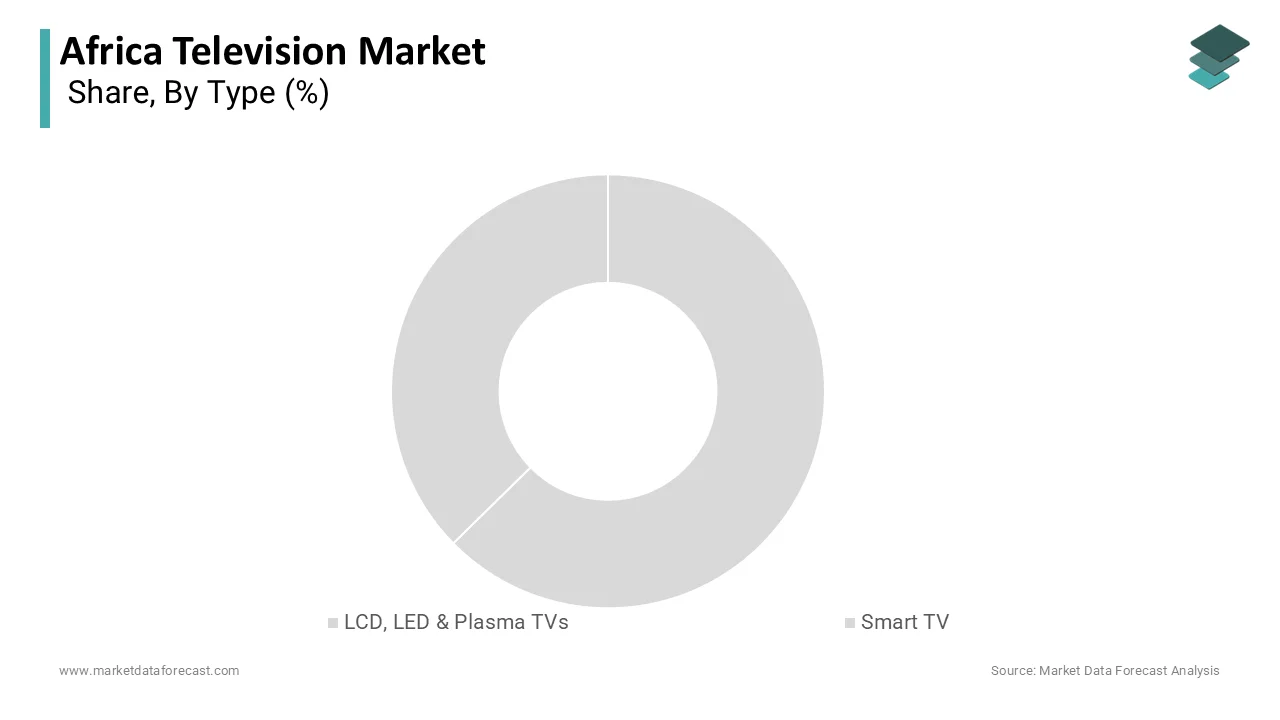
The Smart TV segment is growing at the fastest rate in the Africa television market and is recording a CAGR of 16.3% between 2025 and 2033. This rapid growth is primarily driven by increasing internet penetration, rising smartphone usage, and a shift toward on-demand digital content consumption. The integration of popular streaming services directly into smart TV interfaces is another key factor fueling the growth of this segment. Moreover, telecom operators and retailers are bundling smart TVs with mobile data plans and payment financing options.
By Distribution Channel Insights
The offline distribution channel segment accounted for the majority of television sales in Africa, ith 68.5% of total revenue in 2025. The low level of digital literacy and trust issues regarding online transactions among a significant portion of the population are one of the primary reasons for the development of an offline distribution channel. Traditional retail stores, electronics markets, and direct dealer networks remain the preferred route for consumers purchasing televisions, especially in rural and semi-urban areas. Furthermore, local dealers often provide post-purchase support, installation assistance, and warranty services, which are not always guaranteed through online vendors.
The online distribution channel is emerging as the fastest-growing segment in the Africa television market and is registering a CAGR of 19.5% during the forecast period. A major contributing factor is the expansion of trusted online marketplaces such as Jumia, Amazon.ae, and Takealot, which have improved consumer confidence through cash-on-delivery options, customer reviews, and reliable after-sales service. The rise of e-commerce platforms, increased smartphone usage, and expanding logistics infrastructure are fueling this rapid growth. Apart from these, telecom companies and fintech startups are enabling mobile money integrations, allowing users to complete purchases without traditional banking instruments.
COUNTRY LEVEL ANALYSIS
South Africa maintained the leading position in the Africa television market by capturing 28.5% in 2025. Among the key drivers is the early adoption of digital broadcasting and smart TV technology. It is the most technologically advanced country in the region, with well-established broadcast networks, high broadband penetration, and a strong preference for premium viewing experiences. The presence of international streaming platforms like Netflix and Showmax further enhances demand for connected viewing devices. Besides, South Africa's regulatory environment supports media innovation and foreign investment.
Nigeria is rapidly expanding in the Africa television market. A major growth driver is the rapid expansion of the Nigerian middle class. This demographic shift is boosting consumer spending on electronics, particularly in cities like Lagos, Abuja, and Port Harcourt. Despite infrastructural challenges, it is the fastest-growing market due to its large population, rising disposable incomes, and increasing demand for entertainment and information content. Furthermore, the rise of pay-TV services and satellite broadcasting has significantly enhanced television accessibility. MultiChoice and StarTimes have millions of subscribers across the country, offering packages that include sports, movies, and educational content.
Kenya occupies a prominent position in the African television market. A key driver is the high smartphone and mobile internet penetration. This trend has spurred the integration of OTT features into televisions, encouraging manufacturers to bundle smart functionality into budget-friendly models. The country is known for its vibrant digital economy, and Kenya is at the forefront of adopting over-the-top (OTT) television services and smart TV technology. Apart from these, Kenya’s supportive regulatory framework and investment in fiber-optic infrastructure have attracted global streaming players like Netflix and IROKOtv. The government’s push for digital migration under the National Broadband Strategy has also modernized terrestrial broadcasting.
Egypt plays a strategic role in the Africa television market. A major growth factor is the government’s focus on digital transformation and media modernization. Positioned at the crossroads of Africa, the Middle East, and Europe, Egypt serves as a regional media and broadcasting center with strong state and private sector involvement in television services. Under the Egypt Vision 2030 initiative, authorities have prioritized the transition from analog to digital broadcasting, improving signal quality and expanding channel capacity. Besides, there is a rising demand for satellite and cable services, particularly in urban centers like Cairo and Alexandria. Companies have expanded their subscriber base by offering exclusive sports and entertainment content.
The Rest of Africa category, encompassing countries like Ghana, Morocco, Ethiopia, Tanzania, and Uganda, collectively contributes a notable portion to the market. While individually smaller than Nigeria or South Africa, these nations are showing strong potential due to increasing digital adoption and supportive policy reforms. A notable growth driver is the expansion of mobile broadband and digital infrastructure. This digital leap is enabling greater access to television content through smartphones and smart TVs. Morocco, too, is advancing rapidly with its national broadband plan, aiming for universal access by 2025. With increasing regional collaboration and private-sector engagement, the Rest of Africa segment is positioned for substantial long-term expansion.
KEY MARKET PLAYERS AND COMPETITIVE LANDSCAPE
Overview of Competition in the African Television Market includes
- Samsung Electronics Co. Ltd.
- Sony Corporation
- LG Electronics, Inc.
- Toshiba Corporation
- Haier Electronics Group Co., Ltd.
- VIZIO, Inc.
- Videocon Industries Ltd.
- Sansui Electric Co. Ltd.
The competition in the Africa television market is intensifying as traditional broadcasters, satellite providers, and digital streaming platforms vie for consumer attention. While established players like MultiChoice and StarTimes continue to dominate through extensive channel offerings and widespread distribution networks, new entrants—particularly global streaming giants—are reshaping viewer expectations. The rise of smart TVs and mobile-first content consumption is further disrupting conventional business models, compelling industry leaders to innovate rapidly. Local manufacturers and regional telecom operators are also entering the fray, leveraging partnerships and digital ecosystems to capture market share. Regulatory dynamics, varying across African countries, add another layer of complexity, influencing how companies operate and scale their services. Apart from these, affordability remains a critical battleground, with brands competing to offer the most value-driven solutions without compromising on quality or accessibility. As internet penetration improves and digital literacy expands, the television market is shifting toward a more integrated, on-demand, and mobile-centric landscape. This evolving environment demands agility, strategic collaboration, and continuous adaptation from all market participants.
Top Players in the Market
MultiChoice Group
MultiChoice is a leading player in the African television market, offering satellite-based pay-TV services across more than 50 countries. The company has been instrumental in shaping the continent’s entertainment landscape by providing access to premium sports, movies, news, and local content. Through its DStv platform, it has enabled millions of households to experience high-quality television programming.
StarTimes
StarTimes is a dominant force in digital television across Africa, particularly in East and Central Africa. As a Chinese multinational, it has localized its offerings to suit African consumers, providing affordable set-top boxes and diverse content packages. Its expansion strategy focuses on bridging the digital divide through accessible and culturally relevant TV solutions.
Hisense South Africa
Hisense plays a crucial role in supplying televisions tailored for the African market. Known for offering budget-friendly smart TVs with integrated regional streaming apps, the brand has become a household name in many African countries. Its focus on affordability, durability, and digital readiness aligns well with consumer needs in emerging markets.
Top Strategies Used by Key Market Participants
Localization of Content and Services
- Leading players are tailoring their content and distribution models to meet regional preferences, including language support, local programming, and cultural relevance. This approach enhances user engagement and strengthens customer loyalty across diverse African markets.
- Affordable Pricing and Flexible Payment Models
- To cater to a wide demographic, companies are introducing cost-effective subscription plans, installment-based purchases, and bundled offers that include hardware and service packages. These strategies make television services more accessible to middle- and low-income consumers.
- Expansion of Digital Infrastructure and Smart Capabilities
Market participants are investing in digital broadcasting infrastructure, smart TV development, and mobile-integrated viewing platforms. By integrating online streaming features and improving connectivity options, they are future-proofing their offerings to match evolving consumer behavior.
RECENT HAPPENINGS IN THE MARKET
- In May 2025, StarTimes launched a new line of locally assembled set-top boxes in Kenya, designed to enhance digital TV access in rural areas while complying with national content localization regulations.
- In July 2025, MultiChoice expanded its partnership with Showmax to integrate additional African-produced original content into its DStv platform, aiming to increase subscriber retention and attract younger audiences.
- In March 2025, Hisense introduced a new series of Android-powered smart TVs preloaded with popular African streaming apps, targeting urban consumers seeking connected entertainment experiences.
- In September 2023, Netflix opened a regional content office in Lagos, Nigeria, signaling a long-term commitment to producing and distributing Nigerian and pan-African content tailored for the local and global audience.
- In December 2023, Canal+ Group rebranded its African operations under the A+ brand, consolidating its regional presence and enhancing its marketing strategy to better compete with local and international pay-TV providers.
MARKET SEGMENTATION
This research report on the Africa Television Market has been segmented and sub-segmented into the following.
By Type
- LCD, LED & Plasma TVs
- Smart TV
By Distribution Channel
- offline distribution channel
- online distribution channel
By Country
- China
- India
- Japan
- South Korea
- Australia
- New Zealand
- Thailand
- Indonesia
- Philippines
- Vietnam
- Singapore
- Rest of APAC