- Product Description Description
- Table of Contents TOC
- List of Table & Figure LOT
- Get Free Sample PDF Sample PDF
Market Size, 2025
$12.03 BnMarket Estimate, 2026
$12.56 BnMarket Forecast, 2034
$17.44 BnCAGR, 2026–2034
4.41%Executive Summary: Global Agricultural Antibacterials Market
- Market Scope: In-depth assessment of the global agricultural antibacterials market, tracking product types (copper-based, dithiocarbamate, amide, antibiotics), crop types (cereals & grains, oilseeds & pulses, fruits & vegetables), application methods (foliar spray, soil treatment), and regional performance across Europe, Asia-Pacific, North America, Latin America, and the Middle East & Africa.
- Market Valuation: Valued at USD 12.03 billion in 2025, reaching USD 12.56 billion in 2026, and projected to scale up to USD 17.44 billion by 2034, registering a steady CAGR of 4.41% throughout the forecast period from 2026 to 2034.
- Primary Growth Drivers: Escalating demand for high-quality food and strict food security needs driven by population growth, shifts in environmental patterns triggering bacterial disease outbreaks, and government encouragement of advanced farming methodologies to curb crop losses.
Key Market Segment Metrics
| Category | Leading Segment (Base Year Position) | Fastest-Growing / High-Impact Segment |
|---|---|---|
| By Type, Crop, & Application | Antibiotic & Copper-Based Segments (dominant share fueled by intensive livestock/crop protection), Cereals & Grains, & Foliar Spray (most popular end-user application method) | Soil Treatment Segment & Fruits & Vegetables (high-impact growth driven by early-stage disease prevention and zero-tolerance residue requirements) |
| By Region | Europe (leading volume share at over 70% supported by advanced agricultural techniques and food security structures, with Italy and France as key hubs) | Asia-Pacific (projected to record the highest CAGR, propelled by massive food demands and expanding populations) |
Major Market Players & Market Structure
Market Structure: Highly competitive global marketplace featuring leading life-science corporations and chemical innovators focusing on regulatory compliance, residue reduction, and balanced bio-alternative integration.
Key Companies: BASF SE, Syngenta, Nufarm, Bayer Crop Science, Corteva AgriScience, OHP Inc., Valent Biosciences LLC, Nippon Soda Co Ltd, FMC Corporation, and Sumitomo Chemical Co. Ltd.
Global Agricultural Antibacterials Market Size
The Agricultural antibacterial market size was valued at USD 12.03 billion in 2025 and is anticipated to reach USD 12.56 billion in 2026 to reach USD 17.44 billion by 2034, growing at a CAGR of 4.41% during the forecast period from 2026 to 2034.

The primary factors that boost the global agricultural antibacterial market include rising demand for food, environmental challenges, and declining individual farms. Europe is one of the most significant growth regions contributing to the global agricultural antibacterial market growth. Growing food crop production to meet growing food needs has allowed market players to identify potential new markets. In addition, changes in environmental conditions are a significant cause of insect attacks, including bacterial infections. Farmers are using new planting methods to deal with the challenges of a considerable number of insects or animals in a place, typically to cause damage or disease, which will positively affect the global agricultural market for antibacterial products.
MARKET DRIVERS
The global agricultural antibacterial market's primary drivers include health promotion, the need for a cultivated plant commercially grown on a vast scale, most probably a cereal, fruit, or vegetable, and the need for food security among large nations due to population growth. Changes in people's lives and rising costs increase the demand for quality food, increasing the demand for agricultural antibacterials in the global market. The growing concern among major developed and developing countries for food security increases the need for agriculture, boosting the growth of the global anti-disease market. Many governments encourage farmers to use new farming methods and products to increase yields and ensure food security in the country. The growing population increases the need for a better harvest. The benefits of using agricultural antibacterials, which reduce losses and provide better yields, increase the use of agricultural aantibacterialsin the global agricultural antibacterial market.
MARKET RESTRAINTS
Significant factors that slow down the growth of the global agricultural market include:
- The ignorance of farmers in developing countries.
- The overuse of Agricultural Antibacterial overpayment.
- Increased levels of toxic substances in the soil due to antibacterial use.
Lack of awareness of farmers in developing countries such as China, India, Indonesia, Brazil, etc., is a significant challenge facing the global agricultural market. Excessive use of Antibacterial causes less growt,h in plants, which is very harmful to their development and is a severe threat to human health. Overuse of the product reduces the effect of essential drugs and puts many lives at risk. Increased toxins in the environment due to various Antibiotics cause adequate nutrient deficiencies in plants and affect aquatic and groundwater life. The introduction of safer and more profitable alternatives is expected to hamper market growth. Increased adoption and demand for natural products and organic farming will hinder the market's growth in the upcoming years.
Impact of COVID-19 on the Agricultural Antibacterials Market
COVID-19 is declared as an unprecedented public health emergency that has affected almost the entire industry, and long-term outcomes are expected to contribute to industry growth during forecasting. Ongoing analyst research expandsitsr research framework to ensure the inclusion of the underlying problems of COVID-19 and the potential alternatives in the future. The report provides information on COVID-19 in terms of changes in consumer behavior and demand, procurement mechanisms, redistribution, current economic power, and significant government interventions. The global agricultural antibacterial market is anticipated to have a substantial impact due to COVID-19. Since most plants are comprised of bacteria, antibiotics help to kill the bacteria and provide fresh vegetables and fruits.
REPORT COVERAGE
| REPORT METRIC | DETAILS |
| Market Size Available | 2025 to 2034 |
| Base Year | 2025 |
| Forecast Period | 2026 to 2034 |
| CAGR | 4.41 % |
| Segments Covered | Type, Crop Type, Application |
| Various Analyses Covered | Global, Regional & Country Level Analysis, Segment-Level Analysis, DROC, PESTLE Analysis, Porter’s Five Forces Analysis, Competitive Landscape, Analyst Overview on Investment Opportunities |
| Regions Covered | North America, Europe, APAC, Latin America, Middle East & Africa |
| Market Leaders Profiled | BASF SE, Syngenta, Nufarm, Bayer Crop Science, Corteva AgriScience, OHP Inc., Valent Biosciences LLC, Nippon Soda Co Ltd, FMC Corporation, Sumitomo Chemicals Co Ltd |
SEGMENTAL ANALYSIS
By Type Insights
The antibiotic segment is anticipated to have the most significant global agricultural antibacterial market share due to the escalating demand for animal protein in developing countries; intensive farming is being promoted, leapresence theantibioticsntibacterial in animal products. However, antibiotic resistance is of great concern to public health. Antibiotic-resistant bacteria can be pethagonics to humans, easily transmitted to humans through food chains, and still spread widely in the environment through animal wastes. This can lead to complex, incurable, and chronic illnesses in humans, leading to high healthcare costs and sometimes even death.
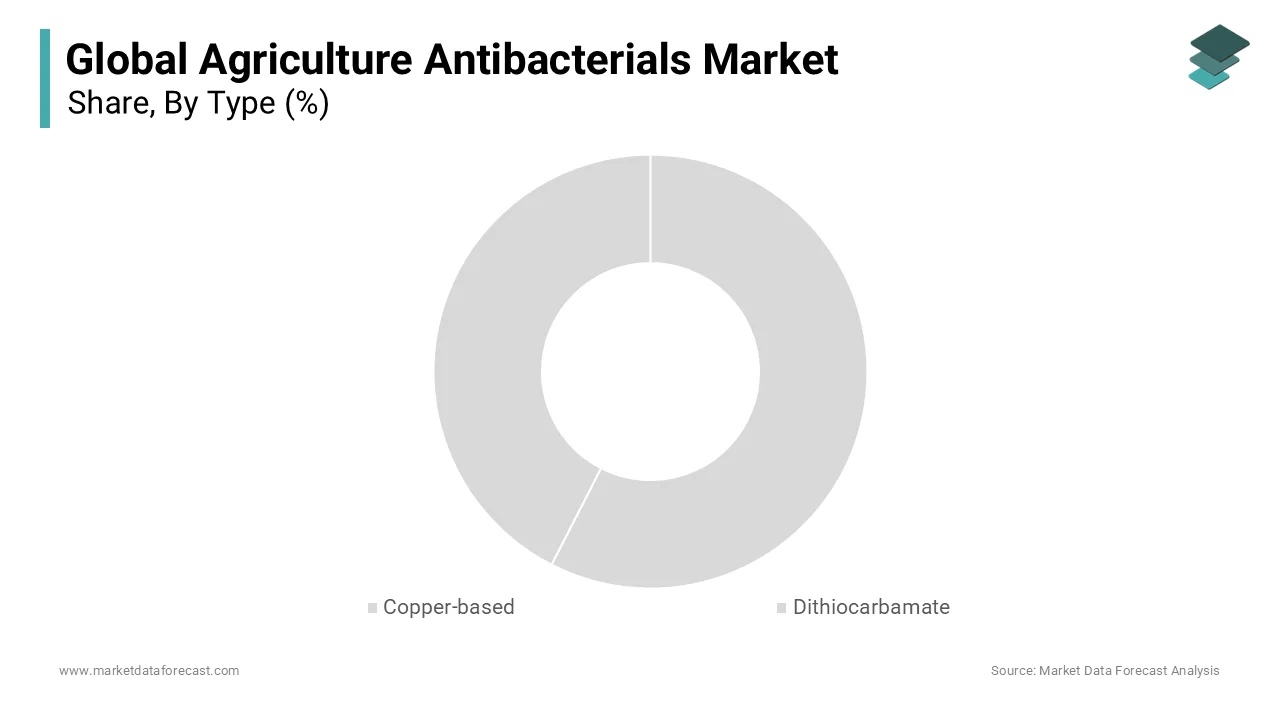
Therefore, strengthening regulations governing the production of antibiotics, distribution, and prescdrugon drugs administration is encouraged. In addition, collaborative international cooperation with international organizations is needed to help developing countries better monitor antibiotic use and antibiotic resistance.
By Crop Insights
Segment most people worldwide depend on eggs for their diet because they are rich in carbohydrates, fiber, and other nutrients. Cereals and cereals include corn, rice, wheat, oats, barley, rye, and other crops. This helps to eliminate chronic diseases if included as part of a diet. However, as consumption is plentiful, grain and grain products are also large, which increases the use of agricultural pesticides, indicating rapid antibacterial growth of grai productsn and grain products.
By Application Insights
The market is divided into Soil Treatment, Foliar Spray, a, nd others depending on the application mode. The soil treatment segment is predicted to expand in the forecast period due to the increased use of bactericides and other food additives and the emergence of pesticide growth control agents in the early stages of plant production. Also, the foliar spray component is predicted to grow because it is the most popular method for end-users due to its easy management and use.
REGIONAL ANALYSIS
The European region plays the most significant share at over 70% terms of volume in the global antibacterial marketin agriculturei, owing to the increasing use of antibacterial products by advanced agricultural techniques and the growing demand for food security in European Countries. Hence, Italy and France formed one of the largest markets in the world at the European level in 2019.
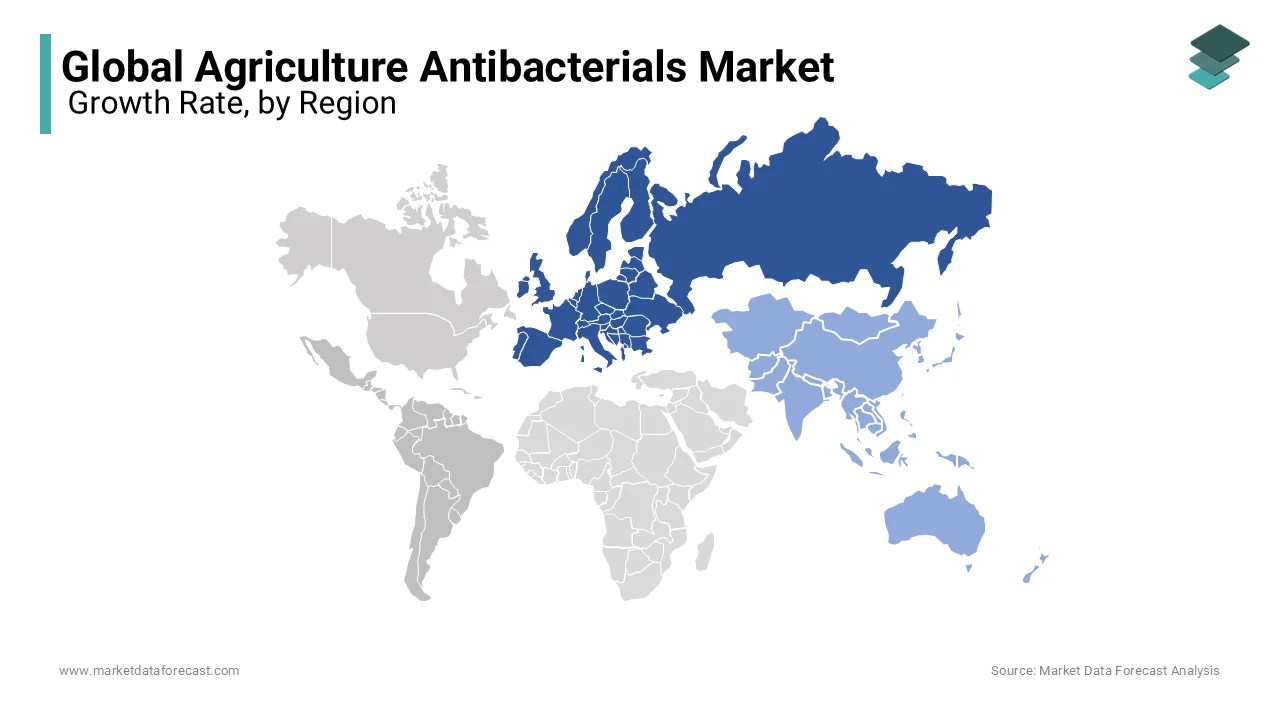
The countries globally have seen increased antibacterial use due to increased awareness among farmers about the effects of bacterial infections on crop yields.
Asia Pacific is anticipated to have the highest CAGR in the global agricultural antibacterial market due to increasing consumers creating a massive demand for food.
COMPETITIVE LANDSCAPE
Major players in the global agricultural antibacterial market,t such as
- BASF SE
- Syngenta
- Nufarm
- Bayer Crop Science
- Corteva Agriscience
KEY MARKET PLAYERS
Some of the market players dominate the global agriculture anti-bacterial market.
- BASF SE
- Syngenta
- Nufarm
- Bayer Crop Science
- Corteva AgriScience
- OHP Inc.
- Valent Biosciences LLC
- Nippon Soda Co Ltd
- FMC
- Sumitomo Chemicals Co Ltd
RECENT MARKET NEWS
- Monheim, Germany, September 22, 2021, Bayer announced that it would expand its vegetable offerings under fresh vegetables under the Bayer umbrella to include physically produced seeds. The launch will focus on certified crop production in the three main crops of the Greenhouse and Greenhouse market: tomato, sweet pepper, and cucumber. Varieties of tomato rootstock in 2023 will follow this. Bayer's expanded portfolio responds directly to the growing customer demand for high-quality seeds. This increased demand provides many Bayer vegetable seed customers a vital opportunity to grow their businesses while supporting consumer food choices and promoting access to nutritious fruits and vegetables.
- On April 6, 2021, OHP Inc., a leading provider of technology-based solutions for greenhouse and nursery production applications, was acquired by AMVAC in 2017 to expand its non-plant space into the crop production sector.
MARKET SEGMENTATION
This research report on the global agricultural anti-bacterial market has been segmented & sub-segmented into the following categories.
By Type
- Copper-based
- Dithiocarbamate
- Amide
- Antibiotic
By Crop Type
- Cereals and Grains
- Oilseeds and pulses
- Fruits and Vegetables
By Application
- Foliar Spray
- Soil treatment
By Region
- North America
- Europe
- Asia Pacific
- Latin America
- Middle and Africa