- Product Description Description
- Table of Contents TOC
- List of Table & Figure LOT
- Get Free Sample PDF Sample PDF
Market Size, 2025
$4.31 BnMarket Estimate, 2026
$4.53 BnMarket Forecast, 2034
$6.77 BnCAGR, 2026–2034
5.14%Global Agricultural Packaging Market Size, Growth, Trends & Forecast (2026–2034)
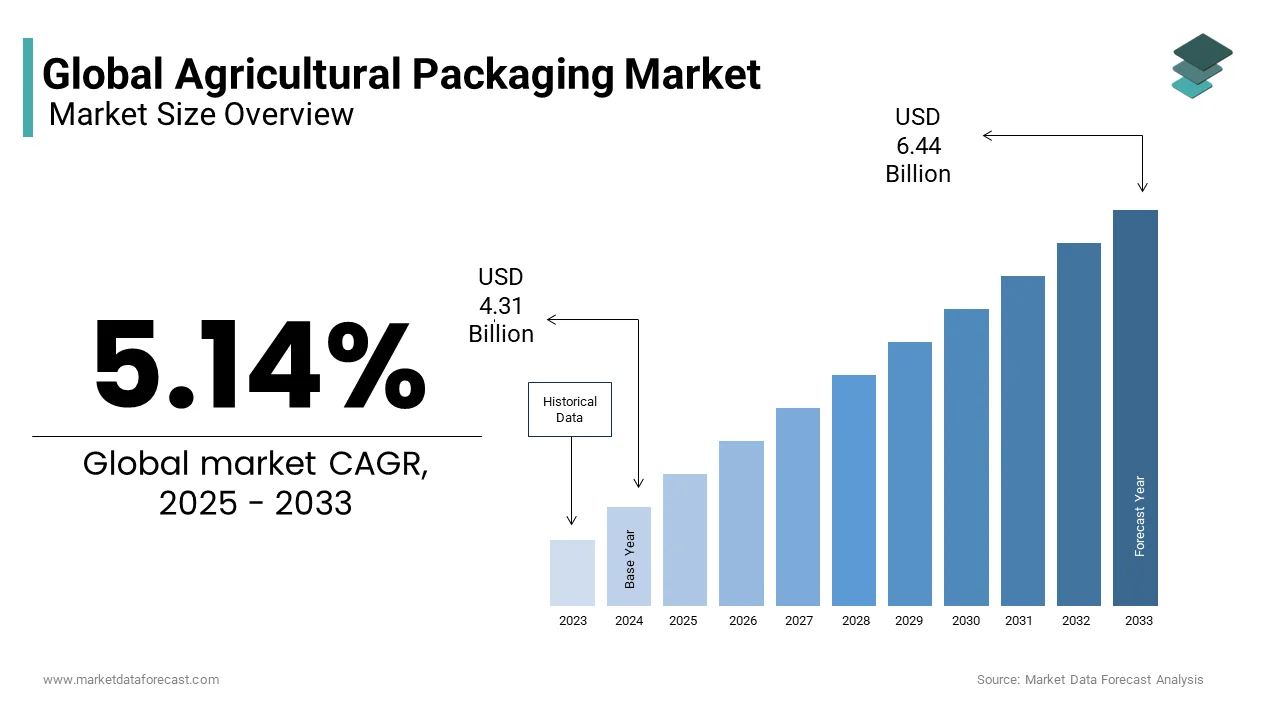
The global agricultural packaging market size was valued at USD 4.31 billion in 2025, is anticipated to reach a valuation of USD 4.53 billion in 2026, and is projected to reach USD 6.77 billion by 2034, growing at a compound annual growth rate (CAGR) of 5.14% from 2026 to 2034. Market expansion is propelled by stringent global regulatory mandates for child-resistant and tamper-evident agrochemical packaging, the rise of precision agriculture requiring unit-dose delivery formats, and an ongoing corporate shift toward eco-friendly, circular packaging solutions.
Key Executive Metrics (At-a-Glance)
- 2025 Base Valuation: USD 4.31 Billion
- 2026 Current Valuation: USD 4.53 Billion
- 2034 Forecast Valuation: USD 6.77 Billion
- Compound Annual Growth Rate (CAGR): 5.14% (2026–2034)
- Key Geographic Footprint: North America, Europe, Asia Pacific, Latin America, and Middle East & Africa
Global Agricultural Packaging Market Segmentation Breakdown
| Segment Category | Largest Segment | Fastest-Growing Segment |
|---|---|---|
| By Material | Plastic (64.8% share in 2025) | Paper and Paperboard (11.9% CAGR) |
| By Product | Pouches & Bags (53.2% share in 2025) | Bottles and Cans (14.3% CAGR) |
| By Barrier Strength | High-Barrier (47.6% share in 2025) | Medium-Barrier Packaging (16.7% CAGR) |
| By Region | Asia Pacific (39.4% share in 2025) | Latin America & Middle East / Africa |
Major Industry Players Profiled
Key market leaders shaping the global agricultural packaging landscape include Amcor Limited (Australia), Berry Global Group, Inc. (US), Sonoco Products Company (US), Greif Inc. (US), Mondi Group (South Africa), NNZ Group (Netherlands), Silgan Holdings, Inc. (US), Proampac LLC (US), and LC Packaging International BV (Netherlands).
 Download Free Sample Report
Global Agricultural Packaging Market Size
The global agricultural packaging market size was valued at USD 4.31 billion in 2025 and is anticipated to reach a valuation of USD 4.53 billion in 2026 and USD 6.77 billion by 2034, growing at a CAGR of 5.14%, from 2026 to 2034.
Agricultural packaging refers to the purpose-engineered materials, including flexible films, rigid containers, bulk bags, and coated papers, designed to preserve the integrity, potency, and regulatory compliance of seeds, fertilizers, pesticides, and animal feed from the point of manufacture to field application. Unlike consumer packaging, its value resides in barrier performance against moisture, UV degradation, chemical permeation, and mechanical rupture under rural logistics stress. As per the study, a percentage of global agrochemical efficacy loss occurs due to improper or degraded packaging, a preventable waste impacting a large number of smallholder farmers. This is a calibrated containment system where failure equates to crop loss, environmental contamination, or human toxicity.
MARKET DRIVERS
Global Regulatory Escalation Mandating Child-Resistant and Tamper-Evident Agrochemical Packaging
Governments worldwide are enforcing stringent child-safety and anti-counterfeiting standards for agrochemicals, transforming packaging from a passive container to an active compliance enabler, which fuels the expansion of the agricultural packaging market. As per the U.S. Environmental Protection Agency, liquid formulations above toxicity must use child-resistant closures, a rule impacting the percentage of herbicide SKUs. For chemicals, the EU's Classification, Labelling and Packaging (CLP) Regulation specifies the information required on a physical label, such as hazard pictograms, signal words, and safety statements. Traditional physical labels are standard, but updated regulations permit digital labels. These digital labels, like those using QR codes, provide additional information and must be clearly linked to the product and freely accessible. In 2025, the Ministry of Agriculture and Farmers' Welfare introduced the Insecticides (First Amendment) Rules, which require mandatory QR codes on all insecticide labels. This regulatory gravity compels manufacturers to treat packaging not as a cost center but as a legal shield, thereby driving demand irrespective of commodity cycles.
Precision Agriculture’s Demand for Unit-Dose and Water-Soluble Delivery Systems
The rise of precision farming, where inputs are calibrated to soil zones, crop phenology, and microclimate, necessitates single-application and pre-measured packaging formats that eliminate field mixing errors, also contribute to the agricultural packaging market growth. As per research, a portion of nitrogen loss in row crops stems from incorrect dilution or timing, a gap addressed by water-soluble pouches and effervescent tablets. According to studies, achieving uniform distribution of nutrients, whether through precise seeding or advanced spreading techniques, can lead to higher crop yields and better nutrient uptake. John Deere revealed that arms using pre-measured seed treatments reduced chemical overuse. Packaging here is a dosing mechanism, which embeds agronomic intelligence into a physical form.
MARKET RESTRAINTS
Multi-Layer Composite Structures Facing Circular Economy Bans in Key Jurisdictions
Most high-barrier agrochemical packaging relies on metallized PET/PE laminates or aluminum-foil composites, materials classified as non-recyclable under emerging EPR regimes, which hinders the expansion of the agricultural packaging market. As per the study, a smaller share of flexible agrochemical packaging is effectively recycled globally due to chemical residue and multi-material complexity. The European Union’s Packaging and Packaging Waste Regulation prohibits non-recyclable multi-layer pouches unless redesigned for mono-material streams. Germany pointed out that agrochemical film constitutes a portion of residual waste by weight despite representing a small percentage of packaging volume, which triggers eco-modulated fees per kg. This regulatory mismatch forces reformulation at prohibitive cost, or exclusion from premium markets.
Rural Logistics Infrastructure Limiting Adoption of Advanced Barrier Materials
The absence of climate-controlled warehousing and proper transport routes in emerging economies exposes packaging to extreme humidity, UV radiation, and mechanical abrasion, which degrades advanced barrier films before field use, and this restricts the growth of the agricultural packaging market. As per research, only a portion of rural storage facilities maintain humidity. India witnessed efficacy loss in granular insecticides stored in non-climate sheds due to moisture ingress through pinholes. According to a study, a percentage of seed treatment packaging fails drop-tests after kilometres of unpaved transit, rupturing seals. The adoption of premium materials will remain theoretical in the regions that need them most until packaging is engineered for infrastructure poverty rather than for laboratory settings.
MARKET OPPORTUNITY
Bio-Based and Compostable Films for Organic and Regenerative Agriculture Inputs
The organic farming boom, growing annually, demands packaging aligned with soil-health principles, which fuels new prospects for the growth of the agricultural packaging market. There should be no microplastics, no chemical leaching, but full biodegradability. Significant advancements have been made in rapidly degrading materials; certified compostable laminates decompose over months under industrial conditions. The U.S. National Organic Program (NOP) has created a technical allowance for compostable biobased films. NOP standards require the films to have a very high percentage of biobased content from renewable materials. The Indian government has reduced the Goods and Services Tax (GST) on biodegradable packaging from 18% to 5%. This policy change makes biodegradable packaging more affordable, encouraging bio-input producers and other industries to adopt eco-friendly alternatives to single-use plastics. This segment transforms packaging from waste stream to soil amendment, which justifies premium pricing while meeting regenerative agriculture’s closed-loop ethos.
Smart Packaging with Embedded Sensors for Real-Time Environmental Monitoring
Integrating NFC tags, humidity indicators, and time-temperature trackers into agrochemical packaging enables supply chain transparency and field-level efficacy validation, giving rise to new growth opportunities within the agricultural packaging market. As per the study, farms using sensor-enabled seed treatment packs reduced replanting by verifying cold-chain integrity pre-planting. Bayer uses QR codes for its products; it is primarily for authentication and accessing product information. In addition, farm app scans packaging sensors to alert smallholders of potency decay, cutting input waste annually. The European Commission will require such traceability in the coming years, which makes smart packaging not optional but infrastructural. This digitization layer turns passive containers into data nodes and thereby enhances trust, compliance, and precision.
MARKET CHALLENGES
Lack of Standardized Degradation Testing for Compostable Films in Tropical Soils
Bio-based packaging claims often fail under real-world agronomic conditions, particularly in high-heat and high-moisture tropical soils, where microbial consortia differ from temperate composting facilities, and the expansion of the agricultural packaging market. As per research, current EN 13432 and ASTM D6400 tests simulate European compost environments, not Southeast Asian rice paddies or Brazilian cerrado. According to FAO, a portion of compostable ag-films retained some level of mass after 365 days in Indian alluvial soil, violating organic certification rules. In 2024, KEBS suspended a certification mark for a specific organic fertilizer brand after tests showed it was substandard and not organic as claimed. Region-specific soil degradation standards must be codified, not based on lab simulations. Until then, compostable claims will remain legally and agronomically vulnerable.
Cost-Prohibitive Child-Resistant Mechanisms for Smallholder-Focused Formulations
Cost-prohibitive child-resistant mechanisms for smallholder-focused formulations are a major challenge for the growth of the agricultural packaging market. Their per-unit cost is unaffordable for sub-100ml sachets targeting smallholders earning less per day, as CR closures are mandatory in OECD markets. As per the study, a portion of African smallholders purchase agrochemicals in 20–50ml refillable bottles — formats incompatible with molded CR caps. India saw child poisoning cases linked to non-CR repackaged pesticides, yet local manufacturers cannot absorb cost increases for compliant closures. According to research, only a small portion of Southeast Asian agro-dealers stock CR-compliant packs due to price resistance. This creates a tragic paradox, and the populations most vulnerable to poisoning cannot access the packaging designed to protect them, a market failure no technology alone can solve.
REPORT COVERAGE
| REPORT METRIC | DETAILS |
| Market Size Available | 2025 to 2034 |
| Base Year | 2025 |
| Forecast Period | 2026 to 2034 |
| CAGR | 5.14% |
| Segments Covered | By Material, Product, Barrier Strength, and Region |
| Various Analyses Covered | Global, Regional, & Country Level Analysis; Segment-Level Analysis; DROC, PESTLE Analysis; Porter’s Five Forces Analysis, Competitive Landscape; Analyst Overview of Investment Opportunities |
| Regions Covered | North America, Europe, APAC, Latin America, Middle East & Africa |
| Market Leaders Profiled | Amcor Limited (Australia), Bemis Company, Inc. (US), Sonoco Products Company (US), Greif Inc. (US), and Mondi Group (South Africa). Some emerging players in the agricultural packaging market include Packaging Corporation of America (US), NNZ Group (Netherlands), LC Packaging International BV (Netherlands), Silgan Holdings, Inc. (US), Proampac LLC (US), Flex-Pack (US), Purity Flexpack Limited (India), Epac Holdings LLC (US), Kenvos Biotech Co., Ltd. (China), Parakh Group (India), and Others. |
SEGMENTAL ANALYSIS
By Material Insights
The plastic segment dominated the agricultural packaging market by capturing 64.8% share in 2025. Its molecular versatility enables precise barrier calibration against moisture, UV, and chemical permeation that no other material replicates at scale, primarily driving the growth of the plastic segment in the global market. As per the U.S. Environmental Protection Agency’s Pesticide Container Regulation, high-density polyethylene (HDPE) is among the materials certified for Class I herbicides — a category covering a percentage of U.S. row-crop applications. Even in organic farming, compostable PLA-PBAT blends, technically plastics, are replacing paper due to superior moisture resistance under monsoon logistics. Plastic’s hegemony is anchored in regulatory codification and not cost, which makes substitution technically unviable despite circular economy burdens.
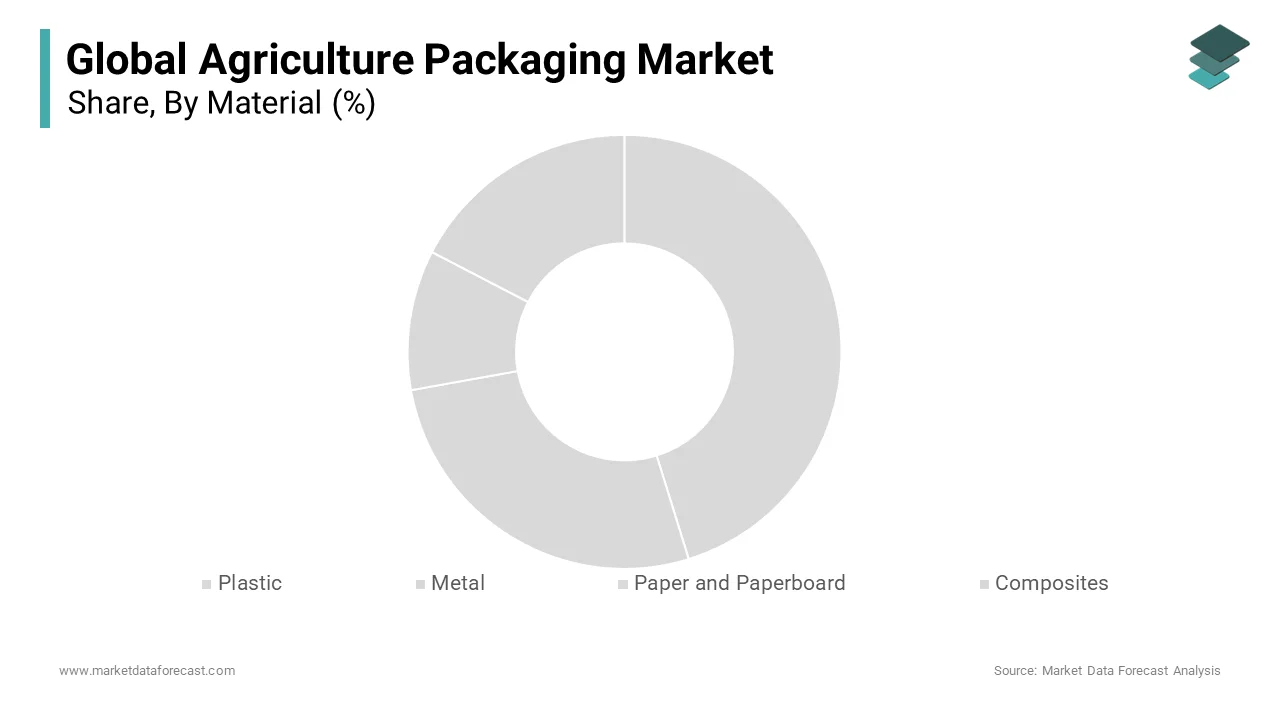
The paper and paperboard segment is predicted to witness the highest CAGR of 11.9% from 2025 to 2033 due to regulatory bans on single-use plastics and the rise of dry, granular bio-inputs compatible with fibrous packaging. The European Union's Packaging and Packaging Waste Regulation (PPWR), which came into force in February 2025, sets broad targets for packaging. The PPWR focuses on making all packaging recyclable by 2030. The regulation requires packaging to be of a certain recyclability performance grade (C or above) by 2030, with higher standards later on. This growth surges from regulatory inevitability and compatibility with low-moisture solid formulations rather than performance parity, which creates a forced substitution wave in compliance-driven markets.
By Product Insights
The pouches and bags segment was the largest segment and held a 53.2% share of the global agricultural packaging market in 2025. They align with the global shift toward smallholder accessibility, unit-dose precision, and rural logistics pragmatism, which propels the dominance of the pouches and bags segment in the global market. These are formats that drums and bottles cannot replicate. As per the International Fertilizer Association, a portion of smallholders in Sub-Saharan Africa and South Asia purchase inputs in under 5kg quantities, a segment served by flexible pouches. Pouches succeed not because of optimal theory. They succeed because they are deployable in practice across infrastructure-poor and capital-constrained environments.
The bottles and cans segment is estimated to register the fastest CAGR of 14.3% during the forecast period, owing to the global boom in liquid bio-stimulants, microbial inoculants, and foliar feeds. These are formulations requiring hermetic, light-blocking, and child-resistant containers, unattainable with flexible films. As per the research, global liquid bio-stimulant sales grew, a portion of which are packaged in bottles with CRC caps to protect photosensitive metabolites. Hence, this segment’s velocity originates from biochemical fragility, where formulation science demands rigid and impermeable containment that no pouch can provide.
By Barrier Strength Insights
The high-barrier segment held the largest share of 47.6% of the global agricultural packaging market in 2025. The growth of the high barrier segment is attributed to agrochemical efficacy as degradation from moisture, oxygen, or UV equates to crop failure, regulatory violation, or environmental contamination. The Indian Ministry of Agriculture and Farmers Welfare restricted the use of glyphosate and its derivatives to only be used by Pest Control Operators (PCOs). Even microbial inoculants require -40°C to +50°C stability, achievable only with high-barrier vacuum-sealed cans. This is not a premium segment, but a compliance baseline, where barrier failure equals legal and agronomic catastrophe.
The medium-barrier packaging segment is anticipated to witness the fastest CAGR of 16.7% from 2025 to 2033, owing to the global rise of dry, granular, and coated formulations, particularly organic fertilizers, biopesticide granules, and seed treatments, that require moderate protection without the cost of foil laminates. Global agricultural packaging trends are shifting toward functional and medium-barrier designs that balance durability, cost, and environmental suitability. Fertilizer makers increasingly adopt polymer-coated urea in woven sacks with extended shelf life. In addition, breathable polypropylene bags with microporous liners are being used to protect fungal inputs, and international guidelines emphasize cost-efficient packaging that performs reliably in rural storage conditions. This segment thrives on intelligent sufficiency, which matches barrier performance to formulation stability, not over-engineering for hypothetical extremes.
REGIONAL ANALYSIS
Asia Pacific Market Analysis
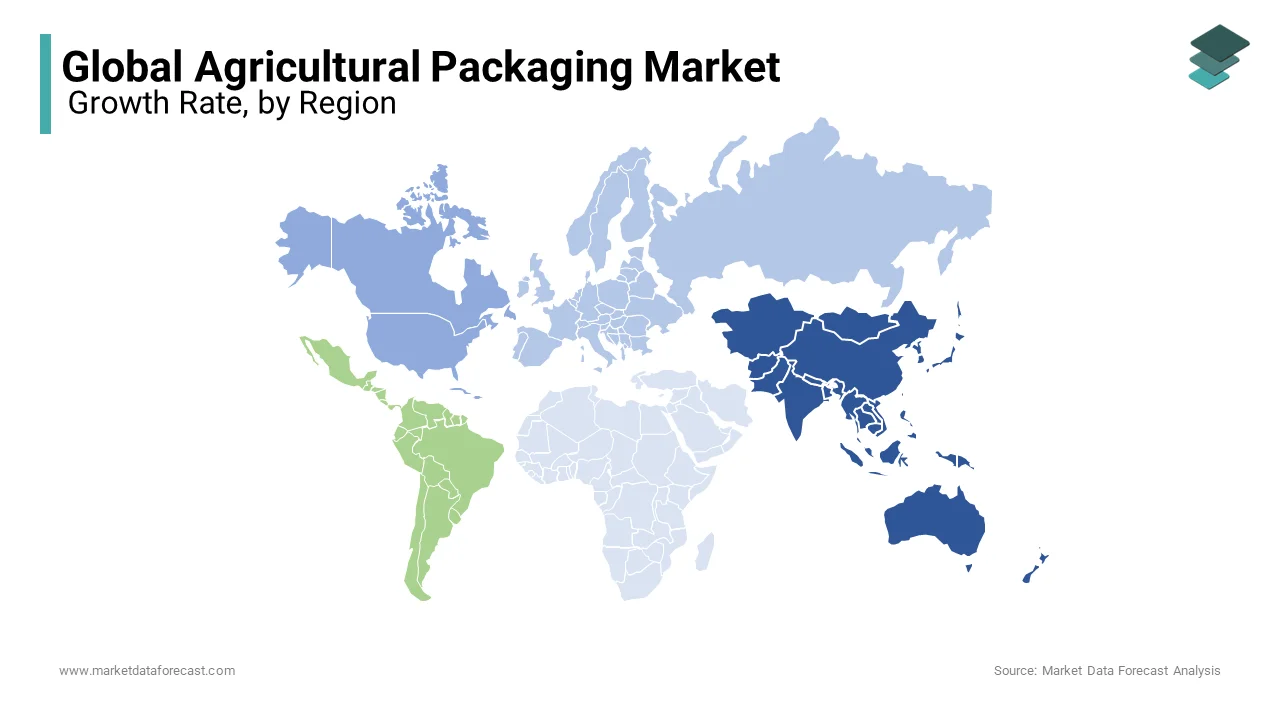
Asia Pacific dominated the agricultural packaging market by accounting for 39.4% share in 2025. The prominence of the Asia Pacific in the global market is primarily driven by volume, as it defines the global architecture of agricultural packaging through state-mandated material substitution, smallholder-scale formats, and monsoon-resilient engineering. India is in the process of implementing regulations that will require mandatory child-resistant closures for certain categories of pesticides, including pouches. As of June 2025, new rules have been introduced that significantly increase safety requirements for insecticide labeling and packaging. However, the rollout includes a grace period for manufacturers, and universal enforcement across all pesticide pouches is not yet fully in effect. China has a registration process for pesticides that are exclusively for export. These products must meet the regulatory requirements of the destination country.
North America Market Analysis
North America followed closely in the agricultural packaging market, with the premium and compliance-driven segment, where EPA and PMRA regulations dictate global packaging standards for chemical stability, child safety, and environmental containment. The U.S. Environmental Protection Agency (EPA) requires that empty, rigid, non-refillable pesticide containers be properly rinsed before disposal. Agricultural packaging is evolving under strict regulatory and sustainability pressures. Canada has proposed new regulations that focus on improving the accuracy of recyclability and compostability labels, specifically for plastics. These rules include prohibiting misleading terms like "biodegradable" and regulating the use of the chasing-arrows symbol. On farms, sensor-enabled treatment packs are showing measurable efficiency gains, which link packaging directly to crop performance. Packaging is increasingly used in modern farming systems for compliance as an environmental safeguard and as a data carrier in addition to its function as a container.
Europe Market Analysis
Europe experienced steady growth in the agricultural packaging market due to circular economy enforcement and biochemical innovation, where packaging must simultaneously comply with EPR bans and preserve next-gen microbial formulations. In Europe, agricultural packaging is also driven by regulation and performance standards rather than by cost. The German Environment Agency has noted that many biodegradable plastics are not suitable for the industrial composting facilities used for organic waste ("Biomüll") because they take too long to decompose. Industry groups also set strict material rules, such as amber HDPE bottles with child-resistant caps for liquid biostimulants, to ensure product stability under UV exposure. Overall, the region prioritizes circularity and biochemical protection, which makes it a testing ground for advanced packaging innovation worldwide.
Latin America Market Analysis
Latin America holds growth potential in the agricultural packaging market owing to export-driven compliance and large-scale mechanization, where global standards override local infrastructure limitations. The Brazilian government regulates pesticide containers and transportation, including strict guidelines for recycling and safety. Argentina has implemented QR-coded traceability for certified soybean seeds to combat counterfeiting; this system is mandated by the National Seed Institute (INASE). Mexico's government has implemented stricter regulations for agrochemicals; they have focused primarily on banning certain highly hazardous pesticides. Here, packaging a passport to global markets was embedded in export protocols and sustainability certifications.
Middle East & Africa Market Analysis
The Middle East and Africa region is predicted to expand in the agricultural packaging market during the forecast period. The regional market growth is driven by Gulf hydroponic innovation and African smallholder pragmatism. Saudi Arabia’s Vision 2030 strongly promotes the adoption of agricultural technologies, including smart farming, IoT, and AI, to increase efficiency and sustainability in date palm cultivation. Regulations and best practices in South Africa focus on maintaining seed viability rather than specific bag materials. In this region, packaging is a tool of food security and is embedded in climate adaptation and digital inclusion strategies.
COMPETITIVE LANDSCAPE
Competition pivots not on price but on regulatory pre-certification, climate resilience, and integration with agronomic workflows. Players differentiate through material science, compostable films, oxygen-scavenging liners, NFC-enabled containers, not generic capacity. No participant competes across all segments; leaders carve defensible niches: Amcor in flexibles, Berry in rigid, Sonoco in fiber. Emerging markets demand infrastructure-adaptive designs; OECD markets require circular compliance. Victory accrues to those who treat packaging not as a container but as a calibrated containment system, where failure equals crop loss or legal liability.
KEY MARKET PLAYERS
A few of the market players in the global agricultural packaging market
- Amcor Limited (Australia)
- Bemis Company, Inc. (US)
- Sonoco Products Company (US)
- Greif Inc. (US)
- Mondi Group (South Africa)
- NNZ Group (Netherlands)
- Berry Global Group, Inc.
- LC Packaging International BV (Netherlands)
- Silgan Holdings, Inc. (US)
- Proampac LLC (US)
- Flex-Pack (US)
- Purity Flexpack Limited (India)
- Epac Holdings LLC (US)
- Kenvos Biotech Co., Ltd. (China)
- Parakh Group (India)
Top Players In the Market
- Amcor engineers high-barrier, child-resistant flexible packaging for global agrochemical giants, combining metallized PET/PE laminates with UN-certified drop resistance. The company expanded its converting capacity to serve with localized, humidity-stable formats. It also partnered to embed NFC sensors in seed treatment bags, which enables field-level traceability and efficacy validation, transforming packaging into an agronomic data layer.
- Berry Global dominates rigid agrochemical packaging through blow-molded HDPE drums and CRC-compliant bottles engineered for extreme climates. The firm acquired a Brazilian closure manufacturer to vertically integrate child-resistant cap production. It also launched SmartSeal, a QR-coded drum liner that auto-logs batch data into farm management software by embedding compliance into logistics workflows.
- Sonoco leads in sustainable, fiber-based agricultural packaging by supplying coated kraft paper bags and composite cans for dry fertilizers and organic inputs. The company co-developed water-resistant paper pouches with IFFCO for microbial inoculants — surviving monsoon humidity.
Top Strategies Used by Key Market Participants
Leading players vertically integrate material science with regulatory compliance, engineering UN drop-test, CRC, and compostability into core offerings. They prioritize regional localization to match climate and infrastructure realities, monsoon films in Asia, and desert-grade HDPE in MENA. Strategic partnerships with agribusinesses embed packaging into digital agronomy platforms. Circular economy innovation targets EPR compliance in the EU and California. Format specialization, pouches for smallholders, drums for mechanized farms, which ensures application-specific dominance.
MARKET SEGMENTATION
This global agricultural packaging market research report is segmented and sub-segmented into the following categories.
By Material
- Plastic
- Metal
- Paper and Paperboard
- Composites
By Product
- Pouches & Bags
- Drums
- Bottles
- Cans
By Barrier Strength
- Low
- Medium
- High
By Region
- North America
- Europe
- Asia Pacific
- Latin America
- Middle East & Africa