- Product Description Description
- Table of Contents TOC
- List of Table & Figure LOT
- Get Free Sample PDF Sample PDF
Market Size, 2025
$11.74 BnMarket Estimate, 2026
$14.56 BnMarket Forecast, 2034
$81.37 BnCAGR, 2026–2034
24%Global AI Camera Market Size
The size of the global AI camera market was valued at USD 11.74 billion in 2025. This market is expected to grow at a CAGR of 24% from 2026 to 2034 and be worth USD 81.37 billion by 2034 from USD 14.56 billion in 2026.
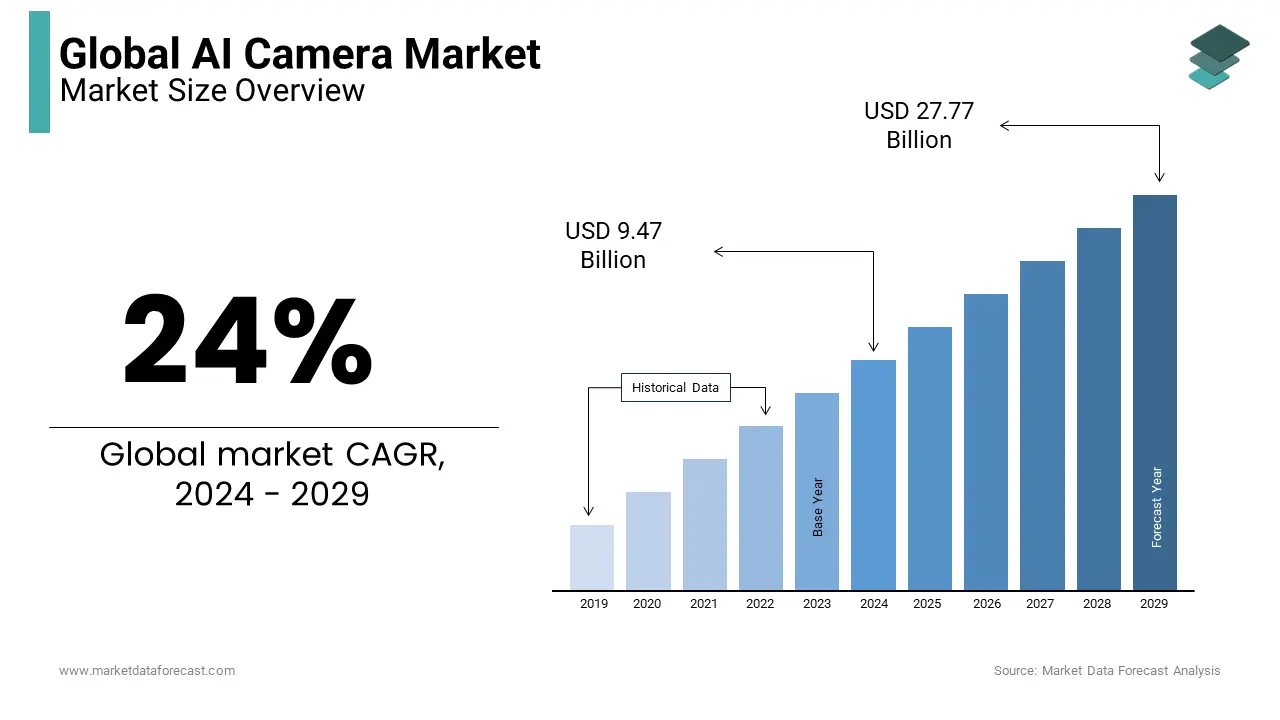
The AI camera market is predicted to experience a substantial rise throughout the estimation period. This can be attributed to the growing demand for defensive measures and security protocols over several end-user sectors. Moreover, the industry’s development is also due to the escalating need for face recognition cameras to assist companies in detecting people and performing surveillance activities on the premises. Apart from this, various governments around the world are investing in and formulating laws and regulations concerning this field, which is contributing to market expansion. For instance, in May 2025, schools in the United States are conducting ground trials latest AI-based camera technology to monitor premises and reduce open shooting cases. However, the ambiguity remains over the moral and ethical usage of data generated by these cameras which is impeding the growth rate.
MARKET DRIVERS
The rising need for sophisticated cameras with state-of-the-art monitoring capabilities is majorly propelling the AI camera market growth.
The need for extremely sophisticated cameras is rising with the surging requirement for technically state-of-the-art monitoring systems due to the risks to public protection and safety. The growing necessity for modern monitoring and protective systems in different industries, including residential, industrial and commercial premises, is propelling the implementation of AI cameras. Industrial buildings and facilities are progressively deploying these to enhance productivity and security. Sectors such as transportation and production logistics take advantage of these cameras for workflow efficiency, surveillance and quality control. These AI-powered CCTV and other systems can identify flaws and shortcomings in goods on conveyor belts and manufacturing lines or trace employee safety obedience.
The rising application of AI CCTV cameras at traffic lights by public authorities to identify and discover vehicle number plates while in transit and stationery positions is further boosting the growth rate of the AI camera market. The mounting popularity of AI-powered cameras in linked devices and mobile phones is promoting the demand for AI cameras.
MARKET RESTRAINTS
One of the key restraints encountered by the AI camera market is data protection and security issues.
These cameras function by gathering and saving facial images; there are legal concerns about how this important personal information will be stored and encrypted from online leaks or hackers and utilized by organizations. Gaining customer confidence in privacy will be vital for expansion. Apart from this, there is a requirement for further technological developments to attain more precise recognition through variations in pose, age, lighting, and other facial features to growth applications. All these are constraining the market from progressing forward.
MARKET OPPORTUNITIES
The increased need for ease of use and security throughout several verticals and the emerging system-on-chips (SOC), systems on modules (SOM), AI Accelerators, and single-board computers are presenting potential prospects for market expansion in the next few years. Likewise, in January 2025, Ambarella, a company engaged in edge AI semiconductors, revealed its Cooper Developer Platform at the CES exhibition. This platform incorporates AI models and services, hardware and software, and provides universal assistance for AI system-on-chip by Ambarella.
MARKET CHALLENGES
Errors, failures, and mistakes of AI in other applications are discouraging potential users from adopting this technology. AI is a promising domain with several concerns about its functioning and usage. Like, in May 2025, Microsoft received backlash from the general public, regarding its launch of a new feature known as CoPilot+ Recall. A large section of society was disgusted with the inbuilt movement recorder for building an information database for upcoming years. Another obstruction hindering market growth is the absence of standardization, which causes compatibility and interactivity problems among AI cameras and other intelligent devices and gadgets or software usages. For example, an AI camera system may not share or exchange information, news, or ideas efficiently with other Internet of Things (IoT) equipment or monitoring software, restricting its capability to operate collectively in connected surroundings.
REPORT COVERAGE
| REPORT METRIC | DETAILS |
| Market Size Available | 2025 to 2034 |
| Base Year | 2025 |
| Forecast Period | 2026 to 2034 |
| CAGR | 24% |
| Segments Covered | By Offering, Technology, Product, Connectivity, Biometric Method, End-User, and Region |
|
Various Analyses Covered | Global, Regional & Country Level Analysis, Segment-Level Analysis, DROC, PESTLE Analysis, Porter’s Five Forces Analysis, Competitive Landscape, Analyst Overview on Investment Opportunities |
| Regions Covered | North America, Europe, APAC, Latin America, Middle East & Africa |
|
Market Leaders Profiled | Vivotek Inc. (Taiwan), Sony Group Corporation (Japan), Zhejiang Dahua Technology Co., Ltd. (China), Panasonic Corporation (Japan), Honeywell Security Group (U.S.), Hangzhou Hikvision Digital Technology Co., Ltd. (China), Hangzhou Hikvision Digital Technology Co., Ltd. (China), Samsung (South Korea), FLIR Systems Inc. (U.S.), Axis Communications AB (Sweden), Panasonic System Networks Co., Ltd. (Japan), Axis Communications AB (Sweden), Canon Inc. (Japan), and others |
SEGMENTAL ANALYSIS
By Offering Insights
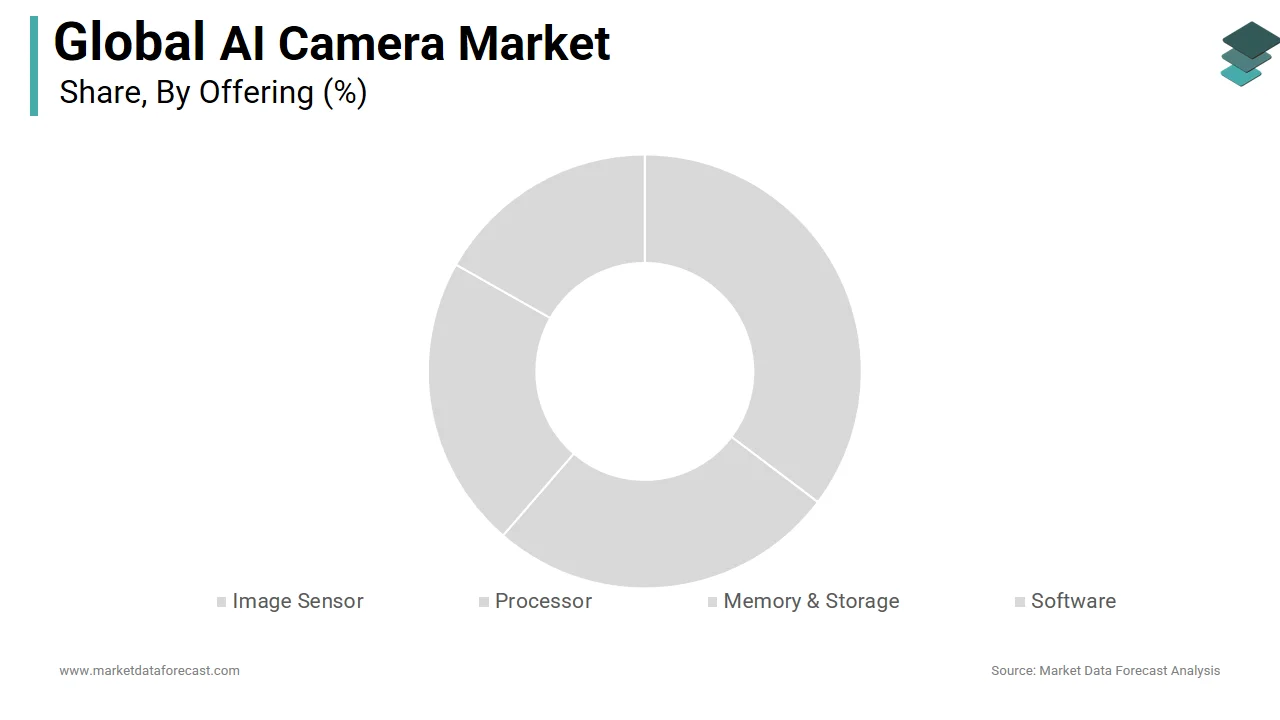
The image sensor segment continued to maintain its position in the AI camera market. The imagery developments in smartphones, automation, ICE & EV cars, smart buildings & premises and mixed reality are primarily pushing forward the segment’s market share. It consists of self-sufficient surveillance are integrating AI-based impression or understanding processing technologies with image sensors along with the computer insight output necessities.
By Technology Insights
The deep learning segment is spearheading the AI camera market and is striving towards further growth over the coming years. The category has rapidly surfaced as the prevailing industrial AI tool for its capability to support personal evaluation judgments and in reviewing cases where detecting particular features proves tough because of the great instability or intricacy. For instance, in July 2025, Infinix collaborated with Samsung Electronics to introduce the state-of-the-art 108-megapixel AI-powered Advanced Deep Learning Algorithm (AIADLA), the organization reported via press release.
By Product Insights
The CCTV camera segment is the most popular category and is estimated to capture more market share in the coming years. The demand for CCTVs has greatly surged around the world due to the increased pace of urbanization in developing countries and the upgradation of existing security and monitoring systems in developed economies. With the advent and fast adoption of digital technologies, food and beverage delivery platforms, consumer electronics, and other innovations in the corporate and industrial sectors, the segment’s market share is rising.
By Connectivity Insights
The wireless segment is a rapidly growing category of the AI camera market and is slated to advance to untapped opportunities in the future. Increased digitalization and the popularity of remote working or operations have led to the progressive adoption of connected devices. Also, there are growing security and safety concerns by high-rise societies and commercial complexes. All this ultimately surged the demand for wireless AI-powered cameras, giving users the ability to monitor from wherever they are at that moment.
By Biometric Method Insights
The facial recognition segment is growing at a higher CAGR and is predicted to witness a tremendous rise during the forecast period for the AI camera market. This can be attributed to the increasing necessity for improved protection and monitoring solutions throughout the public and commercial sectors. Also, governments worldwide are infusing significant amounts of funding into smart city projects that depend on modern technologies for video analysis, such as face recognition.
The optical character recognition segment is also getting traction owing to recent product launches and developments.
By End-User Insights
The consumer electronics segment is the fastest-growing end-user industry. The expectation is to consolidate its current position and gain further ground in the AI camera market during the forecast period. In this industry, the smartphone category is the biggest adopter of AI cameras, and this is also surging the segment’s market share. Companies like Sony, Samsung, and Realme have recently introduced 5G devices with AI-based smartphone photography. Industry players have stressed the importance of AI in the potential of mobile technology. Characteristics such as modern imaging processing, scene recognition, and stabilization enhance the quality of videos and photos. Additionally, the AI camera industry for home electronics is expanding because of breakthroughs in imaging and video production, biometric authentication, augmented reality, intelligent assistants, and changing customer expectations. Security and surveillance is another segment advancing rapidly, considering the broadened cyberattack vector.
REGIONAL ANALYSIS
North America dominated the AI camera market globally in 2025. The AI market is commanded by North America and is poised to achieve greater development in this field in the coming years. The region has a robust technical, including computing and networking infrastructure and an elevated uptake pace for modern and sophisticated technologies such as computer vision and AI.
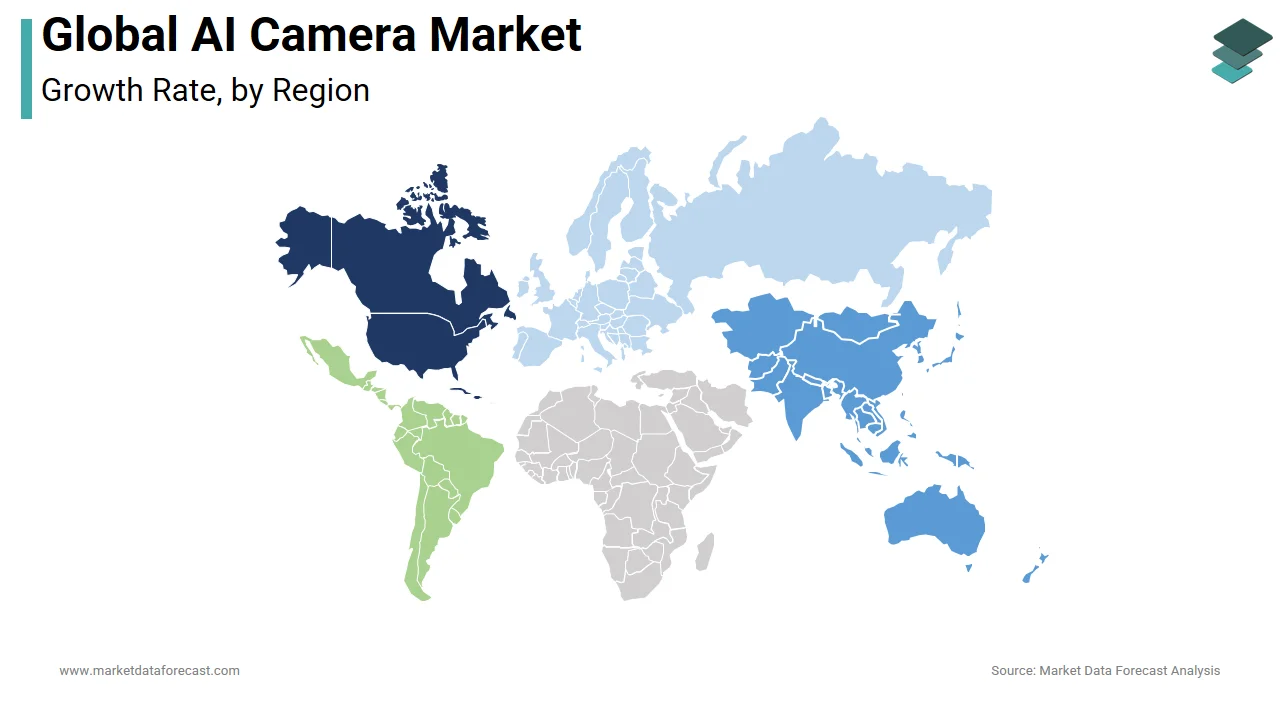
Asia-Pacific is expected to register solid growth during the forecast period in the global market. Asia Pacific is expected to be the fastest-expanding AI camera market for wireless security and monitoring CCTVS and other industry products, due to swift urbanization and growing security risks in the area. In the last few years, APAC nations have been vulnerable to violent extremist and insurgent challenges and land and border conflicts. To manage and curb any illicit activities and keep an eye on their ground, essential facilities, and boundaries, certain economies in the APAC area, like Vietnam, Taiwan, India, South Korea, China, Singapore, Pakistan, Malaysia, and Australia, are rapidly adopting AI-powered cameras.
KEY MARKET PLAYERS
Companies playing a prominent role in the global AI camera market include Vivotek Inc. (Taiwan), Sony Group Corporation (Japan), Zhejiang Dahua Technology Co., Ltd. (China), Panasonic Corporation (Japan), Honeywell Security Group (U.S.), Hangzhou Hikvision Digital Technology Co., Ltd. (China), Hangzhou Hikvision Digital Technology Co., Ltd. (China), Samsung (South Korea), FLIR Systems Inc. (U.S.), Axis Communications AB (Sweden), Panasonic System Networks Co., Ltd. (Japan), Axis Communications AB (Sweden) and Canon Inc. (Japan).
RECENT MARKET HAPPENINGS
- In July 2025, Infinix collaborated with Samsung Electronics to roll out an Advanced Deep Learning Algorithm (AIADLA), which is an AI-powered 108-MP camera. This tactical partnership will take advantage of Samsung’s algorithms for enhanced mobile photography.
- In May 2025, Google released a novel AI-based camera feature that determines items in real-time. This arrives simultaneously as OpenAI launched GPT 4o. Moreover, Google conducted its annual conference known as Google I/O in May 2025.
MARKET SEGMENTATION
This research report on the global AI camera market has been segmented and sub-segmented based on the offering, technology, product, connectivity, biometric method, end-user, and region.
By Offering
- Image Sensor
- CMOS
- ToF
- Processor
- AI Processing Unit
- Memory & Storage
- Software
- AI Analytics
- Analytics at Edge
- Analytics at Server
- AI Analytics
By Technology
- Deep learning
- Natural Language Processing
- Computer Vision
- Context-Aware Computing
By Product
- Compact Cameras
- DSLR Cameras
- CCTV Cameras
- Dome
- PTZ
- Box & Bullet
- Panoramic and Fisheye
- 360 Degree Cameras
By Connectivity
- Wired
- Wireless
- Bluetooth
- Wi-Fi
- Cellular (4G/5G
By Biometric Method
- Image Recognition
- Facial Recognition
- Voice/Speech Recognition
- Optical Character Recognition
By End-User
- Consumer Electronics
- Security & Surveillance
- Residential
- Commercial
- Military and Defense
- Automotive
- BFSI
- Robotics
- Medical
- Retail
- Media and Entertainment
- Transportation
- Others
By Region
- North America
- Europe
- Asia-Pacific
- Latin America
- The Middle East and Africa