- Product Description Description
- Table of Contents TOC
- List of Table & Figure LOT
- Get Free Sample PDF Sample PDF
Market Size, 2025
$4.04 BnMarket Estimate, 2026
$5.26 BnMarket Forecast, 2034
$43.74 BnCAGR, 2026–2034
30.3%Global Artificial Intelligence (AI) in Stadium Market Size
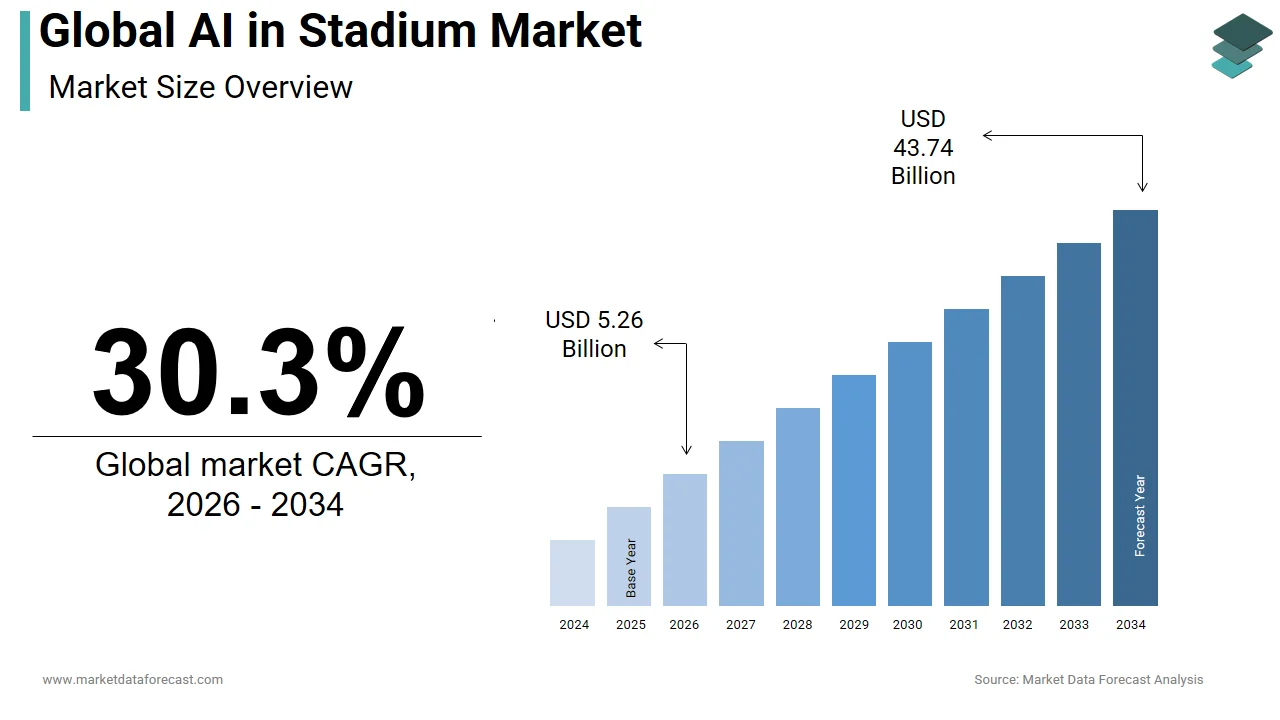
The size of the global AI in stadium market was valued at USD 4.04 billion in 2025. The global market is estimated to be worth USD 43.74 billion by 2034 from USD 5.26 billion in 2026, growing at a CAGR of 30.3% during the forecast period (2026 to 2034).
Artificial Intelligence is the simulation of human intelligence processes by machines, particularly computer systems. Some examples of AI applications are Expert systems, natural language processing, speech recognition, and machine vision. In general, AI systems work by consuming vast volumes of labeled training data, analyzing the data for correlations and patterns, and then predicting future states using these patterns. By examining millions of examples, a chatbot fed examples of text chats learns to make lifelike exchanges with people, and an image recognition program can learn to recognize and describe items in the pictures. Learning, reasoning, and self-correction are the three cognitive processes of AI programming.
Stadium operators and sports properties must adapt their mindsets regarding the design of the fan experience, as well as the new pandemic-related concerns that must be addressed to maintain fan health, safety, and security. AI delivers a set of problem-solving tools that will play a key part in this transformation. Artificial intelligence (AI) is the future of sports stadium infrastructure, replacing traditional building and repair processes and using data solutions to offer a healthier, safer, and more secure live sports environment for fans. Sports stadiums must rethink AI technologies as a new form of infrastructure to meet the requirements of fans, solving challenges that were previously solved with brick-and-mortar, pipe, and personnel.
MARKET DRIVERS
The growing need for Artificial Intelligence in stadiums owned by the government, schools, and other applications on a global scale is propelling the global AI in stadium market. The global artificial intelligence in stadium market size is growing due to increased demand for player monitoring and tracking data, the need for chatbots and virtual assistants to communicate with fans, and the need for real-time data analysis to improve performance. Rising returns on investment, technological developments, and an increase in the number of sporting events are the main drivers of industry expansion. A growing number of stadium visitors are expecting a more intuitive experience, and the host country is searching for new methods to boost the complex's return on investment.
Statistics and data analysis have always been employed in the sports industry. In sports, everything that can be quantified has previously been quantified, making it a fertile ground for artificial intelligence applications. Artificial intelligence (AI) has a daily impact on humans, and its impact on sports has remained rather consistent. Here are a few examples of how AI is affecting the esports sector. The combination of sensor technology and artificial intelligence (AI) aids in the advancement of player technology. To improve the effectiveness of each exercise for everyone, sports training AI is utilized to deliver real-time feedback and generate individualized training plans for players. Sports can benefit from AI predictive analytics to improve their health and fitness. The wearable app can also provide information about the player's tears and tensions, which can help them avoid injury.
MARKET RESTRAINTS
The high initial cost appears to be the most significant impediment to this technology's adoption. This cost includes hardware, software, resources, certification, education, and personnel training. Traditional processes are more expensive in terms of money and resources than setting up systems. Due to the cancellation of sports contests and the closing of stadiums around the world, as well as government lockdown measures and other restrictions, demand for AI in sports has decreased significantly. During the pandemic, the use of chatbots and virtual assistants improved contact with fans and increased the number of followers. The amount of money spent on developing AI technology for sports has decreased significantly. Following the pandemic, investments are projected to rise.
REPORT COVERAGE
| REPORT METRIC | DETAILS |
| Market Size Available | 2025 to 2034 |
| Base Year | 2025 |
| Forecast Period | 2026 to 2034 |
| CAGR | 30.3% |
| Segments Covered | By Type, Application and Region |
|
Various Analyses Covered | Global, Regional & Country Level Analysis, Segment-Level Analysis, DROC, PESTLE Analysis, Porter’s Five Forces Analysis, Competitive Landscape, Analyst Overview on Investment Opportunities |
| Regions Covered | North America, Europe, APAC, Latin America, Middle East & Africa |
|
Market Leaders Profiled | Allgovision Technologies, Byrom PLC, Centurylink, Cisco Systems, Dignia Systems, Ericsson Ab, Fujitsu, Gp Smart Stadium, Hawk-Eye, Huawei Enterprise, and others. |
REGIONAL ANALYSIS
Over the forecast period, North America is expected to dominate the AI in stadium market in the coming years owing to the availability of AI in sports solutions vendors such as Microsoft Corporation, IBM, and SAS, which are assisting artificial intelligence in the stadium market expansion.
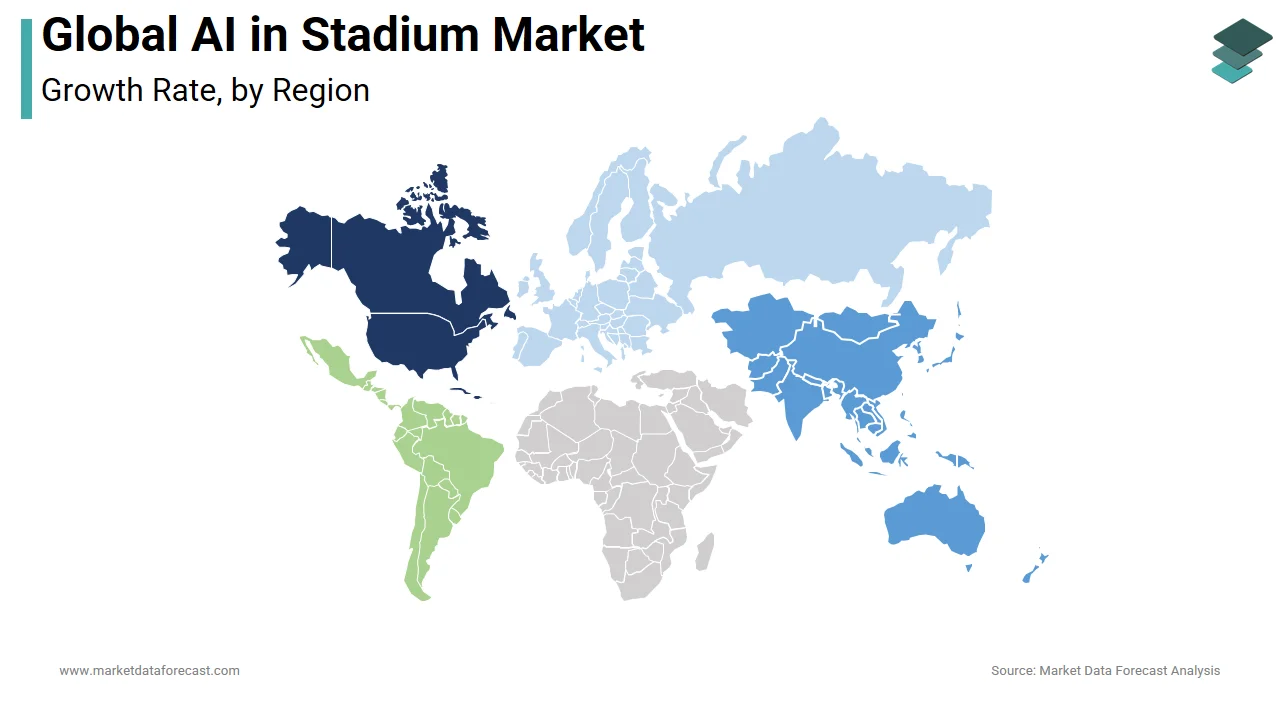
However, due to increased technical expenditures in industries such as cloud and digital technologies, Asia-Pacific is predicted to rise significantly during the forecast period.
KEY PLAYERS IN THE MARKET
Companies playing a dominating role in the global AI in the stadium market include Allgovision Technologies, Byrom PLC, Centurylink, Cisco Systems, Dignia Systems, Ericsson Ab, Fujitsu, Gp Smart Stadium, Hawk-Eye, Huawei Enterprise, and others.
RECENT HAPPENINGS IN THE MARKET
-
With the start of the baseball season, a slew of new mobile payment and self-service alternatives have been announced at Major League Baseball (MLB) stadiums. Instacart announced the activation of a new POS system at Fenway Park in Boston on April 20, 2022.The Caper Counter is a system designed by Caper AI, a software startup that provides checkout systems and other artificial intelligence (AI) retail technology that Instacart bought in the fall. Consumers place their purchases on the Counter, which scans them with computer vision before allowing them to choose their payment method.
-
QTnet has announced that its eSport Challenger's Park will be powered by Juniper Networks' wired, wireless, and security solutions. With a secure Juniper AI-driven network, the Japanese telecommunications service provider claims that their facility is a place where both professional athletes and the general public may engage in sports gaming. QTnet entered the eSports market as part of its diversification plan by acquiring Sengoku Co., Ltd. in 2020, which owns Sengoku Gaming, one of Japan's top professional eSports teams. Furthermore, QTnet's building is now Sengoku Gaming's home stadium.
MARKET SEGMENTATION
This research report on the global AI in stadium market has been segmented and sub-segmented based on type, application and region.
By Type
-
Digital Content Management
-
Stadium & Public Security
-
Building Automation
-
Event Management
-
Network Management
-
Crowd Management
By Application
-
Government
-
Schools
-
Others
By Region
-
North America
-
Latin America
-
Europe
-
Asia Pacific
-
Middle East & Africa