- Product Description Description
- Table of Contents TOC
- List of Table & Figure LOT
- Get Free Sample PDF Sample PDF
Market Size, 2025
$501 MnMarket Estimate, 2026
$534.27 MnMarket Forecast, 2034
$893.55 MnCAGR, 2026–2034
6.64%Executive Summary: Global Aircraft Antenna Market Analysis
- Market Scope: Comprehensive analysis of the global aircraft antenna industry, evaluating frequency bands, end-user segments, applications across navigation and communication, and regional growth dynamics.
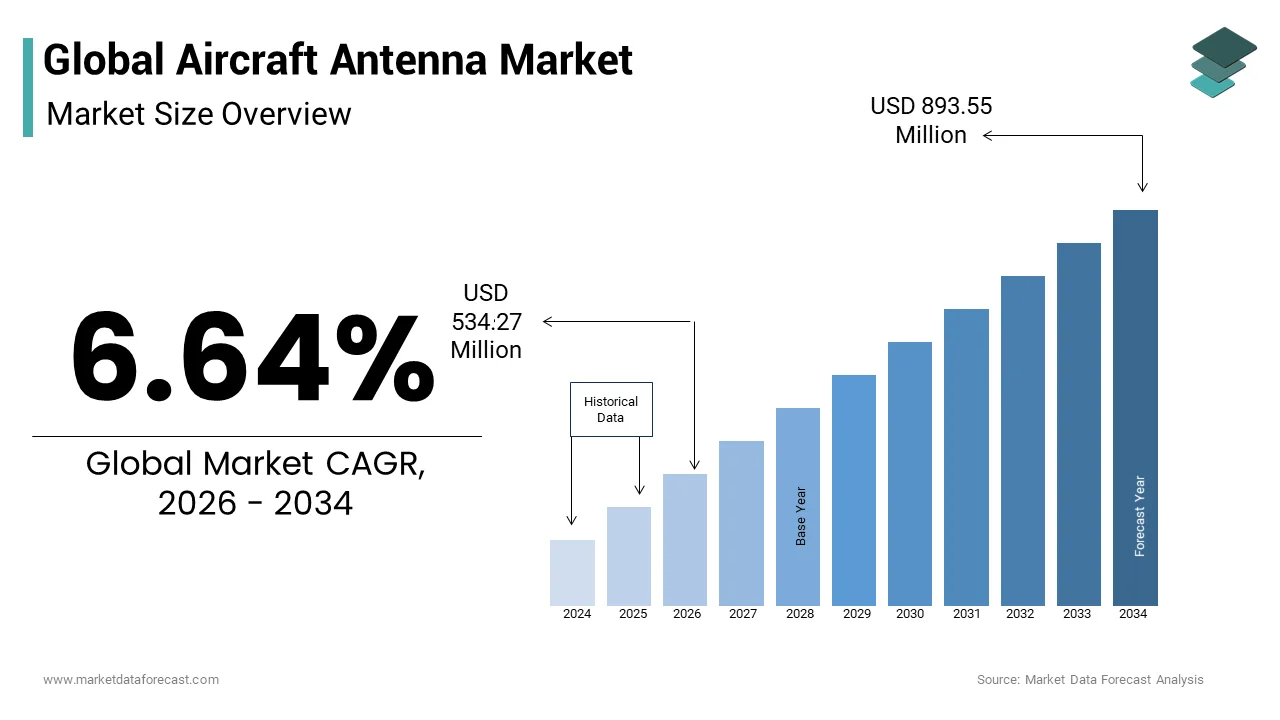
- Market Valuation: Valued at USD 501 million in 2025, estimated at USD 534.27 million in 2026, and projected to reach USD 893.55 million by 2034, growing at a compound annual growth rate (CAGR) of 6.64% during the forecast period from 2026 to 2034.
- Primary Growth Drivers: Rising demand for durable and efficient antennas, growing deployment of unmanned aerial vehicles (UAVs) for public safety, expanding commercial airline fleets in emerging economies, and increased adoption of Ku/Ka-band SATCOM solutions.
Key Market Segment Metrics (2026–2034)
| Category | Leading Segment (2025 Position) | Fastest-Growing / Prominent Segment |
|---|---|---|
| By Application | Navigation & Surveillance (held the largest baseline market share supported by high-frequency tracking and positioning use cases) | Communication (expanding rapidly via demands for high-bandwidth SATCOM and real-time data exchange) |
| By End-User | Military Sector (commands a prominent market share driven by government defense investments, encrypted channels, and drone integration) | Commercial & Military (military anticipated to progress with the highest CAGR backed by global security upgrades) |
| By Frequency Band | VHF & UHF Bands (widely deployed for standard omnidirectional voice and ground-to-air tracking) | Ka/Ku/K Bands (surging due to commercial in-flight connectivity and high-throughput satellite demands) |
| By Region | North America (serves as one of the largest anchor markets supported by key aerospace manufacturers and defense systems) | Asia-Pacific (predicted to grow at a higher CAGR driven by rising commercial passenger traffic and large aircraft order books) |
Major Market Players & Industry Structure
Market Structure: A fragmented yet specialized competitive landscape populated by major aerospace primes, defense contractors, and avionics specialists providing custom frequency solutions for both commercial airliners and military assets.
Key Companies: Antcom Corporation, The Boeing Company, Honeywell International Inc., Sensor Systems Inc., RAMI Aviation, AZIMUT, CMC Electronics Inc., Cobham plc, L3 Harris Technologies, Inc., and HR Smith Group.
Global Aircraft Antenna Market Size
The global aircraft antenna market size was valued at USD 501 million in 2025 and is anticipated to reach USD 534.27 million in 2026 to reach USD 893.55 million by 2034, growing at a CAGR of 6.64% during the forecast period 2026 to 2034.
Aircraft antennas are used by aircraft to navigate using radio frequencies and communicate with traffic control or other planes. There are several sizes and types of aircraft antennas designed for different frequencies. Communication and navigation is the main application of aircraft antennas. Other antennas may also have their own set of specifications for aircraft avionics. Since the location of the receiving station is not fixed, the signal generated by the antenna must be omnidirectional. Aircraft antennas are usually mounted on the top or bottom of the plane. In addition, in recent years, there has been a significant impression of the adoption of aircraft antennas in military drones to optimally carry out search and rescue operations.
MARKET DRIVERS
The growing demand for durable and efficient aircraft antennas and the increasing number of aircraft shipments are presumed to drive the growth of the global aircraft antenna market during the forecast period.
It is suggested that the greater adoption of unmanned aerial vehicles (UAVs) due to the significant adoption of public safety is one of the main reasons for the growth of the global aircraft antennas market. Also, as the number of airlines in economic growth countries such as Asia-Pacific and South America increases, the global demand for aircraft antennas is expected to grow. The development of next-generation aircraft for commercial, military and general aviation is driving the need for antennas of smaller size, higher gain and bandwidth. For example, as the demand for better connectivity with commercial aircraft increases, Ku/Ka-band antennas have been installed to support the SATCOM solution.
The increase in passenger traffic in the commercial aviation industry and the need for separate encrypted channels for military sector communications (for both manned and unmanned platforms) is driving investment in the development of advanced antennas that provide a wide range of Big and safe band. The aircraft antenna business is fragmented with many players in the market that offer different antennas in different frequency ranges of various shapes and sizes.
MARKET RESTRAINTS
However, the manufacturing cost of aircraft antennas is high, which may suppress market growth.
REPORT COVERAGE
| REPORT METRIC | DETAILS |
| Market Size Available | 2025 to 2034 |
| Base Year | 2025 |
| Forecast Period | 2026 to 2034 |
| CAGR | 6.64% |
| Segments Covered | By Frequency Band, End-User, Application, and Region |
| Various Analyses Covered | Global, Regional & Country Level Analysis, Segment-Level Analysis, DROC, PESTLE Analysis, Porter’s Five Forces Analysis, Competitive Landscape, Analyst Overview on Investment Opportunities |
| Regions Covered | North America, Europe, APAC, Latin America, Middle East & Africa |
| Market Leaders Profiled | Antcom Corporation, The Boeing Company, Honeywell International Inc., Sensor Systems Inc, RAMI Aviation, AZIMUT, CMC Electronics Inc., Cobham plc, L3 Harris Technologies, Inc. and HR Smith Group |
SEGMENTAL ANALYSIS
By Application Insights
The global market for aircraft antennas can be divided into communication, and navigation and surveillance. It is estimated that the navigation and surveillance sector has the largest market share in the market in 2018, whose growth can be attributed to increased bandwidth and high-frequency use for aircraft in navigation and surveillance. The sector is also predicted to expand with a considerable growth rate in the coming years.
By End User Insights
The aircraft antennas market can be divided into general aviation, commercial and military sectors. Of these, the military segment accounts for the prominent share and is likely to progress with the highest CAGR in the forecast period. The increasing investments from governments, along with the rise in terrorist activities around the world, fuel the expansion in the military sector.
By Frequency Band Insights
The global market for aircraft antennas can be divided into VHF and UHF, Ka/Ku/ K, HF, X, C, and many other types depending on the type of antenna.
REGIONAL ANALYSIS
Geographically, the global market is divided into North America, Europe, Asia Pacific, the Middle East and Africa, and Latin America.
North America aircraft antennas market is expected to be one of the largest markets during the forecast period. The Asia-Pacific aircraft antennas market is predicted to grow at a higher CAGR over the same period. This is due to the increase in passenger air traffic and the increased demand for new commercial aircraft. The Asia-Pacific region is achieving unprecedented long-term growth in the field of commercial aviation, backed by a series of aircraft that will be delivered to aircraft carriers in the region in the future. This growing aviation sector helps airlines improve their regional/national connectivity to support a wide range of industries such as tourism, commerce and more.
Top Leading Company
Cobham plc currently offers communications and navigation antennas for most Airbus and Boeing aircraft, with the largest market share in the commercial sector.
KEY MARKET PLAYERS
The main players in the aircraft antenna market are
- Antcom Corporation
- The Boeing Company
- Honeywell International Inc.
- Sensor Systems Inc
- RAMI Aviation
- AZIMUT
- CMC Electronics Inc.
- Cobham plc
- L3 Harris Technologies, Inc
- HR Smith Group
RECENT MARKET NEWS
- In August 2018, Chinese military and government agencies used birds like drones called pigeons with GPS antennas to track citizens in the region.
- In May 2018, the Wayne Municipality Fire Department in Indiana used drones to launch life jackets to citizens about to drown.
- In March 2018, Panasonic Avionics Corporation (Panasonic) and APSATCOM (APT Mobile Satcom Limited) collaborated to develop the Extreme Throughput Satellite (XTS) service through the APSTAR-6D satellite.
- Boeing Phantom Works introduced a low-profile flat electronic direction antenna for high-speed data on military aircraft.
- October 2018: SD Avionics partnered with QEST to develop a flat sour antenna for small planes. The system is likely to be compatible with synchronous terrestrial satellite networks operating at different frequencies and with satellites in lower orbits.
MARKET SEGMENTATION
This research report on the global antenna market has been segmented and sub-segmented based on the frequency bands, end-users, applications, and region.
By Frequency Band
- VHF & UHF Band
- Ka/Ku/K Band
- HF Band
- X Band
- C Band
By End-User
- General Aviation
- Commercial
- Military
By Application
- Communication
- Navigation & Surveillance
By Region
- North America
- Europe
- Asia-Pacific
- Latin America
- The Middle East and Africa