- Product Description Description
- Table of Contents TOC
- List of Table & Figure LOT
- Get Free Sample PDF Sample PDF
Market Size, 2025
$2.78 BnMarket Estimate, 2026
$2.96 BnMarket Forecast, 2034
$4.86 BnCAGR, 2026–2034
6.4%Executive Summary: Global Aircraft Galley Market
- Market Scope: Comprehensive global aviation cabin interior and galley equipment market assessment covering aviation carriage types, aircraft configurations, adjustment types (line vs. retro), and regional geographic landscapes.
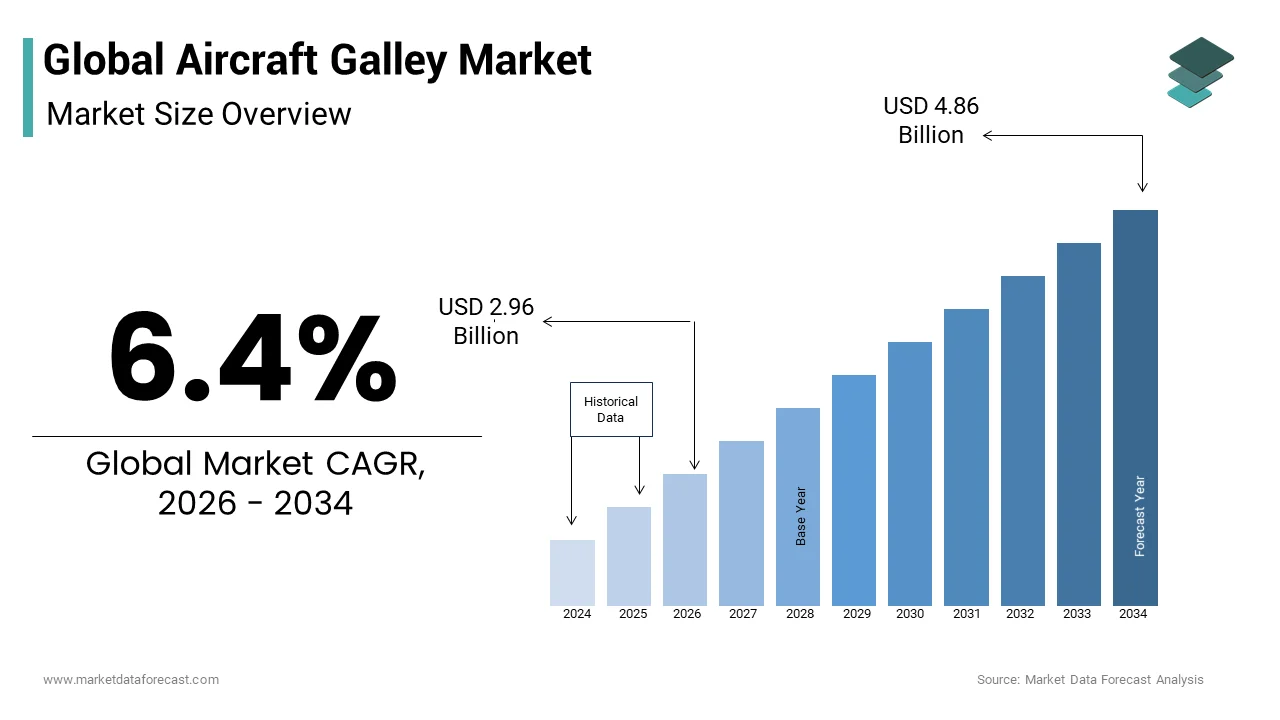
- Market Valuation: Valued at USD 2.78 billion (2025), estimated at USD 2.96 billion (2026), and projected to reach USD 4.86 billion by 2034, registering a robust CAGR of 6.4% (2026–2034).
- Primary Growth Drivers: Surge in global air passenger traffic and low-cost carrier expansions, increasing demand for enhanced in-flight catering services, and the continuous industry push for lightweight, energy-efficient galley inserts (e.g., ovens, water coolers, refrigerators).
Key Market Segment Metrics (2026–2034)
| Category | Leading Segment (2025 Position) | Fastest-Growing Segment |
|---|---|---|
| By Aviation Carriage / Aircraft Type | Narrow-body and single-aisle aircraft (dominant share driven by increasing deployment for short- and medium-haul commercial routes) | Single-aisle aircraft and business jet segments |
| By Adjustment Type | Line adjustment (integrated during initial aircraft manufacturing and assembly) | Retro adjustment / MRO cabin renovations and upgrades |
| By Region | North America and Europe (anchored by major established aerospace manufacturers and airline fleets) | Asia-Pacific (projected to experience significant expansion due to surging commercial aircraft deliveries and military fleet strengthening) |
Major Market Players & Market Structure
Market Structure: Highly consolidated oligopolistic market structure where the top five players represent approximately 80% of total market share, focusing heavily on R&D for lightweight materials, ergonomic design, and cabin connectivity integration.
Key Companies: JAMCO Corporation, Rockwell Collins, Zodiac Aerospace, Bucher Group, Korita Aviation, Aerolux, Turkish Cabin Interior, United Technologies Corporation, Diehl Stiftung & Co. KG, Safran SA, AIM Altitude, and others.
 Download Free Sample Report
Global Aircraft Galley Market Size
The global aircraft galley market size was valued at USD 2.78 billion in 2025 and is anticipated to reach USD 2.96 billion in 2026 to reach USD 4.86 billion by 2034, growing at a CAGR of 6.4% during the forecast period from 2206 to 2034.
Aircraft galley is a specialized cabin compartments dedicated to food preparation, storage, and service on commercial and military aircraft. These critical interior components integrate ovens, chillers, trolleys, and waste management systems while adhering to stringent aviation safety standards. According to the International Air Transport Association, global air passenger traffic is projected to reach 8.2 billion passengers by 2037, driving substantial demand for new aircraft deliveries and cabin retrofits. Boeing indicates that the global commercial aircraft fleet will require approximately 41,000 new units between 2023 and 2042 to replace aging fleets and accommodate growth. This extensive production pipeline directly correlates with increased procurement of advanced galley systems featuring lightweight composite materials. Airlines prioritize ergonomic designs that enhance crew efficiency and reduce service times during short turnarounds. Regulatory bodies such as the Federal Aviation Administration mandate rigorous fire resistance and structural integrity testing for all galley installations. The shift toward premium economy and business class configurations necessitates customized galley layouts with enhanced catering capabilities. Technological advancements focus on energy-efficient appliances and modular components that simplify maintenance procedures. The market responds to evolving passenger expectations for diverse meal options and improved hygiene standards in post-pandemic travel environments.
MARKET DRIVERS
Rising Global Air Passenger Traffic Fuels Fleet Expansion
Increasing global air passenger volumes is a key factor propelling the global aircraft gallery market growth by necessitating the production of new aircraft equipped with modern galley systems. According to the International Civil Aviation Organization, international air traffic has recovered to 95% of pre-pandemic levels, creating urgent demand for additional seating capacity and service infrastructure. As per Airbus global market forecasts, airlines plan to introduce over 2,000 new single-aisle aircraft annually to meet rising middle-class travel demand in emerging economies. Each new aircraft requires fully integrated galley modules tailored to specific airline branding and service models, driving consistent order books for manufacturers. The expansion of low-cost carriers in Asia-Pacific regions accelerates the adoption of standardized lightweight galleys designed for rapid turnaround operations. Long-haul international routes growing at 4% annually require complex galley configurations capable of supporting multi-course meal services for extended durations. Airlines invest in refurbished galleys for existing fleets to maintain competitive service quality and comply with updated health regulations. The correlation between passenger load factors and galley utilization rates ensures that high-density configurations remain a priority for OEMs. Manufacturers respond by developing scalable solutions that fit various aircraft types, from regional jets to wide-body airliners. This sustained traffic growth provides a stable foundation for long-term market expansion and technological investment.
Demand for Premium Cabin Experiences Drives Customization
Growing preference for premium travel experiences further boosts the global market expansion by encouraging airlines to invest in sophisticated galley designs that support enhanced catering services. According to the Boston Consulting Group, premium cabin revenues account for 40% of total airline income despite representing only 10% of seats, highlighting the economic importance of superior service delivery. As per Skift research, 65% of business travelers prioritize meal quality and service speed when selecting airlines, prompting carriers to upgrade galley equipment for better efficiency. Modern galleys incorporate advanced convection ovens, wine chillers, and espresso machines that require specialized electrical and plumbing integration within the cabin structure. Business class suites often feature dedicated mini-galleys allowing personalized service without disrupting main cabin operations. First-class segments utilize luxury materials such as carbon fiber and brushed aluminum to create aesthetically pleasing service areas that reflect brand identity. The trend toward onboard dining partnerships with celebrity chefs necessitates flexible storage solutions for diverse ingredient requirements. Airlines seek modular galley designs that can be reconfigured quickly to adapt to changing route demands and seasonal menus. This focus on differentiation drives innovation in space optimization and appliance functionality, ensuring crews can deliver high-touch service efficiently. Manufacturers collaborate with interior designers to create bespoke solutions that elevate the overall passenger journey.
MARKET RESTRAINTS
High Weight Penalties Limit Design Flexibility
Strict weight constraints are impeding the aircraft gallery market expansion by forcing manufacturers to balance durability with extreme lightweight requirements for galley structures. According to the International Air Transport Association, every kilogram of weight reduction saves approximately 100 dollars in annual fuel costs per aircraft, creating intense pressure to minimize galley mass. As per SAE International standards, galley components must withstand significant g-forces during turbulence while using minimal material, which increases production complexity and cost. Traditional stainless-steel appliances are increasingly replaced by composite materials and titanium alloys that offer lower weight but higher manufacturing expenses. Design engineers face challenges in integrating heavy-duty motors for ovens and compressors for chillers without exceeding structural limits. The need for fire-resistant insulation adds further weight burdens, requiring innovative thin-profile solutions that maintain safety compliance. Airlines often delay galley upgrades if weight savings do not justify the capital expenditure involved in retrofitting. Limited payload capacity on older aircraft restricts the installation of advanced catering equipment with higher power consumption. Manufacturers must conduct extensive testing to certify new lightweight materials meeting rigorous aviation safety regulations. These technical limitations slow the adoption of feature-rich galley systems that could otherwise enhance service quality. Cost benefits from fuel savings must be carefully calculated against initial investment hurdles for airline procurement teams.
Stringent Certification Requirements Prolong Development Timelines
Rigorous aviation certification standards are further impacting the global market expansion by extending time to market for innovative galley technologies and designs. According to the European Union Aviation Safety Agency, comprehensive testing protocols including flammability, toxicity, and structural integrity assessments can take 18 to 24 months to complete. As per Federal Aviation Administration regulations, any modification to galley layout or appliance specification requires separate supplemental type certification, adding significant administrative burdens. Manufacturers must document every material source and manufacturing process step, ensuring traceability for safety audits and liability protection. Changes in international food safety standards necessitate redesigns of storage compartments and waste disposal systems to prevent contamination risks. The complexity of integrating electrical systems with aircraft power supplies requires extensive electromagnetic compatibility testing to avoid interference with avionics. Small and medium enterprises struggle to allocate resources for prolonged certification processes, limiting their ability to compete with established players. Delays in approval push back revenue recognition and increase development costs, impacting profit margins. Airlines hesitate to specify unproven technologies, fearing operational disruptions if certification issues arise during entry into service. The conservative nature of aviation regulation prioritizes safety over innovation, slowing the introduction of smart galley features. This regulatory environment favors incumbent manufacturers with established certification histories and dedicated compliance teams.
MARKET OPPORTUNITIES
Integration of Smart Technologies Enhances Operational Efficiency
Emerging smart technology integration presents significant opportunities for galley manufacturers to offer data-driven solutions that optimize catering operations and maintenance. According to the Aircraft Interiors Expo, connected galley systems can reduce food waste by 20% through real-time inventory tracking and consumption analytics. As per Honeywell Aerospace studies, predictive maintenance sensors embedded in ovens and chillers can decrease unscheduled downtime by 30%, improving flight punctuality and crew satisfaction. Internet of Things-enabled appliances transmits performance data to ground operations, allowing proactive servicing before component failure occurs. Smart trolleys equipped with radio-frequency identification tags automate loading and unloading processes, reducing turnaround time at airports. Digital interfaces provide crews with instant access to meal preferences and dietary restrictions, enhancing personalized service delivery. Energy management systems optimize power usage during different flight phases, contributing to overall aircraft efficiency goals. Airlines value these digital capabilities as they align with broader sustainability initiatives and cost-reduction strategies. Manufacturers can offer software-as-a-service models, generating recurring revenue streams beyond hardware sales. Collaboration with tech firms accelerates the development of user-friendly interfaces for cabin crew training and operation. This technological evolution transforms galleys from static storage units into intelligent service hubs.
Sustainability Initiatives Drive Eco-Friendly Material Adoption
Growing emphasis on environmental sustainability creates opportunities for manufacturers to develop eco-friendly galley components using recycled and biodegradable materials. According to the International Air Transport Association, the aviation industry has committed to achieving net-zero carbon emissions by 2050, prompting airlines to seek lightweight and recyclable interior solutions. As per GreenAir news, sustainable aviation fuel initiatives are complemented by cabin upgrades that reduce overall aircraft weight and waste generation. Manufacturers explore bio-based composites for galley panels and trays that offer comparable strength to traditional plastics with lower environmental impact. Modular designs facilitate easier disassembly and recycling at the end of the lifecycle, supporting circular economy principles. Waste-reduction features such as compactors and separation bins help airlines comply with strict international dumping regulations. Water-saving mechanisms in coffee makers and sinks contribute to reduced water-tank weight and refueling frequency. Airlines promote these green credentials to environmentally conscious passengers, enhancing brand loyalty and market differentiation. Regulatory incentives for sustainable manufacturing practices encourage investment in clean production technologies. Partnerships with material science startups accelerate innovation in durable yet eco-friendly alternatives. This shift toward sustainability opens new procurement channels focused on environmental, social, and governance criteria.
MARKET CHALLENGES
Supply Chain Volatility Disrupts Production Schedules
Global supply chain disruptions challenge the aircraft gallery market growth by causing delays in sourcing critical components such as semiconductors and specialized alloys. According to the International Monetary Fund, global manufacturing lead times remain elevated due to logistical bottlenecks affecting aerospace tier-one suppliers. As per Aviation Week data, shortages of electronic chips required for smart galley controls have extended delivery schedules by 6 to 9 months for major manufacturers. Dependence on single-source suppliers for specialized materials like titanium creates vulnerability to geopolitical tensions and trade restrictions. Transportation costs for heavy galley modules have increased significantly, impacting profit margins for manufacturers and airlines alike. Labor shortages in fabrication facilities reduce output capacity, leading to backlogs in fulfilling new aircraft orders. Just-in-time inventory practices leave manufacturers exposed to unexpected disruptions without adequate buffer stocks. Alternative sourcing requires extensive requalification testing, delaying project timelines and increasing validation costs. Currency fluctuations affect procurement prices for imported components, complicating budget planning for long-term contracts. These supply uncertainties force manufacturers to renegotiate delivery dates, straining relationships with airline customers. Production scheduling becomes unpredictable, affecting the ability to meet peak demand periods during summer travel seasons.
Skilled Labor Shortages Impede Manufacturing Capacity
Acute shortages of technicians possessing specialized composite manufacturing skills constrain the ability of galley producers to scale production volumes effectively. According to the National Association of Manufacturers, 80% of manufacturing companies struggle to fill open positions requiring advanced technical competencies in aerospace assembly. Galley fabrication demands expertise in precision fitting, electrical wiring, and the integration of complex mechanical systems within confined spaces. Training new employees requires 12 to 18 months before achieving proficiency levels necessary for producing certified aviation components. Aging workforce demographics result in the retirement of experienced craftsmen faster than replacement hiring occurs across the industry. Competition from automotive and electronics sectors attracts skilled labor away from aerospace applications by offering similar compensation packages. Geographic concentration of manufacturing facilities in specific regions limits the local talent pool availability for recruitment efforts. Apprenticeship programs require significant investment in training infrastructure and mentorship resources before yielding productive workers. Immigration restrictions in certain countries prevent access to international skilled labor pools that could alleviate domestic shortages. Quality consistency suffers when less experienced personnel handle critical assembly operations without adequate supervision. Production throughput declines when staffing gaps force overtime work, leading to fatigue-related errors and rework requirements. Manufacturers hesitate to accept large-volume contracts, fearing the inability to fulfill commitments with constrained labor resources.
REPORT COVERAGE
| REPORT METRIC | DETAILS |
| Market Size Available | 2025 to 2034 |
| Base Year | 2025 |
| Forecast Period | 2026 to 2034 |
| CAGR | 6.4% |
| Segments Covered | By Aviation carriage, Aircraft type, Adjustment, and Region |
| Various Analyses Covered | Global, Regional & Country Level Analysis, Segment-Level Analysis, DROC, PESTLE Analysis, Porter’s Five Forces Analysis, Competitive Landscape, Analyst Overview on Investment Opportunities |
| Regions Covered | North America, Europe, APAC, Latin America, Middle East & Africa |
| Market Leaders Profiled | Major market players include JAMCO Corporation, Rockwell Collins, Zodiac Aerospace, Bucher Group, Korita Aviation, Aerolux, Turkish Cabin Interior, United Technologies Corporation, Diehl Stiftung & Co. KG, Safran SA, and AIM Altitude. |
SEGMENTAL ANALYSIS
By Aviation Carriage Insights
The narrow-body aircraft segment dominated the market by holding the leading share of the global market in 2025 due to their status as the workhorses of global commercial aviation and highest production volumes. According to the International Air Transport Association, narrow-body aircraft account for approximately 60% of the global commercial fleet, serving short- to medium-haul routes efficiently. As per Boeing market outlook data, airlines are projected to take delivery of over 30,000 new single-aisle aircraft in the next two decades to replace aging fleets and meet capacity demands. Each new narrow-body aircraft requires standardized galley modules designed for quick turnaround and high-frequency operations, driving consistent demand for manufacturers. The proliferation of low-cost carriers in emerging markets further amplifies this demand as these airlines prioritize efficient cabin layouts with compact galleys. Retrofit programs for existing narrow-body fleets also contribute significantly as airlines upgrade interiors to enhance the passenger experience and comply with new safety standards. The standardization of galley dimensions across major narrow-body platforms allows manufacturers to achieve economies of scale in production. This volume-driven model ensures steady revenue streams and stable order books for key market participants. The dominance of this segment is reinforced by its critical role in connecting secondary cities and supporting regional economic growth.
However, the wide-body aircraft segment represents the fastest-growing segment and is estimated to showcase a CAGR of 7.4% over the forecast period owing to the resurgence of long-haul international travel and premium cabin expansions. According to the International Civil Aviation Organization, international passenger traffic is recovering faster than domestic segments, creating urgent demand for wide-body capacity on intercontinental routes. As per Skift analysis, airlines are reintroducing premium economy and business class cabins on wide-body fleets, requiring complex galley configurations to support enhanced dining services. These advanced galleys include multiple ovens, chillers, and beverage centers that occupy significant cabin space but generate higher ancillary revenue. The trend toward ultra-long-haul flights exceeding 15 hours necessitates larger storage capacities and more sophisticated food preparation equipment. Airlines are investing in bespoke galley designs that reflect brand identity and offer personalized service experiences for high-yield passengers. The replacement cycle for older wide-body aircraft also drives demand as newer models feature more efficient and spacious galley layouts. Manufacturers are developing modular systems that allow airlines to reconfigure galleys based on seasonal route demands. This flexibility is crucial for maximizing asset utilization in a volatile travel environment. The growth of this segment is supported by increasing bilateral air service agreements facilitating cross-border connectivity.
By Aircraft Insights
The single-aisle aircraft segment led the market with the major share of the global market in 2025 due to their extensive use in domestic and regional networks across North America, Europe, and Asia. According to Federal Aviation Administration records, single-aisle aircraft perform over 80% of all daily commercial departures in the United States, highlighting their operational centrality. As per Airbus global forecasts, the demand for single-aisle aircraft will remain robust as airlines expand point-to-point networks bypassing traditional hub-and-spoke models. These aircraft require compact and efficient galley solutions that maximize seating capacity while providing essential catering services. The high frequency of flights means galleys undergo intense usage cycles, necessitating durable and easy-to-maintain designs. Low-cost carriers predominantly operate single-aisle fleets and prioritize lightweight galleys to minimize fuel consumption and operating costs. The standardization of galley interfaces across different single-aisle models allows for interchangeable components, reducing inventory costs for airlines. Retrofit activities for aging single-aisle fleets also contribute to market volume as operators seek to modernize cabin interiors. The sheer number of active single-aisle aircraft ensures a steady aftermarket demand for replacement parts and upgrades. This segment remains the backbone of the commercial aviation industry, driving consistent galley procurement.
On the other side, the business jets segment is estimated to witness a CAGR of 8.2% over the forecast period in the global market owing to the growing demand for private travel among high-net-worth individuals and corporations. According to the National Business Aviation Association, business jet flight hours increased by 12% in 2023, reflecting strong recovery and growth in the private aviation sector. As per Textron Aviation data, the delivery of new business jets has reached record levels, with customers requesting highly customized interior configurations including luxury galleys. These galleys are designed to offer restaurant-quality dining experiences at altitude, featuring premium appliances and bespoke finishes. The privacy and comfort offered by business jets make them the preferred mode of travel for executives seeking productivity and relaxation during flights. Manufacturers are integrating smart technologies such as touchscreen controls and automated brewing systems to enhance user convenience. The trend toward larger-cabin business jets allows for more elaborate galley installations, including full-size ovens and refrigeration units. Customization is key in this segment as owners seek unique designs that reflect personal taste and brand identity. The high-margin nature of business jet interiors attracts specialized suppliers focusing on luxury and craftsmanship. This segment benefits from the growing wealth distribution and increasing globalization of business activities.
REGIONAL ANALYSIS
North America Market Analysis
North America dominated the market by holding the largest share of the global market in 2025 and is expected to experience steady market expansion driven by sustained fleet modernization and advanced manufacturing integration, a large existing fleet and a robust manufacturing base. According to the Federal Aviation Administration, the United States has the largest civil aircraft registry in the world, with over 280,000 active aircraft requiring regular maintenance and upgrades. As per Boeing market analysis, North American airlines are aggressively retiring older aircraft and replacing them with fuel-efficient models equipped with modern galley systems. The presence of major original equipment manufacturers and tier-one suppliers in the region facilitates rapid innovation and deployment of new technologies. High labor costs drive demand for automated and easy-to-maintain galley solutions that reduce operational overhead. The strong business aviation sector in the United States contributes significantly to demand for luxury custom galleys. Regulatory standards set by the Federal Aviation Administration influence global design practices, ensuring high safety and quality benchmarks. The region serves as a testing ground for new materials and smart technologies before global rollout. Collaboration between airlines and manufacturers leads to tailored solutions addressing specific operational needs. The mature market focuses on retrofit and upgrade opportunities alongside new production deliveries.
Europe Market Analysis
Europe is projected to maintain consistent growth supported by stringent environmental regulations and aggressive sustainability mandates in the coming years. Europe maintains a strong position in the aircraft galley market, characterized by stringent environmental regulations and a focus on sustainability. According to the European Union Aviation Safety Agency, rigorous certification processes for cabin interiors promote the adoption of eco-friendly and lightweight materials. As per Airbus headquarters data, European airlines are leading the transition toward sustainable aviation fuels and complementary cabin upgrades that reduce the overall carbon footprint. The region is home to several key galley manufacturers who supply global airlines with high-quality composite structures and advanced appliances. Growing demand for premium travel experiences on long-haul routes from European hubs drives innovation in wide-body galley designs. Strict waste management regulations encourage the development of galley systems with efficient compaction and separation capabilities. The mature aerospace industry in countries like France, Germany, and the United Kingdom supports a robust supply chain for specialized components. Research and development initiatives funded by government agencies accelerate innovation in smart galley technologies. The region emphasizes circular economy principles, promoting recyclable materials and modular designs. Cross-border collaboration within the European Union facilitates the harmonization of standards and best practices.
Asia Pacific Market Analysis
Asia-Pacific is poised to register rapid market acceleration driven by surging commercial passenger traffic and expanding fleet modernizations in the near future. Asia-Pacific emerges as the fastest-growing region in the aircraft galley market, fueled by the rapid expansion of air travel and fleet modernization. According to the International Air Transport Association, Asia-Pacific is projected to become the largest aviation market by passenger volume by 2030, driving unprecedented demand for new aircraft. As per Centre for Aviation data, airlines in China, India, and Southeast Asia are placing massive orders for single-aisle and wide-body aircraft to meet rising middle-class demand. This production surge creates substantial opportunities for galley manufacturers to supply both original equipment and aftermarket services. The growth of low-cost carriers in the region prioritizes cost-effective and lightweight galley solutions for high-frequency operations. Increasing disposable incomes are boosting demand for premium travel experiences, prompting full-service carriers to upgrade cabin interiors with advanced galleys. Local manufacturing capabilities are expanding as global suppliers establish production facilities to serve the regional market more efficiently. Government initiatives to develop aviation hubs in countries like Singapore and Dubai further stimulate demand. The region's diverse regulatory landscape requires manufacturers to adapt designs to local standards and preferences. Cultural preferences for specific dining styles influence galley layout and appliance selection in this market.
Latin America Market Analysis
Latin America is anticipated to witness gradual market recovery as regional carriers incrementally renew their fleets and upgrade passenger services over the next several years. Latin America represents a developing market for aircraft galleys with steady growth driven by fleet renewal and economic recovery. According to the International Civil Aviation Organization, air traffic in Latin America is recovering steadily, with airlines investing in newer, more efficient aircraft to reduce operating costs. As per Embraer market reports, the region's strong presence of regional aircraft manufacturers influences demand for specialized galley solutions tailored to smaller airframes. Economic volatility in some countries encourages airlines to prioritize durable and low-maintenance galley components that withstand rigorous usage. The growth of tourism sectors in countries like Brazil and Mexico drives demand for comfortable cabin experiences, including improved catering services. Limited local manufacturing capacity means most galley components are imported, creating opportunities for global suppliers to expand their reach. Regulatory harmonization efforts within the region aim to streamline certification processes and facilitate cross-border trade. Airlines focus on optimizing galley layouts to maximize seating capacity on popular domestic routes. Aftermarket services for maintenance and repair are gaining importance as fleets age and require refurbishment. Partnerships with local distributors help global manufacturers navigate logistical and cultural challenges in this diverse region.
Middle East and Africa Market Analysis
Middle East and Africa is expected to record steady expansion anchored by strategic hub developments and rising investments in luxury long-haul travel over the next few years. The Middle East and Africa show promising growth potential in the aircraft galley market, supported by strategic hub development and fleet expansion. According to the International Air Transport Association, Gulf carriers continue to expand their long-haul networks, requiring advanced wide-body galleys to support premium service offerings. As per Emirates Group data, investment in luxury cabin interiors remains a priority for Middle Eastern airlines seeking to differentiate themselves in competitive global markets. The region serves as a critical connector between East and West, driving demand for high-capacity aircraft with sophisticated catering facilities. African airlines are gradually modernizing their fleets with support from international leasing companies, creating opportunities for entry-level galley solutions. Religious and cultural dietary requirements influence galley design and food preparation equipment selection in this region. Major airports in Dubai and Doha are expanding cargo and passenger terminals, stimulating demand for ground support equipment related to catering. Local regulations are evolving to align with international safety and hygiene standards, improving market accessibility. Global manufacturers are establishing regional offices to provide better customer support and after-sales service. The focus on hospitality excellence drives continuous innovation in galley aesthetics and functionality in this prestigious market.
COMPETITIVE LANDSCAPE
The competition within the aircraft galley market is characterized by a consolidated landscape dominated by established aerospace suppliers and specialized interior manufacturers. Key participants compete primarily on weight reduction technological integration and customization capabilities rather than price alone due to high certification barriers. Major players invest heavily in research and development to create lightweight composite structures that improve fuel efficiency for airlines. Strategic partnerships with original equipment manufacturers ensure early involvement in aircraft design phases securing long term supply contracts. Companies strive to offer modular and flexible galley solutions that allow airlines to adapt cabin configurations for different mission profiles. The market sees continuous efforts to integrate smart technologies such as internet of things sensors for predictive maintenance and inventory management. Intellectual property protection plays a crucial role as companies patent unique locking mechanisms and thermal insulation methods. Geographic expansion into emerging markets provides additional growth avenues for leading firms seeking to diversify revenue streams. The competitive dynamics are further influenced by the need for rigorous compliance with international safety and environmental regulations. Maintaining robust after sales support and refurbishment services is a critical differentiator in this service oriented sector. Companies that successfully balance innovation with cost effectiveness gain significant advantages in retaining airline loyalty.
KEY MARKET PLAYERS
Major market players include
- JAMCO Corporation
- Rockwell Collins
- Collins Aerospace
- Zodiac Aerospace
- Bucher Group
- Korita Aviation
- Aerolux
- Turkish Cabin Interior
- United Technologies Corporation
- Diehl Stiftung & Co. KG
- Safran SA
- AIM Altitude.
Top Players In The Market
- Jamco Corporation stands as a premier supplier of aircraft interior products specializing in advanced galley systems and lavatory modules. The company leverages its expertise in composite materials to produce lightweight and durable galleys that meet stringent aviation safety standards. Recent initiatives include expanding production capacity in Japan and the United States to support increasing demand from major original equipment manufacturers. Jamco actively collaborates with airlines to design customized galley layouts that optimize space utilization and enhance crew efficiency. The firm invests heavily in research and development to integrate smart technologies such as inventory tracking sensors into galley structures. Its commitment to sustainability drives the adoption of recyclable materials and energy efficient appliances in new product lines. Jamco maintains strong relationships with global aerospace primes ensuring consistent order flow for next generation aircraft programs. The company focuses on modular designs that facilitate easy maintenance and rapid turnaround operations for airline customers. These efforts reinforce its reputation for innovation and reliability in the competitive aircraft interior sector.
- Safran SA contributes significantly to the aircraft galley market through its comprehensive portfolio of cabin equipment and catering solutions. The company integrates advanced electrical and mechanical systems into galley modules ensuring seamless compatibility with aircraft power networks. Recent actions include strategic partnerships with technology firms to develop connected galley appliances that provide real time operational data to flight crews. Safran emphasizes weight reduction by utilizing innovative thermoplastic composites and aluminum alloys in its manufacturing processes. The firm supports airlines with lifecycle services including refurbishment and upgrade programs for existing fleets. Its global presence allows Safran to offer localized support and rapid response to customer needs across different regions. Safran prioritizes regulatory compliance and safety certification ensuring all products meet international aviation standards. The company explores sustainable aviation initiatives by designing galleys that minimize waste and energy consumption during flights. These strategies strengthen its position as a trusted partner for both commercial and business aviation sectors worldwide.
- Collins Aerospace plays a pivotal role in the aircraft galley market by delivering integrated cabin solutions that enhance passenger experience and operational efficiency. The company combines expertise in avionics and interiors to create smart galley systems with intuitive user interfaces for cabin crew. Recent developments include launching modular galley inserts that allow airlines to reconfigure cabin layouts quickly based on route demands. Collins Aerospace invests in digital twin technology to simulate galley performance and optimize design before physical production. The firm collaborates with chefs and catering companies to ensure galley appliances meet diverse culinary requirements for global routes. Its extensive supply chain network ensures timely delivery of high quality components to assembly lines worldwide. Collins Aerospace focuses on durability and ease of cleaning to reduce maintenance costs for airline operators. The company actively participates in industry forums to shape future standards for cabin comfort and sustainability. These contributions solidify its leadership in providing holistic interior solutions for modern aircraft fleets.
Top Strategies Used By Key Market Participants
Key participants in the aircraft galley market employ several strategic approaches to maintain their competitive edge and drive sustainable growth. Innovation in lightweight materials remains a primary focus as companies develop advanced composites that reduce overall aircraft weight and fuel consumption. Strategic mergers and acquisitions allow firms to expand their product portfolios and acquire specialized technical expertise efficiently. Partnerships with original equipment manufacturers ensure early integration of galley designs into new aircraft platforms securing stable order books. Investment in digital technologies helps create smart galleys with connectivity features for improved operational monitoring and maintenance. Companies prioritize sustainability by adopting eco friendly materials and energy efficient appliances to meet evolving environmental regulations. Customization services enable providers to tailor galley layouts to specific airline branding and service requirements enhancing customer satisfaction. Focus on aftermarket services including refurbishment and repair creates recurring revenue streams and strengthens client relationships. These strategies collectively enable market leaders to adapt to changing industry demands and technological advancements effectively while maintaining high quality standards.
MARKET SEGMENTATION
This research report on the global aircraft galley market has been segmented and sub-segmented based on the Aviation Carriage, Aircraft Type, Adjustment, and region.
By Aviation Carriage
- Narrow-Body Aircraft
- Wide-Body Aircraft
- Very Large Aircraft
- Local and Commercial Aircraft
By Aircraft Type
- Single-Aisle
- Twin-Aisle
- Business Jets
By Adjustment
- Line
- Retro
By Region
- North America
- Europe
- Asia-Pacific
- Latin America
- The Middle East and Africa