- Product Description Description
- Table of Contents TOC
- List of Table & Figure LOT
- Get Free Sample PDF Sample PDF
Market Size, 2025
$32.89 BnMarket Estimate, 2026
$35.15 BnMarket Forecast, 2034
$59.86 BnCAGR, 2026–2034
6.88%Executive Summary: Global Aircraft Nacelle Systems Market
- Market Scope: Comprehensive global aircraft nacelle systems market analysis covering material compositions, component products, engine types, aircraft categories, end-user settings, regional frameworks, and adoption metrics.
- Market Valuation: Valued at USD 32.89 billion (2025), anticipated to reach USD 35.15 billion in 2026, and projected to scale up to USD 59.86 billion by 2034, expanding at a CAGR of 6.88% during the forecast period from 2026 to 2034.
- Primary Growth Drivers: Rising global air passenger and freight traffic volumes, increased aircraft production to match aging fleet replacements, and continuous technological innovations like additive manufacturing to lower weights and manufacturing expenses.
Key Market Segment Metrics (2026–2034)
| Category | Leading Segment / Position | Growth Dynamics & Outlook |
|---|---|---|
| By Material | Aluminum Alloy | Presumed to lead the market over the forecast period due to high temperature resistance and structural durability. |
| By End-User | Original Equipment Manufacturer (OEM) | Expected to experience the most significant growth as OEMs manufacture and supply factory-fitted gondolas and thrust-reversing tech. |
| By Region | Asia-Pacific | Expected to generate the highest demand driven by rising passenger volume, commercial aircraft orders, and military modernization. |
Major Market Players & Market Structure
Market Structure: Highly consolidated ecosystem driven by major aerospace primes and system integrators managing long-term supply agreements, aftermarket partnerships, and ultra-large engine structural demands (such as for the Boeing 777X and Airbus programs).
Key Companies: Safran SA, United Technologies Corporation (UTC), GE Aviation, GKN Aerospace, Bombardier Inc., Boeing, and Airbus.
Global Aircraft Nacelle Systems Market Size
The global aircraft nacelle systems market size was valued at USD 32.89 billion in 2025 and is anticipated to reach USD 35.15 billion in 2026 to reach USD 59.86 billion by 2034, growing at a CAGR of 6.88% during the forecast period from 2026 to 2034.
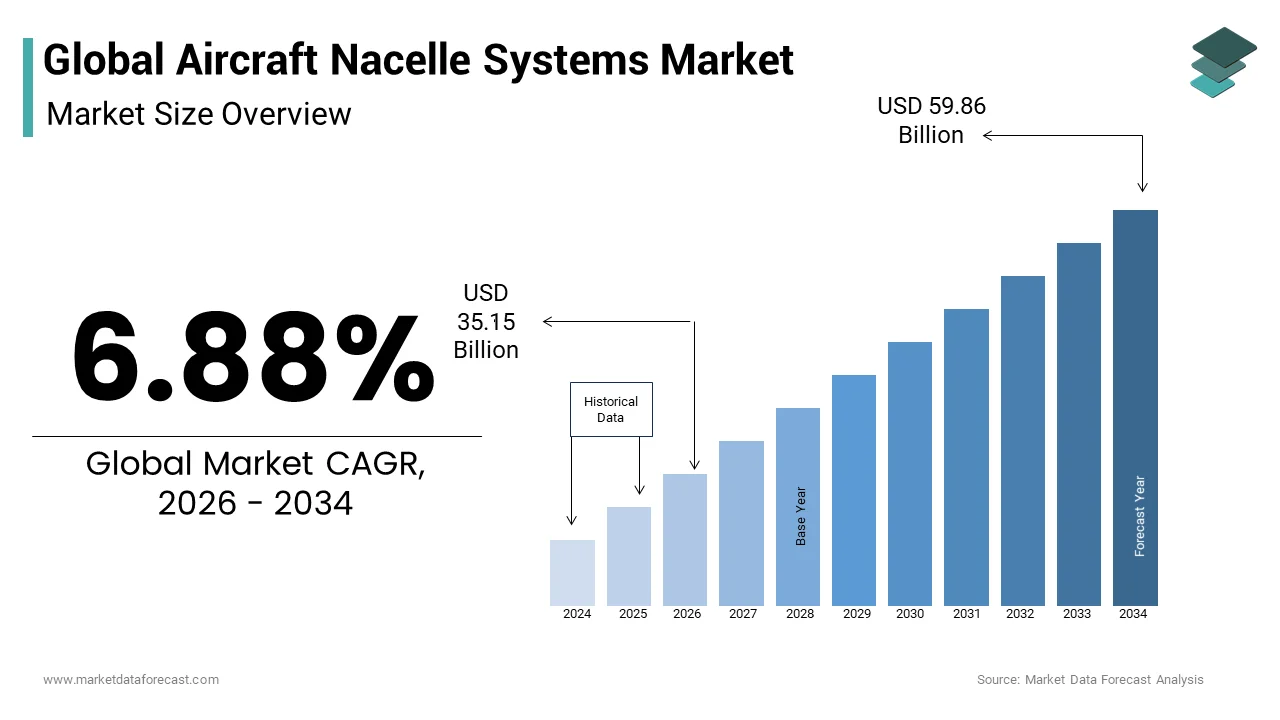
The aircraft nacelle system is an aerodynamic enclosure suitable for housing engines and interfaces with aircraft structures. The advanced composite system incorporates a thrust inverter to help protect and maintain the engine and optimize airflow through the engine. In addition, the Aircraft Nacelle manages various essential functions, including noise reduction, ice removal, internal and external temperature control, fire and lightning protection, and load absorption between the engine and the pylons.
MARKET DRIVERS
The use of additive machining in aircraft nacelle systems can help reduce the weight of the aircraft and manufacturing costs due to the reduction of small parts, such as fasteners.
However, the integration of this technology in the gondola system is still in the development stage. The trajectory of the global aircraft nacelle systems market is expected to continue with current growth opportunities for new and existing players. Furthermore, as the use of air transport for passengers and freight increases, it will be necessary to increase global air transport. This will indirectly lead to the growth of the global Aircraft Nacelle Systems market.
The aircraft nacelle systems have an engine propulsion system and help reduce vibration, defrosting, and engine noise. The Nacelle system also manages external and internal temperature differences, an essential advantage of airplanes. Nacelle integrators are working with original equipment manufacturers and other industries to develop lightweight gondolas with improved performance. This factor is driving the demand for the global aircraft nacelle systems market. The increase in passenger traffic allows airlines to expand their reach to other locations worldwide. In addition, the average age of airlines is increasing, creating growth opportunities for market players.
MARKET RESTRAINTS
The new turbofan, which increases fuel efficiency by increasing the bypass ratio, means a giant Nacelle with a larger fan diameter, threatening to offset the benefits of fuel combustion with higher weight and strength. This could be a significant limitation in the global aircraft nacelle systems market. The repair and maintenance of the Nacelle system are complicated, expensive, and essential limitations in the worldwide market of the aircraft nacelle system. The high shipping costs of large nacelles are hampering the market for aircraft nacelle systems.
REPORT COVERAGE
| REPORT METRIC | DETAILS |
| Market Size Available | 2025 to 2034 |
| Base Year | 2025 |
| Forecast Period | 2026 to 2034 |
| CAGR | 6.88% |
| Segments Covered | By Material, End-User, Product, Engine Type, Aircraft Type, and Region |
| Various Analyses Covered | Global, Regional & Country Level Analysis, Segment-Level Analysis, DROC, PESTLE Analysis, Porter’s Five Forces Analysis, Competitive Landscape, Analyst Overview on Investment Opportunities |
| Regions Covered | North America, Europe, APAC, Latin America, Middle East & Africa |
| Market Leaders Profiled | Safran SA, United Technologies Corporation, GE Aviation, GKN Aerospace, and Bombardier Inc. are some significant companies in the global aircraft nacelle systems market. Boeing, Airbus, and UTC are some of the leading players in the aircraft nacelle systems market. About 1,000 demands for gondolas per year for Boeing and Airbus aircraft. |
SEGMENTAL ANALYSIS
By Material Insights
By material, the aluminum alloy segment is presumed to lead the global aircraft nacelle systems market over the forecast period. Metals such as steel, aluminum, and titanium, and their alloys, are preferred for manufacturing Aircraft Nacelle Systems due to their resistance and durability at high temperatures.
By End-User Insights
According to the end-users, the OEM segment in the aircraft nacelle system is expected to experience the most significant growth during the forecast period. In the aviation industry, airplanes equipped with gondolas and thrust-reversing technology are manufactured and supplied by OEMs.
REGIONAL ANALYSIS
Asia Pacific Market Analysis
The Asia-Pacific region is expected to generate the highest demand for the global Aircraft Nacelle Systems Market during the forecast period. This growing demand is mainly due to the increase in the order and delivery of new aircraft due to the rise in the number of passengers in the region. During 2013-2018, the number of passengers in Vietnam, India, Thailand, China, and Indonesia increased by 130.30%, 117.01%, 76.75%, 73.31%, and 40.91%, respectively. As a result, IATA predicts that by mid-2021, China will replace the United States as the world's largest aviation market (in terms of passenger air traffic), India will be third in the world by 2024, and Indonesia will be fourth in number.
Aircraft OEMs plan to develop strategic expansion plans to increase penetration in the region, which will support the growth of the aircraft nacelle system market. It is also the second country with the highest military spending after North America. In addition, political and geographical tensions in the region have led governments to expand their military capabilities. The military modernization plan to replace the old aircraft is expected to support the sale of transport aircraft, which will lead the market in the coming years.
KEY MARKET PLAYERS
These are some significant companies in the global aircraft nacelle systems market.
- Safran SA
- United Technologies Corporation
- GE Aviation
- GKN Aerospace
- Bombardier Inc
RECENT MARKET NEWS
-
In August 2018, Ducommun signed a long-term contract of more than $ 200 million with an original equipment manufacturer (OEM) to manufacture gondola parts. The 10-year agreement is valid until 2029.
-
In July 2017, Safran Nacelles signed a contract with the Satair Group to provide a lifetime supply chain service for the A340-500 / 600 engine gondola parts.
-
In August 2019, for commercial aircraft, Airbus SE and The Boeing Company recorded aircraft balances of 7,172 and 5,730, respectively.
-
The GE9X engine for the B777X aircraft is the most powerful and largest commercial jet engine. The engine is housed inside a 14.5-foot-wide gondola of the same size as the Boeing 737 fuselage.
-
Safran has invested approximately 10 million euros in an integrated 8,000 square meter gondola plant for the Airbus A320neo.
MARKET SEGMENTATION
This research report on the global aircraft nacelle systems market has been segmented and sub-segmented based on material, component, end-user, and region.
By End User
- OEM
- MRO
By Material
- Composites
- Titanium Alloys
- Nickel Chromium
- Stainless Steel
By Product
- Nacelle
- Thrust Reverser
By Engine Type
- Turbofan
- Turboprop
By Aircraft Type
- Narrow-body Aircraft
- Wide-body Aircraft
- Regional Jet
- Military Aircraft
By Region
- North America
- Europe
- Asia Pacific
- Latin America
- Middle East and Africa