Global Aircraft Radome Market Size, Share, Trends, & Growth Forecast Report, Segmented By Product Type (Nose Radome, SATCOM Radome and Others), Aircraft Type (Commercial Aircraft, Regional Aircraft, General Aviation, Helicopter and Military Aircraft) & Region, Industry Forecast From 2026 to 2034
Market Size, 2025
$2.20 BnMarket Estimate, 2026
$2.43 BnMarket Forecast, 2034
$5.40 BnCAGR, 2026–2034
10.50%Global Aircraft Radome Market Size
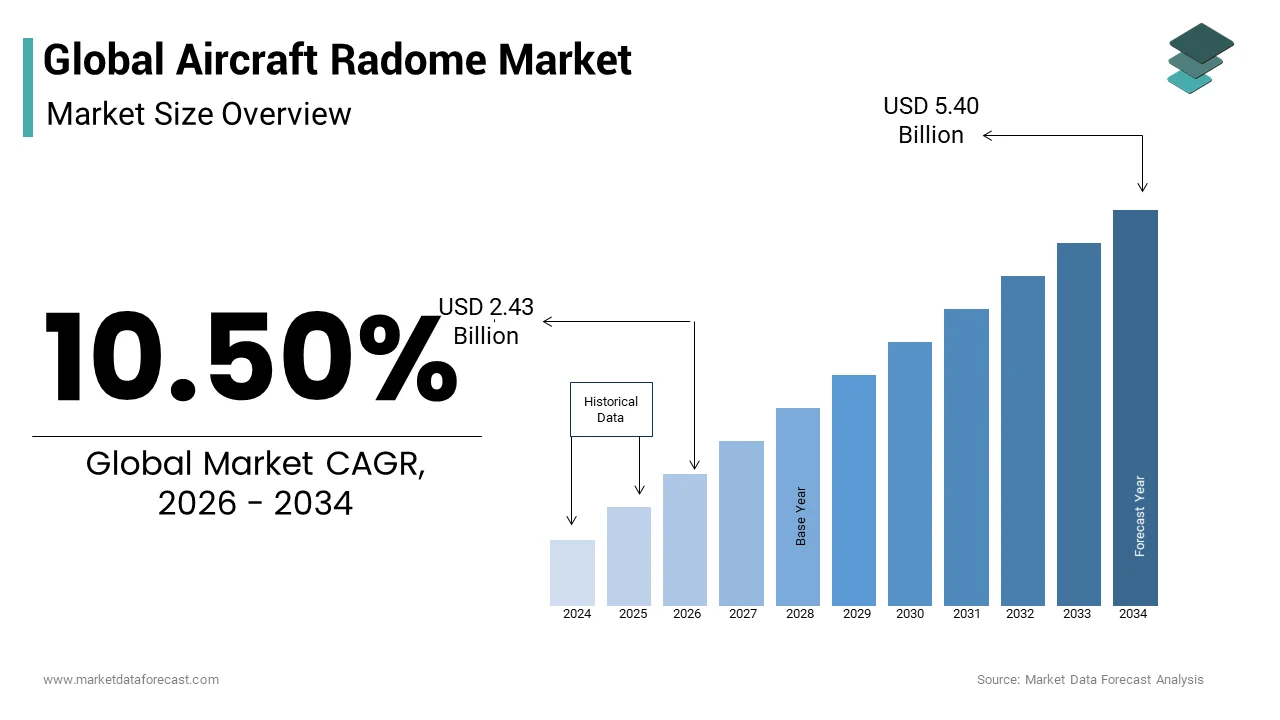
The global aircraft radome market size was valued at USD 2.20 billion in 2025 and is anticipated to reach USD 2.43 billion in 2026 to reach USD 5.40 billion by 2034, growing at a CAGR of 10.50% during the forecast period from 2026 to 2034.
The radome acts as a structural enclosure that protects the radar system. The nose cone of an airplane often acts as a radome that is made up of specific materials such as fiberglass, quartz, honeycomb, and foam cores, which can protect sensitive devices when passing electronic signals. It consists of materials that do not interfere with the transmission of electromagnetic signals. It is also naturally weather-resistant. The radome is used to transmit communications in airplanes efficiently.
MARKET DRIVERS
The Aircraft radome market is projected to grow significantly due to the different properties they offer. This radome integration improves system availability and performance since the antenna is not in direct contact with wind, rain, or ice.
In addition, the use of radomes for aircraft antennas keeps them protected while traveling, which helps in unobstructed communication, significantly reducing maintenance costs. Also, the radome's design is aesthetically pleasing and can be used to hide the equipment inside the dome effectively. These factors are driving the demand for radomes in the aerospace industry. The aircraft radome market is expected to grow as the demand for commercial and military aircraft worldwide increases.
Besides, commercial air travel is on the rise as disposable income increases worldwide. Developing countries such as India and China are investing in the defense sector to buy high-end military aircraft to secure airspace. This factor is also expected to activate the Aircraft radome market during the forecast period.
MARKET RESTRAINTS
However, certain limiting factors interfere to some extent with the demand for Aircraft radomes. The installed radome may malfunction, and dangerous communication may be interrupted during air travel. This factor can limit the expansion of radome during the forecast period. The market for the aircraft radome is affected by several factors, such as an increase in the demand for air travel and a rise in the need for quartz fibres.
REPORT COVERAGE
| REPORT METRIC | DETAILS |
| Market Size Available | 2025 to 2034 |
| Base Year | 2025 |
| Forecast Period | 2026 to 2034 |
| CAGR | 10.50% |
| Segments Covered | By Product Type, Aircraft Type, and Region |
| Various Analyses Covered | Global, Regional & Country Level Analysis, Segment-Level Analysis, DROC, PESTLE Analysis, Porter’s Five Forces Analysis, Competitive Landscape, Analyst Overview on Investment Opportunities |
| Regions Covered | North America, Europe, APAC, Latin America, Middle East & Africa |
| Market Leaders Profiled | Astronics Corporation, Saint-Gobain, Lufthansa Technik, Vermont Composites Inc., General Dynamics Mission Systems, Inc., Starwin Industries, Meggitt PLC, Jenoptik, FACC AG, Northrop Grumman Corporation, and Airbus SE are some of the major players in the aircraft radome market. |
SEGMENTAL ANALYSIS
By Product Insights
The nose radome is more effective because it protects the aircraft equipment directly from sources of interference from wind, snow, and rain at high speeds.
By Aircraft Insights
The commercial aircraft segment is predicted to experience the highest growth rate in the coming years, attributed to the increasing air traffic for logistics and other business purposes.
REGIONAL ANALYSIS
The recent economic recovery is expected to lead the aircraft radome market in North America and Europe. In addition, the trend of globalization and ecotourism is increasing the need to travel by plane. In return, the demand for commercial aircraft is being created. The increase in aircraft orders is directly driving the radome market. Besides, with the presence of developing countries such as India and China in the Asia-Pacific region, the demand for adomesme in this region is increasing as the commercial air travel market expands further.
KEY MARKET PLAYERS
These are some of the major players in the aircraft radome market. Lufthansa Technik has expanded its product offering and currently manufactures and develops radomes of all types and sizes for fuselage and tail-mounted connection systems.
- Astronics Corporation
- Saint-Gobain
- Lufthansa Technik
- Vermont Composites Inc.
- General Dynamics Mission Systems, Inc
- Starwin Industries
- Meggitt PLC
- Jenoptik
- FACC AG
- Northrop Grumman Corporation
- Airbus SE
RECENT MARKET NEWS
-
In 2019, China ordered 300 airplanes from Airbus. The contract is worth approximately $ 34 billion and consists of 290 A320 family aircraft and 10 A350 wide-body aircraft.
-
January 2019, announced plans to buy two Palcon aviation warning and control systems in India and Israel.
-
As of February 2019, the Boeing egrets were 5,904, and the Airbus egrets were 7,390.
MARKET SEGMENTATION
This research report on the global aircraft radome market has been segmented and sub-segmented into the following categories.
By Product Type
- Nose Radome
- SATCOM Radome
- Other Radomes
By Aircraft Type
- Commercial Aircraft
- Regional Aircraft
- General Aviation
- Helicopters
- Military Aircraft
By Region
- North America
- Europe
- Asia Pacifica
- Latin America
- Middle East and Africa
Frequently Asked Questions
Why is the aircraft radome market becoming increasingly important in modern aviation?
The market is growing due to rising aircraft deliveries, increasing demand for advanced radar systems, and the need for reliable protection of critical airborne communication and navigation equipment.
What is an aircraft radome and what role does it play in an aircraft?
An aircraft radome is a protective structural enclosure that shields radar, communication, and navigation antennas while allowing electromagnetic signals to pass through with minimal interference.
How does an aircraft radome improve flight safety and operational performance?
It protects sensitive avionics from weather, bird strikes, debris, and environmental conditions while ensuring uninterrupted radar and communication system performance.
Which aircraft segment generates the highest demand for radome systems?
Commercial aircraft account for a significant share of demand due to fleet expansion, increasing air passenger traffic, and continuous aircraft modernization programs.
What factors are driving growth in the aircraft radome market?
Growing investments in aviation infrastructure, military aircraft modernization, increasing adoption of advanced radar technologies, and rising aircraft production are key growth drivers.
Who are the primary customers in the aircraft radome market?
Commercial aircraft manufacturers, defense organizations, airlines, business jet operators, aerospace suppliers, and maintenance service providers are the primary customers.
What materials are commonly used in modern aircraft radome manufacturing?
Composite materials such as fiberglass, quartz fiber, aramid fiber, and advanced sandwich structures are widely used due to their lightweight and electromagnetic transparency properties.
How are technological advancements shaping the future of aircraft radomes?
The development of lightweight composites, advanced weather-resistant coatings, multifunctional radomes, and improved signal transmission technologies is shaping the future of the market.
What challenges could affect the growth of the aircraft radome market?
High manufacturing costs, stringent aerospace certification requirements, maintenance complexities, and supply chain disruptions could affect market growth.
Which regions are expected to lead the aircraft radome market?
North America remains a leading market due to strong aerospace manufacturing capabilities, while Europe and Asia Pacific are witnessing substantial growth through commercial aviation and defense investments.
Access the study in MULTIPLE FORMATS
Purchase options starting from
$ 2500
Didn’t find what you’re looking for?
TALK TO OUR ANALYST TEAM
Need something within your budget?
NO WORRIES! WE GOT YOU COVERED!
Call us on: +1 888 702 9696 (U.S Toll Free)
Write to us: sales@marketdataforecast.com