- Product Description Description
- Table of Contents TOC
- List of Table & Figure LOT
- Get Free Sample PDF Sample PDF
Market Size, 2025
$643.52 MnMarket Estimate, 2026
$995.65 MnMarket Forecast, 2034
$1297 MnCAGR, 2026–2034
8.1%Global Aircraft Seat Actuation System Market Size, Share, Trends & Forecast (2026–2034)
- Market Scope: Comprehensive global analysis covering specialized electromechanical and hydraulic actuation systems (linear actuators, motors, gearboxes, and control units) across mechanisms, seat classes, components, aircraft types, end users, and regions.
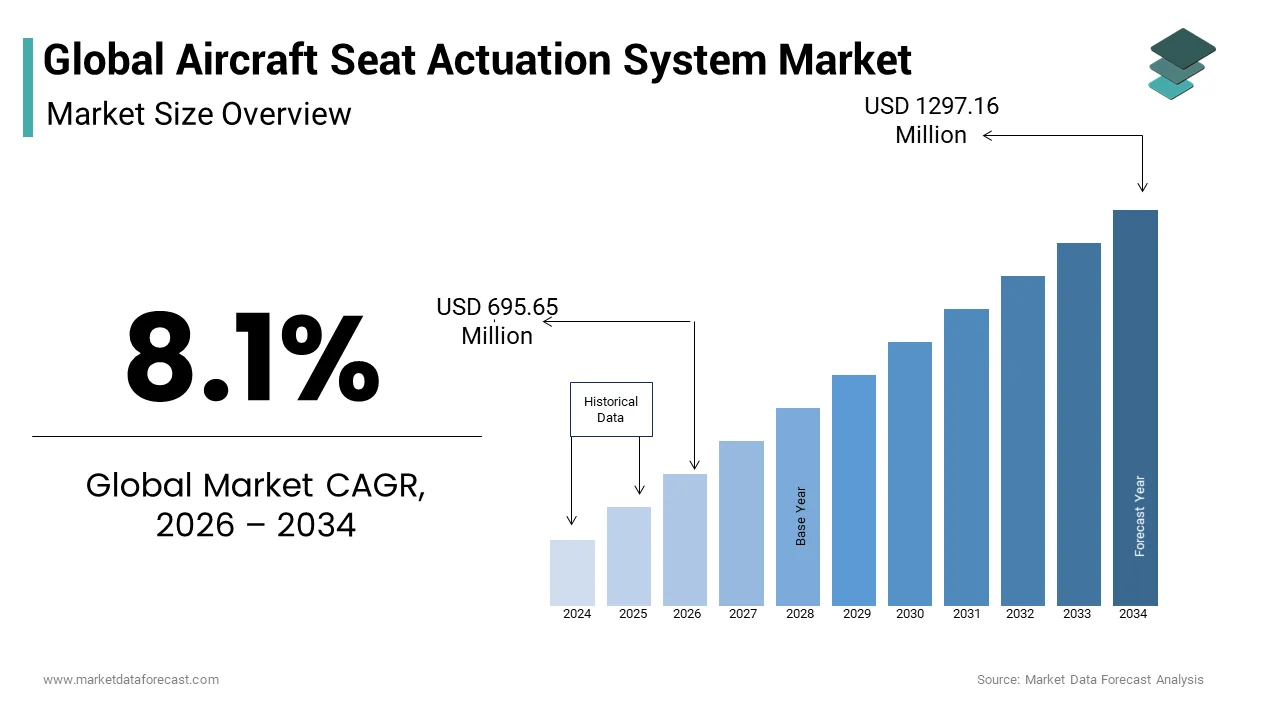
- Market Valuation: Valued at USD 643.52 million in 2025, anticipated to reach USD 995.65 million in 2026, and projected to expand up to USD 1,297.16 million by 2034, registering a robust CAGR of 8.1% from 2026 to 2034.
- Primary Growth Drivers: Rising demand for premium cabin configurations (lie-flat business class seats), stringent regulatory mandates for weight reduction and fuel efficiency, and the integration of smart actuators with IoT for predictive maintenance.
Global Aircraft Seat Actuation System Market Segment Metrics (2026–2034)
| Category | Leading Segment Focus | Growth / Trend Dynamic |
|---|---|---|
| By Mechanism | Linear Actuators | Accounted for the largest share in 2025 for basic recline/leg-rest functions; hybrid dual motion actuators are projected to record the highest CAGR of 8.4%. |
| By End User | Linefit Segment | Led market share in 2025 due to massive new aircraft deliveries; the retrofit segment is growing steadily at a CAGR of 6.5%. |
| By Region | North America | Held the largest market share in 2025 backed by extensive fleet renewals in the US; Asia Pacific is expanding rapidly, led by China. |
Major Market Players & Competitive Landscape
Market Structure: Highly consolidated market featuring established aerospace suppliers competing on weight reduction innovations, advanced material usage, smart IoT integration, and robust lifecycle support services.
Key Market Players: Safran SA, Collins Aerospace (RTX Corporation), Astronics Corporation, Crane Aerospace & Electronics, Moog Inc., Honeywell International Inc., B/E Aerospace, Meggitt Ltd., and Bühler Motor GmbH.
Global Aircraft Seat Actuation System Market Size
The global aircraft seat actuation system market size was valued at USD 643.52 million in 2025 and is anticipated to reach USD 995.65 million in 2026 to reach USD 1297.16 million by 2034, growing at a CAGR of 8.1% from 2026 to 2034.
Aircraft seat actuation systems are the specialized electromechanical and hydraulic components responsible for adjusting passenger and crew seating positions ensuring ergonomic comfort and safety during flight operations. These critical subsystems include linear actuators motors gearboxes and control units that facilitate recline leg rest extension lumbar support adjustment and full flat-bed conversion in premium cabins. The precision engineering of these mechanisms is paramount as they must operate reliably under extreme vibration temperature fluctuations and rigorous safety standards set by aviation authorities. According to the International Air Transport Association, global air passenger traffic reached 4.5 billion in 2024 reflecting a robust recovery that has intensified competition among airlines to differentiate their service offerings through enhanced cabin comfort. This surge in travel demand has accelerated the retrofitting of existing fleets and the procurement of new aircraft featuring advanced lie flat business class seats and modular economy configurations. The European Union Aviation Safety Agency mandates strict certification protocols for all moving parts within the cabin to prevent injury during turbulence or emergency evacuations. Furthermore the industry shift toward lightweight composite materials in actuator housings aims to reduce overall aircraft weight thereby improving fuel efficiency. As airlines prioritize passenger experience to command premium fares the integration of smart actuators with digital cabin management systems becomes increasingly prevalent transforming static seating into dynamic personalized environments.
MARKET DRIVERS
Rising Demand for Premium Cabin Configurations Drives Complex Actuation Requirements
The rising consumer preference for premium travel experiences has compelled airlines to invest heavily in business and first class cabins equipped with sophisticated lie flat seats that rely on advanced actuation systems, which is a key factor propelling the growth of the global aircraft seat actuation systems market. According to Boeing, the global wide body fleet is projected to increase to approximately 8,320 airplanes by the next two decades as long haul international travel recovers. Modern business class seats often utilize multi axis actuation mechanisms to transform from an upright dining position to a fully horizontal sleeping surface requiring precise synchronization of multiple motors and linear drives. These complex movements must be smoothing quiet and reliable to ensure passenger comfort and safety. The integration of memory functions allows passengers to save preferred positions further increasing the electronic complexity of the actuation units. Airlines view these premium amenities as essential for attracting high yield corporate travelers who prioritize rest and productivity during long flights. Consequently manufacturers are developing compact yet powerful actuators capable of handling higher loads while occupying minimal space beneath the seat structure. This trend toward luxurious and highly adjustable seating arrangements directly fuels the demand for high performance actuation systems that can deliver seamless motion control and enhanced durability in demanding operational environments.
Regulatory Mandates for Weight Reduction Enhance Adoption of Lightweight Actuators
Strict environmental regulations and the imperative to reduce operational costs are further fuelling the aircraft seat actuation systems market expansion. According to the International Civil Aviation Organization, the aviation sector has committed to achieving net zero carbon emissions by 2050 necessitating continuous improvements in fuel efficiency across all aircraft components. Every kilogram saved in cabin interiors contributes to lower fuel burn and reduced greenhouse gas emissions over the lifecycle of the aircraft. Traditional steel based actuators are being replaced by those utilizing titanium aluminum alloys and high strength polymers which offer comparable structural integrity at a fraction of the weight. Additionally the miniaturization of electric motors through the use of rare earth magnets allows for more compact and lighter actuation units without compromising torque output. Airlines are increasingly specifying weight savings as a key criterion in seat procurement contracts pushing suppliers to innovate in material science and design optimization. The cumulative effect of reducing the weight of hundreds of actuation systems across a large fleet results in significant annual fuel savings. This regulatory and economic pressure ensures that lightweight and efficient actuation technologies will remain a primary focus for manufacturers seeking to meet sustainability goals and improve airline profitability.
MARKET RESTRAINTS
High Certification and Testing Costs Restrict Market Entry for New Innovators
The aircraft seat actuation systems market faces significant restraints due to the exorbitant costs and lengthy timelines associated with obtaining regulatory certification for new components. According to the Federal Aviation Administration, every moving part in an aircraft cabin must undergo rigorous testing to demonstrate compliance with safety standards including crashworthiness flammability and electromagnetic compatibility. The certification process for a new actuation system can take several years and cost millions of dollars involving extensive laboratory tests and flight trials to prove reliability under all operating conditions. These high barriers to entry limit the number of qualified suppliers and discourage smaller innovative firms from entering the market. Furthermore any design change even if minor requires re certification which adds to the development burden and delays time to market. The complexity of integrating actuators with diverse seat designs from different original equipment manufacturers also necessitates customized testing protocols for each application. This financial and regulatory hurdle forces companies to rely on proven legacy designs rather than adopting cutting edge technologies that may offer superior performance but lack certified status. Consequently the market remains consolidated with a few dominant players who can absorb the high costs of compliance thereby limiting competition and slowing the pace of technological disruption in actuation systems.
Supply Chain Volatility for Rare Earth Materials Impacts Production Stability
The production of aircraft seat actuation systems is heavily dependent on rare earth elements used in high performance permanent magnet motors that are subject to significant supply chain volatility, which is further hampering the global market expansion. According to the United States Geological Survey, China controls approximately 60% of global rare earth mining and 85% of processing capacity creating a geopolitical risk for manufacturers reliant on these critical materials. Disruptions in the supply of neodymium and dysprosium can lead to sudden price spikes and prolonged lead times for electric motors essential for precise seat movement. The automotive and renewable energy sectors also compete for these same resources exacerbating scarcity and driving up costs for aerospace suppliers. Additionally the stringent quality requirements for aerospace grade magnets mean that alternative sources cannot be easily qualified without extensive testing and validation. This dependency on a concentrated supply base makes manufacturers vulnerable to trade restrictions export controls and logistical bottlenecks. To mitigate these risks companies are exploring alternative motor designs such as switched reluctance motors that do not require rare earth magnets but these alternatives often come with trade-offs in size efficiency or noise levels. The ongoing uncertainty in raw material availability remains a persistent challenge affecting production planning and cost stability in the aircraft seat actuation market.
MARKET OPPORTUNITIES
Integration of Smart Actuators with Internet of Things Platforms Creates Predictive Maintenance Opportunities
The emergence of smart actuators equipped with embedded sensors and connectivity features is a significant opportunity for the aircraft seat actuation systems market by enabling predictive maintenance and enhanced passenger personalization. For instance, over 60% of airlines are investing in Internet of Things technologies to improve operational efficiency and asset management. Smart actuators can monitor parameters such as motor temperature vibration levels and cycle counts transmitting real time data to maintenance crews via wireless networks. This capability allows airlines to identify potential failures before they occur reducing unscheduled downtime and minimizing the need for costly spare parts inventory. Furthermore these connected systems can integrate with passenger mobile applications allowing travelers to adjust their seat settings remotely before boarding or save preferences for future flights. The data collected from actuation usage patterns also provides valuable insights for seat designers to optimize ergonomics and durability based on actual customer behavior. Manufacturers who develop open architecture smart actuators can partner with software providers to create comprehensive cabin management ecosystems. This shift from passive mechanical components to intelligent connected devices opens new revenue streams through data services and subscription based maintenance models driving innovation and value creation in the market.
Expansion of Urban Air Mobility and Electric Vertical Takeoff and Landing Vehicles Opens New Application Segments
The urban air mobility market is likely to experience significant growth over the next few years as infrastructure and certification requirements are met. According to Morgan Stanley, the urban air mobility market is projected to reach 1 trillion US dollars by 2040 driven by the demand for short distance air taxi services in congested metropolitan areas. Unlike traditional commercial aircraft eVTOL vehicles have strict weight and space constraints necessitating highly integrated and minimalist actuation systems that maximize cabin utility. Seats in these vehicles often need to reconfigure quickly between passenger transport and cargo modes or fold away to optimize aerodynamics during flight. This requirement drives demand for novel actuation technologies such as shape memory alloys or soft robotics that offer high power density in small form factors. Additionally the electric nature of these vehicles aligns well with electric actuation systems eliminating the need for heavy hydraulic infrastructure. Manufacturers who adapt their expertise to meet the unique demands of this emerging sector can capture early market share and establish themselves as leaders in next generation aviation seating. The growth of urban air mobility thus represents a lucrative frontier for innovation in actuation technology beyond traditional commercial aviation.
MARKET CHALLENGES
Complexity of Integrating Actuators with Diverse Seat Designs Increases Engineering Burden
The aircraft seat actuation systems market faces significant challenges due to the increasing complexity of integrating standardized actuation components with highly customized and diverse seat designs from various original equipment manufacturers. Each airline has unique branding and ergonomic requirements leading to a wide variety of seat configurations that demand bespoke actuation solutions. As per standard industry practices, the lack of universal standards for seat interfaces means that actuator suppliers must engage in extensive collaborative engineering with seat makers to ensure proper fit and function. This customization process increases development time and costs as each new program requires unique mounting brackets wiring harnesses and control software. Furthermore the tight packaging constraints within modern slimline seats leave little room for error requiring precise spatial coordination between the actuator motor gearbox and seat structure. Any misalignment can lead to premature wear noise or failure compromising passenger comfort and safety. The need to support multiple generations of seat designs simultaneously further complicates inventory management and production planning for suppliers. This high level of customization limits economies of scale and places a significant engineering burden on manufacturers who must balance flexibility with efficiency in their production processes.
Cybersecurity Risks Associated with Connected Actuation Systems Threaten Operational Integrity
The increasing connectivity of smart aircraft seat actuation systems introduces new cybersecurity vulnerabilities that pose a significant challenge to market participants and airline operators. As actuators become part of the broader cabin Internet of Things network they potentially expose the aircraft internal systems to external cyber threats if not properly secured. According to the European Union Aviation Safety Agency, the integration of wireless communication protocols in cabin components requires robust encryption and authentication mechanisms to prevent unauthorized access and malicious control. A compromised actuation system could theoretically be used to disrupt passenger comfort cause distraction during critical flight phases or even interfere with other avionics systems through electromagnetic interference. Ensuring the cybersecurity of these embedded devices requires continuous software updates and vulnerability assessments which add to the operational complexity and cost for airlines. Furthermore the supply chain for electronic components in actuators must be vetted to prevent the insertion of hardware trojans or counterfeit parts. The lack of established cybersecurity standards specifically for cabin actuation systems creates uncertainty and liability concerns for manufacturers. Addressing these security risks requires significant investment in secure by design principles and collaboration with cybersecurity experts to protect the integrity of connected cabin infrastructure.
REPORT COVERAGE
| REPORT METRIC | DETAILS |
| Market Size Available | 2025 to 2034 |
| Base Year | 2025 |
| Forecast Period | 2026 to 2034 |
| CAGR | 8.1% |
| Segments Covered | By Type, Seat Class, Component, Aircraft Type, End U, ser, and Region |
| Various Analyses Covered | Global, Regional & Country Level Analysis, Segment-Level Analysis, DROC, PESTLE Analysis, Porter’s Five Forces Analysis, Competitive Landscape, Analyst Overview on Investment Opportunities |
| Regions Covered | North America, Europe, APAC, Latin America, Middle East & Africa |
| Market Leaders Profiled | Zodiac Aerospace, Crane Aerospace & Electronics, ITT Corporation, and Astronics Corporation |
SEGMENTAL ANALYSIS
By Mechanism Insights
The linear actuators segment accounted for the largest share of the aircraft seat actuation systems market in 2025. The dominance of linear actuators segment in the global market is primarily driven by their fundamental role in providing basic seat adjustments such as recline and leg rest extension in economy and premium economy cabins. According to the International Air Transport Association, the global passenger count is projected to reach 10 billion annually by 2040 which necessitates the mass production of affordable and reliable seating solutions. Linear actuators provide the straightforward vertical and horizontal movement required for these high density configurations. They are highly durable and require minimal maintenance which is critical for airlines operating multiple daily cycles. The simplicity of the linear motion design allows for rapid assembly on the production line reducing manufacturing costs for seat makers. Furthermore the mechanical reliability of these systems ensures that passengers experience consistent comfort without the risk of complex mechanical failures during flight. This widespread applicability across the vast majority of economy seats globally guarantees that linear actuators will maintain their position as the leading segment in the market.
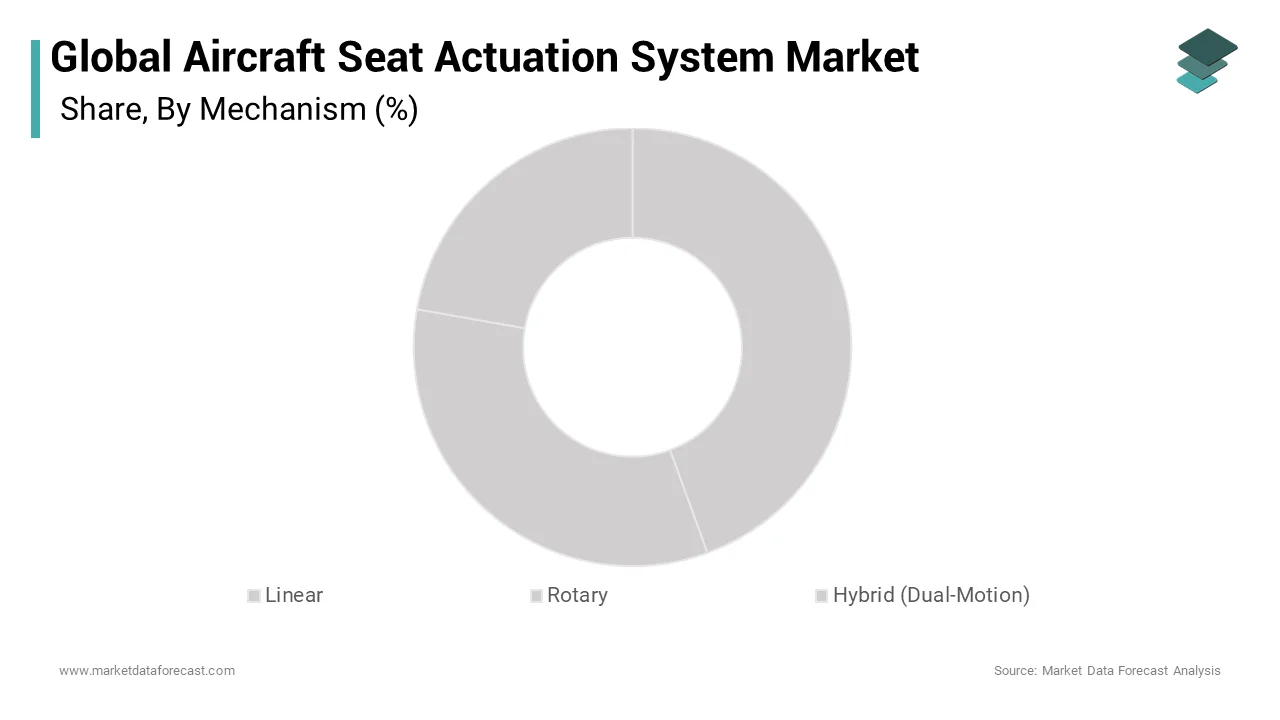
On the other side, the hybrid dual motion actuators segment is predicted to record a CAGR of 8.4% during the forecast period owing to the surging demand for premium business class lie flat seats. For instance, the global fleet of wide body aircraft is expected to grow significantly as long haul international travel fully recovers creating a massive market for high margin premium cabins. Modern business class seats require complex multi axis movements to transform from an upright dining position into a fully horizontal sleeping surface. Hybrid dual motion actuators seamlessly combine linear and rotary movements to achieve these sophisticated configurations while maintaining a compact footprint. This technological capability allows airlines to install fully flat beds in smaller spaces maximizing the number of premium seats per cabin. The premium fares generated by these lie flat seats provide a rapid return on investment for airlines justifying the higher initial cost of hybrid actuation systems. This lucrative economic model ensures that hybrid dual motion technology will experience the most rapid growth in the market.
By End User Insights
The linefit segment led the market by commanding for the major share of the global market in 2025. The growth of the linefit segment in the global market can be credited to the massive volume of new aircraft deliveries and the inherent advantages of factory installed seating systems. According to Boeing, the global commercial airplane fleet is projected to grow from approximately 26,000 units in 2023 to over 47,000 units by 2042 requiring millions of new seats to be installed directly on the production line. Linefit installations ensure that the seat actuation systems are perfectly integrated with the aircraft electrical and structural frameworks during the initial manufacturing phase. This seamless integration guarantees optimal weight distribution simplified wiring harness routing and immediate compliance with stringent airworthiness certifications. Airlines prefer linefit solutions because they eliminate the need for costly and time consuming aftermarket modifications allowing the aircraft to enter service immediately upon delivery. Furthermore original equipment manufacturers negotiate long term contracts with seat makers to secure favorable pricing and guaranteed delivery schedules. This massive and consistent production volume ensures that linefit will remain the dominant end user segment for aircraft seat actuation systems.
However, the retrofit segment is a promising segment and is anticipated to grow at a CAGR of 6.5% during the forecast period owing to the urgent need to modernize aging global fleets to remain competitive. According to Cirium, the average age of the global commercial aircraft fleet has gradually increased prompting airlines to invest heavily in cabin refurbishments to attract passengers and extend the operational life of their assets. Retrofitting existing aircraft with advanced seat actuation systems allows airlines to completely transform the passenger experience without the massive capital expenditure required to purchase new airplanes. Modern retrofit actuators are designed to be lightweight and compact enabling airlines to increase seat density or add premium cabins to older narrow body and wide body platforms. This cabin modernization directly translates into higher ticket revenues and improved brand perception. Furthermore the modular design of new actuation systems simplifies the installation process minimizing aircraft downtime during the retrofit phase. This compelling economic and operational value ensures that the retrofit segment will grow at the fastest pace in the coming years.
REGIONAL ANALYSIS
North America Market Analysis
North America had the largest share of the global aircraft seat actuation systems market in 2025. The United States is likely to maintain its leadership position in the North American aircraft seat actuation systems market for the next few years due to extensive fleet renewal programs. The United States occupies a dominant position in the North American aircraft seat actuation systems market. The market status is characterized by massive domestic fleet operations and the presence of leading seat manufacturing conglomerates. According to the Federal Aviation Administration, the United States possesses the largest commercial aviation network in the world handling over 900 million passengers annually. This immense volume necessitates the continuous procurement of durable and cost effective actuation systems for narrow body and wide body aircraft. The primary driving factor is the intense competition among legacy and low cost carriers to differentiate their premium cabin offerings driving demand for complex hybrid dual motion actuators. Furthermore the strong focus on fleet modernization and weight reduction aligns with strict environmental mandates accelerating the adoption of lightweight linear and hybrid systems. The robust supply chain and advanced engineering capabilities within the country ensure that the United States remains the undisputed leader in the North American market.
Europe Aircraft Market Analysis
Europe is another promising regional segment in the global market. France and Germany are expected to continue their dominance in the European market for the next few years as they spearhead cabin interior innovations. France and Germany serve as the central powerhouses of the European aircraft seat actuation systems market due to the presence of major airframe manufacturers and a strong emphasis on premium cabin innovation. According to industry benchmarks, the European aerospace ecosystem is a global leader in developing advanced business class and first class seating solutions that require highly sophisticated actuation mechanisms. The primary driving factor is the stringent regulatory environment regarding passenger safety and environmental sustainability which compels seat makers to integrate lightweight materials and energy efficient motors. Additionally the high concentration of long haul international flights originating from European hubs creates a strong demand for lie flat seats equipped with hybrid dual motion systems. The collaborative research initiatives between European universities and aerospace firms foster continuous technological advancements in actuator design. This combination of manufacturing excellence and premium market focus ensures that Europe remains a critical hub for high value seat actuation technologies.
Asia Pacific Market Analysis
The Asia Pacific is predicted to be the fastest growing regional segment in the global market during the forecast period. China is poised to become the fastest growing hub for aircraft seat actuation systems in the Asia Pacific region over the coming years as it expands its aviation infrastructure. China stands as the fastest growing and most influential market in the Asia Pacific aircraft seat actuation systems sector owing to the unprecedented fleet expansion and a rapidly expanding middle class with a strong preference for air travel. According to the Civil Aviation Administration of China, the nation plans to increase its number of civil airports to 450 by 2035 requiring thousands of new aircraft equipped with modern seating systems. The primary driving factor is the aggressive modernization of domestic airline cabins to meet international service standards driving massive demand for both linefit and retrofit actuation solutions. Furthermore the Chinese government is actively promoting the localization of aerospace supply chains encouraging domestic manufacturers to develop indigenous actuation technologies to reduce reliance on foreign imports. The sheer scale of aircraft deliveries and the rapid upgrade of cabin interiors ensure that China will continue to drive the growth and technological innovation of the market in the Asia Pacific region.
Latin America Market Analysis
Latin America is anticipated to account for a notable share of the global market over the forecast period. Brazil is likely to see steady growth in its aircraft seat actuation market over the next few years as it integrates newer aircraft into its regional fleets. Brazil maintains a commanding position in the Latin American aircraft seat actuation systems market due to the gradual fleet modernization and the integration of advanced systems onto newly acquired and refurbished platforms. According to Brazilian civil aviation authorities, the recent acquisition of new generation narrow body aircraft has necessitated the procurement of state of the art seating and actuation systems. The primary driving factor is the need to secure vast territorial borders and improve regional connectivity which requires durable and reliable actuation mechanisms capable of withstanding diverse operational environments. Additionally local aerospace industries are developing specialized retrofit solutions to extend the service life of older aircraft focusing on cost effective linear actuators that improve passenger comfort without excessive capital expenditure. The combination of new platform acquisitions and the urgent need to upgrade older aircraft ensures a steady demand for seat actuation equipment providing a stable foundation for market growth in Brazil and the broader region.
Middle East and Africa Market Analysis
The Middle East and Africa is expected to exhibit steady growth in the global market during the forecast period. The United Arab Emirates is expected to continue leading the Middle East and Africa market for the next few years by setting global standards for luxury cabin experiences. The United Arab Emirates acts as the primary catalyst for the Middle East and Africa aircraft seat actuation systems market and is renowned for its ultra premium aviation hubs and the highest concentration of luxury cabin configurations globally. According to the General Civil Aviation Authority, the United Arab Emirates is home to major international carriers that operate extensive fleets of wide body aircraft featuring fully enclosed suites and advanced lie flat beds. The primary driving factor is the relentless pursuit of ultimate passenger luxury which requires the most sophisticated hybrid dual motion actuators available in the market. These systems must operate with absolute silence and precision to maintain the premium experience expected by high net worth travelers. Furthermore the extreme ambient temperatures in the region necessitate the use of highly durable and heat resistant actuation components. The combination of massive traffic volumes extreme operating conditions and a focus on luxury ensures that the United Arab Emirates drives premium demand for advanced actuation systems.
COMPETITIVE LANDSCAPE
Competition in the aircraft seat actuation systems market is characterized by a consolidated landscape dominated by a few major aerospace suppliers with extensive technical expertise and established relationships with airframers. High barriers to entry due to stringent safety certifications complex engineering requirements and long qualification timelines protect incumbent players from new competitors. Leading companies differentiate themselves through superior weight reduction innovations advanced material usage and seamless integration with digital cabin management systems. Price competition is moderate as airlines prioritize reliability safety and passenger comfort over initial cost savings for critical seating components. However vendors compete aggressively on lifecycle support services customization capabilities and speed of delivery for both linefit and retrofit projects. The shift toward smart connected actuators creates new battlegrounds for innovation where software agility and data analytics become key differentiators. Strategic alliances with seat manufacturers and technology firms are frequently utilized to share development risks and access specialized expertise. Regional players focus on niche markets or specific national carriers while global leaders leverage their broad portfolios to secure large scale fleet contracts. Overall the market remains stable with continuous technological advancement and strong demand for premium cabin upgrades driving sustained competitive intensity among top tier manufacturers.
KEY MARKET PLAYERS
Some of the key players dominating the global aircraft seat actuation systems market are
- Safran SA
- Collins Aerospace (RTX Corporation)
- Astronics Corporation
- Crane Aerospace & Electronics (Crane Company)
- Moog Inc.
- Meggitt Ltd. (Parker-Hannifin Corporation)
- Antavia SAS (AMETEK Inc.)
- Bühler Motor GmbH
- CEF Industries, LLC
- SERMAT SAS
- Elektro-Metall Export GmbH
- Honeywell International Inc.
- ITT Enidine Inc.
- maxon international ag
- B/E Aerospace
- Rollon S.p.A. (Timken Company)
- Hical Technologies Private Limited
Top Players In the Market
- Safran Seats USA stands as a global leader in aircraft seating solutions providing advanced actuation systems for premium and economy cabins. The company specializes in lightweight linear actuators and hybrid dual motion mechanisms that ensure smooth and reliable seat adjustments. Recent strategic initiatives include the development of next generation smart actuators integrated with Internet of Things sensors for predictive maintenance capabilities. Safran actively collaborates with major airframers to design customized seating architectures that optimize cabin space and passenger comfort. Their commitment to sustainability is evident in the use of recyclable materials and energy efficient motors. By focusing on innovation and ergonomic excellence Safran continues to set industry standards for safety and reliability in aircraft interior components globally.
- Collins Aerospace contributes significantly to the market through its comprehensive portfolio of electromechanical actuation systems designed for diverse aircraft platforms. The company leverages extensive engineering expertise to deliver robust and compact actuators that meet stringent weight and safety requirements. Recent actions to strengthen its position involve expanding production capacities for high torque motors used in lie flat business class seats. Collins Aerospace also invests heavily in research and development to create modular actuation units that simplify installation and reduce maintenance downtime. The company focuses on integrating digital control interfaces that allow seamless connectivity with cabin management systems. Through continuous technological advancement and customer centric design Collins Aerospace maintains a strong reputation for delivering high performance seating solutions worldwide.
- B/E Aerospace plays a pivotal role in the global market by supplying precision engineered actuation components for commercial and business aviation sectors. The company specializes in durable linear drives and rotary mechanisms that provide precise control over seat recline and leg rest positions. Recent efforts to bolster its market presence include launching a new line of ultra lightweight actuators made from advanced composite materials to support fuel efficiency goals. B/E Aerospace actively partners with seat manufacturers to develop bespoke solutions that enhance passenger experience while minimizing structural weight. The company emphasizes rigorous quality control and compliance with international aviation standards. By prioritizing product reliability and operational efficiency B/E Aerospace delivers critical seating technologies that support the evolving needs of modern airline fleets across the globe.
Top Strategies Used by the Key Market Participants
Key players in the aircraft seat actuation systems market prioritize research and development to create lightweight and energy efficient actuators that reduce overall aircraft weight and fuel consumption. Strategic partnerships with original equipment manufacturers enable companies to integrate actuation systems directly into new seat designs ensuring optimal performance and reduced integration costs. Expansion into the retrofit market allows participants to capture growth opportunities from airlines modernizing aging fleets with advanced comfort features. Investment in smart technologies such as Internet of Things connectivity and predictive maintenance software enhances system reliability and reduces operational downtime. Focus on sustainable manufacturing practices and recyclable materials addresses environmental regulations and meets the green goals of the aviation industry globally.
MARKET SEGMENTATION
This research report on the global aircraft seat actuation systems market is segmented and sub-segmented into the following categories.
By Mechanism
- Linear
- Rotary
- Hybrid (Dual-Motion)
By Aircraft Type
- Narrowbody Aircraft
- Widebody Aircraft
- Regional Transport Aircraft
- Helicopters
By Seat Class
- First
- Business
- Premium Economy
- Economy
By End User
- OEM Line-fit
- Retrofit/Aftermarket
By Component
- Actuator Motor
- Gearbox and Screw Assembly
- Control Electronics (PCU)
- Harness and Sensors
By Region
- North America
- Europe
- Asia Pacific
- Latin America
- Middle East & Africa