- Product Description Description
- Table of Contents TOC
- List of Table & Figure LOT
- Get Free Sample PDF Sample PDF
Market Size, 2025
$588.67 BnMarket Estimate, 2026
$607.92 BnMarket Forecast, 2034
$786.39 BnCAGR, 2026–2034
3.27%Global Airlines Market Summary
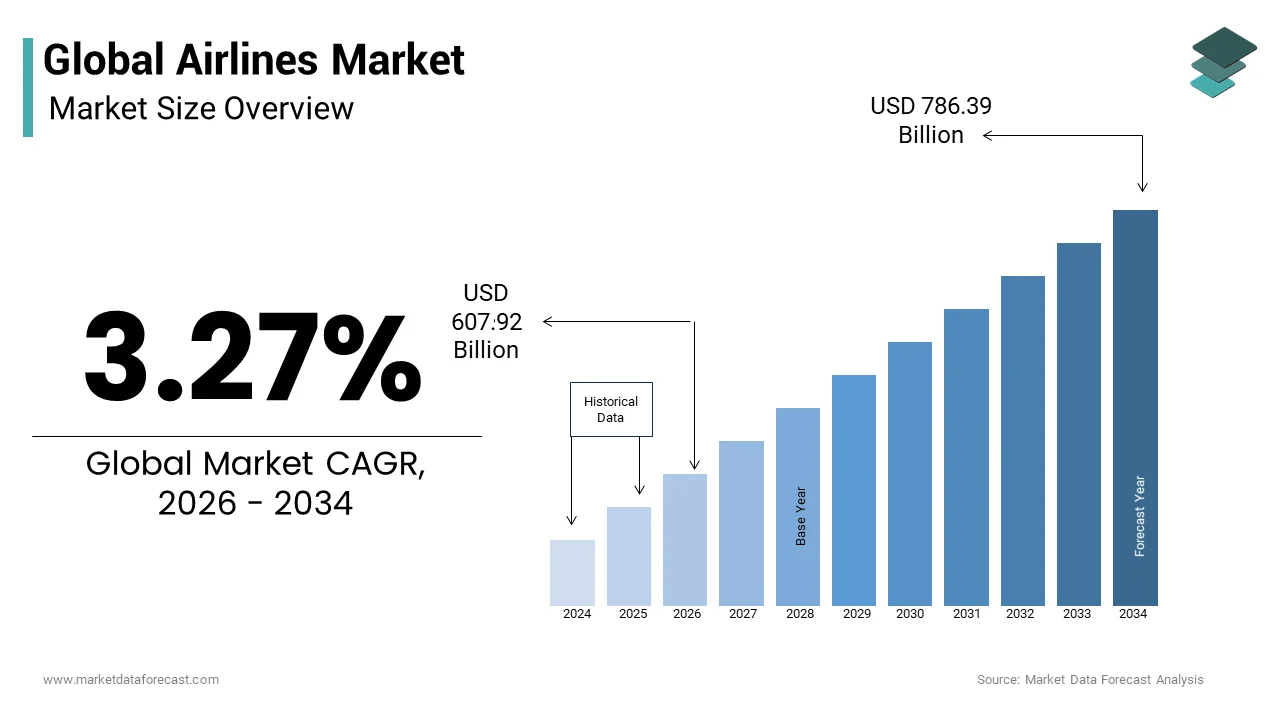
The global airlines market size was valued at USD 588.67 billion in 2025, projected to reach USD 607.92 billion in 2026, and USD 786.39 billion by 2034, growing at a CAGR of 3.27% from 2026 to 2034. Market growth is driven by increasing air travel demand, expanding domestic and international passenger traffic, and ongoing investments in modern aircraft and airline infrastructure. Recovery in the post-pandemic travel sector and rising disposable incomes are further fueling market expansion.
Key Market Trends
- Rising domestic and international passenger air traffic
- Increasing adoption of fuel-efficient and technologically advanced aircraft
- Expansion of airline networks and low-cost carrier services
- Growth in business and leisure travelis supporting airline revenue
Segmental Insights
- Based on transport, the domestic transport segment dominated in 2024, capturing 62.8% share, driven by rising intra-country travel and affordable airfares.
- Based on application, the passenger segment led the market in 2024, reflecting strong demand for both business and leisure travel.
Regional Insights
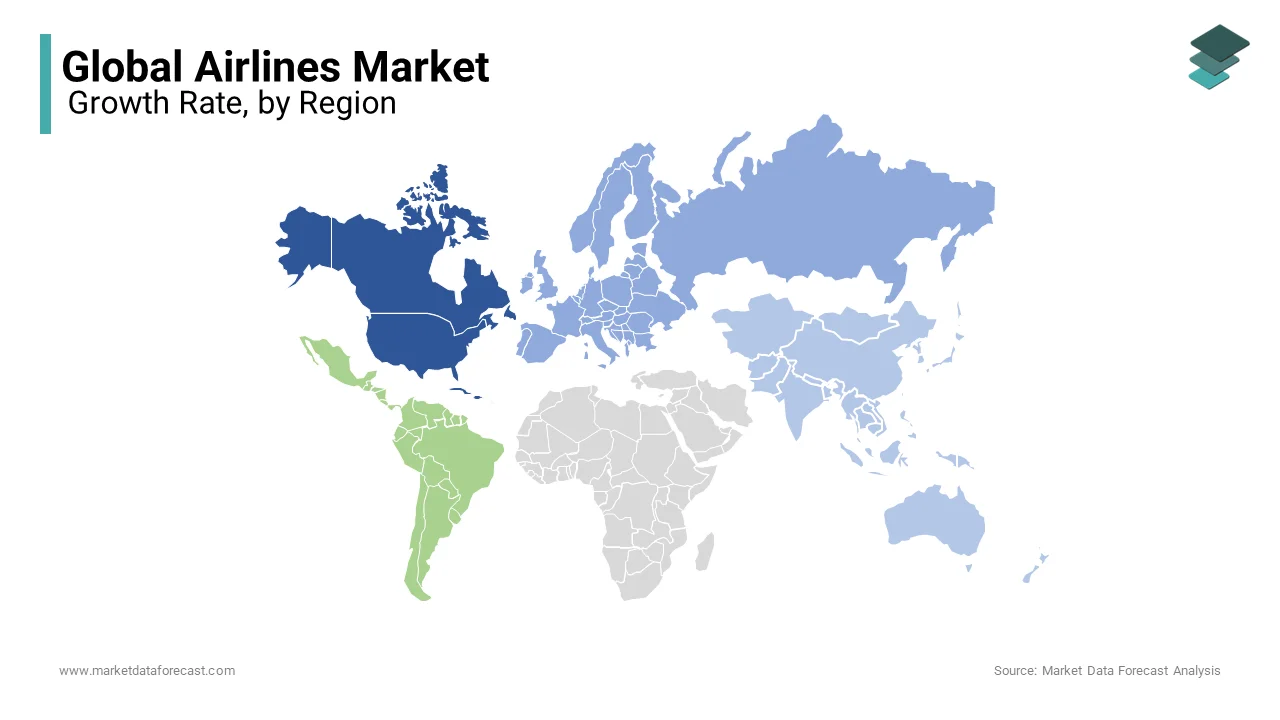
- North America was the top performer in 2024 with a 32% share, supported by high air travel demand, advanced airline infrastructure, and a strong network of domestic and international flights.
- Asia-Pacific is expected to grow rapidly due to an increasing middle-class population, urbanization, and tourism growth.
- Europe focuses on high operational efficiency, sustainable aviation fuels, and the expansion of low-cost carriers.
- Latin America is emerging as a growing market, supported by increased domestic connectivity and airline modernization initiatives.
- Middle East & Africa are gradually expanding air travel networks, driven by tourism growth, airport development, and strategic airline hubs.
Competitive Landscape
Leading players in the global airlines market include Air France KLM, American Airlines Group, ANA Holdings, British Airways, Delta Air Lines, Deutsche Lufthansa, Hainan Airlines, Japan Airlines, LATAM Airlines Group, and Qantas Airways. These companies are focusing on fleet modernization, expanding route networks, digitalization of operations, and strategic partnerships to strengthen their market position
Global Airlines Market Size
The global airlines market size was valued at USD 588.67 billion in 2025 and is anticipated to reach USD 607.92 billion in 2026 and USD 786.39 billion by 2034, growing at a CAGR of 3.27% during the forecast period from 2026 to 2034.
Airlines are commercial air transport services dedicated to passenger and cargo movement across international, regional, and domestic routes. It is known for high capital intensity and operational complexity; the sector functions as an important artery of global connectivity and economic integration. As per the Airports Council International (ACI), 8.7 billion passenger movements in 2023, which is often used in broader mobility analysis. Air transport contributes directly to global GDP while enabling an additional share through its broader economic linkages, according to a study. The industry operates within a tightly regulated environment shaped by safety, environmental, and geopolitical considerations. Fleet modernization, route expansion, and digital integration have become central to competitive positioning, with airlines increasingly aligning operations to sustainability mandates and shifting consumer expectations.
MARKET DRIVERS
Rising Global Travel Demand Driven by Expanding Middle-Class Populations
The increasing demand for travel, along with the rising population of the middle class, is driving the growth of the airline market. The global middle-class population surged in recent years, with a notable share of this growth originating in developing economies over the past decade. In India, the middle-class segment is projected to surge notably by 2030, fueling a surge in domestic and international air travel. The International Air Transport Association (IATA) forecasts that by 2041, a notable share of new air passengers will originate from Asia-Pacific. Low-cost carriers have capitalized on this trend by expanding regional connectivity and offering affordable fares. For instance, IndiGo carried millions of passengers in 2023, emphasizing the demand elasticity in price-sensitive markets.
Surge in International Tourism and Cross-Border Mobility
The reemergence of international tourism is additionally propelling the growth of the airline market. According to the United Nations World Tourism Organization (UNWTO), global international tourist arrivals reached 1.3 billion in 2023, recovering to 88% of pre-pandemic levels. Europe and the Middle East led this rebound, with destinations like Spain and the United Arab Emirates reporting record inbound figures. The UAE welcomedar large number of international visitors in the first half of 2023, an increase year-on-year, as per research. Airlines have responded with aggressive route reinstatements and capacity additions. Like Emirates, for example, restored services to several destinations by mid-2023. Apart from these, the easing of visa regulations in countries such as Saudi Arabia and Indonesia has further amplified long-haul demand.
MARKET RESTRAINTS
Volatility in Aviation Fuel Prices and Supply Chain Dependencies
Fluctuations in aviation fuel prices due to problems in logistics and distribution are restricting the growth of the airline market. Jet fuel constitutes a notable share of an airline’s operating expenses, which makes it one of the most sensitive cost components. As per IATA, the global aviation industry spent a substantial amount on jet fuel in 2022, an increase from the previous year due to geopolitical disruptions and supply constraints. The Russia-Ukraine conflict significantly impacted refining capacity and distribution logistics, which resulted in regional fuel shortages in Eastern Europe. In 2023, Singapore’s aviation fuel prices surged per tonne, a level that strained regional carriers’ profitability. Furthermore, airlines face limited hedging options and long lead times in fuel procurement, leaving them vulnerable to sudden price spikes. These fluctuations directly influence route viability, particularly on thin long-haul routes, and often result in capacity rationalization or fare increases that dampen consumer demand.
Stringent Environmental Regulations and Carbon Emission Pressures
Tightening environmental regulations aimed at curbing carbon emissions is restraining the growth of the airline market. As per the study, international aviation contributed to global CO₂ emissions in 2022, prompting aggressive policy responses. The European Union’s inclusion of aviation in its Emissions Trading System (EU ETS) requires airlines to surrender allowances for every tonne of CO₂ emitted, with compliance costs increasing for EU-based carriers, according to research. In addition, the Carbon Offsetting and Reduction Scheme for International Aviation (CORSIA) requires carbon-neutral growth from 2020 levels, affecting participating nations. Airlines must invest in sustainable aviation fuels (SAF), which currently supply a smaller share of total fuel consumption, as per a study. These regulatory burdens increase operational costs and necessitate fleet modernization by posing financial challenges, especially for smaller operators.
MARKET OPPORTUNITIES
Expansion of Low-Cost Carriers in Emerging Markets
The proliferation of low-cost carriers (LCCs) in emerging economies offers a growth opportunity for the airline market. As per CAPA – Centre for Aviation, Asia-Pacific hosts several LCCs, accounting for a portion of regional passenger traffic in 2023. In Southeast Asia, countries like Indonesia and the Philippines have witnessed an annual growth in domestic air travel, driven by carriers such as AirAsia and Cebu Pacific. India’s LCC segment captured a notable share of the domestic landscape in 2023, with IndiGo and Akasa Air expanding fleets to meet rising demand. The affordability and operational efficiency of LCCs have unlocked air travel for first-time flyers, particularly in tier-2 and tier-3 cities. Moreover, regulatory liberalization, such as the ASEAN Open Skies policy, has enabled cross-border expansion.
Adoption of Digital Transformation and Personalized Passenger Experiences
The digital innovation is posing new opportunities for the growth of the airline market. Many airlines are investing in biometric boarding systems, with some major airports globally deploying facial recognition technology. Delta Air Lines saw a reduction in boarding time after implementing biometric gates in airports. Besides, artificial intelligence-driven personalization is enhancing ancillary revenue. Also, Lufthansa noted an increase in ancillary sales through tailored in-flight offers based on passenger data analytics. Mobile app engagement has surged, with Qantas saying the number of active monthly users on its digital platform has surged. Blockchain is being piloted for secure credential management, while predictive maintenance systems are reducing aircraft downtime. These digital advancements not only improve operational resilience but also elevate customer loyalty and lifetime value in an increasingly competitive landscape.
MARKET CHALLENGES
Workforce Shortages and Operational Readiness Gaps
The shortage of skilled aviation professionals continues to threaten the operational stability, and the rise is certainly a key factor that is impeding the growth of the airline market. As per the International Air Transport Association (IATA), the global aviation sector will require a notable number of new pilots, cabin crew, and maintenance technicians over the next two decades. In addition, the United States reported a deficit of pilots, with regional airlines particularly affected, according to research. Training pipelines have not kept pace with demand, which is exacerbated by pandemic-era furloughs and early retirements. Similarly, aircraft maintenance backlogs have grown. These workforce gaps lead to flight cancellations, reduced scheduling reliability, and increased labor costs,s which affect consumer confidence and airline profitability in a recovery phase.
Geopolitical Instability and Airspace Restrictions
The geopolitical conflicts are increasingly disrupting global flight operations and network planning, which is a challenge for the global airline market. Also, a portion of potential long-haul routes between Europe and Asia were rerouted due to airspace closures over Ukraine, Russia, and Belarus, according to research. These detours add significant flight times and fuel consumption. For example, flights from London to Tokyo average additional flying hours and increased operational costs per flight, as per the study. The Red Sea crisis forced major carriers to suspend flights to the Middle East, diverting traffic via southern Africa and extending journey durations. Airlines must now incorporate geopolitical risk assessments into strategic planning, investing in real-time monitoring systems and flexible routing protocols to maintain service continuity.
REPORT COVERAGE
| REPORT METRIC | DETAILS |
| Market Size Available | 2025 to 2034 |
| Base Year | 2025 |
| Forecast Period | 2026 to 2034 |
| CAGR | 3.27% |
| Segments Covered | By Transport, Application, and Region |
| Various Analyses Covered | Global, Regional, and Country Level Analysis; Segment-Level Analysis; DROC; PESTLE Analysis; Porter’s Five Forces Analysis; Competitive Landscape; Analyst Overview of Investment Opportunities |
| Regions Covered | North America, Europe, APAC, Latin America, Middle East & Africa |
| Market Leaders Profiled | Air France KLM, American Airlines Group, ANA Holdings, British Airways, Delta Air Lines, Deutsche Lufthansa, Hainan Airlines, Japan Airlines, LATAM Airlines Group, Qantas Airways. |
SEGMENTAL ANALYSIS
By Transport Insights
The domestic transport segment dominated the airlines market by capturing 62.8% of the global market share in 2025. The growth of the domestic transport segment is primarily driven by high-frequency short-haul travel, deeply integrated regional economies, and the proliferation of low-cost carriers (LCCs) that have democratized air travel. In the United States, domestic flights represented a substantial number of passengers, making it the world’s largest domestic aviation market, according to research. The accessibility of air travel in vast countries like China and India has further amplified domestic demand, with China’s domestic passenger volume surging, as per the research.
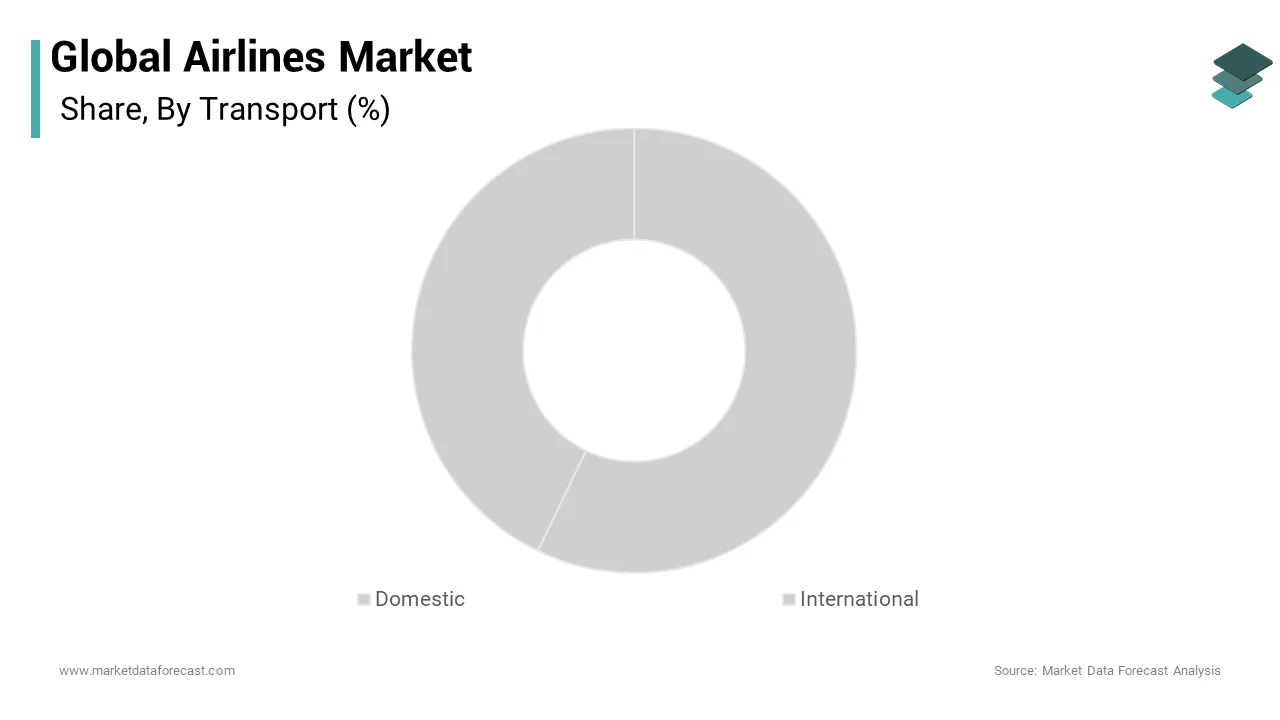
The international transport segment is estimated to register the fastest CAGR of 9.4% over the forecast period, owing to the resurgence of global tourism and the reestablishment of long-haul connectivity after pandemic-related disruptions. In 2023, international passenger traffic recovered a portion of 2019 levels, reaching substantial numbers of travelers as per the study. Also, key growth corridors, such as Asia to Europe and the Middle East to North America, are witnessing capacity expansions, with Emirates operating many of its pre-pandemic international network by mid-2023. Moreover, visa liberalization initiatives, such as Saudi Arabia’s introduction of e-visas for 50 countries, have broadened travel access.
By Application Insights
The passenger segment led the airlines market by capturing a significant share of the global market in 2025. The growth of the passenger segment is driven by the sheer volume of air travelers and the extensive infrastructure dedicated to commercial passenger operations. In 2023, global airlines carried a substantial volume of passengers, an increase from the previous year, according to the study. The growth of this segment is also driven by densely populated regions such as South Asia and Southeast Asia, where middle-class expansion has led to a surge in first-time flyers. India’s domestic passenger traffic alone crossed a significant mark in 2023, as per research, driven by affordable fares and route expansion by carriers like IndiGo and Akasa Air.
The freight segment is predicted to witness the highest CAGR of 8.7% from 2025 to 2033 due to the exponential rise in e-commerce and the need for time-sensitive logistics, particularly for pharmaceuticals, electronics, and perishables. Global air cargo volumes reached significant metric tons, with e-commerce accounting for a portion of this demand, as per the study. The pandemic accelerated the shift toward digital retail, with Amazon and Alibaba increasing their reliance on air freight for cross-border deliveries. Moreover, dedicated cargo carriers like FedEx and Cargolux have expanded fleet capacity, while passenger airlines are optimizing belly-hold utilization on long-haul routes. The International Air Cargo Association (TIACA) shows that Asia-Pacific handles a portion of global air freight, driven by manufacturing hubs, which strengthens the segment’s momentum.
REGIONAL ANALYSIS
North America Market Analysis
North America was the top performer in the global airlines market in 2024 and accounted for 32% of the global market share in 2025. The domination of North America in the global market is primarily driven by the United States, which operates the world’s largest and most technologically advanced aviation network. U.S. airlines handled millions of passengers in 2023, as per the research, supported by a robust hub-and-spoke system and high aircraft utilization rates. Major carriers such as Delta, American, and United have invested heavily in fleet modernization and digital infrastructure, enhancing operational efficiency. Apart from these, the Federal Aviation Administration (FAA) forecasts an annual growth in air traffic through 2035, driven by sustained domestic demand and transatlantic connectivity. The presence of leading aerospace manufacturers and MRO (maintenance, repair, and overhaul) facilities further strengthens the region’s competitive edge by ensuring long-term resilience and innovation in air transport operations.
Europe Market Analysis
Europe is the second-largest in the airline market and accounted for 28.1% of the global market share in 2024. The growth of Europe in the global market is driven by a dense network of short- to medium-haul routes, high passenger mobility, and a mature regulatory framework that supports competition and safety. In addition, European airlines transported a large number of passengers, including both intra-regional and international travelers, according to a study. The success of low-cost carriers such as Ryanair and Wizz Air, which collectively carried millions of passengers, has significantly expanded access to air travel.
Asia Pacific Market Analysis
Asia Pacific is expected to be the most lucrative region in the global airlines market and is predicted to expand at the fastest rate during the forecast period. China, India, and Southeast Asian nations are driving expansion through rapid urbanization, rising disposable incomes, and government-backed aviation infrastructure projects. In addition, China’s civil aviation sector transported millions of passengers, nearing full recovery from pandemic lows, as per the study. India’s aviation market is projected to expand in the coming years, with passenger traffic growing annually, according to research.
Latin America Market Analysis
Latin America grew steadily in the global airlines market, yet exhibits steady growth potential, as noted by IATA in its 2023 regional outlook. Brazil stands as the regional leader, contributing a notable share of Latin America’s air traffic, with domestic passenger numbers surging, according to a study. The expansion of low-cost carriers like GOL and Volaris has increased affordability and route coverage across fragmented geographies. Apart from these, the region’s integration into global trade networks has boosted air cargo demand, particularly for perishable exports such as flowers, fruits, and seafood from Colombia and Ecuador. According to research, international passenger traffic grew in 2023 compared to the previous year.
Middle East And Africa Market Analysis
The Middle East & Africa are likely to grow steadily in the global airlines market during the forecast period, with the Gulf Cooperation Council (GCC) nations driving the majority of activity, as per data from the Arab Air Carriers Organization (AACO). The UAE and Qatar serve as pivotal global transit hubs, with Emirates, Etihad, and Qatar Airways operating extensive long-haul networks connecting Asia, Europe, and Africa. In addition, Dubai International Airport handled millions of passengers. The region’s strategic geography enables efficient east-west connectivity, attracting high volumes of transfer traffic. In addition, Saudi Arabia’s Vision 2030 initiative includes a significant investment in aviation infrastructure, aiming to increase annual passenger capacity. Africa is facing challenges in connectivity and fleet modernization.
COMPETITIVE LANDSCAPE
The airline market is characterized by intense competition shaped by geopolitical, economic, and technological forces. Full-service carriers compete with low-cost airlines on price, frequency, and route coverage, particularly in high-density regions like the Asia Pacific. Incumbents face pressure from new entrants and digital-native operators leveraging lean cost structures and agile operations. Differentiation is achieved through service quality, loyalty programs, and seamless digital experiences. Hub-based carriers such as Emirates and Singapore Airlines dominate long-haul transit traffic, while point-to-point LCCs like AirAsia and IndiGo control significant domestic shares. Sustainability commitments and fuel efficiency are emerging as competitive differentiators. Airlines are also competing for skilled labor, airport slots, and regulatory approvals, with consolidation and partnerships becoming essential to maintain scale and resilience in a capital-intensive, margin-sensitive industry.
KEY MARKET PLAYERS
These are the major market players in the global airline market
- Air France KLM
- American Airlines Group
- Cathay Pacific Airways
- Singapore Airlines
- ANA Holdings
- British Airways
- Delta Air Lines
- Deutsche Lufthansa
- Hainan Airlines
- Japan Airlines
- LATAM Airlines Group
- Qantas Airways
Top Players In The Market
- Qantas Airways, Australia’s national carrier, plays a pivotal role in shaping air connectivity across the Asia Pacific region. The airline has strengthened its regional footprint through strategic alliances with Japan Airlines, China Eastern, and Emirates by enhancing network reach across key Asian markets. The carrier has also invested in digital transformation, introducing biometric boarding and AI-driven customer service tools. Qantas expanded its loyalty program, offering enhanced redemption options across Asia, increasing customer retention. Sustainability initiatives, including a commitment to net-zero emissions by 2050 and trials of sustainable aviation fuel (SAF) on domestic routes, place Qantas as a forward-thinking operator in the region’s evolving aviation landscape.
- Singapore Airlines maintains a dominant presence in the Asia Pacific market through its reputation for service excellence and operational efficiency. The airline leverages Singapore’s strategic location as a global aviation hub to connect major cities across Asia, Europe, and Oceania. The carrier launched enhanced premium economy offerings and upgraded in-flight entertainment systems to elevate passenger experience. Singapore Airlines also deepened its partnership with regional affiliates by enabling cost-efficient coverage of secondary markets. The airline has been a pioneer in adopting sustainable aviation fuel, operating one of the world’s first commercial SAF-powered flights between Singapore and Melbourne. Its investment in digital platforms, including a revamped mobile app with real-time flight updates, strengthens customer engagement across the region.
- Cathay Pacific Airways serves as a key air gateway for Greater China and Southeast Asia, operating from its Hong Kong hub. Cathay Pacific Airways successfully worked to rebuild its flight capacity in 2023. It achieved its target of reaching 70% of its pre-pandemic passenger flight capacity by the end of 2023, serving about 80 destinations in total. The airline focused on rebuilding its network to key markets, including Japan, Thailand, and the UK, and was on track to restore full capacity by the end of 2024. Cathay Pacific has been systematically enhancing its digital platform to improve the customer journey, rather than launching a single new platform.
Top Strategies Used By Key Market Participants
Key players in the airline market are deploying multifaceted strategies to enhance competitiveness and adapt to evolving market dynamics. Fleet modernization is a dominant approach, with carriers investing in fuel-efficient aircraft such as the Airbus A350 and Boeing 787 to reduce operating costs and emissions. Airlines are expanding route networks, particularly in high-growth Asia-Pacific corridors, to capture rising travel demand. Strategic alliances and codeshare agreements with regional and global carriers are being leveraged to extend network reach without proportional capital investment. Digital transformation initiatives, including biometric boarding, AI-driven customer service, and mobile app enhancements, are improving operational efficiency and passenger experience. Sustainability is increasingly central, with airlines investing in sustainable aviation fuel, carbon offset programs, and eco-efficient ground operations. In addition, low-cost subsidiaries are being utilized to penetrate price-sensitive markets while protecting full-service brand integrity.
RECENT MARKET NEWS
- In January 2023, Singapore Airlines launched a new premium economy cabin on its long-haul fleet, enhancing passenger comfort and increasing yield potential on high-demand routes across Europe and North America.
- In March 2023, Qantas Airways announced a partnership with Boeing to develop Australia’s first sustainable aviation fuel refinery, aiming to produce 100 million liters annually by 2026 to reduce carbon emissions.
- In June 2023, Cathay Pacific Airways reintroduced non-stop flights to London Heathrow from Hong Kong using the fuel-efficient Airbus A350-1000, restoring one of its flagship long-haul services.
- In September 2023, Japan Airlines expanded its codeshare agreement with American Airlines to include 25 new routes across Asia and the United States, strengthening trans-Pacific connectivity.
- In February 2024, Air India signed a firm order for 250 aircraft from Airbus, Boeing, and Rolls-Royce, marking one of the largest fleet modernization deals in aviation history to revamp its international and domestic operations.
MARKET SEGMENTATION
This research report on the global airlines market is segmented and sub-segmented into the following categories.
By Transport
- Domestic
- International
By Application
- Passenger
- Freight
By Country
- North America
- Europe
- Asia-Pacific
- Latin America
- Middle East and Africa