- Product Description Description
- Table of Contents TOC
- List of Table & Figure LOT
- Get Free Sample PDF Sample PDF
Market Size, 2025
$5.43 BnMarket Estimate, 2026
$5.78 BnMarket Forecast, 2034
$9.50 BnCAGR, 2026–2034
6.41%Global Airport Stands Equipment Market Report Summary
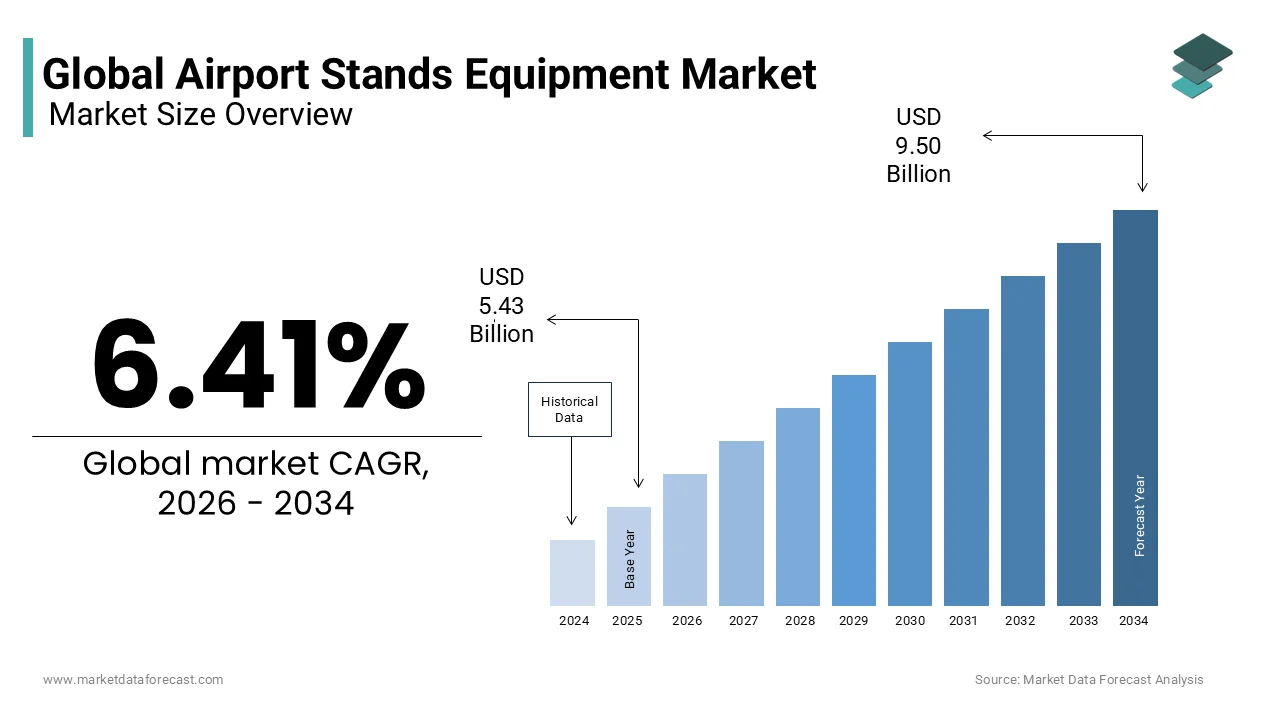
The global airport stands equipment market was valued at USD 5.43 billion in 2025, is estimated to reach USD 5.78 billion in 2026, and is projected to reach USD 9.50 billion by 2034, growing at a CAGR of 6.41% during the forecast period from 2026 to 2034. The growth of the global airport stands equipment market is driven by increasing air passenger traffic, expansion of airport infrastructure, and rising investments in airport modernization projects. Growing demand for efficient ground handling operations, enhanced aircraft turnaround efficiency, and advanced passenger boarding systems is further supporting market growth. Additionally, the adoption of automated and energy-efficient airport stand equipment, coupled with the expansion of commercial aviation fleets, is contributing to the market's steady expansion.
Key Market Trends
-
Rising global air passenger traffic is driving investments in airport expansion and modernization projects.
-
Increasing demand for automated and smart ground support equipment is improving airport operational efficiency.
-
Growing adoption of energy-efficient and electric airport stand equipment is supporting sustainability initiatives.
-
Expansion of commercial aircraft fleets is increasing the need for advanced aircraft stand management solutions.
-
Integration of digital monitoring and predictive maintenance technologies is enhancing equipment reliability and reducing operational downtime.
Segmental Insights
-
Based on type, the air bridge segment dominated the global airport stands equipment market in 2025. The segment's leadership is attributed to the continuous expansion of commercial aviation, increasing flight movements, and growing demand for safe, efficient, and convenient passenger boarding systems.
-
Based on application, the aircraft operations segment held the largest share of the global airport stands equipment market in 2025. The segment's dominance is driven by the increasing need for efficient aircraft parking, servicing, boarding, fueling, and turnaround operations at commercial airports.
Regional Insights
-
The global airport stands equipment market is witnessing steady growth due to increasing airport infrastructure investments, expanding aviation networks, and rising demand for efficient ground handling systems.
-
North America dominated the global airport stands equipment market by accounting for 32.5% of the market share in 2025. The region's leadership is supported by the presence of major international airports, continuous airport modernization programs, high air passenger traffic, and substantial investments in advanced aviation infrastructure.
-
Europe remains a significant market due to ongoing airport expansion projects, increasing adoption of smart airport technologies, and stringent operational safety standards.
Competitive Landscape
The global airport stands equipment market is highly competitive, with manufacturers focusing on automation, energy-efficient technologies, smart airport solutions, and advanced ground support equipment to strengthen their market presence. Companies are investing in research and development, product innovation, and strategic partnerships to enhance operational efficiency, passenger safety, and airport sustainability. Key players operating in the global airport stands equipment market include ADB Safegate BV, ADELTE Group SL, Cavotec SA, Dedienne Aerospace, DENGE, FMT Aircraft Gate Support Systems AB, HHI Corp., Holden Industries Inc., HYDRO Systems KG, JETechnology Solutions, John Bean Technologies Corp., Mallaghan GA Inc., Omega Aviation Services Inc., Semmco Group, ShinMaywa Industries Ltd., Textron Inc., thyssenkrupp AG, TREPEL Airport Equipment GmbH, Adtec Plasma Technology, and Waag.
 Download Free Sample Report
Global Airport Stands Equipment Market Size
The global airport stands equipment market size was valued at USD 5.43 billion in 2025, and is expected to be worth USD 9.50 billion by 2034 from USD 5.78 billion by 2026. The market is growing at a CAGR of 6.41% during the forecast period.
Airport stands equipment is a specialized array of ground support infrastructure designed to facilitate the safe and efficient parking servicing and turnaround of aircraft at terminal gates or remote aprons. This critical segment includes passenger boarding bridges pre conditioned air units ground power units fixed electrical grounding systems and hydrant fueling dispensers that integrate directly with the airport tarmac infrastructure. The operational integrity of these systems is paramount as they ensure seamless connectivity between the terminal building and the aircraft thereby minimizing turnaround times and enhancing passenger experience. As global air traffic continues its robust recovery post pandemic the pressure on airport infrastructure has intensified necessitating modernization of existing stand equipment to handle higher frequencies and larger aircraft types. According to Airports Council International (ACI) World, global passenger traffic reached 9.4 billion in 2024, surpassing pre-pandemic levels by 4% and prompting calls for sustained infrastructure investment to match rising demand. The European Union mandates strict environmental standards for ground operations which compels airports to replace diesel dependent equipment with electric alternatives. Furthermore, stringent decarbonisation targets under the European Green Deal and airport emission frameworks accelerate the transition from diesel to electric ground support equipment across European hubs. The integration of digital monitoring systems into stand equipment allows for real time data collection on usage patterns and maintenance needs ensuring optimal performance and reducing downtime. This technological evolution transforms static infrastructure into intelligent assets that contribute to overall airport efficiency and sustainability goals.
MARKET DRIVERS
Surge in Wide Body Aircraft Operations Drives Demand for High Capacity Stand Infrastructure
The increasing deployment of wide body aircraft on long haul routes is driving the growth of the airport stands equipment market. This necessitates substantial upgrades to airport stand equipment to accommodate their unique service requirements. Wide body jets such as the Boeing 777X and Airbus A350 demand significantly higher volumes of pre conditioned air and electrical power during ground stops compared to narrow body counterparts due to larger cabin volumes and advanced avionics systems. According to Boeing the global fleet of wide body aircraft is projected to grow around 4 percent annually through 2040 driven by rising international travel demand particularly in Asia Pacific and Middle East corridors. This growth trajectory forces airports to install high capacity preconditioned air units capable of delivering up to 120 tons of cooling per hour to maintain cabin comfort during boarding and deplaning processes. Additionally these aircraft require dual bridge configurations or specialized single bridges with extended reach to facilitate efficient passenger flow across multiple doors simultaneously. The structural load bearing requirements of heavier aircraft also mandate reinforcement of stand pavements and installation of robust ground power units rated at 90 kilovolt amperes or higher to support onboard systems without engaging auxiliary power units. Airlines prioritize airports with modern stand infrastructure as it reduces fuel burn associated with auxiliary power unit usage and minimizes turnaround delays. Thus airports in major hubs like Dubai Singapore and London are investing heavily in retrofitting existing stands and constructing new remote stands equipped with next generation high capacity systems to remain competitive in attracting long haul carriers and maximizing slot utilization efficiency.
Regulatory Mandates for Electrification Accelerate Adoption of Fixed Ground Power and Pre Conditioned Air Systems
Stringent environmental regulations imposed by aviation authorities and local governments are compelling airports to transition from diesel powered mobile ground support equipment to fixed electric stand systems, which further contributes to the expansion of the airport stands equipment market. The European Union Fit for 55 package aims to reduce greenhouse gas emissions by 55 percent by 2030 relative to 1990 levels which directly impacts airport ground operations where diesel generators and heaters contribute significantly to local air pollution. Also, the regulatory push drives demand for fixed electrical grounding systems that deliver clean reliable power directly from the grid eliminating noise and emissions associated with traditional methods. Airports such as Amsterdam Schiphol and Paris Charles de Gaulle have implemented comprehensive electrification programs installing fixed pre conditioned air units at over 80 percent of their contact stands to comply with local air quality directives. The shift also aligns with corporate sustainability goals of airlines who seek to minimize their carbon footprint by utilizing shore power instead of burning jet fuel for electricity generation. Furthermore fixed systems offer lower operational costs over their lifecycle compared to mobile equivalents due to reduced maintenance and fuel expenses. This regulatory environment creates a sustained demand for modern electric stand equipment manufacturers who can provide compliant solutions that meet both performance and environmental standards thereby reshaping the procurement strategies of airport authorities globally.
MARKET RESTRAINTS
High Capital Expenditure Requirements Restrict Infrastructure Upgrades in Developing Regions
The substantial financial outlay required for installing and upgrading this equipment is a limitation to the growth of the airport stands equipment market. This trend is particularly visible in developing economies where budget constraints are acute. A single passenger boarding bridge can cost between 1 million and 2 million US dollars while fixed pre conditioned air and ground power units add further hundreds of thousands of dollars per stand depending on capacity and technological sophistication. According to the World Bank many airports in emerging markets operate with limited capital reserves and rely heavily on government subsidies or international loans for infrastructure development which often prioritizes runway extensions or terminal buildings over stand equipment modernization. This financial pressure results in prolonged reliance on outdated mobile ground support equipment which although cheaper initially incurs higher operational and maintenance costs over time. The complexity of integrating fixed systems into existing apron layouts also involves extensive civil works including trenching for electrical conduits and hydraulic lines which disrupts ongoing operations and adds to the total project cost. Moreover the return on investment for stand equipment upgrades is often indirect as it primarily enhances operational efficiency and passenger experience rather than generating direct revenue streams. This makes it challenging for airport authorities to justify large capital expenditures especially when facing competing priorities such as security enhancements or baggage handling system upgrades. Hence, many airports in Latin America and Africa continue to operate with insufficient stand infrastructure leading to bottlenecks during peak hours and limiting their ability to attract premium long haul carriers that require advanced ground handling capabilities.
Technical Complexity and Integration Challenges with Legacy Infrastructure Impede Rapid Deployment
Integrating modern airport stand equipment with legacy terminal and apron infrastructure is a significant technical hurdle that delays project timelines, increases implementation costs, and ultimately hampers the expansion of the global market. Many older airports were designed decades ago without provisions for fixed electrical grounding or pre conditioned air systems meaning that retrofitting requires complex engineering solutions to navigate existing underground utilities structural columns and terminal foundations. The lack of standardized interfaces between different manufacturers equipment and airport management systems further complicates integration requiring bespoke software development and hardware adapters to ensure seamless communication and control. Additionally the physical constraints of congested aprons limit the placement of large fixed units forcing designers to optimize footprints while maintaining safety clearances for aircraft movement and ground vehicle traffic. These technical challenges are exacerbated by the need to maintain continuous airport operations during installation which restricts work windows to nighttime hours and extends project durations. The risk of unforeseen subsurface conditions such as undocumented pipes or weak soil stability also introduces contingency costs and schedule slippage. As a result airport authorities often hesitate to undertake comprehensive stand equipment upgrades opting instead for incremental improvements that may not fully realize the efficiency benefits of modern integrated systems thereby slowing overall market adoption rates in mature aviation markets.
MARKET OPPORTUNITIES
Expansion of Smart Airport Initiatives Creates Opportunities for IoT Enabled Stand Equipment
The global trend toward smart airport development is a major growth area for manufacturers in the airport stands equipment market. They can capitalize on this by integrating IoT sensors and data analytics into stand equipment, transforming them into intelligent nodes within the airport ecosystem. Modern passenger boarding bridges and ground power units equipped with IoT sensors can transmit real time data on usage status energy consumption and mechanical health to central airport management systems enabling predictive maintenance and optimized resource allocation. According to Sita the air transport IT specialist over 60 percent of airports are currently investing in smart technologies to enhance operational efficiency and passenger experience creating a fertile ground for connected stand equipment solutions. These intelligent systems allow airport operators to monitor bridge positioning accuracy detect anomalies in power delivery and schedule maintenance proactively before failures occur thereby reducing unplanned downtime and improving asset utilization. Furthermore integration with flight information display systems enables automatic adjustment of stand equipment settings based on aircraft type and scheduled arrival times streamlining the turnaround process. The data generated by these smart stands also provides valuable insights into passenger flow patterns and equipment usage trends helping airports plan future capacity expansions more effectively. Manufacturers who embed advanced connectivity features into their products gain a competitive edge by offering value added services such as remote diagnostics and performance reporting. This shift from passive hardware to active digital assets aligns with broader airport digitalization strategies and opens new revenue streams through service contracts and data licensing agreements driving innovation and differentiation in the airport stands equipment market.
Growth in Sustainable Aviation Fuel Infrastructure Drives Demand for Compatible Hydrant Dispensers
The accelerating adoption of sustainable aviation fuel offers a unique opportunity for the airport stands equipment market. This shift is driven by airports upgrading their hydrant fueling systems to handle blended and pure sustainable fuels. Unlike conventional jet fuel sustainable aviation fuel often requires specific material compatibility in hoses seals and pumps to prevent degradation and ensure safe handling due to differences in chemical composition and lubricity. Airports must install dedicated or dual purpose hydrant pits that can switch between conventional and sustainable fuel sources allowing airlines to meet their blending mandates without operational disruptions. This requirement drives demand for new hydrant dispensers equipped with advanced metering and monitoring systems that track fuel type volume and quality in real time ensuring compliance with sustainability reporting standards. Manufacturers who develop compatible dispensing technology gain first mover advantage in this emerging niche as airports prioritize suppliers who can guarantee seamless integration with existing hydrant networks. Furthermore the modular design of modern hydrant systems allows for easy upgrades to accommodate future fuel types such as hydrogen or synthetic kerosene positioning early adopters for long term relevance. This transition not only supports environmental goals but also creates a replacement cycle for aging fueling infrastructure as airports seek to modernize their stand equipment to support the evolving fuel landscape and attract environmentally conscious airlines.
MARKET CHALLENGES
Supply Chain Volatility for Critical Components Disrupts Manufacturing and Delivery Timelines
Supply chain volatility affects the availability of critical components such as steel aluminum electronic controllers and hydraulic parts, which constrains the growth of the airport stands equipment market. Global disruptions caused by geopolitical tensions trade restrictions and raw material shortages have led to extended lead times and increased costs for manufacturers who rely on just in time inventory models. Steel prices fluctuated by over 20 percent in recent years due to energy cost spikes and tariff policies forcing manufacturers to absorb higher input costs or pass them on to customers potentially delaying procurement decisions by airport authorities. The shortage of semiconductor chips also affects the production of smart control units and sensors integrated into modern stand equipment causing bottlenecks in the assembly of intelligent passenger boarding bridges and ground power units. These supply chain constraints compel manufacturers to diversify sourcing strategies and hold larger safety stocks which ties up working capital and reduces operational flexibility. Additionally logistics bottlenecks at ports and transportation networks further exacerbate delivery delays making it difficult to coordinate complex installation projects that require precise timing with airport construction schedules. This uncertainty undermines confidence in project planning and may lead airports to postpone equipment upgrades until supply conditions stabilize thereby slowing market growth and affecting revenue predictability for industry participants.
Skilled Labor Shortage Hinders Installation and Maintenance of Advanced Stand Systems
A persistent shortage of skilled technicians and engineers capable of installing maintaining and repairing sophisticated airport stand equipment is a critical challenge to the growth and operational reliability in the global market. Modern stand systems incorporate complex electrical hydraulic and digital components that require specialized training to handle safely and effectively yet the aviation industry struggles to attract and retain qualified personnel. The aging workforce in many developed countries means that institutional knowledge is retiring faster than it is being replaced leading to gaps in expertise required for troubleshooting integrated smart systems and high voltage electrical units. Training programs for new entrants are often lengthy and costly requiring certification in multiple disciplines such as electrical engineering mechanics and software diagnostics which discourages rapid workforce expansion. This labor scarcity results in longer installation timelines for new equipment and delayed response times for maintenance repairs increasing the risk of operational disruptions and safety incidents. Airports may face penalties for non compliance with safety standards if equipment is not maintained properly due to lack of qualified staff. Furthermore the competition for skilled labor from other sectors such as renewable energy and automotive manufacturing drives up wage costs squeezing margins for service providers. Addressing this challenge requires collaborative efforts between manufacturers airports and educational institutions to develop targeted training pipelines and apprenticeship programs that ensure a steady supply of competent professionals capable of supporting the evolving technological landscape of Airport Stands Equipment Market.
REPORT COVERAGE
| REPORT METRIC | DETAILS |
| Market Size Available | 2025 to 2034 |
| Base Year | 2025 |
| Forecast Period | 2026 to 2034 |
| CAGR | 6.41% |
| Segments Covered | By Type, Application, and Region. |
| Various Analyses Covered | Global, Regional & Country Level Analysis, Segment-Level Analysis, DROC, PESTLE Analysis, Porter’s Five Forces Analysis, Competitive Landscape, Analyst Overview of Investment Opportunities |
| Regions Covered | North America, Europe, APAC, Latin America, Middle East & Africa |
| Market Leaders Profiled | ADB Safegate BV, ADELTE Group SL, Cavotec SA, Dedienne Aerospace, DENGE, FMT Aircraft Gate Support Systems AB, HHI Corp., Holden Industries Inc., HYDRO Systems KG, JETechnology Solutions, John Bean Technologies Corp., Mallaghan GA Inc., Omega Aviation Services Inc., Semmco Group, ShinMaywa Industries Ltd., Textron Inc., thyssenkrupp AG, TREPEL Airport Equipment GmbH, Adtec Plasma Technology, and Waag |
SEGMENTAL ANALYSIS
By Type Insights
In 2025, the air bridge segment held the majority share of the airport stands equipment market because of the relentless expansion of the global commercial passenger fleet and the corresponding surge in daily flight movements. Longitudinal projections monitored by Airports Council International outline that global passenger traffic will reach 10 billion by 2040, requiring widespread expansion of gate capacities and boarding bridge setups at global hubs. Modern air bridges are essential for facilitating the rapid boarding and deplaning of passengers particularly on high capacity wide body aircraft that can carry over 400 individuals. Airports are increasingly replacing manual or remote stand operations with automated apron drive and nose loaded bridges to minimize passenger walking distances and enhance overall terminal throughput. The proliferation of single aisle aircraft like the Airbus A320 family and the Boeing 737 family further amplifies this demand as these platforms dominate short haul routes with multiple daily cycles requiring robust and reliable bridge connections. Furthermore the integration of advanced docking guidance systems directly into the bridge architecture ensures precise aircraft alignment reducing the risk of fuselage damage and accelerating the turnaround process. This continuous need to scale passenger handling capacity solidifies the air bridge as the undisputed leader in the airport stands equipment market.

A fruther critical factor driving the supremacy of the air bridge segment is the widespread modernization of legacy airport infrastructure aimed at elevating the passenger experience and achieving operational excellence. According to Airports Council International global capital expenditure on airport infrastructure exceeded 120 billion dollars in recent years with a significant portion allocated to terminal expansions and gate upgrades. Aging airports in mature markets are retrofitting their existing stands with next generation glass walled and climate controlled boarding bridges to improve natural lighting and passenger comfort during the boarding process. These modern structures also incorporate integrated pre conditioned air hoses and visual docking indicators which streamline ground operations and reduce the reliance on mobile ground support equipment. Furthermore the push for universal accessibility mandates the installation of bridges with adjustable floor gradients and wider enclosures to accommodate passengers with reduced mobility and oversized baggage. The aesthetic enhancement of terminal environments through sleek bridge designs also aligns with the architectural visions of modern airport developers seeking to create iconic travel hubs. By transforming the critical interface between the terminal and the aircraft into a seamless and comfortable transition zone airports can significantly boost passenger satisfaction scores and secure higher aeronautical revenues.
The electrical ground power unit segment is on the rise and is expected to be the fastest growing segment in the market by witnessing the highest CAGR during the forecast period due to stringent global environmental regulations aimed at eliminating the use of aircraft auxiliary power units during ground operations. The European Union's Alternative Fuels Infrastructure Regulation (AFIR) legally mandates that member state airports provide fixed electrical ground power to stationary aircraft across contact gates. Auxiliary power units burn expensive jet fuel and emit substantial levels of nitrogen oxides and particulate matter making them a primary target for local air quality authorities. By plugging into a 400 hertz ground power unit aircraft can draw clean electricity directly from the local grid to operate cabin lighting air conditioning and avionics without generating localized pollution. Airports worldwide are aggressively replacing diesel powered mobile generator sets with fixed underground or pedestal mounted electrical units to comply with these green mandates. The financial incentives are equally compelling as ground power is significantly cheaper than burning aviation fuel allowing airlines to reduce their ground handling costs by up to 30 percent. This powerful combination of regulatory compliance and operational cost savings is accelerating the procurement of electrical ground power units at an unprecedented pace globally.
A major factor propelling the rapid growth of the electrical ground power unit segment is the advent of advanced solid state frequency converter technologies that drastically improve energy efficiency and power quality. Legacy rotary converter units are bulky noisy and prone to mechanical wear whereas solid state converters utilize advanced semiconductor components to deliver pure sine wave power with an efficiency rate exceeding 95 percent. This technological leap allows manufacturers to design compact and lightweight ground power units that occupy minimal apron space and generate negligible acoustic noise thereby enhancing the working environment for ground handling personnel. Furthermore these modern units feature intelligent load management capabilities that can dynamically adjust power output based on the specific requirements of different aircraft types ranging from regional turboprops to large wide body jets. The seamless integration of these smart converters with airport energy management systems also enables real time monitoring of electricity consumption facilitating better utility cost allocation and supporting the broader sustainability goals of aviation stakeholders.
By Application Insights
The aircraft operations segment was the largest in the global market and occupied a significant share in 2025. This supremacy of the segment was supported by the inherently high frequency of daily flight cycles and the continuous need for reliable ground support equipment during every single turnaround. Every time an aircraft arrives at a gate it necessitates the immediate connection of stands equipment to ensure passenger safety cabin comfort and aircraft servicing before the next departure. This relentless operational tempo means that stands equipment is subjected to continuous mechanical and electrical stress requiring robust designs capable of withstanding thousands of articulation cycles per year. Airlines and airport operators prioritize the procurement of highly durable and automated equipment for daily operations to minimize the risk of technical failures that could cause flight delays and incur heavy penalty fees. The sheer volume of daily movements ensures that the aircraft operations application remains the foundational and most heavily funded segment within the entire airport stands equipment ecosystem.
In addition, this segment keeps its top rank because the intense pressure on airlines to minimize aircraft turnaround times particularly among the rapidly expanding low cost carrier sector. As per the International Air Transport Association low cost carriers aim to achieve turnaround times of under 30 minutes for narrow body aircraft to maximize daily asset utilization and keep ticket prices competitive. Achieving these aggressive targets requires perfectly synchronized ground operations where passenger boarding bridges dock instantly and electrical ground power units are connected within seconds of aircraft chock placement. Any delay in deploying stands equipment directly cascades into missed departure slots increased fuel burn and diminished passenger satisfaction. Consequently airlines are willing to invest heavily in premium automated docking systems and rapid deployment stands equipment that guarantee operational precision and speed. The proliferation of point to point route networks operated by these carriers further amplifies the need for efficient stands equipment at secondary airports that historically lacked advanced infrastructure. This relentless pursuit of operational efficiency and cost reduction ensures that aircraft operations will continue to drive the majority of capital investments in airport stands equipment for the foreseeable future.
The maintenance repair and overhaul application segment is expected to exhibit a noteworthy CAGR over the forecast period owing to the increasing average age of the global commercial aircraft fleet which necessitates more frequent and intensive heavy maintenance checks. According to the International Society of Transport Aircraft Trading the average age of the global commercial fleet is gradually rising requiring airlines to perform comprehensive C and D checks that involve extensive structural inspections and component replacements. During these prolonged maintenance events aircraft are parked in specialized hangars or dedicated maintenance stands for weeks at a time requiring specialized stands equipment such as heavy duty ground power units high capacity pre conditioned air hoses and custom access platforms. Unlike daily turnaround operations which utilize standardized contact stands maintenance operations demand highly flexible and mobile equipment that can be configured around the specific maintenance task being performed. The surge in freighter conversions and the extension of aircraft service lives further amplify the demand for robust maintenance stands capable of supporting heavy loads and providing continuous power to aircraft systems while the main engines are removed. This sustained need for specialized ground support infrastructure during lengthy maintenance intervals is propelling the rapid expansion of the maintenance repair and overhaul segment.
The segment is expanding quickly due to the widespread adoption of predictive maintenance strategies that require highly specialized diagnostic and testing stands equipment. According to Boeing the integration of advanced health monitoring systems on modern aircraft generates massive volumes of operational data which maintenance organizations analyze to predict component failures before they occur. When a potential issue is identified the aircraft must be connected to sophisticated ground diagnostic units that can simulate flight conditions run deep system tests and download extensive data logs from the aircraft central maintenance computers. This requires the installation of high bandwidth data links and specialized electrical ground power units capable of delivering stable power to sensitive avionics during prolonged testing phases. Furthermore the repair of complex components like auxiliary power units and integrated drive generators requires dedicated test stands equipped with precise measurement instruments and environmental control chambers. As airlines shift from reactive to proactive maintenance models the demand for these advanced diagnostic and testing stands is surging. Maintenance facilities are heavily investing in upgrading their ground support infrastructure to accommodate these new technological requirements thereby driving the exceptional growth rate of the maintenance repair and overhaul application segment.
REGIONAL ANALYSIS
North America Airport Stands Equipment Market Analysis
North America outperformed other regions in the global Airport Stands Equipment market and accounted for a 32.5% share in 2025. This dominance of the North American market was driven by extensive modernization initiatives at major hubs and stringent regulatory mandates for ground handling safety. The region benefits from a mature aviation infrastructure where airports are increasingly replacing aging ground support equipment with automated and electric alternatives to meet sustainability goals. Following a full recovery past pre-pandemic thresholds, the Federal Aviation Administration projects sustained long-term domestic passenger growth, driving airport transitions to high-efficiency gate technologies like electric ground power units. As per data from Airports Council International North American airports are investing billions of dollars in terminal expansions and gate upgrades which directly stimulates demand for modern docking systems and passenger boarding bridges. The presence of leading manufacturers and technology providers in the region fosters innovation in smart ground handling solutions. Regulatory pressure to reduce carbon emissions drives the adoption of electric tugs and loaders which are integral components of airport stands operations. The high labor costs in the region further incentivize automation to improve operational efficiency and reduce dependency on manual workforce. Strategic partnerships between airport authorities and equipment suppliers facilitate the integration of Internet of Things enabled devices that monitor equipment status in real time. This technological advancement ensures minimal downtime and enhanced safety standards. The robust financial health of major airlines and airport operators in North America supports continuous capital expenditure on state of the art ground support infrastructure ensuring sustained market growth.
Europe Airport Stands Equipment Market Analysis
Europe followed closely behind in the global Airport Stands Equipment market and occupied a 28.7% share in 2025. This position of the European market was fuelled by strict environmental regulations and a strong focus on sustainable aviation practices. Mandating significant reductions in airport-related emissions, the European Union Green Deal is driving major changes in the market. According to Eurostat, air passenger transport in the European Union climbed to 1.1 billion in 2024, surpassing pre-pandemic levels and intensifying the necessity for optimised ground operations. As per the European Union Aviation Safety Agency, European hubs face escalating regulatory push to adopt zero-emission ground support equipment to curb carbon footprints and local noise pollution. Major hubs such as London Heathrow Frankfurt and Amsterdam Schiphol are leading the transition to electric airport stands equipment by investing in charging infrastructure and renewable energy sources. The aging infrastructure in many European airports necessitates comprehensive upgrades to passenger boarding bridges and visual docking guidance systems to accommodate larger wide body aircraft. Government subsidies and grants support the adoption of green technologies making it financially viable for airport operators to replace diesel powered equipment. The presence of established ground support equipment manufacturers in countries like Germany and France drives local innovation and export capabilities. Collaborative initiatives among European airports promote standardization of electric charging protocols enhancing interoperability. The commitment to achieving net zero emissions by 2050 ensures long term demand for eco friendly airport stands solutions.
Asia Pacific Airport Stands Equipment Market Analysis
Asia-Pacific is swiftly growing in the Airport Stands Equipment market due to rapid expansion of airport infrastructure and rising air passenger traffic in emerging economies. The region is projected to witness the highest compound annual growth rate as countries such as China India and Southeast Asian nations invest heavily in new airport construction and terminal expansions. According to the International Civil Aviation Organization Asia-Pacific is expected to become the largest aviation market by passenger volume by 2037 surpassing North America and Europe. As per data from the Centre for Asia Pacific Aviation over 100 new airports are planned or under construction in the region requiring substantial procurement of ground support equipment including aircraft stands and docking systems. The rise of low cost carriers increases the frequency of flights and the need for quick turnaround times which drives demand for efficient and automated stands equipment. Governments in countries like India and Indonesia are implementing national aviation policies that prioritize infrastructure development to support economic growth. The adoption of smart airport technologies such as automated guided vehicles and remote controlled docking systems is gaining traction in major hubs like Singapore Changi and Beijing Daxing. Local manufacturing capabilities are expanding reducing reliance on imports and lowering costs. The increasing focus on passenger experience leads to investments in advanced passenger boarding bridges with climate control and accessibility features. Urbanization and rising middle class incomes fuel travel demand ensuring sustained growth for the airport stands equipment sector in this dynamic region.
Latin America Airport Stands Equipment Market Analysis
Latin America is moving ahead steadfastly in the global Airport Stands Equipment market owing to gradual infrastructure improvements and increasing private sector participation in airport management. The region faces challenges related to budget constraints but presents opportunities for modernization through public private partnerships. According to the Latin American and Caribbean Civil Aviation Commission air passenger traffic has shown steady recovery post pandemic with Brazil and Mexico leading the growth trajectory. As per analysis from the Inter American Development Bank investment in airport infrastructure is critical to support tourism and trade which are vital economic drivers for the region. Major airports in Sao Paulo and Mexico City are undergoing expansions that include upgrades to ground handling equipment to improve efficiency and safety standards. The shift toward concession models allows private operators to inject capital for purchasing modern electric ground support equipment and automated docking systems. Regulatory bodies are increasingly emphasizing safety compliance which drives the replacement of obsolete stands equipment with newer certified models. The growing prevalence of international flights requires airports to handle larger aircraft necessitating robust and versatile stands equipment. Local distributors are partnering with global manufacturers to provide maintenance and spare parts services ensuring operational continuity. Economic volatility remains a risk but the long term potential for aviation growth supports gradual market expansion. The focus on improving connectivity between remote regions and major urban centers drives demand for reliable ground support solutions.
Middle East and Africa Airport Stands Equipment Market Analysis
The Middle East and Africa region is likely to expand significantly in the Airport Stands Equipment market with significant growth potential in Gulf Cooperation Council countries contrasted by infrastructure gaps in other areas. Moreover, the Middle East accounts for a growing share of the market driven by ambitious aviation strategies aimed at establishing global transit hubs. According to the International Air Transport Association the Gulf region is home to some of the world busiest airports including Dubai and Doha which continuously expand their facilities to accommodate increasing passenger volumes. As per data from the General Authority of Civil Aviation in Saudi Arabia the kingdom is investing billions of dollars in new airport projects as part of its Vision 2030 initiative to boost tourism and logistics. These mega projects require extensive procurement of advanced airport stands equipment such as automated passenger boarding bridges and electric ground power units. The focus on luxury and premium passenger experiences drives the adoption of high end docking systems with enhanced comfort features. In Africa the African Union Agenda 2063 highlights the importance of improving air connectivity to foster intra continental trade. While infrastructure development is slower due to funding challenges initiatives by the African Development Bank support airport modernization in key hubs like Johannesburg and Nairobi. The adoption of solar powered ground support equipment is gaining interest due to abundant sunlight and energy cost considerations. Political stability in the Gulf attracts global equipment manufacturers to establish regional service centers. The strategic location of the Middle East as a global connector ensures sustained demand for high capacity and efficient airport stands solutions.
COMPETITIVE LANDSCAPE
Competition in the airport stands equipment market is characterized by a mix of established global manufacturers and specialized regional providers who compete on technology reliability and service quality. The market features high barriers to entry due to stringent safety certifications and the need for proven track records in critical aviation infrastructure. Leading companies differentiate themselves through advanced automation features energy efficiency and integrated digital monitoring capabilities that appeal to modern smart airport initiatives. Price competition remains intense particularly for standardized equipment like ground power units where multiple suppliers offer similar specifications. However premium segments such as automated passenger boarding bridges see less price sensitivity as airports prioritize durability and passenger experience. Strategic alliances with airport authorities and long term service contracts create sticky customer relationships that protect incumbent players from new entrants. The shift toward sustainable solutions has intensified rivalry as companies race to develop eco friendly technologies that comply with evolving environmental mandates. Regional players often compete on cost and local support while global leaders leverage brand reputation and comprehensive product portfolios to secure large scale infrastructure projects in major international hubs.
KEY MARKET PLAYERS
Some of the key players dominating the global airport stands equipment market are
- ADB Safegate BV
- ADELTE Group SL
- Cavotec SA
- Dedienne Aerospace
- DENGE
- FMT Aircraft Gate Support Systems AB
- HHI Corp.
- Holden Industries Inc.
- HYDRO Systems KG
- JETechnology Solutions
- John Bean Technologies Corp.
- Mallaghan GA Inc.
- Omega Aviation Services Inc.
- Semmco Group
- ShinMaywa Industries Ltd.
- Textron Inc.
- thyssenkrupp AG
- TREPEL Airport Equipment GmbH
- Adtec Plasma Technology
- Waag
Top Players in the Market
- Thyssenkrupp Airport Systems stands as a global leader in passenger boarding bridge technology providing innovative solutions for airports worldwide. The company specializes in automated apron drive bridges that enhance operational efficiency and passenger comfort through precise docking capabilities. Recent strategic initiatives include the development of energy efficient models equipped with advanced insulation and smart control systems to reduce power consumption. Thyssenkrupp actively collaborates with major airport authorities to integrate digital monitoring tools that enable predictive maintenance and minimize downtime. Their commitment to sustainability is evident in the use of recyclable materials and low emission manufacturing processes. By focusing on high-quality engineering and customer-centric design, the company continues to set industry standards. These solutions ensure maximum safety and reliability in ground handling infrastructure across diverse climatic conditions and airport environments globally.
- JBT Corporation contributes significantly to the airport stands equipment market through its comprehensive portfolio of ground support equipment including electrical ground power units and pre conditioned air systems. The company leverages its strong engineering expertise to deliver robust and reliable solutions that meet stringent international aviation standards. Recent actions to strengthen its position include expanding its service network globally to provide faster response times and comprehensive maintenance support for airline customers. JBT Corporation also invests heavily in research and development to create solid state frequency converters that offer superior power quality and energy efficiency. The company focuses on integrating IoT sensors into its equipment to enable real time performance monitoring and data driven decision making for airport operators ensuring optimal asset utilization and reduced operational costs throughout the equipment lifecycle.
- Adtec Plasma Technology plays a pivotal role in the visual docking guidance system segment offering advanced laser based solutions that ensure precise aircraft positioning at stands. The company’s technology enhances safety by eliminating the risk of collisions between aircraft and terminal structures during the parking process. Recent efforts to bolster its market presence involve upgrading its software algorithms to support a wider range of aircraft types including next generation wide body jets. Adtec Plasma Technology actively partners with airport infrastructure developers to integrate its guidance systems with existing terminal management platforms for seamless operations. The company emphasizes user friendly interfaces and high visibility displays to assist pilots in various weather conditions. By prioritizing innovation and reliability Adtec Plasma Technology maintains a strong reputation for delivering critical safety equipment that supports efficient turnaround operations at busy international hubs around the world.
Top Strategies Used by the Key Market Participants
Key players in the airport stands equipment market prioritize product innovation by developing energy efficient and automated systems that reduce operational costs and environmental impact for airport authorities. Strategic partnerships with airport construction firms and terminal designers enable companies to integrate their equipment seamlessly into new infrastructure projects from the initial planning stages. Expansion into emerging markets through localized manufacturing and service centers helps participants capture growth opportunities in regions with rapidly expanding aviation sectors. Investment in digital technologies such as Internet of Things sensors and predictive maintenance software allows manufacturers to offer value added services that enhance equipment reliability and uptime. Focus on sustainability drives the adoption of electric and hybrid powered ground support equipment to comply with strict environmental regulations and meet the green goals of modern airports globally.
MARKET SEGMENTATION
This research report on the global airport stands equipment market is segmented and sub-segmented into the following categories.
By Type
- Air bridge
- Preconditioned air unit
- Stand entry guidance system
- Electrical ground power unit
By Application
- Aircraft operations
- MRO
By Region
- North America
- Europe
- Asia Pacific
- Latin America
- Middle East & Africa