- Product Description Description
- Table of Contents TOC
- List of Table & Figure LOT
- Get Free Sample PDF Sample PDF
Market Size, 2025
$84.43 BnMarket Estimate, 2026
$88.52 BnMarket Forecast, 2034
$142.15 BnCAGR, 2026–2034
6.1%Executive Summary: Global Alfalfa Hay Market
- Market Scope: Comprehensive global alfalfa hay market analysis covering product types, livestock application sectors, export-import logistics, regional leadership frameworks, and sustainable agricultural cultivation trends.
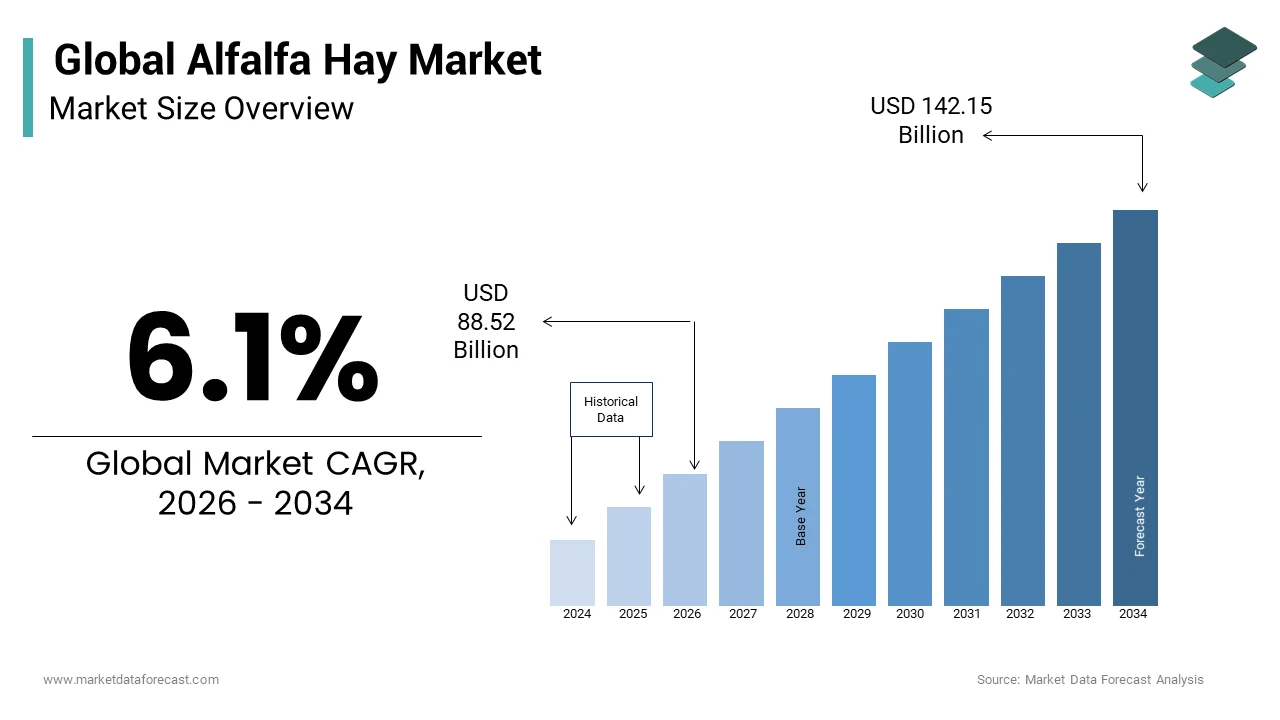
- Market Valuation: Valued at USD 84.43 billion (2025), estimated at USD 88.52 billion (2026), and projected to reach USD 142.15 billion by 2034, registering a robust CAGR of 6.1% (2026–2034).
- Primary Growth Drivers: Expanding global dairy production, intensification of livestock farming, and increasing demand for high-quality forage in dairy, beef, and equine nutrition. Key catalysts include alfalfa's superior protein content, digestibility, nitrogen fixation sustainability, rising Asian import demands (particularly China), precision agriculture, and drought-tolerant crop innovations.
Key Market Segment Metrics (2026–2034)
| Category | Leading Segment (2025 Position) | Fastest-Growing Segment |
|---|---|---|
| By Product / Form Type | Bales Segment (dominated in 2025 owing to widespread adoption, storage ease, and cost-effective handling) | Pellets and high-density compressed cubes for export efficiency |
| By Application | Meat and Dairy Animal Feed Segment (accounted for 58.8% of global market share in 2025) | Horse / Equine Feed Segment (projected to grow at a CAGR of 5.5% during the forecast period) |
| By Cultivation & Technology | Traditional field cultivation with standard mechanical harvesting | Precision agriculture, drought-tolerant seed genetics, and biotechnology advancements |
| By Region | North America (led market with a 39.3% share in 2025, supported by large production and export capabilities) | Asia-Pacific (rapidly growing market driven by rising dairy production and imported premium forage dependence) |
Major Market Players & Market Structure
Market Structure: Highly competitive global forage landscape characterized by heavy investments in sustainable production practices, advanced seed genetics, precision farming technologies, quality certifications, and strategic logistics partnerships to strengthen export capabilities.
Key Companies: Alfalfa Monegros S.L., Coaba, Alframix, Forage First, Los Venteros S.C., Grupo Osés, Haykingdom Inc., Greenfield Global, Standlee Hay Company, Green Prairie International, Cubeit Hay Company, M&C Hay, Glenvar Hay, McCracken Hay Company, SL Follen Company, Al Dahra ACX Global Inc., Anderson Hay & Grain Inc., Border Valley, Knight Ag Sourcing, Hay USA, Bailey Farms, Riverina Pty Ltd, and Gruppo Carli.
Global Alfalfa Hay Market Size
The global alfalfa hay market was valued at USD 84.43 billion in 2025 and is anticipated to reach USD 88.52 billion in 2026, from USD 142.15 billion by 2034, growing at a CAGR of 6.1% from 2026 to 2034.
Alfalfa hay represents a critical segment of the global agricultural commodities sector, focusing on the production and distribution of dried forage derived from Medicago sativa. This nutrient dense crop is widely recognized as the premier feed source for high performance livestock, particularly dairy cattle, due to its exceptional protein content and digestibility. The market dynamics are heavily influenced by the interplay between domestic consumption in major producing nations and international trade flows driven by regional feed deficits. According to the United States Department of Agriculture, the United States remains a top global producer of alfalfa hay, with 2025 projections indicating approximately 15.3 million harvested acres, which underscores the crop's strategic importance in North American agriculture. Furthermore, the Food and Agriculture Organization of the United Nations indicates that alfalfa fixes significant amounts of atmospheric nitrogen, thereby enhancing soil health and reducing the need for synthetic fertilizers in rotational cropping systems. This ecological benefit supports sustainable farming practices while maintaining high agricultural productivity. In Asia, specifically, China has emerged as a dominant importer, driven by its rapidly expanding dairy industry, which requires consistent, high quality forage to meet milk production targets. As per the National Bureau of Statistics of China, raw milk output reached 41.97 million tons in 2023, representing an increase of approximately 6.7% over the previous year, creating a structural demand for imported alfalfa to supplement domestic forage supplies. These factors collectively define the market landscape, where nutritional value, environmental sustainability, and global trade policies converge to shape supply and demand trends.
MARKET DRIVERS
Expansion of Global Dairy Production and Intensification of Livestock Farming
The relentless expansion of the global dairy industry is one of the major factors propelling the expansion of the global alfalfa hay market. Dairy cows require specific nutritional profiles to sustain high levels of lactation, and alfalfa hay provides an optimal balance of protein, fiber, and energy. According to the International Dairy Federation, world milk production is expected to surpass 1 billion tonnes in 2025, driven by rising consumer demand in emerging economies. This growth necessitates a corresponding increase in feed availability, particularly premium forages that support intensive farming systems. In countries like China, the shift from smallholder backyard farming to large scale commercial dairy operations has significantly amplified the demand for imported alfalfa hay. As per the USDA Foreign Agricultural Service, China's industry consolidation continues with large-scale farms expanding, even as total herd size may fluctuate due to economic headwinds. Alfalfa hay is preferred over other forages due to its high relative feed value, which directly correlates with improved milk protein and fat content. Consequently, dairy farmers are willing to pay a premium for superior quality alfalfa to enhance operational efficiency and profitability. This structural shift towards intensification ensures a robust and growing demand base for alfalfa hay, sustaining market momentum across key producing and consuming regions.
Increasing Demand for High Quality Protein in Equine and Beef Sectors
Beyond the dairy sector, the growing emphasis on animal performance in the equine and beef industries is further boosting the alfalfa hay market growth. Horse owners and trainers increasingly recognize the nutritional benefits of alfalfa for maintaining muscle mass, bone density, and overall vitality in performance horses. According to the American Horse Council, there were an estimated 6.65 million horses in the United States in 2023, with a significant portion engaged in competitive sports or recreational activities that require specialized diets. Alfalfa hay is often included in these diets due to its high calcium content and digestible energy, which supports rigorous physical activity. Similarly, in the beef sector, the use of alfalfa hay in finishing rations helps improve weight gain and meat quality. The National Cattlemen's Beef Association highlights that feeder cattle supplemented with high quality forage exhibit better feed conversion ratios and reduced days to market. As consumer preference for high quality lean beef rises, producers are adopting more precise feeding strategies that incorporate premium forages. Additionally, the growing popularity of organic and grass fed beef labels further boosts the demand for non-genetically modified and pesticide free alfalfa hay. This diversification of end users beyond dairy creates multiple revenue streams for producers and stabilizes market demand against fluctuations in any single sector. The willingness of equine and beef producers to invest in superior nutrition underscores the versatile appeal of alfalfa hay in the broader livestock industry.
MARKET RESTRAINTS
Water Scarcity and Environmental Regulatory Pressures
Alfalfa cultivation is highly water intensive that require substantial irrigation to achieve optimal yields, which is significantly hampering the global market expansion. In major producing areas such as the Western United States, prolonged droughts and declining aquifer levels have forced farmers to reduce acreage or switch to less water demanding crops. According to the United States Geological Survey, irrigation remains the largest category of water use in many western states, with alfalfa identified as a high-water-use crop due to its deep root system and multiple harvest cycles. State governments in California and Arizona have implemented strict water allocation policies, limiting the amount of groundwater and surface water available for irrigation. These regulatory measures increase production costs and create uncertainty for growers, who must invest in efficient irrigation technologies or face penalties. Furthermore, environmental groups advocate for reducing alfalfa cultivation to preserve natural ecosystems and restore river flows, adding social pressure to curtail production. The National Resources Defense Council emphasizes that sustainable water management practices are essential to mitigate the environmental impact of intensive alfalfa farming. As climate change exacerbates water stress, the availability of affordable irrigation water becomes a critical constraint on supply. This environmental bottleneck limits the ability of producers to expand output in response to growing demand, thereby restraining market growth and potentially leading to higher prices that may dampen consumption in price sensitive markets.
High Production Costs and Volatility in Input Prices
The economic viability of alfalfa hay production is increasingly constrained by rising input costs, including fuel, fertilizers, labor, and machinery maintenance, which is further hindering the global market growth. Farmers face fluctuating prices for diesel fuel, which powers harvesting and baling equipment, as well as for fertilizers; although alfalfa fixes nitrogen, it still requires phosphorus, potassium, and sulfur for optimal growth. According to the Economic Research Service of the United States Department of Agriculture, production expenses for U.S. farms reached record highs in recent years, with significant impacts seen across energy and labor sectors. Labor shortages further exacerbate these costs, as skilled operators are needed to manage complex harvesting schedules and ensure timely baling to prevent spoilage. The American Farm Bureau Federation notes that labor availability remains a top concern for producers, with wage rates increasing due to competition from other sectors. Additionally, the cost of land rental and insurance has surged, making it difficult for new entrants to establish operations and for existing farmers to maintain profitability. These financial pressures force some producers to reduce acreage or exit the market entirely, leading to tighter supplies. The volatility in input costs makes long term planning challenging and discourages investment in capacity expansion. Consequently, the high cost structure of alfalfa production limits the potential for significant market growth and creates vulnerability to economic downturns that may reduce livestock producers' willingness to pay premium prices for high quality hay.
MARKET OPPORTUNITIES
Development of Drought Tolerant and High Yield Varieties
Advancements in agricultural biotechnology and plant breeding is a significant opportunity for the alfalfa hay market. Researchers are increasingly focusing on genetic traits that enhance water use efficiency and resistance to pests and diseases, thereby reducing the dependency on irrigation and chemical inputs. According to the Agricultural Research Service of the United States Department of Agriculture, recent studies on young alfalfa stands have tested genetic strains alongside pivot sprinkler technologies to optimize water-use response. These innovations allow farmers to maintain productivity even in regions with limited water resources, addressing one of the primary constraints on production. Furthermore, the integration of precision agriculture technologies, such as soil moisture sensors and satellite imagery, enables growers to optimize irrigation schedules and apply inputs more efficiently. As per the National Institutes of Health, precision agriculture technologies can lead to water usage reductions of 30% to 50% while improving crop yields by 10% to 20%. As climate change intensifies, the demand for resilient crop varieties will grow, providing a competitive advantage to producers who adopt these advanced seeds. Additionally, the potential for exporting these proprietary seed technologies to other major producing regions, such as South America and Asia, offers additional revenue streams. By embracing innovation, the alfalfa industry can enhance its sustainability profile and secure long term supply stability. This technological evolution not only mitigates environmental risks but also opens new markets for high performance forage products that meet the evolving needs of modern livestock operations.
Expansion of Trade Agreements and Export Markets to Asia
The liberalization of trade policies and the establishment of new bilateral agreements offer substantial opportunities for the alfalfa hay market. Countries such as China, Japan, and South Korea have limited arable land and water resources, making them reliant on imports to satisfy their livestock feed requirements. According to the General Administration of Customs of China, the country imported 742,124 metric tons of alfalfa in the first nine months of 2025, with a significant majority sourced from the United States. The implementation of free trade agreements and the reduction of tariffs facilitate smoother and more cost effective export processes for major producing nations such as the United States and Canada. The United States Trade Representative indicates that trade facilitation measures have reduced logistical barriers, enabling faster delivery times and lower transportation costs. Furthermore, the increasing awareness of food safety and quality standards in Asia drives demand for certified high quality alfalfa hay from reputable suppliers. Producers who adhere to international quality certifications, such as those provided by the National Alfalfa and Forage Alliance, are well positioned to capture this growing market segment. Additionally, the rise of e commerce platforms for agricultural commodities enhances market accessibility, allowing buyers to source products more efficiently. By leveraging these trade opportunities, alfalfa exporters can diversify their customer base and reduce dependence on domestic markets. This strategic expansion into Asia not only boosts revenue but also strengthens the global position of the alfalfa hay industry as a key player in international agricultural trade.
MARKET CHALLENGES
Susceptibility to Pests and Diseases Impacting Yield Quality
The alfalfa crop is highly susceptible to various pests and diseases, which pose a significant challenge to expansion of the alfalfa hay market. Infestations by insects such as the alfalfa weevil, aphids, and potato leafhopper can cause substantial damage to stands, reducing both biomass and nutritional value. According to the University of California Agriculture and Natural Resources division, pest outbreaks are a primary concern for growers, requiring integrated management to prevent significant economic losses. Additionally, fungal diseases such as common leaf spot and anthracnose thrive in humid conditions, further compromising plant health and forage quality. The reliance on chemical pesticides to control these threats raises concerns about environmental impact and residue levels in the final product, which can affect marketability, particularly in organic and export segments. The Environmental Protection Agency has tightened regulations on certain pesticides, limiting the options available to growers and increasing the complexity of pest management strategies. Furthermore, the development of resistance in pest populations necessitates continuous research and rotation of control methods, adding to operational costs. Climate change exacerbates these challenges by altering pest life cycles and expanding their geographic range. The Intergovernmental Panel on Climate Change notes that warmer temperatures may lead to more frequent and severe pest outbreaks in traditional growing regions. These biological threats create uncertainty in production planning and can lead to supply shortages that disrupt market stability. Managing these risks requires integrated pest management approaches that balance efficacy with sustainability, posing an ongoing challenge for producers.
Logistics and Supply Chain Bottlenecks in International Trade
The efficient distribution of alfalfa hay, particularly for export markets is hindered by logistics and supply chain bottlenecks that increase costs and delay deliveries, which is further challenging the alfalfa hay market growth. Alfalfa hay is a bulky and low density commodity, requiring significant storage space and specialized handling during transportation. According to the American Trucking Associations, the industry faces ongoing challenges with driver availability and rising freight costs, affecting the timely movement of goods from farms to ports. Port congestion and container shortages further complicate international shipments, causing delays that can compromise the quality of the product due to exposure to moisture and heat. Industry reports indicate that shipping reliability has fluctuated significantly in recent years, impacting the consistency of global supply chains. Additionally, the lack of adequate storage infrastructure in some producing regions leads to post harvest losses due to spoilage and weather damage. These logistical inefficiencies increase the overall cost of alfalfa hay, making it less competitive in price sensitive markets. Furthermore, geopolitical tensions and trade disputes can disrupt shipping routes and impose additional tariffs, creating uncertainty for exporters and importers alike. The World Trade Organization highlights that trade barriers and logistical disruptions significantly impact agricultural commodity flows. Addressing these challenges requires investment in infrastructure improvements and the adoption of digital logistics solutions to enhance visibility and efficiency. Until these issues are resolved, supply chain vulnerabilities will remain a persistent challenge for the global alfalfa hay market.
REPORT COVERAGE
| REPORT METRIC | DETAILS |
| Market Size Available | 2025 to 2034 |
| Base Year | 2025 |
| Forecast Period | 2026 to 2034 |
| CAGR | 6.1% |
| Segments Covered | By Type, Application, and Region |
| Various Analyses Covered | Global, Regional & Country Level Analysis, Segment-Level Analysis, DROC, PESTLE Analysis, Porter’s Five Forces Analysis, Competitive Landscape, Analyst Overview of Investment Opportunities |
| Regions Covered | North America, Europe, APAC, Latin America, Middle East & Africa |
| Market Leaders Profiled | Monegros, S.L., Coaba, Los Venteros S.C., Grupo Osés, HaykingdomInc.c, STANDLEE HAY COMPANY, Green Prairie International, Cubeit Hay Company, M&C Hay, Glenvar Hay, McCracken HAY COMPANY, SL Follen Company, Al Dahra ACX Global Inc., Anderson Hay & Grain Inc., Border Valley, Knight Ag Sourcing, Hay USA, Bailey Farms, Riverina Pty Ltd, and Gruppo Carli and Others. |
SEGMENTAL ANALYSIS
By Type
The bales segment dominated the market by holding the highest share of the global market in 2025. The dominance of bales segment in the global market is driven by their widespread adoption in traditional livestock farming and ease of handling for small to medium scale operations. The dominance of this segment is further attributed to the established infrastructure for baling, storage, and transportation, which has been refined over decades of agricultural practice. According to the United States Department of Agriculture, the vast majority of hay in the U.S. is harvested and stored as bales, reflecting its entrenched position in domestic supply chains. Small square bales are particularly favored by horse owners and small dairy farms due to their manageable weight and ease of manual handling, while large round bales are preferred by beef cattle producers for their efficiency in field feeding. The versatility of bales allows for flexible storage options, including barns and outdoor stacks with proper covering, making them accessible to farmers with varying levels of infrastructure investment. Furthermore, the lower processing cost associated with baling compared to pelleting or cubing makes it a cost effective option for producers. The National Alfalfa and Forage Alliance notes that bale quality grading systems provide a standardized method for pricing, ensuring transparency in trade. This standardization facilitates local and regional trade, where visual inspection and core sampling are common practices. The familiarity of end users with bale feeding equipment and techniques further reinforces the segment's leadership. As long as traditional farming methods persist alongside modern operations, bales will remain the primary form of alfalfa hay distribution, sustaining its market dominance through convenience and economic efficiency.
By Application Insights
The meat and dairy animal feed segment dominated the market by occupying 58.8% of the global market share in 2025. The dominance of meat and dairy animal feed segment in the global market can be credited to the critical role of alfalfa in enhancing milk production and meat quality. Dairy cows require high protein and fiber diets to sustain lactation, and alfalfa hay provides an optimal balance of nutrients. According to the International Dairy Federation, global dairy demand continues to grow, with world milk production expected to reach 983 million tonnes by 2024. In the United States, the National Agricultural Statistics Service reports that dairy production remains a primary end-use for harvested alfalfa due to its superior relative feed value. Similarly, in the beef sector, alfalfa is used in finishing rations to improve weight gain and marbling, which commands premium prices in the market. The National Cattlemen's Beef Association emphasizes that alfalfa supplementation reduces the need for grain, thereby lowering feed costs and improving rumen health. The expansion of large scale commercial dairy operations in Asia and Latin America further amplifies demand, as these facilities prioritize consistent and high performance feed inputs. Alfalfa's ability to improve milk protein and fat content directly impacts farmer profitability, creating a strong economic incentive for its inclusion in dairy rations. This fundamental nutritional requirement ensures that the meat and dairy segment remains the primary driver of alfalfa hay consumption globally, underpinning market stability and growth.
On the other side, the horse feed segment is anticipated to showcase a CAGR of 5.5% during the forecast period in the global market owing to the increasing popularity of equestrian sports and recreational horse ownership, which drives demand for premium quality forage. According to the American Horse Council, the U.S. horse population was estimated at 6.65 million in 2023, with many owners willing to pay a premium for high quality, leafy alfalfa hay that supports muscle development and bone health. Alfalfa is particularly valued for its high calcium content and digestible energy, which are essential for performance horses and growing foals. The United States Equestrian Federation notes that the participation in competitive equestrian events supports a robust market for specialized equine nutrition. Additionally, the rise of equine wellness trends encourages the use of natural and organic feed options, with alfalfa being a preferred choice due to its minimal processing requirements. Small square bales of premium alfalfa are highly sought after in this segment due to their ease of handling and reduced waste. The expansion of equine tourism and leisure activities in emerging economies also contributes to market growth. As disposable incomes rise, more individuals are investing in horse ownership and care, creating a robust demand for specialized feed products. This shift towards high value niche markets positions the horse feed segment as a key driver of growth in the alfalfa hay industry.
REGIONAL ANALYSIS
North America Market Analysis
North America held the dominant position in the global alfalfa hay market and accounted for 39.3% of the global market share in 2025. The dominance of North America in the global market is majorly driven by its status as the largest producer and consumer of alfalfa hay. The United States and Canada are expected to continue their dominance in the export of high-compression alfalfa bales over the next few years, leveraging their advanced logistical infrastructure to meet the rising demand for premium forage in Asian markets. The United States is the leading producer, with vast cultivation areas in states such as California, Wisconsin, and Idaho. According to the United States Department of Agriculture, the country harvested 15.6 million acres of alfalfa and alfalfa-mixtures in 2024, supporting a robust domestic dairy and beef industry. The region benefits from advanced agricultural technologies, efficient logistics networks, and established quality grading standards that facilitate trade. Canada also contributes significantly to regional production, with exports to the United States and overseas markets. The presence of major seed companies and research institutions drives innovation in crop varieties and farming practices. Domestic demand is sustained by the large livestock population, while export opportunities to Asia provide additional growth avenues. The integration of precision agriculture and sustainable farming practices enhances productivity and environmental stewardship. Regulatory support for agricultural exports and trade agreements further strengthen the market position of North America. As the region continues to lead in technological adoption and production efficiency, it remains the cornerstone of the global alfalfa hay industry, setting benchmarks for quality and sustainability.
Asia Pacific Market Analysis
The Asia-Pacific region represents a rapidly growing market for Alfalfa Hay. China, Japan, and South Korea are projected to expand their strategic forage reserves and increase their reliance on high-quality North American alfalfa over the next few years to support their domestic dairy self-sufficiency goals. China is the world's largest importer of alfalfa hay, as its domestic production cannot meet the needs of its expanding dairy industry. According to the General Administration of Customs of China, the country imported over 742,000 metric tons of alfalfa in the first nine months of 2025, maintaining its position as a top global buyer. The modernization of dairy farming in China has led to a preference for high quality imported forage to improve milk yield and quality. Other countries in the region, such as Japan and South Korea, also import alfalfa to supplement their limited domestic feed supplies. The region's growing middle class and increasing consumption of dairy products drive the expansion of commercial dairy farms, which rely on imported alfalfa for consistent nutrition. Government initiatives in China to promote dairy self-sufficiency further support market growth. However, water scarcity and land constraints limit domestic production potential, making imports essential. The establishment of trade relationships with major exporting countries ensures a steady supply of alfalfa hay. As the dairy sector in Asia Pacific continues to modernize and expand, the region's dependence on imported alfalfa is expected to increase, solidifying its position as a key growth engine in the global market.
Europe Market Analysis
Europe holds a significant position in the Alfalfa Hay Market. The growth of Europe is attributed to the focus on sustainable production and local consumption. Countries such as Spain, France, and Italy are major producers within the region, leveraging favorable climatic conditions for alfalfa cultivation. European producers are likely to see an increase in alfalfa acreage over the next few years as the Common Agricultural Policy continues to incentivize the cultivation of nitrogen-fixing legumes to meet regional protein self-sufficiency and climate targets. According to the European Commission, the EU's protein strategy encourages the production of forage legumes like alfalfa to enhance the region's feed sovereignty. This policy framework encourages farmers to incorporate alfalfa into crop rotations, enhancing soil health and biodiversity. The region's strong emphasis on environmental sustainability drives the adoption of organic and non genetically modified alfalfa varieties. Domestic demand is primarily met by local production, with limited imports required for specific high quality needs. The European livestock sector, particularly dairy and beef, relies on alfalfa for its nutritional benefits, but the scale of production is smaller compared to North America. Trade within the European Union facilitates the movement of alfalfa hay between member states, ensuring supply stability. Challenges such as water scarcity in Southern Europe and regulatory pressures on pesticide use impact production levels. However, the commitment to sustainable agriculture and protein self sufficiency maintains the relevance of alfalfa in the European market. As environmental standards tighten, the region is likely to see continued innovation in sustainable alfalfa farming practices.
Argentina and Brazil are expected to accelerate the industrialization of their alfalfa sectors over the next few years, transitioning from traditional grazing to more intensive baling and pelleting for both domestic feedlots and emerging export opportunities. Argentina is a significant producer of alfalfa, utilizing it primarily for beef cattle production and dairy farming. According to the Ministry of Agriculture of Argentina, the country possesses vast areas of alfalfa pastures that support its globally recognized beef industry. However, the market is largely domestic, with a growing interest in expanding export activity. Mexico is increasingly importing alfalfa hay from the United States to meet the demands of its growing dairy industry, particularly in northern states. The proximity to the United States facilitates cross border trade, making imports a viable option for Mexican farmers. Brazil and Chile also have growing alfalfa sectors supporting their respective livestock industries. The region faces challenges such as variable climate conditions and limited access to advanced farming technologies, which constrain production efficiency. However, increasing investment in agricultural infrastructure and the adoption of improved seed varieties offer opportunities for growth. As livestock production intensifies in Latin America, the demand for high quality forage is expected to rise. Regional cooperation and trade agreements could further enhance market dynamics, allowing for greater exchange of alfalfa hay and expertise. The region's potential lies in modernizing production practices and expanding domestic capacity to meet rising feed demands.
Middle East and Africa Market Analysis
The Middle East and Africa region holds a niche position in the Alfalfa Hay Market due to the limited domestic production and reliance on imports. Saudi Arabia and the United Arab Emirates are likely to remain the primary drivers of global alfalfa trade growth over the next few years as they further restrict domestic irrigation to preserve ancient aquifers, leading to a near-total reliance on imported forage. Countries in the Gulf Cooperation Council, such as Saudi Arabia and the United Arab Emirates, import alfalfa hay to support their dairy and camel industries. According to the Food and Agriculture Organization of the United Nations, water scarcity in the region is a primary factor influencing agricultural policy, leading several nations to phase out water-intensive domestic forage crops. Saudi Arabia has implemented policies to significantly reduce domestic alfalfa production to conserve water resources, resulting in a substantial increase in import volumes from North America and Europe. Egypt is a notable producer in Africa, but primarily for domestic consumption, with limited export capacity. The region's harsh climate and arid conditions pose significant challenges to local agriculture, making imports essential for maintaining livestock productivity. Growing investments in food security and livestock development drive demand for high quality imported forage. However, logistical challenges and high transportation costs impact market accessibility. As populations grow and dietary preferences shift towards dairy products, the demand for alfalfa hay is expected to increase. Strategic partnerships with exporting countries and investments in port infrastructure could improve supply chain efficiency. The region's market dynamics are defined by the balance between water conservation goals and the need to sustain livestock production through imported feed resources.
COMPETITIVE LANDSCAPE
The competitive landscape of the Alfalfa Hay Market is characterized by a mix of large integrated agribusinesses and independent growers vying for dominance in both domestic and international sectors. Large companies leverage economies of scale and advanced technologies to maintain leadership positions while smaller producers focus on niche markets and local relationships. Competition is driven largely by product quality consistency and adherence to sustainability standards which are critical for accessing premium export markets. Companies differentiate themselves through certifications such as Organic and Non GMO appealing to environmentally conscious consumers and specialized livestock sectors. Price competitiveness remains a factor but is often secondary to reliability and nutritional value in long term contracts. Strategic alliances with logistics providers and port authorities enhance supply chain efficiency and reduce operational risks. The market sees continuous innovation in seed genetics and harvesting techniques to improve yield and resource efficiency. Regulatory compliance and water management practices also influence competitive dynamics with sustainable sourcing becoming a key differentiator. As demand for high quality forage grows companies that integrate technology and sustainability into their operations gain significant traction in the global marketplace.
KEY MARKET PLAYERS
Some of the key players dominating the market are
- Alfalfa Monegros, S.L.
- Coaba
- Alframix
- Forage First
- Los Venteros S.C.
- Grupo Osés
- Haykingdom Inc.
- Greenfield Global
- STANDLEE HAY COMPANY
- Green Prairie International
- Cubeit Hay Company
- M&C Hay
- Glenvar Hay
- McCracken HAY COMPANY
- SL Follen Company
- Al Dahra ACX Global Inc.
- Anderson Hay & Grain Inc.
- Border Valley
- Knight Ag Sourcing
- Hay USA
- Bailey Farms
- Riverina Pty Ltd
- Gruppo Carli.
Top Players In The Market
- Alframix is a leading producer and exporter of high quality alfalfa hay with a strong presence in international markets including Asia and the Middle East. The company focuses on sustainable farming practices and advanced processing technologies to ensure consistent nutritional value and purity. Recent actions include the expansion of its storage facilities to enhance supply chain reliability and reduce post harvest losses. Alframix also invests in research and development to improve seed varieties and irrigation efficiency. By obtaining international certifications such as ISO and HACCP the company strengthens its reputation for quality and safety. These initiatives enable Alframix to meet the stringent requirements of global dairy producers. Their commitment to environmental stewardship and operational excellence solidifies their position as a trusted supplier in the competitive alfalfa hay market.
- Forage First is a prominent player in the alfalfa hay industry known for its extensive network of growers and distribution channels across North America and export markets. The company specializes in producing premium alfalfa bales and pellets tailored to the needs of high performance livestock. Recent actions involve the implementation of digital tracking systems to provide customers with real time information on crop origin and quality metrics. Forage First also collaborates with agricultural experts to offer technical support and feeding recommendations to clients. This value added service enhances customer loyalty and differentiates the brand in a commoditized market. By focusing on transparency and customer engagement Forage First strengthens its market position. Their strategic partnerships with logistics providers ensure timely delivery and maintain product integrity during transit.
- Greenfield Global is a key contributor to the alfalfa hay market with a focus on sustainable production and export oriented operations. The company operates large scale farms equipped with modern harvesting and processing equipment to maximize efficiency and yield. Recent actions include the adoption of solar powered irrigation systems to reduce carbon footprint and water usage. Greenfield Global also expands its product portfolio to include organic alfalfa hay catering to the growing demand for natural feed options. The company actively participates in international trade fairs to build relationships with overseas buyers and explore new market opportunities. By prioritizing sustainability and innovation Greenfield Global enhances its competitive edge. Their dedication to quality control and environmental responsibility ensures long term growth and resilience in the global alfalfa hay industry.
Top Strategies Used by Key Market Participants
Key players in the Alfalfa Hay Market primarily focus on vertical integration and sustainability certifications to maintain competitive advantage. Companies increasingly control the entire supply chain from seed selection to final export to ensure quality consistency and traceability. This strategy mitigates risks associated with weather variability and market fluctuations. Another major approach involves investing in water efficient technologies such as drip irrigation and drought tolerant seed varieties to address environmental concerns. These innovations reduce production costs and appeal to eco conscious buyers. Manufacturers also diversify their product offerings by introducing pellets and cubes alongside traditional bales to cater to different logistical needs. Strategic partnerships with logistics providers enhance supply chain efficiency and reduce transportation costs. Additionally firms engage in direct contracts with large dairy operations to secure stable demand and long term revenue streams. These combined strategies help companies navigate market challenges and sustain growth in the competitive global landscape.
MARKET SEGMENTATION
This research report on the global alfalfa hay market is segmented and sub-segmented into the following categories.
By Type
- Pellets
- Bales
- Cubes
By Application
- Meat/Dairy Animal Feed
- Poultry Feed
- Horse Feed
- Other
By Region
- North America
- Europe
- Asia Pacific
- Latin America
- The Middle East and Africa