- Product Description Description
- Table of Contents TOC
- List of Table & Figure LOT
- Get Free Sample PDF Sample PDF
Market Size, 2025
$530.35 MnMarket Estimate, 2026
$572.30 MnMarket Forecast, 2034
$1052.25 MnCAGR, 2026–2034
7.91%Executive Summary: Global Almond Powder Market
- Market Scope: Comprehensive market evaluation of the global almond powder (almond flour) sector, analyzing product types (blanched vs. natural), applications (bakery, confectionery, cosmetics), end-users (household, commercial), distribution channels, and regional demand.
- Market Valuation: Valued at USD 530.35 million in 2025, reaching USD 572.30 million in 2026, and projected to expand up to USD 1,052.25 million by 2034, registering a strong CAGR of 7.91% throughout the forecast period from 2026 to 2034.
- Primary Growth Drivers: Rising adoption of gluten-free, low-carb, and keto-friendly diets; increasing health-consciousness and demand for nutrient-dense, protein-rich plant ingredients; and expansion of the commercial bakery and confectionery sectors.
Key Market Segment Metrics
| Category | Leading Segment (Base Year Position) | Fastest-Growing / High-Impact Segment |
|---|---|---|
| By Product Type, Application, End-User & Channel | Blanched Almond Flour (dominant type), Baking Category (capturing nearly half of market share), Commercial End-User (leading sector), & Offline Distribution (major revenue share via retail) | Blanched Almond Flour segment (projected at a 7.80% CAGR), Natural Almond Flour variants, and Online Retail Channels driven by e-commerce expansion. |
| By Region / Country | North America (dominant regional market backed by high domestic production and consumption of almond products) | Asia-Pacific (fastest-growing region propelled by rising urbanization, dietary shifts, and growing food processing industries in countries like South Korea and India). |
Major Market Players & Market Structure
Market Structure: A competitive global marketplace featuring major agricultural processors, specialized nut companies, and health-food brands focusing on product diversification, clean-label compliance, and expansion across commercial and household retail networks.
Key Companies: King Arthur Flour Company Inc., Blue Diamond Growers, Treehouse California Almonds LLC, Bob’s Red Mill Natural Foods, Anthony’s Goods, Aldrin Brothers, Hodgson Mill Inc., Organic Bio SA, Rolling Hills Nut Company Inc., and Shiloh Farms.
 Download Free Sample Report
Global Almond Powder Market Size
The global almond powder market size was valued at USD 530.35 million in 2025 and is anticipated to reach a valurtion of USD 572.30 million in 2026 and USD 1052.25 million by 2034, growing at a CAGR of 7.91% from 2026 to 2034.
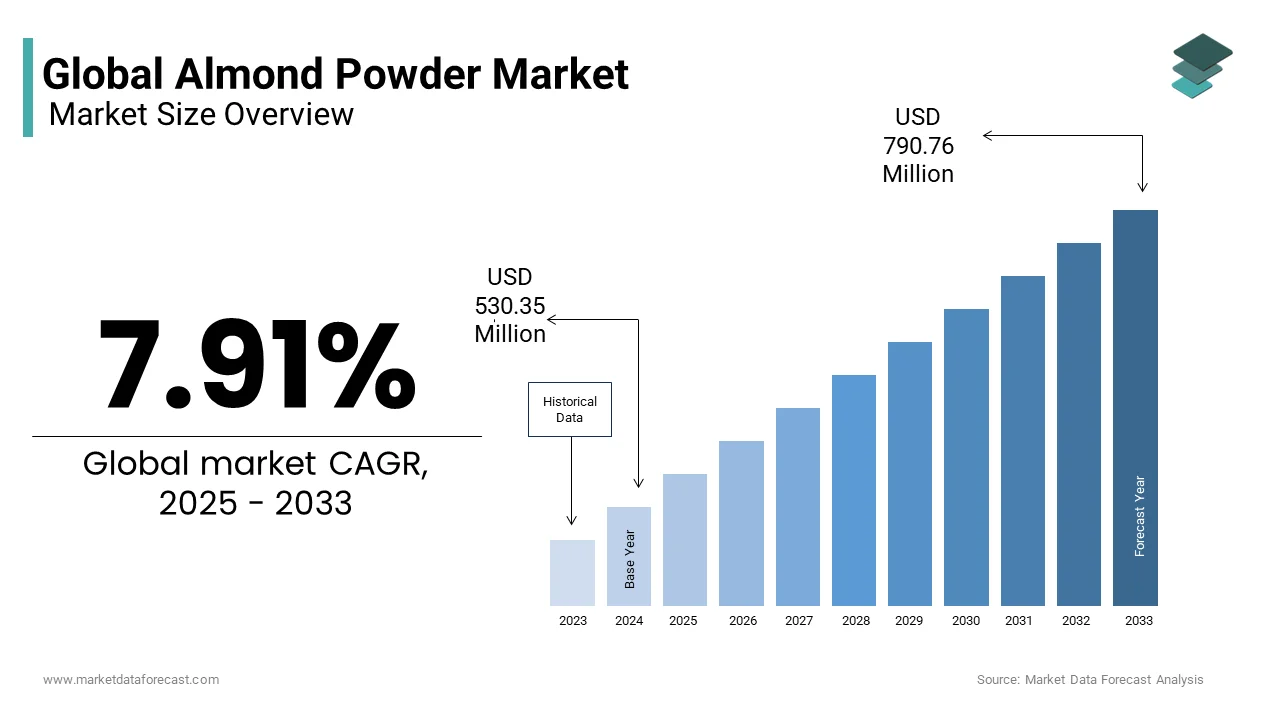
Almond flour or powder is a popular substitute for regular wheat flour since it is low in carbs, high in nutrients, and slightly sweeter in flavor. Almond flour is high in nutrients, protein, vitamins, and minerals.
In 2019, blanched almond flour accounted for more than a third of the total almond flour market share. Almond flour is a common ingredient in a wide range of products, including bread, candy, and cosmetics. Cakes, cookies, bread, pastries, and other products made with almond flour are available on the market. Almond flour products maintain a lot of critical nutrients, which is why they've been getting a lot of traction in the market. Consumer preferences are changing, and people are becoming more aware of the health benefits of eating almond products. Demand for almond flour products will continue to rise. In addition, rising consumer demand for gluten-free diets and tighter standards will continue to drive demand for processing equipment. Furthermore, the growing demand for bakery products will provide lucrative prospects for almond flour market players.
MARKET DRIVERS
Changes in people's lifestyles and diverse consumer trends toward the use of almond flour in various baked goods with varying flavors are driving the global almond powder market expansion. The bakery business has had a significant impact on the market.
The benefits supplied by almond flour, on the other hand, are projected to propel the almond flour industry forward as consumers have grown more health-conscious since the outbreak of the pandemic. Almond powder is formed from a blend of blanched and natural almonds. These almonds have been ground into a fine powder. The almond powder contains a lot of protein as well as other nutrients like fiber, vitamin E, manganese, vitamin B2, magnesium, and phosphorus. Almond powder has a broad list of health advantages, including decreasing blood pressure, increasing immunity, enhancing focus, and maintaining overall brain health. The expansion of the almond powder market is being fueled by rising personal disposable income and increased knowledge of the health advantages of almonds, particularly in developing economies. Other major influencers of the almond powder market growth include changing lifestyles, rising stress levels, and rising demand for gluten-free products. The growing popularity of e-commerce platforms, as well as the growth and expansion of the e-commerce industry, particularly in developing nations, and the widespread use of almond powder in the bakery confectionery industry, will drive up the almond powder market value. Almond flour is a common ingredient in skin care products like lotions and creams. The natural component of almond flour is excellent for a range of home uses. The global almond powder market is expected to develop in response to rising urban populations, rising living standards, changing lifestyles, and rising demand for almond-derived goods such as almond butter and almond oil.
MARKET RESTRAINTS
Consumer preference for high-protein, fiber, minerals, vitamins, and carbohydrate cereals such as wheat flour, oat flour, rice flour, and others over baked goods such as bread, cookies, and rolls. The almond flour market is projected to be hampered as a result of this. Furthermore, the recent epidemic of the new coronavirus has had an influential supply chain and is expected to have a short-term impact on the market. However, the growing popularity of handmade recipes will provide a significant obstacle to the almond powder market's expansion. Because a large portion of the population is allergic to almonds, the almond powder market's growth potential will be further limited. The latest coronavirus outbreak has exacerbated the supply and demand for almond powder.
Impact of COVID-19 on the Global Almond Powder Market
Due to lockdowns, travel bans, and company closures, the COVID-19 pandemic has hurt economies and businesses in numerous ways. Food and beverage production plants are among the major businesses experiencing severe disruptions, such as supply chain restrictions and facility closures. The disruption of global supply chains caused by the closure of numerous plants and factories in various nations has a severe influence on manufacturing activities, delivery timetables, and multiple commodities sales. Companies have already warned of possible delays in product deliveries and a drop in future sales.
REPORT COVERAGE
| REPORT METRIC | DETAILS |
| Market Size Available | 2025 to 2034 |
| Base Year | 2025 |
| Forecast Period | 2026 to 2034 |
| CAGR | 7.91% |
| Segments Covered | By Product Type, Application, End User, Distribution Channel, and Region |
| Various Analyses Covered | Global, Regional & Country Level Analysis, Segment-Level Analysis, DROC, PESTLE Analysis, Porter’s Five Forces Analysis, Competitive Landscape, Analyst Overview on Investment Opportunities |
| Regions Covered | North America, Europe, APAC, Latin America, Middle East & Africa |
| Market Leaders Profiled | King Arthur Flour Company Inc, Aldrin Brothers, Anthony’s Goods, Hodgson Mill Inc, Organic Bio.SA, Rolling Hills Nut Company Inc., Shiloh Farms, Treehouse California Almonds LLC, Blue Diamond Growers, Bob’s Red Mill Natural Foods, and Others. |
SEGMENT ANALYSIS
By Product Type Insights
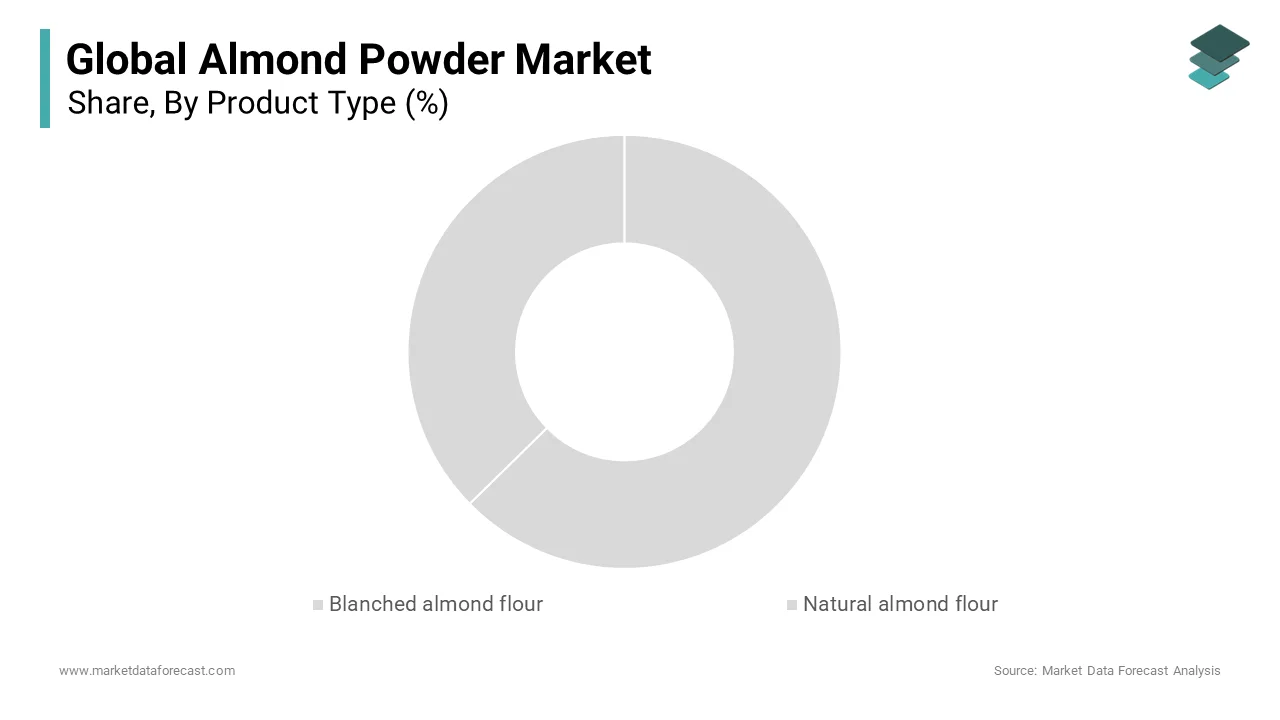
The blanched almond flour segment accounted for the largest proportion of the global almond powder market by type. Because of the expanding need for bakery and confectionery items around the world, as well as the growing desire for high-protein baking products, blanched almond flour has become the most popular choice of almond flour among customers. The market for blanched almond flour is estimated to rise at a CAGR of 7.80% over the forecast period, owing to the increased demand for confectionery goods.
By Application Insights
The baking category dominated the almond powder market, accounting for almost half of the market share, and is likely to continue to do so throughout the forecast period. To achieve market growth and sustainability, leading manufacturers have focused on providing consumer-centric products at reasonable pricing. Bakery items are expected to see a considerable increase in demand as the nutritious content of diverse products rises. This, in turn, is expected to increase the almond powder market's potential.
By End User Insights
The commercial segment dominated the almond powder market in terms of end users. Because of increased investments in commercial venues such as airports, hospitals, hotels, and restaurants, the demand for almond flour is likely to rise significantly. Some of the market's primary drivers include the ease with which sales and purchases may be made, the variety of brands available, and the pricing. Natural almond flour sales are predicted to increase, resulting in a significant demand for almond flour in the commercial sector.
By Distribution Channel Insights
Based on the distribution channel, the offline segment accounted for a major portion of the worldwide almond powder market. Supermarkets/hypermarkets, convenience stores, and specialty stores make up the offline segment. Convenience stores provide the convenience and variety of options that a changing consumer seeks. Players in the market are opening new convenience stores in various regions to expand their reach and client base. To entice customers, specialty retailers are introducing various types of almond flour goods with healthier ingredients, such as vitamin B1, consequently boosting the market's growth. Furthermore, due to macroeconomic variables such as consumer spending and increasing disposable income, the specialty retail business is expected to have erratic growth.
REGIONAL ANALYSIS
North America dominated the almond flour industry, accounting for the largest proportion of the global market. The market in the region is expected to grow significantly during the forecast period, owing to increased consumption and production of almonds and their products.
As demand for natural dietary supplements grows in the Asia Pacific region, the region is likely to lead the worldwide almond flour market. Increased urbanization, an increase in the number of food processing enterprises, and large imports of almond-derived goods could move the global almond flour market in the region forward. Brazil and South Korea are two other major players in the worldwide almond flour market. The global almond flour market in these nations is likely to be driven by rising demand for high-quality cookies.
KEY MARKET PLAYERS
Some of the market players dominate the global almond powder market.
- King Arthur Flour Company Inc.
- Aldrin Brothers
- Anthony’s Goods
- Hodgson Mill Inc
- Organic Bio, SA
- Rolling Hills Nut Company Inc.
- Shiloh Farms
- Treehouse California Almonds, LLC
- Blue Diamond Growers
- Bob’s Red Mill Natural Foods
MARKET SEGMENTATION
This market research report on the global almond powder market has been segmented and sub-segmented based on product type, application, end user, distribution channel, and region.
By Product Type
- Blanched almond flour
- Natural almond flour
By Application
- Confectionery
- Cosmetics
- Bakery
- Others
By End User
- Household
- Commercial
By Distribution Channel
- Online
- Offline
By Region
- North America
- Europe
- Latin America
- Middle East & Africa
- Asia Pacific