- Product Description Description
- Table of Contents TOC
- List of Table & Figure LOT
- Get Free Sample PDF Sample PDF
Global Aluminum Composite Panels (ACP) Market Size
The global aluminum composite panels (ACP) market was valued at USD 5,811.13 million in 2024, is estimated to reach USD 6,231.28 million in 2025, and is projected to reach USD 10,892.00 million by 2033, growing at a CAGR of 7.23% from 2025 to 2033.
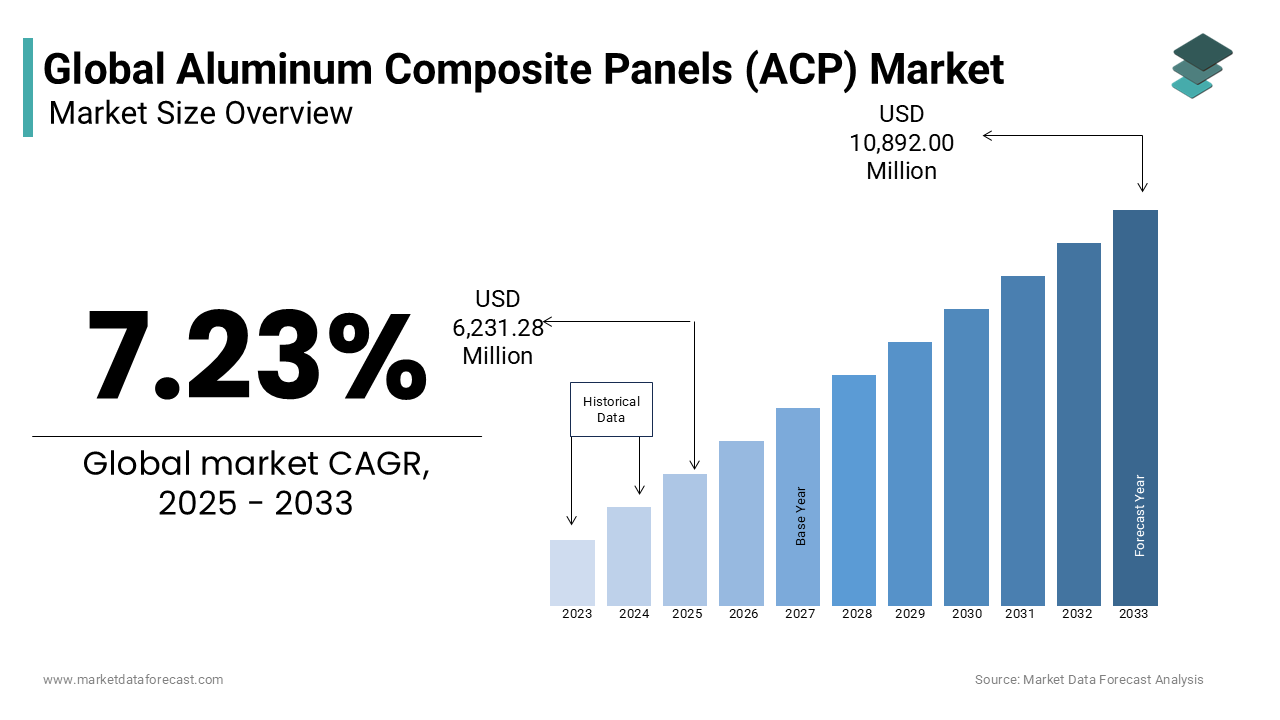
The aluminum composite panels (ACP) are engineered flat panels composed of two thin aluminum sheets bonded to a non-aluminum core, which is predominantly polyethylene or fire-retardant mineral-filled materials. These panels are extensively utilized in architectural cladding, façade systems, interior decoration, and signage due to their lightweight nature, design flexibility, and durability. As per the U.S. Green Building Council, over 40% of new commercial constructions in the United States incorporate materials that contribute to energy efficiency and sustainable design, a criterion ACPs increasingly meet when manufactured with eco-conscious cores.
MARKET DRIVERS
Urbanization and High-Rise Construction Boom
The rapid urbanization of high-rise commercial and residential buildings, where aluminum composite panels are majorly propelling the growth of the aluminum composite panels (ACP) market. According to the United Nations Department of Economic and Social Affairs, over 56% of the global population resided in urban areas in 2022, projected to rise to 60% by 2030. According to the Ministry of Housing and Urban-Rural Development, more than 7,000 high-rise buildings were constructed between 2010 and 2022, many featuring ACP-based curtain walls. The material’s lightweight property reduces structural load, making it ideal for skyscrapers, while its aesthetic versatility supports contemporary architectural expression. Additionally, as per the Council on Tall Buildings and Urban Habitat, Dubai hosts over 2,000 high-rise structures, 85% of which utilize ACPs in exterior cladding.
Demand for Energy-Efficient Building Envelopes
The global push for energy-efficient buildings has elevated the adoption of aluminum composite panels with thermal break technologies and insulating cores, which will further elevate the growth of aluminum composite panels (ACP) market. As per the International Energy Agency, buildings account for nearly 30% of global final energy consumption, which is prompting stricter energy codes and green building certifications such as LEED and BREEAM. ACPs contribute to improved thermal performance when integrated with insulated cavity systems, reducing HVAC loads. In Europe, the European Commission reports that over 85% of new public buildings must meet nearly zero-energy building (nZEB) standards as of 2021, accelerating the use of advanced façade materials.
MARKET RESTRAINTS
Fire Safety Concerns Following Major Incidents
The flammability of polyethylene-core aluminum composite panels has raised significant safety concerns following catastrophic fires such as the 2017 Grenfell Tower tragedy in London, which claimed 72 lives. Similarly, Australia’s National Construction Code now mandates non-combustible cladding for high-rises. As per the Building Research Establishment, over 400 high-rise buildings in the UK were identified with unsafe cladding by 2021, leading to costly remediation efforts exceeding £5 billion. These events have instilled hesitancy among developers and regulators, which is slowing adoption despite advancements in fire-retardant core technologies.
Volatility in Aluminum Prices and Supply Chain Disruptions
The aluminum composite panel production is highly sensitive to fluctuations in primary aluminum prices, which are influenced by energy costs, geopolitical tensions, and trade policies. According to the U.S. Geological Survey, the global average price of aluminum surged from $1,700 per metric ton in 2020 to over $2,800 in 2022. China is the world’s largest aluminum producer which curtailed output by 5% in 2022 due to hydropower shortages in Yunnan province, as reported by the China Nonferrous Metals Industry Association. Additionally, logistics disruptions from events like the Red Sea shipping crisis in 2024 delayed raw material deliveries, which is increasing lead times by up to 30% for ACP manufacturers in the Middle East and Europe.
MARKET OPPORTUNITIES
Expansion of Sustainable and Recyclable ACP Variants
The growing emphasis on circular economy principles is driving innovation in recyclable and low-carbon aluminum composite panels that is creating new opportunities for the growth of aluminum composite panels (ACP) market. Aluminum is inherently recyclable, requiring only 5% of the energy needed for primary production, as stated by the International Aluminum Institute. Companies like Alucobond and 3A Composites have introduced panels with mineral-filled cores and pre-finished coatings that meet Class A fire ratings and Cradle to Cradle certification standards. In 2023, the European Aluminum Association reported that 76% of post-consumer aluminum in Europe was recycled, reinforcing the material’s sustainability profile.
Adoption in Emerging Economies’ Infrastructure Projects
The large-scale urban infrastructure initiatives in countries such as India, Indonesia, and Saudi Arabia are creating substantial demand for cost-effective and aesthetically versatile cladding solutions. As per India’s Ministry of Housing and Urban Affairs, the Smart Cities Mission has sanctioned over 8,000 projects across 100 cities, many involving commercial complexes and transit hubs utilizing ACPs for façades. Similarly, Saudi Arabia’s Vision 2030 includes NEOM, a $500 billion futuristic city, where architectural innovation relies heavily on lightweight, corrosion-resistant materials like ACPs.
MARKET CHALLENGES
Regulatory Fragmentation and Compliance Complexity
The aluminum composite panel industry faces a fragmented global regulatory landscape, with divergent fire safety, environmental, and building code requirements across regions. In the European Union, EN 13501-1 classifies construction products by fire performance, mandating Class B-s1, d0 or higher for high-rise façades, whereas Gulf Cooperation Council countries often accept Class E, creating inconsistency in material specifications. As per the Dubai Municipality, over 30% of imported ACP batches failed compliance tests in 2022 due to mislabeling or substandard core composition. Additionally, the absence of universal standards for recyclability claims complicates marketing of “green” panels.
Counterfeit and Substandard Products in Developing Markets
The proliferation of low-cost, unregulated ACP manufacturing in parts of Southeast Asia and Africa undermines product quality and brand integrity is additionally to degrade the growth of aluminum composite panels (ACP) market. As reported by India’s Bureau of Indian Standards, nearly 42% of ACP samples tested in 2023 failed to meet IS 14825 safety standards, primarily due to inadequate core density and flammable fillers. In Nigeria, the Standards Organization of Nigeria seized over 1,200 square meters of counterfeit ACPs in 2022, falsely branded as fire-resistant. These substandard panels pose safety risks and erode consumer trust.
REPORT COVERAGE
| REPORT METRIC | DETAILS |
| Market Size Available | 2024 to 2033 |
| Base Year | 2024 |
| Forecast Period | 2025 to 2033 |
| Segments Covered | By Product, Application and Region. |
| Various Analyses Covered | Global, Regional, & Country Level Analysis; Segment-Level Analysis, Drivers, Restraints, Opportunities, Challenges, PESTLE Analysis, Porter’s Five Forces Analysis, Competitive Landscape, Analyst Overview of Investment Opportunities |
| Regions Covered | North America, Europe, Asia Pacific, Latin America, Middle East, and Africa |
| Key Market Players | 3A Composites, Arconic Corporation, Alucoil, Alubond U.S.A., Mitsubishi Chemical Corporation, Yaret Industrial Group, Alstrong Enterprises India Pvt Ltd, Jyi Shyang Industrial Co. Ltd., Guangzhou Xinghe ACP Co. Ltd., Reynobond (Arconic Architectural Products), Viva Composite Panel Pvt. Ltd., Multipanel UK Ltd., Hycomb Panels, Eurobond Industries Pvt. Ltd., and Alpolic (Mitsubishi Chemical). |
SEGMENTAL ANALYSIS
By Product Insights
The PVDF (Polyvinylidene Fluoride) segment was the largest and held 45.3% of the aluminum composite panels (ACP) market share in 2024 with the PVDF’s superior weather resistance and long-term color retention by making it ideal for exterior architectural applications. The material maintains gloss retention above 90% after 10 years of exposure, as validated by the American Architectural Manufacturers Association (AAMA) Standard 2605, which specifies high-performance coatings for architectural aluminum. This stringent durability benchmark has made PVDF the preferred choice in high-rise buildings and extreme climates. Additionally, the growing demand for sustainable and low-maintenance façades in urban infrastructure projects across Asia and the Middle East has accelerated PVDF adoption.
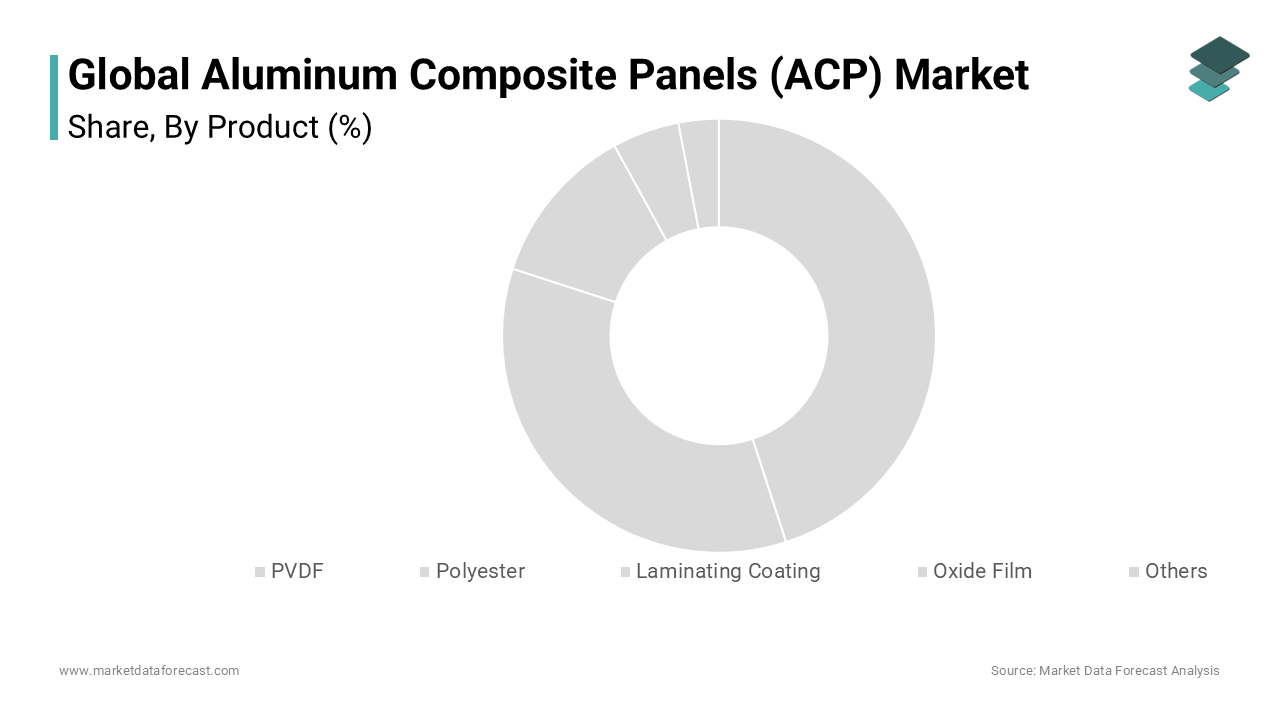
The laminating coating segment is projected to register a CAGR of 7.8% from 2025 to 2033 with the rising demand for lightweight, design-flexible panels in interior applications and retail fit-outs. Unlike paint-based coatings, laminating involves bonding decorative films or foils to aluminum surfaces, enabling intricate textures, wood grains, and custom prints without volatile organic compound (VOC) emissions. The technology also supports digital printing integration by enabling brand-specific designs in shopping malls and airports, a trend amplified by the global retail renovation wave post-pandemic.
By Application Insights
The construction segment was the largest by accounting for a dominant share of the aluminum composite panel market in 2024. The rise of high-rise buildings in megacities is a key driver; the Council on Tall Buildings and Urban Habitat (CTBUH) reported that 143 buildings of 200 meters or higher were completed globally in 2022. Additionally, green building standards such as LEED and BREEAM incentivize energy-efficient materials, and ACMs contribute by reducing structural load and improving thermal performance when combined with insulation. The U.S. Green Building Council states that over 90,000 projects worldwide are LEED-certified, many incorporating ACMs.
The automotive application segment is lucratively growing at a CAGR of 9.2% from 2025 to 2033 with the shift toward lightweight vehicle design to improve fuel efficiency and meet emissions regulations. Aluminum composite panels are increasingly used in semi-trailers, electric buses, and luxury vehicle bodies due to their strength-to-weight ratio. Companies like Mercedes-Benz and Volvo Trucks have integrated ACMs into trailer sidewalls, reducing vehicle tare weight by up to 300 kg per unit, as noted in Daimler’s 2022 sustainability report.
REGIONAL ANALYSIS
Asia Pacific Aluminum Composite Panels (ACP) Market Analysis
Asia Pacific was the top performer by accounting for global aluminum composite panel market with 52.2% of the share in 2024 with the rapid urbanization, booming infrastructure investment, and the region’s role as a manufacturing and export hub for building materials. China alone produces more than 70% of the world’s ACMs, with major players like Alcoa, China Hongwang, and Kingspan operating large-scale production facilities. Additionally, mega-events like Expo 2030 in Riyadh and the 2028 Olympics in Los Angeles are driving regional demand, with many projects sourcing ACMs from Southeast Asian suppliers due to cost efficiency and scalability.
Middle East & Africa Aluminum Composite Panels (ACP) Market Analysis
The Middle East & Africa aluminum composite panels (ACP) market growth is also growing with the visionary urban development programs in the Gulf Cooperation Council (GCC) countries. Dubai’s Museum of the Future and Abu Dhabi’s Guggenheim branch have showcased the aesthetic and functional potential of ACMs in futuristic design. Furthermore, the region’s harsh desert climate demands UV-resistant, thermally stable materials qualities inherent in high-grade PVDF-coated panels. The Gulf Standardization Organization (GSO) has mandated fire-safe and weather-resistant cladding in high-rises since 2017, boosting demand for compliant ACMs.
Europe Aluminum Composite Panels (ACP) Market Analysis
Europe aluminum composite panels (ACP) market growth is eventually to grow during the forecast period with the strong regulatory framework. The European Commission’s Green Deal mandates a 55% reduction in greenhouse gas emissions by 2030, which is influencing building material choices. ACMs with recyclable cores and low-VOC coatings are increasingly specified in public and commercial projects.
North America Aluminum Composite Panels (ACP) Market Analysis
North America aluminum composite panel market growth is likely to grow during the forecast period with the robust commercial construction and stringent building codes that favor durable, fire-compliant materials. ACMs are widely used in strip malls, airports, and hospitals due to their ease of installation and design flexibility. The adoption of International Building Code (IBC) standards, which require Class A fire-rated cladding in high-occupancy buildings, has steered demand toward fire-retardant ACMs with mineral cores.
Latin America Aluminum Composite Panels (ACP) Market Analysis
Latin America ACM market growth is likely to grow with Brazil and Mexico as key markets. Urbanization and rising middle-class demand for modern commercial spaces are key growth levers. Most ACMs are imported from Asia due to limited local production, exposing the market to currency fluctuations.
COMPETITIVE LANDSCAPE
The competition in the aluminum composite panels market is intense, shaped by technological differentiation, regional expansion, and regulatory compliance. While global players dominate with advanced product portfolios, regional manufacturers compete on cost and localization. The market is witnessing a shift from price-based competition to value-driven offerings, emphasizing fire safety, sustainability, and design flexibility. Companies are investing heavily in R&D to meet stringent building codes, especially after high-profile fire incidents linked to substandard cladding.
KEY MARKET PLAYERS
A few of the major companies in the global aluminum composite panels (ACP) market include
- 3A Composites
- Arconic Corporation
- Alucoil
- Alubond U.S.A.
- Mitsubishi Chemical Corporation
- Yaret Industrial Group
- Alstrong Enterprises India Pvt Ltd
- Jyi Shyang Industrial Co. Ltd.
- Guangzhou Xinghe ACP Co. Ltd.
- Reynobond (Arconic Architectural Products)
- Viva Composite Panel Pvt. Ltd.
- Multipanel UK Ltd.
- Hycomb Panels
- Eurobond Industries Pvt. Ltd.
- Alpolic (Mitsubishi Chemical)
Top Players in the Aluminum Composite Panels Market
Alcoa Corporation
Alcoa Corporation is a global leader in aluminum production and a key innovator in aluminum composite panels, particularly in high-performance architectural applications. In the Asia Pacific market, Alcoa has strengthened its footprint through strategic collaborations with local fabricators and distributors in China, India, and Southeast Asia. The company emphasizes sustainability by integrating recycled aluminum into its ACM products, aligning with regional green building trends. In 2023, Alcoa launched a new fire-rated ACM panel line at the China International Building Exhibition, targeting high-rise developments in megacities. It also expanded its technical support services in Singapore to assist architects and contractors with compliance and installation.
3A Composites
3A Composites is a subsidiary of Schweiter Technologies, which is renowned for its premium aluminum composite material brand, Alucobond, widely used in iconic architectural projects across the Asia Pacific. The company has deepened its regional presence by establishing technical hubs in India, Japan, and the UAE to support design integration and engineering specifications. It actively partners with architectural firms and contractors on landmark developments, including airport terminals and commercial towers in Bangkok, Mumbai, and Sydney. The company also conducts regular training programs for installers across Southeast Asia to ensure compliance with international safety standards.
Kingspan Group
Kingspan Group was headquartered in Ireland is a major player in high-performance insulation and building envelope solutions, including aluminum composite panels under its Kingspan Architectural brand. The company has focused on delivering integrated façade systems that combine ACMs with insulation for energy-efficient buildings, aligning with regional net-zero targets. In 2023, Kingspan launched a new range of low-carbon ACM panels at the Hong Kong Green Building Week, emphasizing full lifecycle sustainability.
Top Strategies Used by the Key Market Participants
Key players in the aluminum composite panels market are deploying multifaceted strategies to strengthen their global and regional positions. Product innovation is a primary focus, with companies investing in R&D to develop fire-resistant, sustainable, and lightweight panels compliant with evolving building codes. Major firms are expanding their manufacturing footprint in high-growth regions like Asia Pacific to reduce lead times and logistics costs. Strategic partnerships with architectural firms, contractors, and government bodies are being leveraged to gain project-specific advantages. Companies are also enhancing their technical support and design assistance services, including BIM modeling and façade engineering, to differentiate from competitors.
MARKET SEGMENTATION
The research report on the global aluminum composite panels (ACP) market has been segmented and sub-segmented based on categories.
By Product
- PVDF
- Polyester
- Laminating Coating
- Oxide Film
- Others
By Application
- Construction
- Automotive
- Advertising Boards
- Railways
By Region
- North America
- Europe
- Asia-Pacific
- Latin America
- Middle East and Africa