- Product Description Description
- Table of Contents TOC
- List of Table & Figure LOT
- Get Free Sample PDF Sample PDF
Market Size, 2025
$29.24 BnMarket Estimate, 2026
$30.88 BnMarket Forecast, 2034
$47.82 BnCAGR, 2026–2034
5.62%Global Aluminum Foil Market Size, Growth, Trends & Forecast (2026–2034)
The global aluminum foil market size was valued at USD 29.24 billion in 2025, is projected to reach USD 30.88 billion in 2026, and is expected to hit USD 47.82 billion by 2034, registering a compound annual growth rate (CAGR) of 5.62% during the forecast period from 2026 to 2034. Driven by the rising demand for lightweight, flexible packaging in the food and beverage sectors, the rapid expansion of electric vehicles (EVs), and renewable energy infrastructure, the market is scaling rapidly worldwide.
Key Executive Metrics (At-a-Glance)
- 2025 Base Valuation: USD 29.24 Billion
- 2026 Current Valuation: USD 30.88 Billion
- 2034 Forecast Valuation: USD 47.82 Billion
- Compound Annual Growth Rate (CAGR): 5.62% (2026–2034)
- Dominant End-Use Segment: Packaging (holding the highest market share in 2025 due to widespread applications in food preservation, pharmaceuticals, and consumer goods)
- Fastest-Growing End-Use Segment: Industrial (projected at a CAGR of 5.8%, heavily driven by the EV boom and renewable energy deployment)
- Dominant Application Segment: Wrappers (capturing 38.2% of the market share in 2025, supported by convenience foods, catering, and meal kits)
- Fastest-Growing Application Segment: Blister Packs and Pouches (projected at a CAGR of 7.2%, driven by pharmaceutical and personal care demands)
- Dominant Region: Asia Pacific (holding 37.2% of the global market share in 2025, anchored by China's massive production and consumption output)
- Second Largest Region: Europe (accounting for 24.3% of the global share in 2025, backed by established industrial and food processing sectors)
Core Market Drivers
- Rising Demand from Food Packaging: High barrier properties protecting against moisture, light, and oxygen, extending shelf life for processed and convenience foods.
- Expansion of Electrical & Electronics Sector: Accelerated adoption of lithium-ion batteries in electric vehicles (EVs), where aluminum foil serves as a lightweight, conductive current collector.
Primary Market Restraints & Challenges
- Production Emissions & Environmental Concerns: High energy intensity and greenhouse gas emissions during primary aluminum smelting, resulting in stricter compliance pressures.
- Raw Material Price Volatility: Fluctuations in bauxite and alumina supplies creating economic uncertainties and challenges for long-term manufacturing plans.
Global Aluminum Foil Market Segmentation Breakdown
| Segment Category | Leading Sub-Segment (Base Year) | Fastest-Growing Sub-Segment (2026–2034) |
|---|---|---|
| By End Use | Packaging (highest share in 2025, essential for food, dairy, meat, and pharmaceutical protection) | Industrial (5.8% CAGR, fueled by EV battery growth and green energy grid components) |
| By Application | Wrappers (38.2% share in 2025, favored for freshness, ease of use, and heat distribution) | Blister Packs and Pouches (7.2% CAGR, driven by pharma medicines and cosmetic sachets) |
| By Region | Asia Pacific (37.2% share in 2025, led by China's production, manufacturing, and e-commerce) | Middle East & Africa / Latin America (experiencing steady growth through expanding packaging & construction) |
Major Industry Players Profiled
Key global enterprises shaping the competitive aluminum foil market include Novelis Inc., Hindalco Industries Limited, Constellium N.V., Rusal, Wrisco Industries Inc., Amcor plc, Tetra Pak International S.A., China Hongqiao Group Limited, Eurofoil, Toyo Aluminium Ekco Products Co., Ltd., Plus Pack AS, and UACJ Corporation.
Global Aluminum Foil Market Size
The global aluminum foil market size was valued at USD 29.24 billion in 2025 and is expected to reach USD 47.82 billion by 2034 from USD 30.88 billion in 2026. The market is projected to grow at a CAGR of 5.62%.
The aluminum foil sheets are thin, flexible sheets of aluminum used across a wide range of industrial, commercial, and household applications. Aluminum foil is valued for its lightweight nature, excellent thermal conductivity, impermeability to light and moisture, and recyclability, making it a preferred material in packaging, construction, electrical insulation, and food preservation sectors. According to the International Aluminum Institute (IAI), aluminum recycling rates exceed 70% globally, reinforcing the material’s environmental appeal. Additionally, growing demand from the food and beverage sector where aluminum foil is extensively used for wrapping, baking, and storing perishable goods has contributed to steady market growth. In the pharmaceutical and electronics industries, aluminum foil plays a crucial role in blister packaging and heat dissipation components, further expanding its application base.
MARKET DRIVERS
Rising Demand from the Food Packaging Industry
One of the primary drivers of the Aluminum Foil Market is the growing demand from the food packaging sector, which relies heavily on aluminum foil for its excellent barrier properties against moisture, light, and oxygen. According to the U.S. Department of Agriculture (USDA), over 90% of processed food products in the United States require some form of protective packaging, with aluminum foil playing a critical role in extending shelf life and preserving freshness. The convenience food trend, especially in urban centers, has led to increased use of aluminum foil trays, wraps, and containers. In addition, the rise in e-commerce and home meal delivery services has further amplified the need for durable, temperature-resistant packaging solutions.
Expansion of the Electrical and Electronics Sector
Another key driver fueling the growth of the Aluminum Foil Market is the rapid expansion of the electrical and electronics industry, where aluminum foil is widely used in capacitors, transformers, and battery components. In particular, the electric vehicle (EV) boom has significantly impacted aluminum foil consumption. Lithium-ion batteries used in EVs often employ aluminum foil as a current collector due to its lightweight and high conductivity.
MARKET RESTRAINTS
Environmental Concerns Related to Production Emissions
One of the major restraints affecting the Aluminum Foil Market is the environmental impact associated with aluminum production, particularly the high carbon emissions generated during the smelting process. According to the International Energy Agency (IEA), aluminum production accounts for nearly 2% of global greenhouse gas emissions, with primary aluminum smelting being one of the most energy-intensive industrial processes. This has led to increasing scrutiny from environmental regulators and sustainability-focused consumers. Moreover, while aluminum is highly recyclable, not all regions have the necessary infrastructure to support large-scale recycling initiatives. In developing economies, where waste collection and sorting systems are still evolving, a significant portion of post-consumer aluminum ends up in landfills rather than being reprocessed.
As pressure mounts from policymakers and environmental organizations to reduce industrial carbon footprints, manufacturers in the aluminum foil market face rising compliance costs and potential restrictions on new production facilities, which could hinder market expansion in certain regions.
Volatility in Raw Material Prices
Another significant restraint impacting the Aluminum Foil Market is the volatility in raw material prices, particularly fluctuations in alumina and bauxite supply. Since aluminum is derived from bauxite ore through an energy-intensive refining process, any disruptions in the supply chain can lead to sharp price increases. Geopolitical tensions, export restrictions, and regulatory changes in key producing nations also contribute to price instability. These economic pressures make long-term planning difficult for manufacturers and can limit market growth, especially for smaller players without access to hedging mechanisms or vertically integrated supply chains.
MARKET OPPORTUNITIES
Growing Adoption in Flexible and Sustainable Packaging Solutions
A major opportunity emerging in the Aluminum Foil Market is the increasing adoption of aluminum foil in flexible and sustainable packaging formats. As global awareness of environmental issues rises, companies are seeking alternatives to single-use plastics, and aluminum foil offers a viable solution due to its recyclability and ability to preserve product integrity. According to the Ellen MacArthur Foundation, only 14% of plastic packaging is effectively collected for recycling globally, prompting brands to explore metal-based alternatives. Aluminum foil’s ability to be repeatedly recycled without degradation makes it an attractive choice for environmentally conscious manufacturers. Additionally, the rise of premium and organic food markets has spurred demand for high-barrier packaging materials that protect product quality while aligning with sustainability goals. Beyond food packaging, aluminum foil is gaining traction in pharmaceutical blister packs and cosmetic sachets, where tamper resistance and product protection are essential.
Increasing Use in Battery and Energy Storage Technologies
The rapid development of battery and energy storage technologies presents a substantial growth opportunity for the Aluminum Foil Market. Aluminum foil is a critical component in lithium-ion and solid-state batteries, serving as a lightweight and conductive current collector for positive electrodes. Automotive manufacturers are increasingly adopting aluminum foil-based battery designs to reduce vehicle weight and improve energy efficiency. Companies like Tesla and BYD have incorporated advanced aluminum foil technologies into their battery modules to enhance performance and extend driving range. Moreover, research institutions and industry leaders are exploring ultra-thin aluminum foils that offer higher conductivity and better thermal management capabilities. In addition to electric vehicles, stationary energy storage systems for solar and wind farms are creating new demand channels. Governments investing in grid stability and clean energy transition programs are accelerating the deployment of large-scale battery installations that rely on aluminum foil components.
MARKET CHALLENGES
Regulatory Pressure and Compliance Requirements
One of the major challenges confronting the Aluminum Foil Market is the increasing regulatory scrutiny aimed at reducing industrial emissions and promoting sustainable manufacturing practices. Governments around the world are implementing stricter environmental policies to curb carbon footprints and encourage resource efficiency. According to the European Environment Agency (EEA), the European Union has set ambitious targets under the Green Deal initiative, aiming for a 55% reduction in greenhouse gas emissions by 2030. Similar regulatory frameworks are being adopted in North America and parts of Asia-Pacific, placing pressure on aluminum producers to adopt cleaner production methods.
These regulations often result in higher operational costs for manufacturers, as they must invest in emission control technologies, switch to renewable energy sources, and comply with extended producer responsibility (EPR) laws that mandate recycling and waste management measures. The Aluminum Association notes that compliance with these evolving standards may slow down the approval of new production facilities, particularly in regions with stringent environmental oversight.
Intensifying Competition from Alternative Materials
Another significant challenge facing the Aluminum Foil Market is the growing competition from alternative materials such as plastic films, paper-based composites, and biodegradable polymers. As industries seek cost-effective and lighter-weight packaging options, substitutes to aluminum foil are gaining traction, particularly in non-critical applications where barrier properties are less essential.
Furthermore, advancements in bio-based and compostable materials are attracting attention from sustainability-conscious consumers and businesses. Companies in the food service and retail sectors are experimenting with plant-derived films that offer similar functionality to aluminum foil but with lower environmental impact.
REPORT COVERAGE
| REPORT METRIC | DETAILS |
| Market Size Available | 2025 to 2034 |
| Base Year | 2025 |
| Forecast Period | 2026 to 2034 |
| CAGR | 5.62% |
| Segments Covered | By End Use, Application, and Region |
| Various Analyses Covered | Global, Regional, & Country Level Analysis; Segment-Level Analysis; DROC; PESTLE Analysis; Porter’s Five Forces Analysis; Competitive Landscape; Analyst Overview of Investment Opportunities |
| Regions Covered | North America, Europe, APAC, Latin America, Middle East & Africa |
|
Market Leaders Profiled | Rusal, Wrisco Industries Inc., PECTEC Corporation, Amcor plc, Tetra Pak International S.A., China Hongqiao Group Limited, Arnold Magnetic Technologies, Coppice Alupack Ltd., Zenith Alluminio Srl, Eurofoil, Toyo Aluminium Ekco Products Co., Ltd., Hindalco Industries Ltd., Danpak, Plus Pack AS, Hubei HYD Aluminum Co., Ltd., Southern Aluminium Industry (China) Co., Ltd., and others. |
SEGMENTAL ANALYSIS
By End Use Insights
The packaging segment dominated the global Aluminum Foil Market with highest share in 2025 with the widespread use of aluminum foil in food and beverage, pharmaceutical, and consumer goods packaging applications. Aluminum foil’s impermeability to moisture, light, and oxygen makes it an ideal material for high-barrier packaging solutions, especially in perishable food items such as dairy products, meats, and baked goods. Additionally, the rise in ready-to-eat meals, frozen foods, and premium organic packaging has further boosted demand. In the pharmaceutical sector, blister packs made from aluminum foil are extensively used for tablet and capsule packaging due to their tamper-proof nature and ability to protect against environmental degradation.
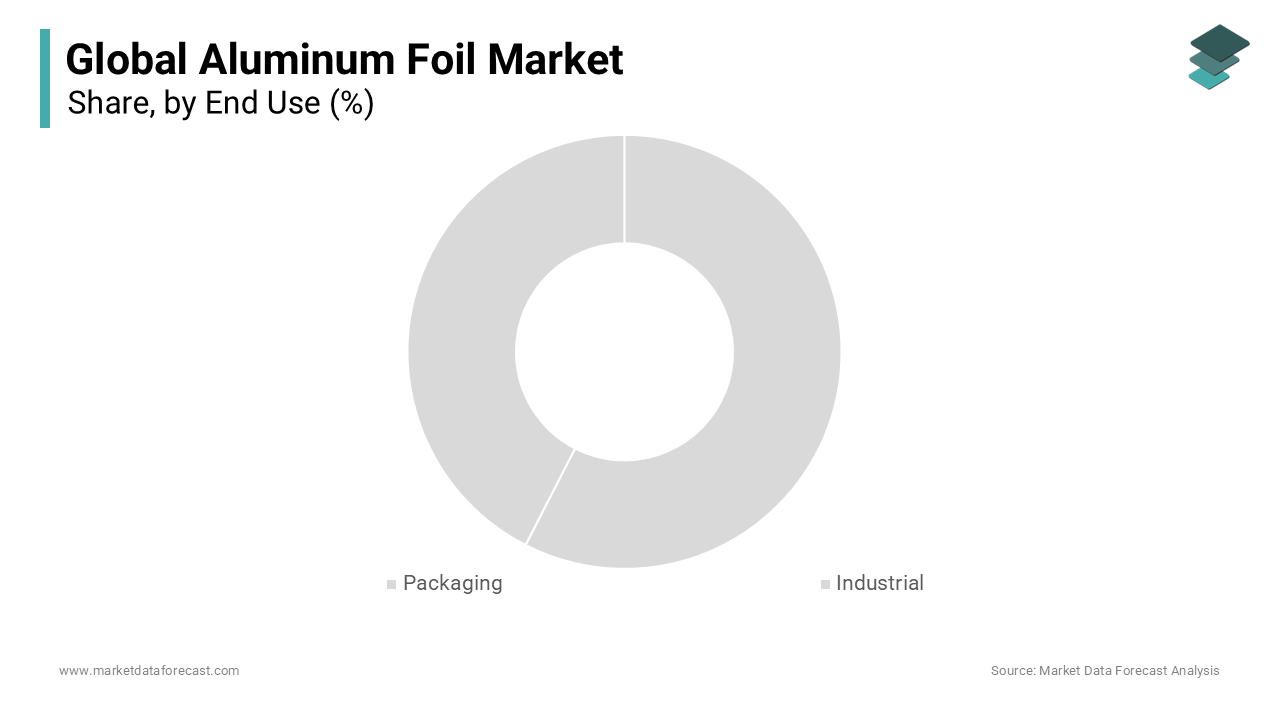
The industrial application segment is emerging with a CAGR of 5.8% throughout the forecast period. According to BloombergNEF, global battery demand is expected to grow by more than 30% annually through 2030, largely driven by the electric vehicle (EV) boom and renewable energy infrastructure expansion. Each EV battery requires around 20 kilograms of aluminum foil as a lightweight current collector, according to the Aluminum Association, making this one of the most dynamic growth areas. Furthermore, the adoption of aluminum foil in HVAC systems, insulation materials, and solar panel components is gaining momentum. Governments investing in smart grid technologies and green building standards are accelerating the deployment of aluminum foil-based industrial solutions.
By Application Insights
The wrappers segment held 38.2% of the Aluminum Foil Market share in 2025. One of the primary drivers of this segment’s dominance is the growing preference for convenience foods and ready-to-cook meal kits, which often incorporate aluminum foil wrappers to maintain freshness and ease of use. The U.S. Food and Drug Administration (FDA) recognizes aluminum foil as a safe and inert packaging material, reinforcing its widespread acceptance among consumers and food service providers.
Moreover, the hospitality and catering industries rely heavily on aluminum foil wrappers for portion control, heat retention, and presentation purposes. A report by the National Restaurant Association indicates that over 70% of professional chefs prefer using aluminum foil for oven-based cooking due to its superior heat distribution and non-reactive nature.
The blister packs and pouches segment in the Aluminum Foil Market is likely to witness a CAGR of 7.2% during the forecast period. This surge is primarily driven by rising demand in the pharmaceutical and personal care industries, where aluminum foil blister packs offer excellent protection against moisture, light, and contamination.
Pharmaceutical manufacturers increasingly rely on aluminum foil-based blister packaging to ensure the integrity and longevity of tablets, capsules, and other solid dosage forms. According to the World Health Organization (WHO), blister packs have become the preferred packaging format for medicines in both developed and emerging markets due to their portability, tamper-evident features, and individual dose tracking capabilities. In addition to pharmaceuticals, the cosmetics and nutraceutical sectors are adopting aluminum foil pouches for single-use sachets of creams, serums, supplements, and probiotics. These pouches provide extended shelf life while allowing for convenient and hygienic product dispensing.
REGIONAL ANALYSIS
Asia Pacific
Asia Pacific held 37.2% of the global Aluminum Foil Market share in 2025. According to the China Nonferrous Metals Industry Association (CNIA), China alone accounts for nearly 30% of global aluminum production, making it the world’s largest consumer and exporter of aluminum foil products. Additionally, the rise of e-commerce and food delivery services has fueled the need for durable, temperature-resistant packaging solutions, further boosting aluminum foil consumption. Governments in Southeast Asia are also promoting the use of sustainable packaging materials as part of broader environmental policies.
Europe
Europe was accounted in holding 24.3% of the global Aluminum Foil Market share in 2025. European countries such as Germany, Italy, and France lead in aluminum foil consumption due to their well-established food processing, pharmaceutical, and automotive industries. Additionally, the push toward reducing plastic waste has prompted major retailers and food brands to switch to aluminum foil-based alternatives. Companies like Nestlé and Unilever have announced initiatives to phase out non-recyclable plastics in favor of metal-based packaging, further strengthening the market position of aluminum foil in Europe.
North America
North America aluminum foil market growth is driven by mature industrial sectors and high adoption rates in packaging, aerospace, and electronics applications. The United States is a major consumer of aluminum foil due to its large food and beverage industry and extensive use in pharmaceutical packaging. Technological advancements in lightweight battery foils for electric vehicles are also fueling market expansion. Automotive giants such as Tesla and Ford are incorporating ultra-thin aluminum foils into their battery modules to enhance energy density and reduce weight.
Middle East & Africa
The Middle East and Africa Aluminum Foil Market is likely to hva eprominet steady growth opportunities with the expanding construction, food packaging, and industrial sectors. Countries like Saudi Arabia, UAE, and Egypt are witnessing increased demand for aluminum foil in food service, retail, and pharmaceutical packaging. According to the Gulf Petrochemicals and Chemicals Association (GPCA), the GCC region has seen a 6% annual increase in food packaging consumption since 2020.
Latin America
Latin America Aluminum Foil Market growth is majorly driven by the consistent growth in packaging, construction, and consumer goods applications. Brazil and Mexico are the leading consumers in the region, driven by expanding food processing industries and increasing adoption of sustainable packaging solutions. According to the Brazilian Aluminum Association (ABAL), domestic aluminum foil consumption has grown by nearly 4% annually over the past five years.
The rise in fast-food chains and online grocery delivery services in cities like São Paulo, Mexico City, and Bogotá has heightened demand for aluminum foil trays and wraps that ensure food safety and thermal protection. Moreover, the pharmaceutical industry in Argentina and Chile is increasingly utilizing aluminum foil blister packs to meet international quality standards.
KEY MARKET PLAYERS AND COMPETITIVE LANDSCAPE
Rusal, Wrisco Industries Inc., PECTEC Corporation, Amcor plc, Tetra Pak International S.A., China Hongqiao Group Limited, Arnold Magnetic Technologies, Coppice Alupack Ltd., Zenith Alluminio Srl, Eurofoil, Toyo Aluminium Ekco Products Co., Ltd., Hindalco Industries Ltd., Danpak, Plus Pack AS, Hubei HYD Aluminum Co., Ltd., Southern Aluminium Industry (China) Co., Ltd., and Zhejiang Junma Aluminum Industry Co., Ltd. are the key players in the global aluminum foil market.
The competition in the Aluminum Foil Market is characterized by a mix of established global players and regionally focused manufacturers vying for dominance through innovation, sustainability, and operational efficiency. Multinational corporations such as Novelis, Hindalco, and Constellium maintain strong footholds due to their extensive production capabilities, broad product portfolios, and robust R&D initiatives. However, regional players in China, India, and Eastern Europe are gaining traction by offering cost-competitive alternatives and leveraging local supply chains.
Market participants are differentiating themselves through product specialization, with an increasing focus on ultra-thin foils for electronics and battery applications, as well as eco-friendly packaging solutions that cater to shifting consumer preferences. Strategic moves such as mergers, joint ventures, and capacity expansions are becoming more frequent as companies seek to strengthen their global presence and secure raw material supplies.
Regulatory pressures related to environmental compliance and resource efficiency are reshaping competitive dynamics, compelling firms to invest in cleaner production methods and circular economy models. Additionally, advancements in coating technologies, automation, and digital manufacturing tools are enabling companies to improve product consistency and reduce waste. As demand from sectors like electric mobility, renewable energy, and smart packaging continues to rise, the Aluminum Foil Market remains highly dynamic and increasingly innovation-driven.
TOP PLAYERS IN THE MARKET
Novelis Inc.
Novelis is a global leader in aluminum rolling and recycling, playing a pivotal role in shaping the Aluminum Foil Market through its sustainable production practices and extensive product portfolio. The company supplies high-quality aluminum foil to key industries including packaging, automotive, and construction. With a strong presence across North America, Europe, and Asia, Novelis has been instrumental in advancing closed-loop recycling systems that reduce raw material dependency and environmental impact.
The company’s focus on innovation and customer-specific solutions has strengthened its market position. Novelis supports evolving industry demands while reinforcing its dominance in the global aluminum value chain by investing in advanced coating technologies and lightweighting initiatives.
Hindalco Industries Limited
Hindalco, a flagship company of the Aditya Birla Group, is one of the largest integrated producers of aluminum products globally. It plays a crucial role in the Aluminum Foil Market by offering a wide range of foil products tailored for food packaging, pharmaceuticals, and industrial applications. Hindalco's vertically integrated operations enable cost-effective production and consistent quality, making it a preferred supplier in emerging markets.
The company has consistently invested in R&D to develop ultra-thin foils with superior strength and barrier properties. Its strategic expansion into Southeast Asia and Africa has enhanced regional supply chain capabilities, which is further strengthening its footprint in the global aluminum foil landscape.
Constellium N.V.
Constellium is a major participant in the Aluminum Foil Market, known for its high-performance foil products used in flexible packaging, industrial applications, and aerospace components. The company emphasizes technological innovation and sustainability by offering recyclable aluminum solutions that align with global environmental goals.
Constellium’s deep expertise in precision rolling and surface engineering enables it to deliver customized foil grades for demanding applications such as battery components and thermal management systems. Through strategic partnerships and continuous investment in advanced manufacturing facilities, Constellium reinforces its competitive edge and contributes significantly to the evolution of the aluminum foil markets.
TOP STRATEGIES USED BY KEY MARKET PLAYERS
Key players in the Aluminum Foil Market are adopting strategic approaches to reinforce their market positions and drive long-term growth. One of the most prevalent strategies is expanding production capacities and investing in green manufacturing, where companies are upgrading smelting and rolling facilities to enhance efficiency while reducing carbon emissions. This aligns with global sustainability trends and regulatory mandates pushing for cleaner industrial practices.
Another critical strategy involves product innovation and development of specialized foil grades tailored to niche applications such as electric vehicle batteries, high-barrier food packaging, and medical blister packs. Companies are collaborating with research institutions and end-use industries to engineer ultra-thin, high-strength, and corrosion-resistant foils that meet evolving performance standards.
The strengthening supply chain resilience through vertical integration and strategic acquisitions has become a priority. Leading manufacturers are securing upstream bauxite and alumina sources and expanding downstream distribution networks to ensure stable feedstock availability and improved market responsiveness. These initiatives collectively enhance competitiveness and support sustained growth in the global aluminum foil sector.
RECENT HAPPENINGS IN THE MARKET
- In March 2023, Novelis announced a multi-million-dollar investment to expand its aluminum foil production facility in South Carolina, aiming to increase capacity for high-value packaging foils and meet growing demand from North American food and beverage clients.
- In August 2023, Hindalco launched a new line of ultra-thin aluminum foils specifically designed for use in lithium-ion battery components, marking a strategic shift toward supporting clean energy applications and expanding beyond traditional packaging markets.
- In January 2025, Constellium introduced a proprietary coated aluminum foil technology aimed at enhancing moisture resistance and extending shelf life for perishable food products, positioning itself as a leader in premium packaging solutions.
- In September 2025, UACJ Corporation expanded its European operations by acquiring a specialty foil manufacturer based in Germany, strengthening its foothold in the pharmaceutical and industrial foil segments across the continent.
- In May 2026, Aleris partnered with a leading electric vehicle battery manufacturer to co-develop next-generation aluminum foils optimized for higher conductivity and reduced weight, reinforcing its role in the EV supply chain and accelerating growth in the industrial application segment.
- In April 2025, Granges AB, a Swedish manufacturer specializing in rolled aluminum products, acquired a specialty foil producer in Italy to enhance its presence in the European pharmaceutical packaging sector. This acquisition is expected to allow Granges to offer more advanced aluminum foil solutions and strengthen their market position in high-growth applications.
MARKET SEGMENTATION
This research report on the global aluminum foil market has been segmented and sub-segmented based on end use, application, and region.
By End Use
- Packaging
- Industrial
By Application
- Wrapper
- Container
- Blister packs
- Pouches
By Region
- North America
- Europe
- Asia Pacific
- Latin America
- Middle East & Africa