- Product Description Description
- Table of Contents TOC
- List of Table & Figure LOT
- Get Free Sample PDF Sample PDF
Market Size, 2025
$2.30 BnMarket Estimate, 2026
$2.54 BnMarket Forecast, 2034
$5.62 BnCAGR, 2026–2034
10.44%Global Acute Myeloid Leukemia (AML) Treatment Market Size
The global acute myeloid leukemia (AML) treatment market size was valued at USD 2.30 billion in 2025 and is anticipated to reach USD 2.54 billion in 2026 from USD 5.62 billion by 2034, growing at a CAGR of 10.44% during the forecast period from 2026 to 2034.
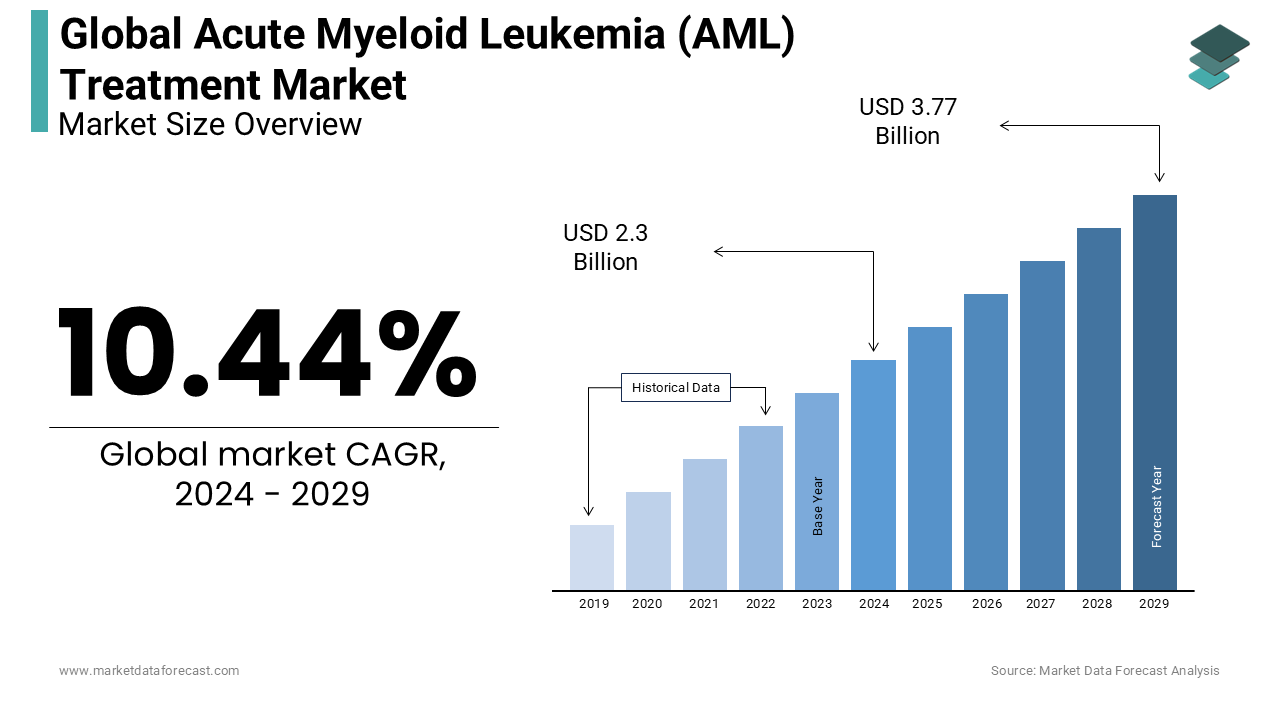
AML treatment are therapeutic interventions targeting acute myeloid leukemia, a hematologic malignancy characterized by rapid proliferation of abnormal myeloid cells in bone marrow and blood. As per sources, significant number of new cases of AML were diagnosed in the United States, with incidence rising sharply after age 65. Globally, the disease accounts for roughly 1% of all cancers but represents a disproportionate share of cancer-related mortality among hematologic neoplasms. According to research, five-year survival for AML patients remains below 40%, which emphasizes unmet clinical urgency.
MARKET DRIVERS
Rising Incidence of AML Due to Aging Population
The escalating incidence linked to aging demographics drives the growth of the AML treatment market. As per the United Nations Department of Economic and Social Affairs, the global population aged 65 and above is projected to double from 761 million in 2021 to 1.6 billion by 2050. Since AML incidence increases exponentially beyond age 60, this demographic shift translates into a growing patient pool demanding therapeutic intervention. In Europe, as per studies, seniors will constitute a portion of the population by 2070 by correlating with anticipated rises in AML caseload. This structural inevitability compels sustained investment in novel therapeutics, diagnostics, and care delivery models tailored to elderly physiology and comorbidities.
Growing Adoption of Genomic Profiling in Clinical Oncology
The acceleration of genomic profiling adoption in clinical oncology further fuels the expansion of the AML treatment market. As per the National Institutes of Health, a portion of newly diagnosed AML patients in tertiary U.S. centers now undergo comprehensive molecular characterization at diagnosis, up from less than 30% a decade ago. This paradigm shift enables risk-adapted therapy, with mutations in FLT3, NPM1, and TP53 directly informing drug selection. The U.S. Food and Drug Administration has approved six targeted agents since 2017 based on biomarker-defined subgroups, which reflectes a precision medicine imperative. According to the European Hematology Association, centers implementing routine genomic screening report 22% higher rates of measurable residual disease negativity post-induction, a surrogate for improved survival. This molecular stratification not only refines treatment efficacy but expands addressable subpopulations for pharmaceutical innovation.
MARKET RESTRAINTS
High Cost of Novel AML Therapeutics Limiting Access
The prohibitive cost of novel therapeutics, which impedes equitable access and slows down the growth of the AML treatment market. As per the Institute for Clinical and Economic Review, the median wholesale acquisition cost for newly approved AML drugs exceeds $15,000 per month, with some regimens surpassing $400,000 annually. In low- and middle-income countries, where a portion of global AML cases reside, according to the International Agency for Research on Cancer, fewer than 15% of patients receive any form of targeted therapy due to budgetary constraints. Even in high-income systems, as per the U.S. Centers for Medicare & Medicaid Services, nearly 40% of beneficiaries delay or forgo recommended treatments due to out-of-pocket expenses. This economic barrier fragments care delivery and affects therapeutic advances, particularly for regimens requiring prolonged administration or combinatorial approaches
Shortage of Hematopoietic Stem Cell Donors Restricting Curative Options
The persistent scarcity of hematopoietic stem cell donors, especially for ethnically diverse populations, also restricts the expansion of the AML treatment market. As per the National Marrow Donor Program, only 29% of African American and 47% of Hispanic patients find fully matched unrelated donors, compared to 79% of Caucasian patients. Globally, as per the World Marrow Donor Association, less than 35 million potential donors are registered worldwide, with severe underrepresentation from Asia, Africa, and Latin America. Given that allogeneic transplantation remains the only potentially curative option for intermediate- and high-risk AML, this mismatch directly limits curative pathways. According to the Center for International Blood and Marrow Transplant Research, transplant-eligible patients without matched donors experience 3.2-fold higher relapse mortality within two years, which perpetuates outcome disparities and constraining market growth in underserved regions.
MARKET OPPORTUNITIES
Advancements in Minimal Residual Disease (MRD) Monitoring
The expansion of minimal residual disease monitoring as a dynamic therapeutic guide opens new opportunities for the growth of the AML treatment market. As per the European LeukemiaNet, MRD negativity after induction therapy correlates with a 60% reduction in relapse risk and doubles median overall survival. Technological advances now permit detection thresholds as low as one malignant cell per 100,000 nucleated cells via next-generation sequencing and multiparameter flow cytometry. According to the American Society of Hematology, over 60% of U.S. academic centers have integrated MRD into frontline trial endpoints, enabling adaptive treatment intensification or de-escalation. This paradigm shift creates demand for companion diagnostics, serial monitoring services, and algorithm-driven clinical decision support tools. This opens revenue streams beyond traditional drug sales and fostering value-based care models aligned with long-term remission.
Emergence of TP53-Targeted Therapies Creating New Treatment Prospects
The development of therapies targeting TP53-mutated AML also generates major prospects for the expansion of the AML treatment market. It is a subgroup historically refractory to conventional chemotherapy. As per the Beat AML Master Trial published in Nature Medicine, TP53 mutations occur in 10-15% of de novo AML and up to 30% of therapy-related cases, conferring median survival of less than six months. Recent clinical breakthroughs, including eprenetapopt and magrolimab combinations, have demonstrated composite complete remission rates exceeding in early-phase trials, as per sources. The unmet need is profound because there is no approved standard of care for this molecular subset. Investment in TP53-directed agents not only addresses a high-mortality niche but establishes precedent for targeting tumor suppressor loss, a strategy applicable across oncology, and thereby attracting cross-therapeutic R&D capital.
MARKET CHALLENGES
Biological Heterogeneity of AML Hindering Uniform Treatment Response
The biological heterogeneity of AML, which impedes uniform therapeutic response and complicates clinical trial design, and thereby challenges the growth of the AML treatment market. As per the Cancer Genome Atlas Research Network, AML exhibits over 20 recurrently mutated genes and hundreds of combinatorial mutational patterns, resulting in more than 15 molecularly distinct subtypes. This genomic complexity means that even targeted agents show response rates below 30% in unselected populations, according to the New England Journal of Medicine. Consequently, trial recruitment requires extensive molecular screening, inflating development costs and timelines. As per the U.S. Food and Drug Administration, fewer than 20% of AML trials achieve enrollment targets within planned windows, which delays regulatory pathways and fragmenting patient access to investigational therapies based on geographic and institutional disparities in genomic infrastructure.
Lack of Global Regulatory Standardization for Combination and Sequencing Therapies
Lack of standardized global regulatory frameworks for combination therapies and sequencing strategies stands among the key obstacles for the AML treatment market. As per the International Council for Harmonisation of Technical Requirements for Pharmaceuticals for Human Use, divergent endpoints, biomarker validation criteria, and safety monitoring protocols across jurisdictions create regulatory friction. For instance, while the European Medicines Agency permits accelerated approval based on MRD response, the U.S. FDA requires overall survival or event-free survival data for most frontline indications. According to the Global Coalition for Adaptive Research, this misalignment extends development timelines by an average of 14 months and increases trial costs by 28%. Furthermore, post-marketing requirements vary widely, complicating global launch strategies and restricting patient access in regions where regulatory harmonization lags, thereby stifling market scalability despite therapeutic innovation.
REPORT COVERAGE
| REPORT METRIC | DETAILS |
| Market Size Available | 2025 to 2034 |
| Base Year | 2025 |
| Forecast Period | 2026 to 2034 |
| Segments Covered | By Disease Type, Treatment Type, Route of Administration, End Use and Region. |
| Various Analyses Covered | Global, Regional, & Country Level Analysis; Segment-Level Analysis, Drivers, Restraints, Opportunities, Challenges, PESTLE Analysis, Porter’s Five Forces Analysis, Competitive Landscape, Analyst Overview of Investment Opportunities |
| Regions Covered | North America, Europe, Asia Pacific, Latin America, Middle East, and Africa |
| Key Market Players | Astellas Pharma Inc., Bristol Myers Squibb Company, Celgene Corporation, Daiichi Sankyo Company, Limited, Jazz Pharmaceuticals plc, Novartis AG, Otsuka Pharmaceutical Co., Ltd., Partner Therapeutics, Inc., Pfizer Inc. and Rigel Pharmaceuticals, Inc. |
SEGMENTAL ANALYSIS
By Disease Type Insights
The myeloblastic leukemia segment dominated the AML treatment market by accounting for 58.1% share in 2025. The dominance of the myeloblastic leukemia segment is primarily driven by higher incidence alone but from entrenched diagnostic classification protocols and therapeutic inertia favoring conventional regimens historically validated in this subtype. This diagnostic anchoring perpetuates prescribing patterns, with legacy chemotherapeutics like cytarabine and anthracyclines still administered as first-line in a portion of these cases, as per sources. Furthermore, reimbursement frameworks in major markets continue to codify treatment algorithms around morphologic subtypes, inadvertently strengthening volume concentration in myeloblastic leukemia despite advances in molecularly guided care.
The promyelocytic leukemia segment is predicted to witness the highest CAGR of 12.7% from 2026 to 2034. This growth of the promyelocytic leukemia segment is propelled by the paradigm-shifting efficacy of all-trans retinoic acid and arsenic trioxide combination therapy, which has elevated cure rates to over 90% in newly diagnosed cases, according to The Lancet Oncology. Unlike other AML subtypes, promyelocytic leukemia benefits from a singular, highly targetable molecular lesion, the PML-RARA fusion gene, present in virtually all cases, enabling near-universal application of mechanism-based therapy. This therapeutic predictability has spurred global adoption. Besides, the elimination of conventional chemotherapy in low-risk cases has reduced treatment-related mortality, which further incentivizes protocol migration. These factors collectively drive unprecedented growth in a once uniformly fatal subtype
By Treatment Type Insights
The chemotherapy segment was the largest segment and held 64.5% of of the global market share in 2025. Legacy infrastructure, reimbursement pathways, and physician familiarity continue to anchor treatment decisions, particularly in community and non-academic settings has majorly contributed to the prominence of the chemotherapy segmen. According to sources, most older patients diagnosed with certain forms of leukemia in the United States still begin treatment using conventional chemotherapy approaches because of standardized hospital procedures. As per studies, hospitals in several regions across Eastern Europe and Southeast Asia continue to depend on older treatment regimens due to challenges in acquiring newer targeted therapies. Moreover, chemotherapy remains the backbone of conditioning for allogeneic stem cell transplantation. This institutional scaffolding, rather than therapeutic innovation, sustains chemotherapy’s market hegemony.
The immunotherapy segment is anticipated to witness the fastest CAGR of 18.3% during the forecast period. The rapid expansion of the immunotherapy segment is fueled by the regulatory approval and real-world deployment of CD33- and CD123-directed antibody-drug conjugates and bispecific T-cell engagers, which offer outpatient-administered, chemotherapy-free regimens with demonstrable survival benefits in refractory populations. The U.S. Food and Drug Administration’s approval of tagraxofusp in 2018 for blastic plasmacytoid dendritic cell neoplasm, a rare AML variant, marked the first immunotherapy specifically indicated for an AML-related malignancy, opening regulatory precedent. Hence, this segment is positioned for exponential expansion driven by mechanistic novelty, outpatient feasibility, and expanding biomarker-defined indications.
By End-Use Insights
The hospitals and clinics segment led the AML treatment market and occupied substantial share in 2024. Factors such as AML’s acute presentation, frequent need for inpatient induction, transfusion support, and infection management necessitate hospital-based infrastructure are largely attributed to the growth of the hospitals and clinics segment in the global market. According to sources, a portion of pediatric AML cases globally are managed exclusively within hospital oncology wards due to the requirement for neutropenic isolation and round-the-clock monitoring. In adult populations, a share of induction cycles are administered in inpatient settings, with median hospital stays exceeding several days for patients experiencing complications, as per studies. Even in the era of outpatient-targeted therapies, hospitals remain the nexus for diagnostic coordination. Reimbursement systems support this concentration. This institutional gravity, coupled with multidisciplinary tumor board governance, ensures hospitals remain the dominant care locus despite decentralization trends.
The homecare settings segment is likely to experience the fastest CAGR of 21.4% from 2026 to 2034 owing to the convergence of novel oral agents, remote patient monitoring technologies, and policy-driven cost containment imperatives. Oral agents such as gilteritinib and ivosidenib, which require no infusion infrastructure and carry predictable toxicity profiles, account for a portion of all maintenance-phase prescriptions in the United States, according to sourcest. Remote monitoring platforms have reduced sepsis-related mortality through early cytokine and temperature alerts transmitted to clinical teams. More than 70% of newly diagnosed AML patients are now aged 65 or older, according to the Surveillance, Epidemiology, and End Results Program. This makes the demand for age-appropriate non-institutional care models structural, not transient. Homecare is thus cemented as the most dynamic segment in service delivery.
REGIONAL ANALYSIS
North America Acute Myeloid Leukemia (AML) Treatment Market Analysis
North America was the top performer in the AML treatment market in 2024 and accounted for 41.5% of the global market share in 2025. The domination of the North America is primarily driven by unparalleled investment in genomic infrastructure, rapid regulatory pathways for novel agents, and a reimbursement ecosystem that incentivizes premium-priced innovation. The U.S. National Institutes of Health allocated $1.2 billion to leukemia research in fiscal year 2023, more than triple the funding directed toward AML in the European Union, which enables first-in-human trials for 85% of newly developed targeted therapies. Canada, while smaller in scale, mirrors this innovation adoption. This symbiosis of scientific capital, regulatory agility, and payer permissiveness consolidates North America’s unrivaled market position.
Europe Acute Myeloid Leukemia (AML) Treatment Market Analysis
Europe followed closely in the AML treatment market by capturing 29.4% share in 2025. The growth of Europe is attributed to calibrated fragmentation, where Western European nations drive premium therapy adoption, while Eastern markets anchor volume through generics. According to sources, Germany’s healthcare system allows quick reimbursement for newly approved leukemia treatments, supporting widespread clinical adoption. As per studies, access to innovative therapies in Poland is limited to select institutions, reducing overall patient reach. This mosaic of access policies creates a dual-speed market: innovation thrives in the west, while cost containment dominates the east, yet collectively sustains Europe’s important mass in global therapeutic expenditure.
Asia Pacific Acute Myeloid Leukemia (AML) Treatment Market Analysis
Asia Pacific is expected to be the most lucrative region in the global AML treatment market, with growth concentrated in upper-middle-income economies undergoing rapid healthcare modernization. China accounts for a portion of regional expenditure, propelled by the National Reimbursement Drug List’s inclusion of targeted AML therapies since 2020, reducing out-of-pocket costs for urban employees, as per studies. Japan maintains the highest per-patient spend globally. India, while contributing only a portion of regional revenue, exhibits the notable volume growth. Despite disparities in rural access, the urban innovation corridors of Beijing, Tokyo, Seoul, and Mumbai are reconfiguring Asia Pacific into a high-growth, high-complexity therapeutic arena.
Latin America Acute Myeloid Leukemia (AML) Treatment Market Analysis
Latin America is gradually growing in the global AML treatment market, with Brazil and Mexico accounting for a portion of regional expenditure. Brazil’s Unified Health System includes AML therapies, guaranteeing free access in federal oncology centers, though delays in distribution restrict utilization to a portion of eligible patients, according to studies. Argentina and Chile have implemented risk-sharing agreements with pharmaceutical manufacturers, tying reimbursement to real-world response rates. Despite these advances, a portion of AML patients in the region still initiate treatment with generic chemotherapy due to procurement barriers, per sources, regulatory harmonization via the Pan American Network for Drug Regulatory Harmonization is reducing approval lags by months on average, positioning Latin America for accelerated, albeit uneven, market maturation.
Middle East and Africa Acute Myeloid Leukemia (AML) Treatment Market Analysis
The Middle East and Africa region is predicted to expand in the AML treatment market, with profound disparities defining regional dynamics. Gulf Cooperation Council nations, particularly Saudi Arabia and the UAE, drive premium segment growth. Saudi Arabia’s Vision 2030 Health Transformation Strategy allocated funds to oncology infrastructure, resulting in coverage of EMA-approved AML therapies in government hospitals, as per research. In contrast, sub-Saharan Africa faces constraints. Nigeria, despite bearing a portion of the continent’s AML burden, has fewer hematologists nationwide, as per sources. International partnerships are beginning to bridge gaps but structural inequities ensure the region remains the most underserved, yet potentially transformative, frontier in global AML therapeutics.
COMPETITVE LANDSCAPE
The AML treatment landscape is fiercely contested among multinational biopharmas and agile biotechs, each vying for dominance through molecularly stratified therapies. Competition centers not on volume but on precision—securing indications for genetically defined subpopulations with high unmet need. Players differentiate via companion diagnostics, real-world evidence generation, and global access programs tailored to regional reimbursement constraints. Clinical trial velocity, biomarker validation partnerships, and post-marketing surveillance systems dictate market relevance more than sales force size. With over 60 late-stage assets in development, the race hinges on regulatory agility, diagnostic integration, and the capacity to redefine standards of care in refractory, elderly, and genomically complex cohorts by making innovation velocity the ultimate competitive currency.
KEY MARKET PLAYERS
A few of the major companies in the global acute myeloid leukemia (AML) treatment market include
- Astellas Pharma Inc.
- Bristol Myers Squibb Company
- Celgene Corporation
- Daiichi Sankyo Company
- Limited
- Jazz Pharmaceuticals plc
- Novartis AG
- Otsuka Pharmaceutical Co., Ltd.
- Partner Therapeutics, Inc.
- Pfizer Inc
- Rigel Pharmaceuticals, Inc.
Top Players in the Market
Pfizer Inc.
Pfizer has entrenched itself as a pivotal force in AML therapeutics through its acquisition of Array BioPharma and subsequent development of gilteritinib, a FLT3 inhibitor approved for relapsed/refractory disease. The company actively expands access via global risk-sharing agreements and real-world evidence partnerships. Pfizer also invests in decentralized trial models to capture underrepresented populations, which supports its dominance in precision hematology without reliance on legacy chemotherapy portfolios.
Novartis AG
Novartis commands influence via its pioneering role in molecularly targeted AML therapy, notably with midostaurin for FLT3-mutated cases and its ongoing development of menin inhibitors for KMT2A-rearranged disease. Novartis also forged data-sharing alliances with academic consortia across Asia and Latin America to accelerate biomarker validation and regional regulatory approvals by embedding its pipeline within evolving global diagnostic ecosystems.
Bristol Myers Squibb
Bristol Myers Squibb strengthened its AML footprint through the transformative acquisition of Celgene, gaining control of venetoclax in combination regimens and expanding its immuno-oncology pipeline. It also launched “Project AEGIS,” a global hub-and-spoke diagnostic network, enabling rapid genomic profiling at point of care. Strategic partnerships with telehealth platforms now facilitate remote monitoring for oral regimens, which broadens real-world adoption beyond academic centers.
Top Strategies Used by Key Market Participants
Key players deploy biomarker-driven clinical trial designs to secure accelerated approvals and expand label indications across molecular subsets. They forge risk-sharing agreements with payers to mitigate cost barriers in public health systems. Strategic acquisitions of biotech firms with niche pipelines accelerate therapeutic diversification. Companies invest in decentralized trial infrastructure to capture global patient diversity and expedite recruitment. Partnerships with diagnostic labs embed proprietary assays into standard workflows by ensuring therapy-diagnostic codependency. Digital therapeutics and remote monitoring platforms are integrated to support outpatient administration, which reduces hospital dependency and improves adherence in elderly populations
RECENT MARKET HAPPENINGS
- In 2024, Quizartinib (Vanflyta), developed by Daiichi Sankyo Company, was authorized by the UK Medicines and Healthcare Products Regulatory Agency (MHRA). This is an oral route of administration with the combination of chemotherapy, which is effective in treating AML. This drug is prescribed according to the healthcare provider and can lower the abnormal growth of the cancer cells in the bone marrow.
MARKET SEGMENTATION
This research report on the global acute myeloid leukemia treatment market has been segmented and sub-segmented by disease type, treatment type, route of administration, end use and region.
By Disease Type
- Myeloblastic Leukemia
- Myelomonocytic Leukemia
- Promyelocytic Leukemia
- Monocytic Leukemia
By Treatment Type
- Chemotherapy
- Anti-Metabolites
- Alkylating Agents
- Anthracycline Drugs
- Other Chemotherapy Types
- Targeted Therapy
- Immunotherapy
- Other Treatment Types
By Route Of Administration
- Parenteral
- Oral
By End-User
- Hospitals & Clinics
- Specialty Centers
- Homecare Settings
- Ambulatory Care Centers
By Region
- North America
- Europe
- Asia-Pacific
- Latin America
- Middle East and Africa