- Product Description Description
- Table of Contents TOC
- List of Table & Figure LOT
- Get Free Sample PDF Sample PDF
Global Analytical Instrumentation Market Size
The global analytical instrumentation market was valued at USD 49.04 billion in 2024, is estimated to reach USD 52.34 billion in 2025, and is projected to reach USD 88.06 billion by 2033, growing at a CAGR of 19.33% from 2025 to 2033.
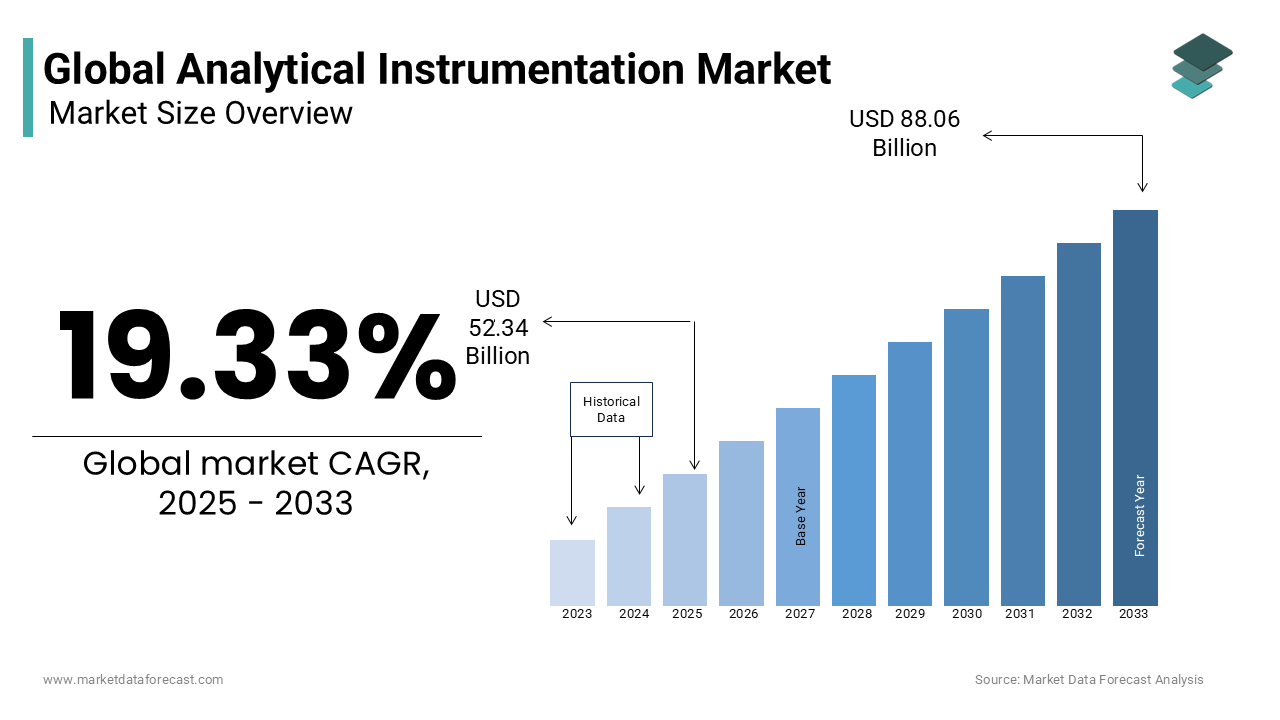
The analytical instrumentation is a suite of advanced technologies designed to identify, quantify, and characterize chemical, biological, and physical properties of substances across diverse scientific environments. These instruments including mass spectrometers, chromatographs, spectroscopy systems, and automated lab platforms are foundational in ensuring precision and reproducibility in research, quality control, and regulatory compliance. As per the National Institute of Standards and Technology, over 90% of pharmaceutical approvals in the U.S. rely on data generated through validated analytical instrumentation to meet FDA requirements for purity and efficacy.
MARKET DRIVERS
Expansion of Biopharmaceutical R&D and Personalized Medicine
The surge in biopharmaceutical research and the shift toward personalized medicine are significantly amplifying the growth of the Analytical Instrumentation Market. Monoclonal antibodies, cell and gene therapies, and mRNA vaccines require rigorous analytical validation at every development stage. According to the U.S. Food and Drug Administration, the number of Investigational New Drug (IND) applications for biologics increased by 37% between 2020 and 2023, reflecting a structural shift in drug development paradigms. These complex molecules demand advanced mass spectrometry, capillary electrophoresis, and high-resolution chromatography to ensure structural integrity and batch consistency.
Stringent Regulatory and Environmental Monitoring Requirements
The global regulatory frameworks mandating environmental safety, food integrity, and industrial emissions control are additionally fuelling the growth of Analytical Instrumentation Market. Governments and international bodies are enforcing stricter limits on contaminants, necessitating precise detection at trace levels. The U.S. Environmental Protection Agency requires continuous monitoring of over 80 priority pollutants in water supplies using gas chromatography-mass spectrometry (GC-MS) and inductively coupled plasma mass spectrometry (ICP-MS), with detection limits as low as parts per trillion. In food safety, the World Health Organization estimates that 600 million people fall ill annually from contaminated food, prompting countries like Japan and South Korea to adopt mandatory LC-MS/MS screening for pesticides.
MARKET RESTRAINTS
High Capital and Operational Costs Limiting Accessibility in Developing Economies
The acquisition and maintenance of high-end analytical instruments pose significant financial barriers in low- and middle-income countries, which is impeding the growth of Analytical Instrumentation Market. As per African Society for Laboratory Medicine, only 30% of national reference labs in the region have functional ICP-MS units for heavy metal analysis, despite rising contamination from mining activities. Additionally, the scarcity of skilled technicians exacerbates underutilization; UNESCO reports a deficit of over 120,000 analytical scientists across South Asia and Africa. These financial and human capital constraints impede the equitable deployment of analytical technologies, limiting their impact in regions with growing public health and environmental monitoring needs.
Instrument Standardization and Interoperability Challenges
The widespread adoption of analytical instrumentation lies in the lack of universal standardization and system interoperability is inhibiting the growth of Analytical Instrumentation Market. Different manufacturers employ proprietary software, data formats, and calibration protocols, hindering seamless integration across laboratory workflows. In multi-site clinical trials, discrepancies in analytical outputs between labs using different LC-MS platforms can delay regulatory submissions by months. As per U.S. National Institutes of Health, 28% of reproducibility failures in preclinical research were linked to inconsistent instrument calibration across institutions. Furthermore, the absence of harmonized digital interfaces complicates data sharing in global initiatives like pandemic surveillance networks.
MARKET OPPORTUNITIES
Integration of Artificial Intelligence and Predictive Analytics in Instrumentation
The integration of artificial intelligence (AI) with analytical instrumentation, which is gearing up for growth opportunities for the growth of Analytical Instrumentation Market. Modern instruments generate terabytes of spectral and chromatographic data, which AI algorithms can analyze in real time to detect anomalies, identify compounds, and optimize experimental parameters. Siemens Healthineers and Thermo Fisher Scientific have already embedded machine learning models into their mass spectrometry platforms to reduce false positives in clinical diagnostics. According to McKinsey & Company, AI-driven analytics can reduce data processing time in drug development by up to 60%, accelerating time-to-market for new therapeutics.
Miniaturization and Field-Deployable Analytical Devices
The development of portable, handheld, and microfluidic-based analytical instruments is expected to surge the growth of Analytical Instrumentation Market in the coming years. These compact systems enable real-time analysis in remote or resource-constrained settings, bypassing the need for centralized laboratories. The U.S. Department of Defense has deployed over 5,000 handheld Raman spectrometers for chemical threat detection in field operations, with devices like the Agilent 4300 Handheld FTIR achieving 95% accuracy in identifying hazardous substances within seconds. In agriculture, the Food and Agriculture Organization notes that portable NIR (near-infrared) analyzers are being used by smallholder farmers in India and Kenya to assess soil nutrient levels, improving fertilizer efficiency by up to 40%. The Global Fund has also distributed miniaturized PCR devices for tuberculosis detection in rural clinics across Southeast Asia, reducing diagnosis time from weeks to hours.
MARKET CHALLENGES
Rapid Technological Obsolescence and R&D Pressure
The growing pace of innovation in analytical instrumentation creates intense pressure on manufacturers to continuously upgrade their product lines is risking rapid obsolescence of existing systems. Instruments that were considered state-of-the-art five years ago may lack compatibility with current data standards or AI integration capabilities, which is diminishing their utility in modern labs. This forces research institutions and companies to reinvest frequently, straining budgets. The American Association for Clinical Chemistry warns that over 30% of installed analytical systems in U.S. hospitals are underutilized due to software incompatibility with newer diagnostic protocols.
Cybersecurity Vulnerabilities in Networked Laboratory Systems
They are exposed to growing cybersecurity threats is additionally to degrade the growth of analytical instrumentation market. Modern instruments often run on legacy operating systems with limited patch support, making them susceptible to ransomware and data breaches. The U.S. Cybersecurity and Infrastructure Security Agency disclosed that in 2023, over 120 laboratory networks in the pharmaceutical and academic sectors experienced cyber intrusions targeting intellectual property and clinical trial data. According to the International Society of Automation, 65% of industrial control systems in labs lack endpoint protection.
REGIONAL ANALYSIS
| REPORT METRIC | DETAILS |
| Market Size Available | 2024 to 2033 |
| Base Year | 2024 |
| Forecast Period | 2025 to 2033 |
| Segments Covered | By Product Type, End-User Industry and Region. |
| Various Analyses Covered | Global, Regional, & Country Level Analysis; Segment-Level Analysis, Drivers, Restraints, Opportunities, Challenges, PESTLE Analysis, Porter’s Five Forces Analysis, Competitive Landscape, Analyst Overview of Investment Opportunities |
| Regions Covered | North America, Europe, Asia Pacific, Latin America, Middle East, and Africa |
| Key Market Players | Agilent Technologies Inc., Thermo Fisher Scientific Inc., PerkinElmer Inc., Shimadzu Corporation, Bruker Corporation, Waters Corporation, ABB Ltd., Siemens AG, JEOL Ltd., Mettler-Toledo International Inc., Endress+Hauser Group, Horiba Ltd., Hitachi High-Tech Corporation, Danaher Corporation, and Bio-Rad Laboratories Inc. |
SEGMENTAL ANALYSIS
By Product Type Insights
The chromatography instruments segment held 34.2% of the global analytical instrumentation market by capturing 34.3% of the share in 2024 with pharmaceutical quality control and environmental monitoring. Additionally, the rise in biopharmaceuticals has driven the adoption of advanced techniques like ultra-high-performance liquid chromatography (UHPLC), which reduces analysis time by up to 70% compared to conventional HPLC, as demonstrated in studies published by the American Chemical Society. With over 120,000 chromatography systems installed annually worldwide, per data from SDi’s Global Assessment Report, the segment remains foundational to regulated analytical workflows across industries.
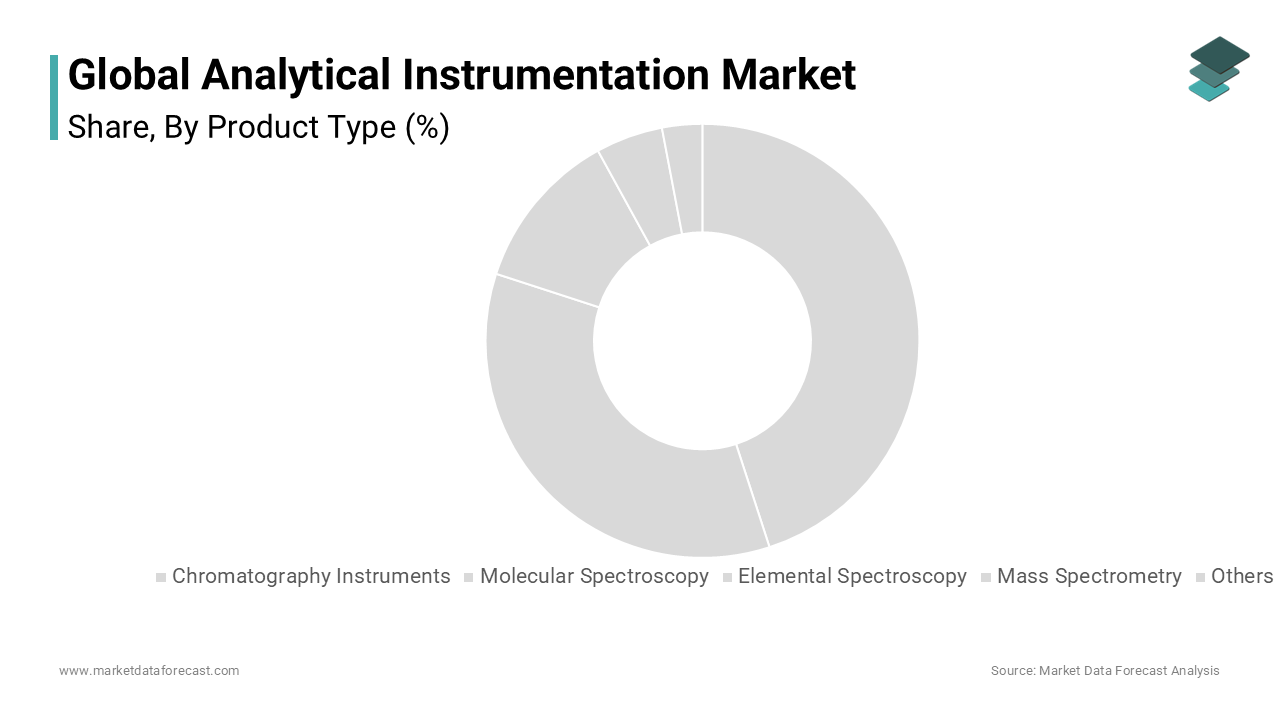
The mass spectrometry segment is lucratively to register a CAGR of 8.7% from 2025 to 2033 with its unparalleled sensitivity and specificity in identifying molecular structures, making it important in proteomics, metabolomics, and clinical diagnostics. The technology enables detection of biomolecules at femtogram levels, a capability essential for early disease biomarker discovery. In clinical labs, tandem mass spectrometry (MS/MS) is now standard for newborn screening, detecting over 50 metabolic disorders from a single blood spot, a practice adopted in all 50 U.S. states and expanding globally.
By End-User Industry Insights
The pharmaceuticals and biopharmaceuticals sector was the largest and held 40.2% of the global analytical instrumentation market share in 2024. Every stage from drug discovery to manufacturing and quality assurance relies on analytical instruments to ensure safety, efficacy, and compliance. The U.S. Food and Drug Administration mandates that each batch of a pharmaceutical product undergo full analytical characterization, including identity, purity, potency, and impurity profiling, a process that involves multiple chromatographic and spectroscopic techniques.
The environmental segment is estimated to witness a CAGR of 9.1% during the forecast period with the escalating regulatory enforcement and public concern over pollution. Governments worldwide are tightening limits on contaminants in air, water, and soil, necessitating advanced detection capabilities. According to the World Health Organization, 2.2 billion people lack access to safe drinking water, which is prompting nations like India and Indonesia to expand water testing infrastructure. India’s Central Pollution Control Board has established over 300 new environmental labs since 2020, each equipped with chromatography and spectroscopy systems.
REGIONAL ANALYSIS
North America Analytical Instrumentation Market Analysis
North America analytical instrumentation market was the top performer by capturing 38.3% of share in 2024 with its dense network of research institutions, pharmaceutical giants, and stringent regulatory frameworks. The United States analytical instrumentation market was the largest with a prominent share in 2024. Additionally, the FDA’s risk-based inspection model requires pharmaceutical manufacturers to maintain continuous analytical monitoring, driving demand for compliant instrumentation. Companies like Thermo Fisher Scientific, Agilent Technologies, and PerkinElmer are headquartered in the U.S. by enab ling rapid deployment of new technologies.
Asia Pacific Analytical Instrumentation Market Analysis
Asia Pacific was positioned second by capturing 32.3% of analytical instrumentation market share in 2024 with strong momentum driven by industrial growth, healthcare modernization, and government-led science initiatives. China and India are leading countries in the transformation, investing heavily in domestic R&D infrastructure to reduce reliance on Western technologies. China’s Ministry of Science and Technology reports that the country increased its R&D expenditure to 2.55% of GDP in 2023, up from 1.4% in 2010, with significant allocations for national metrology centers and analytical labs. Japan and South Korea analytical instrumentation market growth is likely to grow with firms like Shimadzu and Hitachi dominating regional supply chains. Additionally, the ASEAN region is expanding environmental and food safety testing; Indonesia’s Ministry of Health established 34 new food testing labs between 2021 and 2023 to combat adulteration.
Europe Analytical Instrumentation Market Analysis
Europe analytical instrumentation market growth is expected to grow with a significant CAGR during the forecast period. The European Union’s regulatory framework through the European Medicines Agency and REACH legislation that mandates rigorous analytical validation for pharmaceuticals, chemicals, and environmental agents by ensuring consistent demand for high-performance systems. The Horizon Europe program has funded over 200 projects focused on sustainable instrumentation, including miniaturized sensors and AI-driven analytics.
Latin America Analytical Instrumentation Market Analysis
Latin America analytical instrumentation market growth is likely to grow with Brazil and Mexico emerging as key growth nodes despite economic volatility. Brazil’s Ministry of Health implemented a national newborn screening program in 2022 that now covers over 3 million infants annually, relying on tandem mass spectrometry for metabolic disorder detection. The Oswaldo Cruz Foundation (Fiocruz) is a leading public health institute that has installed over 50 new analytical systems since 2020 to support vaccine and drug quality control.
Middle East & Africa Analytical Instrumentation Market Analysis
The Middle East & Africa analytical instrumentation market growth is esteemed to have steady opportunities in the coming years. The UAE and Saudi Arabia are leading modernization efforts, investing in healthcare, food security, and environmental protection. Saudi Arabia’s Vision 2030 includes a $30 billion investment in healthcare infrastructure, with new hospitals and research centers equipped with advanced analytical systems. The King Abdullah International Medical Research Center in Riyadh has established a genomics and metabolomics core facility featuring high-resolution mass spectrometers.
COMPETITIVE LANDSCAPE
The competitive landscape of the analytical instrumentation market is defined by technological differentiation, regulatory agility, and geographic reach. While established multinational corporations dominate through integrated product ecosystems and global service networks, regional players are gaining ground by offering cost-effective, localized solutions. Competition is shifting from hardware-centric offerings to holistic platforms that combine instrumentation with software, data management, and compliance support. The rise of precision medicine, environmental monitoring, and biopharmaceutical development has intensified demand for high-sensitivity, multi-modal systems, pushing companies to innovate continuously. Intellectual property, service responsiveness, and adherence to international standards play a decisive role in securing contracts in regulated industries.
KEY MARKET PLAYERS
A few of the major companies in the global analytical instrumentation market include
- Agilent Technologies Inc.
- Thermo Fisher Scientific Inc.
- PerkinElmer Inc.
- Shimadzu Corporation
- Bruker Corporatio
- Waters Corporation
- ABB Ltd.
- Siemens AG
- JEOL Ltd.
- Mettler-Toledo International Inc
- Endress+Hauser Group
- Horiba Ltd.
- Hitachi High-Tech Corporation
- Danaher Corporation
- Bio-Rad Laboratories Inc.
Top Players in the Analytical Instrumentation Market
Thermo Fisher Scientific
Thermo Fisher Scientific is a dominant force in the analytical instrumentation landscape, offering a comprehensive portfolio spanning mass spectrometry, chromatography, and spectroscopy. In the Asia Pacific region, the company has deepened its footprint through localized manufacturing, technical centers, and strategic collaborations with academic and government institutions. The facility complements its existing service network across India, Japan, and Australia. The company has also expanded its e-commerce platform in Southeast Asia, enabling faster procurement for mid-sized labs.
Shimadzu Corporation
Shimadzu Corporation, headquartered in Japan, is a cornerstone of the analytical instrumentation market in Asia Pacific, leveraging its regional heritage to deliver precision-engineered solutions in chromatography, spectroscopy, and mass spectrometry. The company has maintained strong relationships with national research bodies, including India’s Council of Scientific and Industrial Research (CSIR) and South Korea’s Korea Research Institute of Standards and Science (KRISS), supporting metrology and environmental monitoring initiatives. In 2022, Shimadzu inaugurated a new application development center in Bengaluru to accelerate support for India’s growing pharmaceutical sector. It has also introduced compact, energy-efficient GC-MS and LC-MS systems tailored for mid-tier laboratories with space and budget constraints.
Agilent Technologies
Agilent Technologies has established a robust presence in the Asia Pacific analytical instrumentation market by focusing on innovation, sustainability, and customer-centric solutions. The company has strengthened its regional operations through strategic investments in R&D and service infrastructure, including the expansion of its facility in Singapore to serve as a regional repair and calibration center. In 2023, Agilent launched the "Lab of the Future" initiative in Japan and Australia, integrating IoT-enabled instruments with cloud-based analytics platforms to improve lab efficiency and data traceability. It has also collaborated with China’s National Institutes for Food and Drug Control to develop standardized methods for biologic characterization.
Top Strategies Used by the Key Market Participants
Key players in the analytical instrumentation market are deploying advanced strategies to consolidate their global influence and adapt to evolving scientific demands. Companies are also investing in modular and scalable platforms that allow laboratories to upgrade components without replacing entire systems, reducing total cost of ownership. Strategic localization is another approach, with firms establishing regional manufacturing, service hubs, and innovation centers in high-growth markets like India and Southeast Asia to shorten delivery times and enhance technical support. Collaborations with academic institutions, regulatory bodies, and healthcare networks are being leveraged to co-develop application-specific workflows and gain early market entry.
MARKET SEGMENTATION
The research report on the global analytical instrumentation market has been segmented and sub-segmented based on categories.
By Product Type
- Chromatography Instruments
- Molecular Spectroscopy
- Elemental Spectroscopy
- Mass Spectrometry
- Others
By End-User Industry
- Pharmaceuticals and Biopharmaceuticals
- Clinical and Diagnostics Laboratories
- Environmental Testing Laboratories
- Chemical and Petrochemical
- Others
By Region
- North America
- Europe
- Asia-Pacific
- Latin America
- Middle East and Africa