- Product Description Description
- Table of Contents TOC
- List of Table & Figure LOT
- Get Free Sample PDF Sample PDF
Market Size, 2025
$5.44 BnMarket Estimate, 2026
$6.31 BnMarket Forecast, 2034
$20.69 BnCAGR, 2026–2034
16%Executive Summary: Global Anomaly Detection Market
- Market Scope: Comprehensive global anomaly detection market evaluation covering types of services, core solutions (network and user behavior), deployment architectures, applications, vertical industries, and regional geographic frameworks.
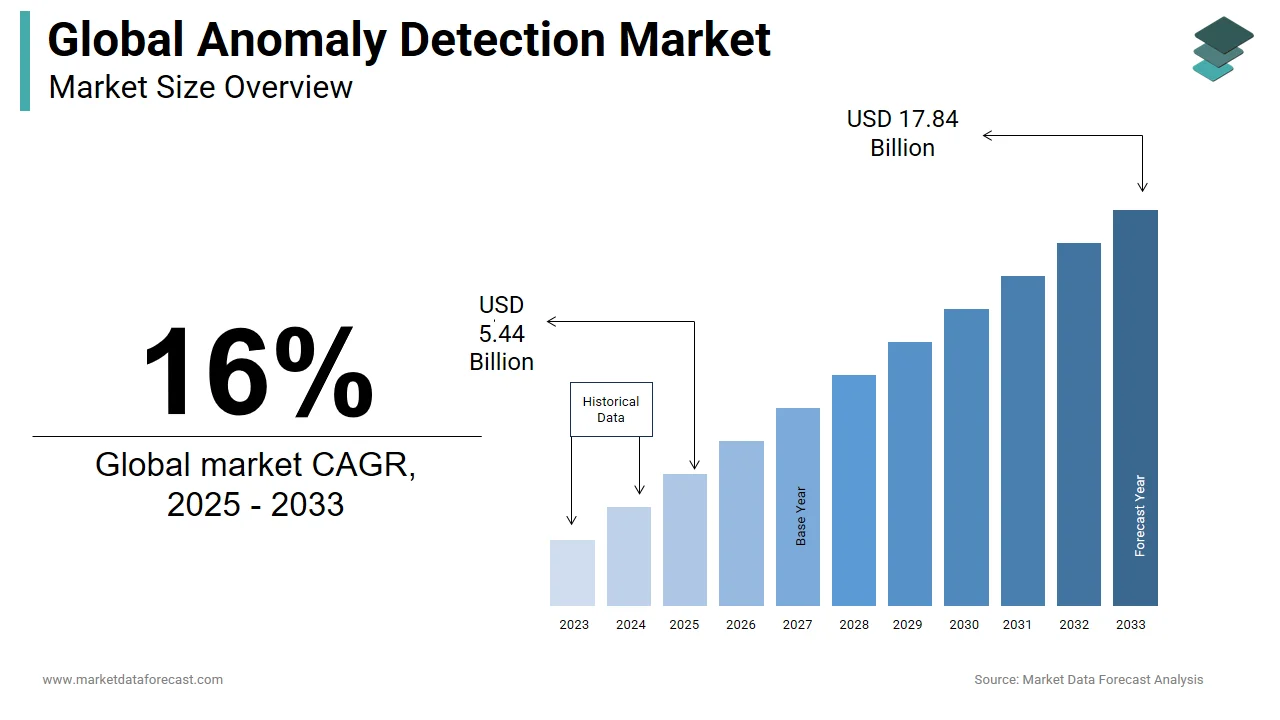
- Market Valuation: Valued at USD 5.44 billion (2025), estimated at USD 6.31 billion (2026), and projected to reach USD 20.69 billion by 2034, registering a CAGR of 16.0% (2026–2034).
- Primary Growth Drivers: Exponential growth in networked and IoT devices leading to higher traffic congestion, rising frequency of cyberattacks and financial fraud across critical data-rich industries, and stringent regulatory compliance directives (such as FFIEC guidelines for banking monitoring).
Key Market Segment Metrics (2026–2034)
| Category | Leading Segment (2025 Position) | Fastest-Growing / Key Segment |
|---|---|---|
| By Solution | Network Behavior Anomaly (dominates due to expanding network infrastructures and traffic complexity) | Network Behavior Segment (expected to extend with the highest growth rate driven by advanced attacker threats) |
| By Deployment | Cloud Deployment (expected to account for the principal market share due to cost-efficiency and remote scalability) | Cloud-Based Infrastructure (favored for flexibility, central management, and multi-device access) |
| By Application | Intrusion & Fraud Detection (anticipates highest enterprise demand to safeguard sensitive digital assets) | System Status Monitoring & Fault Detection (vital for automated industrial and IT ecosystem reliability) |
| By Vertical | BFSI (Banking, Financial Services, and Insurance) is the leading worldwide segment, projected to continue its reign) | IT & Telecommunications, Retail, and Healthcare (experiencing rapid surges due to connected data streams) |
| By Region | North America (dominated the global market fueled by trends like BYOD and major enterprise adoption) | Asia-Pacific (foreseen as the fastest-growing region driven by rapid IT sector expansion in India, China, and Japan) |
Major Market Participants & Market Structure
Market Structure: Highly competitive landscape comprising major tech conglomerates and security software vendors focusing on AI integration, automated behavior analytics, and real-time alert architectures.
Key Companies: International Business Machines Corporation (IBM), SAS Institute, Inc., Cisco Systems, Inc., Dell Technologies, Inc., Hewlett Packard Enterprise Company, Symantec Corporation, Trend Micro, Inc., Splunk, Inc., Wipro Limited, Securonix, Inc., Gurucul, Happiest Minds, and Guardian Analytics.
Global Anomaly Detection Market Size
The global anomaly detection market was worth USD 5.44 billion in 2025. The global market is predicted to reach USD 6.31 billion in 2026 and USD 20.69 billion by 2034, growing at a CAGR of 16% during the forecast period.
Anomaly detection can be called a process for identifying anomalies, such as an unusual change in the process or event in a procedure that does not follow the expected pattern or dataset. This change in the usual pattern of the activity is the leading cause of a failure, defect, or error in the process. Anomaly detection is extensively used for applications such as intruder detection, fraud detection, system health monitoring, and many more in a similar ecosystem.
MARKET DRIVERS
The main factor contributing to the growth of the global anomaly detection market is the growing number of networked devices.
The more extensive the network, the more likely traffic congestion is to lead to unusual patterns in the system. Anomaly detection detects these strange patterns in network traffic, which could be an essential reason for detecting intruders, cyberattacks, and fraud.
The increasing number of connected devices in banking and finance, healthcare, manufacturing, information technology, telecommunications, defense, and the government should stimulate the market to detect anomalies during the forecast period. These industries regularly process essential data, which exposes them to fraud, theft, and hacking, allowing criminals to take control of the business infrastructure.
Banking operations include numerous periodic and aperiodic activities and transactions carried out by employees, customers, and external agencies. The nature of these activities is complicated and requires constant monitoring to ensure that neither the bank nor its end customers are adversely affected by malicious and random events. This represents a tremendous opportunity for companies offering solutions and services to prevent such anomalies. For example, CSI anomaly detection software for banks updates the institution on suspicious activity by generating automatic alerts, allowing them to maintain diligence and compliance. The various directives or regulations issued by regulatory agencies and agencies should stimulate the market during the projection period. For example, as a financier, the Federal Financial Institutions Review Council (FFIEC) requires establishing a process to help monitor possible abnormal behavior in online banking.
MARKET RESTRAINTS
Competition from open-source alternatives that hamper the demand for business solutions and the lack of skills and experience are some of the factors restricting the global anomaly detection market.
REPORT COVERAGE
| REPORT METRIC | DETAILS |
| Market Size Available | 2025 to 2034 |
| Base Year | 2025 |
| Forecast Period | 2026 to 2034 |
| CAGR | 16% |
| Segments Covered | By Type of Service, Solution, Deployment, Application, Vertical, and Region |
|
Various Analyses Covered | Global, Regional & Country Level Analysis, Segment-Level Analysis, DROC, PESTLE Analysis, Porter’s Five Forces Analysis, Competitive Landscape, Analyst Overview on Investment Opportunities |
| Regions Covered | North America, Europe, APAC, Latin America, Middle East & Africa |
|
Market Leaders Profiled | International Business Machines Corporation (United States), SAS Institute, Inc. (United States), Cisco Systems, Inc. (United States), Dell Technologies, Inc. (United States), Hewlett Packard Enterprise Company (United States), Symantec Corporation (United States), Trend Micro, Inc. (Japan), Splunk, Inc. (United States) and Others. |
SEGMENTAL ANALYSIS
By Type of Service Insights

By Solution Insights
Of these, the network behavior anomaly segment is likely to extend with the highest growth rate during the estimated period due to increasing technological developments and attacker threats.
By Deployment Insights
The cloud segment is expected to account for the principal portion of the global anomaly detection market because of its numerous benefits, such as cost-efficiency, remote access, etc.
By Application Insights
Intrusion and fraud detection are anticipated to register the highest demand in this business in the coming years.
By Vertical Insights
Of these, the BFSI is the leading worldwide segment, which is projected to continue its reign in the forecast period.
REGIONAL ANALYSIS
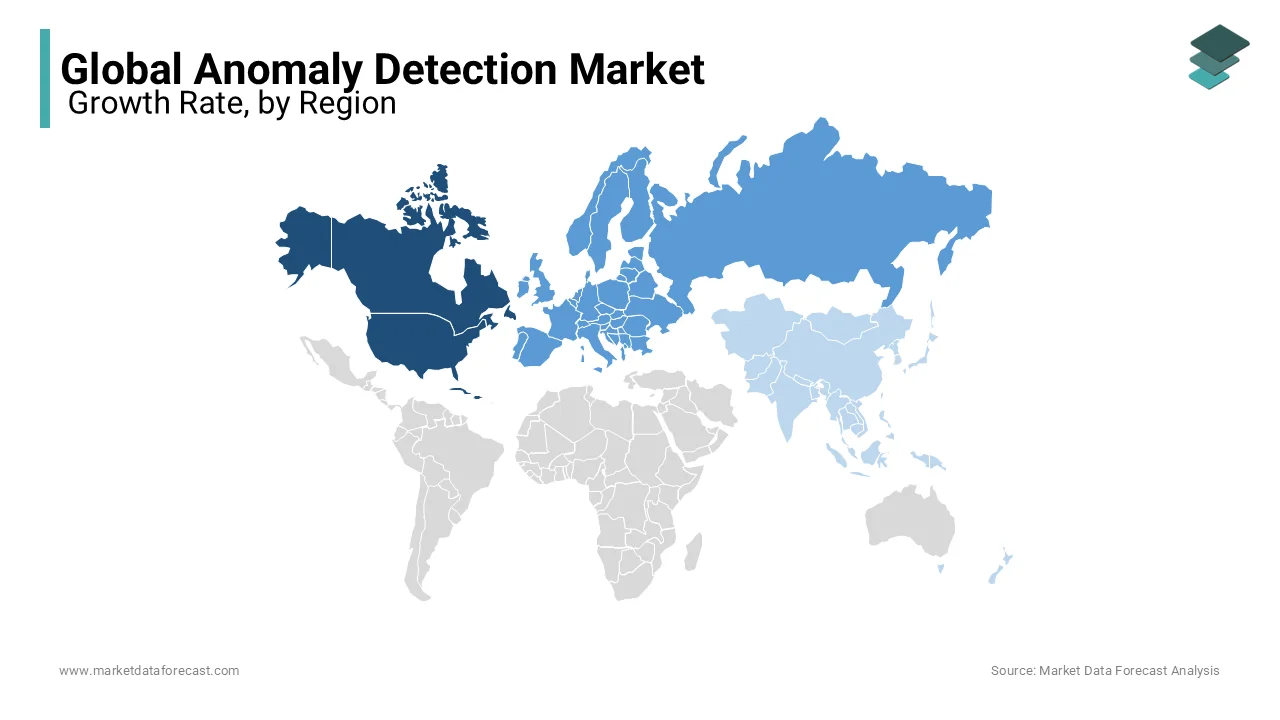
North America's anomaly detection market dominated the global business due to growing trends such as BYOD, which encourages employees to bring their devices to the office. Large companies actively adopt this trend, improving performance and productivity. On the other hand, Europe's anomaly detection market closely follows North America in terms of value and volume. Europe and North America are technically advanced regions, and an essential factor that affects the progress of this market in Europe is the investments of the various critical actors in this region. This has led numerous small businesses to grow and partner with large suppliers to provide services. Asia-Pacific anomaly detection market is foreseen to be the fastest-growing region due to the increasing development of the information and technology sector in nations like India, China, Japan, etc.
KEY MARKET PARTICIPANTS
The major companies operating in the global anomaly detection market include International Business Machines Corporation (United States), SAS Institute, Inc. (United States), Cisco Systems, Inc. (United States), Dell Technologies, Inc. (United States), Hewlett Packard Enterprise Company (United States), Symantec Corporation (United States), Trend Micro, Inc. (Japan), Splunk, Inc. (United States), Wipro Limited (India), Securonix, Inc. (United States), Gurucul (United States), Happiest Minds (India) and Guardian Analytics (United States).
RECENT MARKET HAPPENINGS
-
In March 2019, Microsoft expanded its availability of anomaly detectors with the launch of the Microsoft Azure anomaly detector, which easily integrates anomaly detection capabilities into user applications so that they can quickly identify data models that are unusual, rare, or irregular.
-
In April 2019, Guardian Analytics Inc., a market leader in real-time behavior analysis and machine learning solutions for detecting bank payment and corporate B2B portal fraud, announced a webinar series on detecting electronic fraud in real time.
MARKET SEGMENTATION
This research report on the global anomaly detection market is segmented and sub-segmented based on the type of service, solution, deployment, application, vertical, and region.
By Type of Service
- Professional Service
- Managed Service
By Solution
- Network Behavior
- User Behavior
By Deployment
- Cloud
- On-Premise
By Application
- Intrusion Detection
- Fraud Detection
- System Status Monitoring
- Fault Detection
- Others
By Vertical
- Banking
- Financial Services and Insurance (BFSI)
- Retail
- Manufacturing
- IT and Telecommunications
- Government
- Aerospace and Defense
- Medical Care
- Others
By Region
-
North America
-
The United States
-
Canada
-
Rest of North America
-
-
Europe
-
The United Kingdom
-
Spain
-
Germany
-
Italy
-
France
-
Rest of Europe
-
-
The Asia Pacific
-
India
-
Japan
-
China
-
Australia
-
Singapore
-
Malaysia
-
South Korea
-
New Zealand
-
Southeast Asia
-
-
Latin America
-
Brazil
-
Argentina
-
Mexico
-
Rest of LATAM
-
-
The Middle East and Africa
-
Saudi Arabia
-
UAE
-
Lebanon
-
Jordan
-
Cyprus
-