- Product Description Description
- Table of Contents TOC
- List of Table & Figure LOT
- Get Free Sample PDF Sample PDF
Market Size, 2025
$2.46 BnMarket Estimate, 2026
$2.58 BnMarket Forecast, 2034
$3.84 BnCAGR, 2026–2034
5.08%Global Anti-Fog Additives Market Size, Growth, Trends & Forecast (2026–2034)
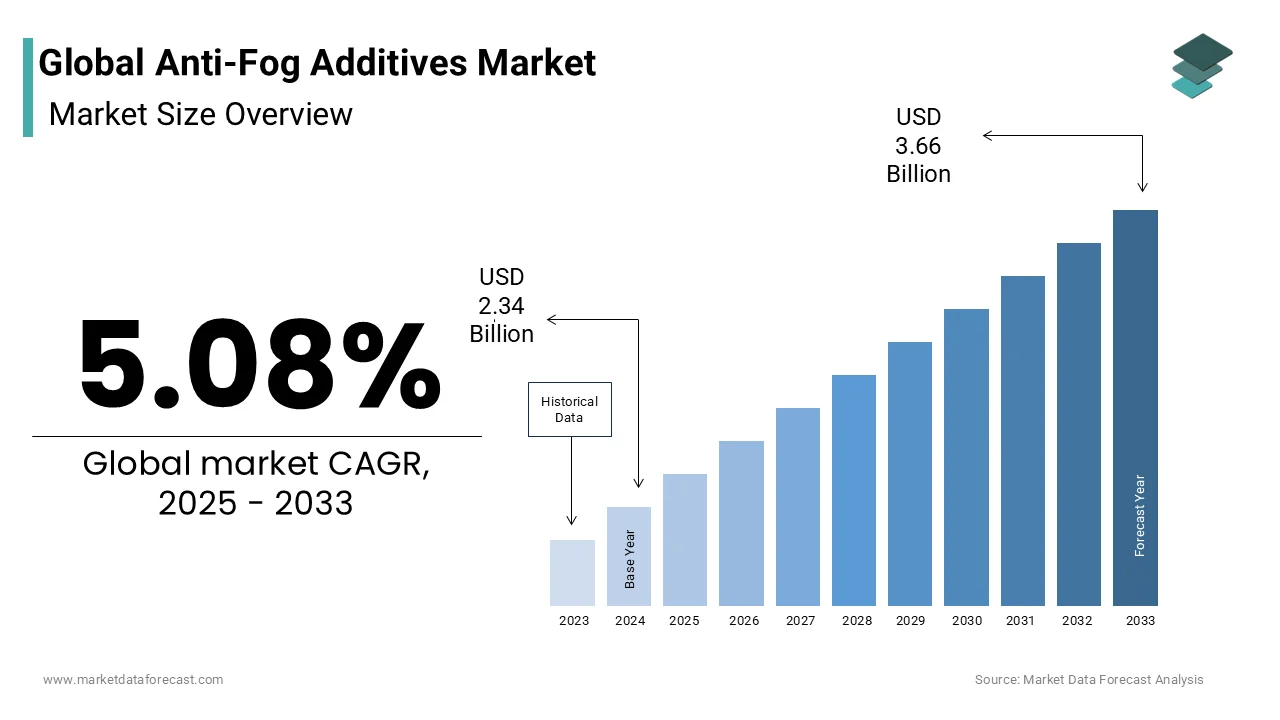
The global anti-fog additives market size was valued at USD 2.46 billion in 2025, reached USD 2.58 billion in 2026, and is projected to reach USD 3.84 billion by 2034, growing at a compound annual growth rate (CAGR) of 5.08% from 2026 to 2034. Propelled by increasing global demand for energy-efficient retail refrigeration, advanced agricultural films, and stringent occupational safety mandates for protective visors and eyewear, the worldwide market demonstrates steady long-term growth.
Key Executive Metrics (At-a-Glance)
- 2025 Base Valuation: USD 2.46 Billion
- 2026 Current Valuation: USD 2.58 Billion
- 2034 Forecast Valuation: USD 3.84 Billion
- Compound Annual Growth Rate (CAGR): 5.08% (2026–2034)
- Regional Highlights: Asia-Pacific leads the regional market capture with a 41.3% share in 2025, driven by manufacturing scale and agricultural modernization.
Core Market Drivers & Growth Triggers
- Energy-Efficient Retail Refrigeration: Increasing integration of passive anti-fog solutions in display cases to eliminate resistive heating wires and curb store electricity consumption.
- Occupational Safety Regulations: Stricter global mandates for optical clarity in high-humidity industrial, medical, and food-processing personal protective equipment (PPE).
Primary Market Restraints & Challenges
- Substrate Incompatibility & Volatility: Formulation challenges with polycarbonate and acrylic substrates alongside price volatility in hydrophilic surfactants (e.g., polyethylene glycol esters).
Global Anti-Fog Additives Market Segmentation Breakdown
| Segment Category | Largest Segment | Fastest-Growing Segment |
|---|---|---|
| By Type | Ethoxylated Sorbitan Esters (38.2% in 2025) | Titanium Dioxide-Based Additives (11.4% CAGR) |
| By Application | Agricultural Films (46.8% in 2025) | Coating Films for Helmets and Goggles (14.9% CAGR) |
| By Region | Asia-Pacific (41.3% in 2025) | Asia-Pacific / Emerging Regions |
Major Industry Players Profiled
Key corporations shaping the global anti-fog additives market include BASF SE, Evonik Industries, Croda International Plc., Nouryon, Clariant AG, Schulman, PolyOne Corporation, DuPont, Ashland Inc., and Corbion N.V.
Global Anti-Fog Additives Market Size
The global anti-fog additives market size was valued at USD 2.46 billion in 2025 and is expected to reach USD 3.84 billion by 2034 from USD 2.58 billion in 2026. The market is projected to grow at a CAGR of 5.08%.
Anti-fog additives are chemical formulations engineered to inhibit condensation-induced surface opacity on transparent substrates. These additives function by modifying surface tension to enable uniform water sheeting rather than droplet formation, preserving optical clarity in humid or thermally variable environments. Their deployment spans automotive glazing, refrigeration displays, safety eyewear, and architectural fenestration systems exposed to thermal gradients. As per the study, commercial refrigeration units in American supermarkets consume approximately kWh per square meter annually, where fogged glass impedes consumer visibility and increases lighting energy use, a condition mitigable through anti-fog treatments.
MARKET DRIVERS
Escalating Demand for Energy-Efficient Retail Refrigeration Systems
Retail refrigeration systems increasingly integrate anti-fog additives to maintain product visibility without supplementary heating elements, thereby reducing energy consumption, which fuels the growth of the anti-fog additives market. As per the research, open vertical refrigerated display cases in U.S. grocery chains account for a share of total store electricity usage, with fogging contributing to an increase in lighting and defogging energy loads. Anti-fog coatings eliminate the need for resistive heating wires embedded in glass, which traditionally consume 40–60 watts per linear meter. This energy conservation imperative, aligned with global decarbonization mandates, which compels retailers to adopt passive anti-fog solutions at scale.
Regulatory Push for Enhanced Occupational Safety in High-Humidity Industrial Zones
The occupational safety regulators globally are tightening mandates for vision clarity in environments prone to thermal shock and moisture accumulation, which is boosting the expansion of the anti-fog additives market. The fogging of protective face shields contributed to a sshare of recorded near-miss incidents in European chemical manufacturing facilities. Anti-fog coated visors improved task accuracy in steam-intensive sectors such as pharmaceutical sterilization and food processing. This regulatory recalibration has triggered a year-over-year procurement surge in certified anti-fog additives by European PPE manufacturers.
MARKET RESTRAINTS
Incompatibility with Certain Polymer Substrates Limiting Application Breadth
The formulation incompatibility with polycarbonate and acrylic substrates widely used in lightweight glazing, restricts the growth of the anti-fog additives market. The injection-molded transparent components in automotive interiors utilize polycarbonate due to its impact resistance, yet only a portion of commercially available anti-fog agents maintain efficacy beyond notable hours of UV exposure on this substrate. According to study, phase separation occurs in a portion of ethoxylated sorbitan-based anti-fog formulations when applied to acrylic sheets under thermal cycling between -10°C and 60°C. This incompatibility forces manufacturers to undertake costly reformulation cyclesmand thereby throttling scalability and fragmenting supply chains.
Volatility of Raw Material Pricing for Hydrophilic Surfactants
Its vulnerability to price fluctuations in key hydrophilic surfactants such as polyethylene glycol esters and alkyl polyglucosides also hampers the expansion of the anti-fog additives market. These constitute a percenatge of formulation mass. According to study, the Producer Price Index for organic surface-active agents surged, driven by upstream ethylene oxide supply constraints and palm oil derivative volatility. There has been a spike in import costs for C12-C14 alcohol ethoxylates in Southeast Asia, directly inflating additive production costs per kilogram. This instability discourages long-term procurement contracts and forces small-to-midsize formulators to absorb margin compression, as a portion lack hedging mechanisms.
MARKET OPPORTUNITIES
Integration with Smart Glass Technologies for Dynamic Environmental Response
Emerging electrochromic and thermochromic glazing systems offer a novel application vector for next-generation anti-fog additives that respond to real-time humidity and temperature shifts serves a significant opportunity for the anti-fog additive market growth. Researchers have developed zwitterionic anti-fog layers that activate hydrophilicity when ambient humidity exceeds, reducing additive migration and extending service life compared to static formulations. This integration enables additive manufacturers to co-develop with smart glass OEMs, which is a segment expand in domestic value in the coming years by unlocking premium pricing models and patent-protected formulation partnerships.
Expansion into Medical and Laboratory Equipment with Sterilization Compatibility
The global proliferation of fog-resistant medical face shields and diagnostic instrument viewports creates a high-value niche demanding autoclave-stable anti-fog chemistry provides major opportunities for the anti-fog additives market. Large number of surgical and examination face shields were procured globally, with a percentage now requiring ISO 15883-1 compliance for steam sterilization at 134°C. The U.S. cleared new anti-fog coated medical devices, specifying non-migratory, silicone-free formulations. According to research, polyvinyl alcohol-grafted anti-fog layers retain most of optical clarity after several autoclave cycles.
MARKET CHALLENGES
Long-Term Durability Under Cyclic Environmental Stress Remains Unresolved
Most commercial anti-fog additives degrade under repeated thermal-humidity cycling, weakening reliability in automotive and architectural applications, which is a key challenge for the anti-fog additives market. Commercially available spray-on anti-fog agents for automotive side mirrors lose efficacy within months under real-world conditions involving diurnal temperature swings of 45°C and exposure to road salts. This durability deficit forces end-users into frequent reapplication cycles, which increases lifecycle costs per vehicle annually, and thereby eroding consumer trust and delaying mass adoption in premium segments.
Lack of Standardized Performance Metrics Across Application Verticals
The absence of universally accepted testing protocols for anti-fog performance creates market fragmentation and inhibits cross-industry formulation optimization further constrains the expansion of the anti-fog additives market. As per the study, no global standard exists to quantify anti-fog efficacy across substrates, which forces regional markets to rely on disparate benchmarks, ASTM F2054 for eyewear, JIS R3212 for architectural glass, and DIN 52317 for automotive. This metrological inconsistency impedes regulatory harmonization and inflates compliance costs. Manufacturers serving three major sectors simultaneously incur significant amount annually in redundant certification testing.
REPORT COVERAGE
| REPORT METRIC | DETAILS |
| Market Size Available | 2025 to 2034 |
| Base Year | 2025 |
| Forecast Period | 2026 to 2034 |
| CAGR | 5.08% |
| Segments Covered | By Type, Application, and Region |
| Various Analyses Covered | Global, Regional, & Country Level Analysis; Segment-Level Analysis; DROC; PESTLE Analysis; Porter’s Five Forces Analysis; Competitive Landscape; Analyst Overview of Investment Opportunities |
| Regions Covered | North America, Europe, APAC, Latin America, Middle East & Africa |
| Market Leaders Profiled | Nouryon (Netherlands), Croda International Plc. (U.K.), Clariant AG (Switzerland), Schulman (U.S.), PolyOne Corporation (U.S.), Evonik Industries (Germany), DuPont (U.S.), Ashland Inc. (U.S.) Corbion N.V. (Netherlands), and others |
SEGMENTAL ANALYSIS
By Type Insights
The ethoxylated sorbitan esters segment was largest segment in the anti-fog additives market by accounting for 38.2% of share in 2025 with hydrophilic-lipophilic balance tunability, which enables manufacturers to calibrate surface activity across diverse polymer matrices without compromising optical clarity. Food packaging converters particularly favor this chemistry. The FDA has established specific regulations for polysorbate 80, listing it as a permitted food additive for certain uses, and has granted it Generally Recognized As Safe (GRAS) status for specific applications. Moreover, their low migration profile minimizes contamination risk, which makes them irreplaceable in premium fresh-produce packaging where fog-induced spoilage accounts for notable share in annual global losses.
The titanium dioxide-based anti-fog additives segment is estimated to register the fastest CAGR of 11.4% between 2026 and 2034. The rapid acceleration of the titanium dioxide-based anti-fog additives segment is fueled by dual functionality i.e TiO2 nanoparticles not only suppress fogging via photocatalytic hydrophilicity under ambient light but also degrade organic contaminants, which aligns with hygiene-centric post-pandemic design mandates. As per the study, 15-nanometer anatase-phase titanium dioxide coatings possess antimicrobial properties useful for self-disinfecting surfaces. Automotive mirror manufacturers are equally captivated. Asia’s architectural glass sector further propels demand. Like, China is the world's largest producer of titanium dioxide (TiO2) and has numerous manufacturers producing coated glass products. This coated glass is used for many applications, including self-cleaning glass for windows and building facades
By Application Insights
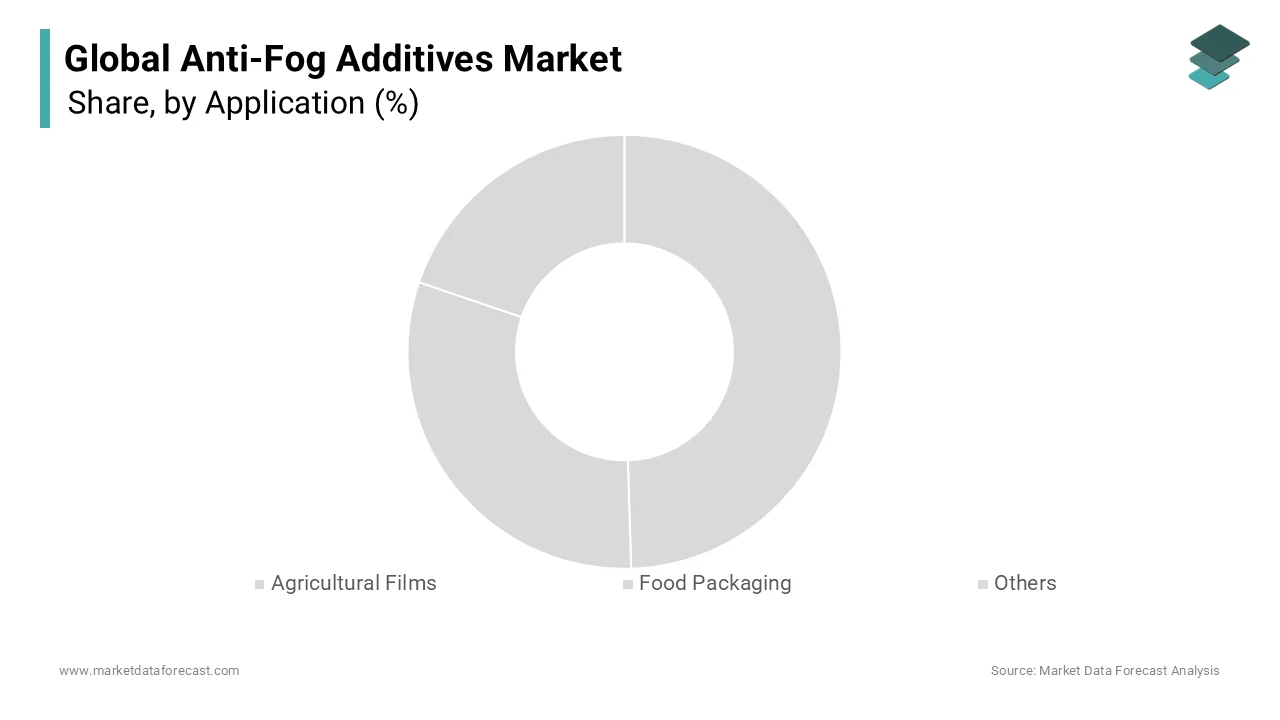
The agricultural films segment dominated the anti-fog additives market by occupying 46.8% share in 2025. Greenhouse films treated with anti-fog agents deliver measurable agronomic advantages, which propels the dominance of the agricultural films segment in the global market. Also, anti-fog films enhance crop yields and health by increasing light transmission and reducing fungal disease risk. In the Netherlands, a major greenhouse economy, a portion of commercial horticultural films now incorporate glycerol ester-based additives, enabling light diffusion coefficients, as per study. Economic incentives further cement dominance.
The coating films for helmets and goggles segment is anticipated to witness the fastest CAGR of 14.9% from 2026 to 2034. Factors such as regulatory tightening and performance standard escalation across industrial and recreational sectors are attributing to the growth of the coating films for helmets and goggles segment in the global market. Manufacturers of safety goggles for the German and European markets must meet the EN 166:2001 and its successor EN ISO 16321:2022 European safety standards. Simultaneously, the global e-sports peripherals business demands fog-resistant visors for VR headsets. Military procurement augments growth.
REGIONAL ANALYSIS
Asia Pacific Market Analysis
Asia Pacific led the anti-fog additives market by capturing 41.3% of the share in 2025. The prominence of the Asia Pacific in the global market is propelled by China’s manufacturing scale, India’s agritech modernization, and Southeast Asia’s export-oriented food packaging boom. China alone accounts for a portion of regional volume, driven by state-backed greenhouse expansion and automotive glazing mandates. Also, automakers use enhanced anti-fog technology, often combining heating elements with coatings or deploying full CMS, to differentiate their high-end models and justify higher prices.
Europe Market Analysis
Europe was positioned second by capturing 27.3% of anti-fog additive market share in 2025. The growth of the Europe in the global market is propelled by Germany’s precision chemical synthesis infrastructure and stringent EU regulatory frameworks governing food contact and occupational safety. he EU sets a specific migration limit (SML) for individual substances and an overall migration limit (OML) of 10 milligrams per square decimeter for plastic materials that come into contact with food. The Netherlands’ greenhouse sector consumes notable metric tons of anti-fog masterbatch annually.
North America Market Analysis
North America anti-fog additives market growth is likely to grow with the regulatory rigor from the U.S. FDA and performance-driven procurement in automotive and medical sectors. The FDA ensures that all food-contact substances, including anti-fog additives, are safe for their intended use through a pre-market authorization process. Canada saw a reduction in winter road accidents attributable to anti-fog-treated helmet visors among snowmobile operators. Increased demand for high-performance automotive glazing by manufacturers like Ford and BMW is driving demand for anti-fog additives in Mexico.
Latin America Market Analysis
Latin America witnessed a moderate expansion in the anti-fog additives market, with Brazil and Chile driving growth through agritech investment and chilled food export mandates. Brazil allocated millions as fund to upgrade hectares of greenhouse infrastructure with fog-resistant films. In Argentina, the drive for domestic anti-fog masterbatch production is attributed to standard industrial policy rather than a prohibitive Mercosur tariff.
Middle East and Africa Market Analysis
The Middle East and Africa region is expected to grow in the anti-fog additive market during the forecast period, with growth concentrated in Egypt’s greenhouse expansion, South Africa’s mining PPE mandates, and UAE’s luxury automotive glazing standards. China and Egypt partnered to construct large-scale greenhouse projects in the desert regions by reclaiming thousands of hectares for cultivation. The Egyptian government has also initiated other large-scale agricultural projects to turn the desert green. The increasing demand for anti-fog applications in the broader UAE market, particularly within the packaging and food industries, has increased the importation of anti-fog additives like ethoxylated sorbitan esters. Meanwhile, the automotive sector relies on different technologies for defogging.
COMPETITIVE LANDSCAPE
KEY MARKET PLAYERS
Some of the key players dominating the global anti-fog additives market are
- Nouryon (Netherlands)
- Croda International Plc. (the U.K.)
- Clariant AG (Switzerland)
- Schulman (U.S.)
- PolyOne Corporation (U.S.)
- Evonik Industries (Germany)
- DuPont (U.S.)
- Ashland Inc. (U.S.)
- Corbion N.V. (Netherlands)
TOP STRATEGIES USED BY KEY MARKET PLAYERS
Key players deploy formulation innovation anchored in regulatory foresight, co-developing additives with end-users to preempt compliance shifts. They vertically integrate specialty monomer synthesis to secure cost and purity control. Strategic patent clusters around substrate-specific durability and activation triggers deter commoditization. Regional production hubs near automotive and agritech clusters ensure just-in-time delivery. Partnerships with academic institutes accelerate performance validation under extreme environmental stress. Bio-based and recyclable chemistry investments align with ESG procurement mandates. Digital twin platforms simulate additive migration and surface energy decay by slashing R&D timelines. Licensing models for niche applications preserve margins without capital overextension.
COMPETITION OVERVIEW
The anti fog additives market features concentrated technological prowess amid fragmented regional formulators. Competition pivots on regulatory agility, substrate compatibility, and lifecycle durability rather than price. Incumbents leverage decades of surfactant chemistry IP while startups target nano-hybrid and stimuli-responsive niches. Collaboration with end-industry OEMs defines formulation relevance, automotive and medical sectors demand co-engineered solutions. Asia’s cost-driven producers gain share in agricultural films but lack certification for premium food and pharma. Europe’s players lead in compliance-intensive segments via REACH and FDA-aligned portfolios. Differentiation now stems from environmental persistence data, recyclability compatibility, and digital formulation services and not merely chemical efficacy.
TOP PLAYERS IN THE MARKET
- BASF SE anchors its dominance through molecular design innovation, tailoring ethoxylated sorbitan esters for food-grade compliance and thermal resilience. The firm collaborates to optimize greenhouse film formulations, enhancing light diffusion under high humidity. BASF also co-developed a recyclable anti-fog masterbatch with Borealis, certified under RecyClass protocols for polyolefin streams.
- Evonik leverages nano-engineering to fuse photocatalytic titanium dioxide with hydrophilic surfactants, creating dual-action anti-fog and self-cleaning coatings. The company established a dedicated coatings validation lab to serve Asia’s architectural glass boom.
- Croda dominates the bio-based anti-fog segment with plant-sourced polyglycerol esters certified under USDA BioPreferred and EU Ecolabel standards. The firm opened a dedicated biorefinery for fermentation-derived additive capacity. Croda co-engineered a humidity-triggered release system with Helmholtz-Zentrum Berlin, activating hydrophilicity.
MARKET SEGMENTATION
This research report on the global anti-fog additives market has been segmented and sub-segmented based on type, application, and region.
By Type
- Glycerol Esters
- Polyglycerol Ester
- Sorbitan Esters of fatty acids
- Ethoxylated Sorbitan Esters
- Polyoxyethylene esters of oleic acid
- Gelatin
- Titanium Dioxide
By Application
- Agricultural Films
- Food Packaging
- Others (coating films for helmets, goggles, mirrors)
By Region
- North America
- Europe
- Asia-Pacific
- Latin America
- Middle East and Africa