- Product Description Description
- Table of Contents TOC
- List of Table & Figure LOT
- Get Free Sample PDF Sample PDF
Market Size, 2025
$1.31 BnMarket Estimate, 2026
$1.40 BnMarket Forecast, 2034
$2.32 BnCAGR, 2026–2034
6.57%Global Antimony Market Summary
The global antimony market size was valued at USD 1.31 billion in 2025, and is anticipated to reach USD 1.40 billion in 2026, and is projected to reach USD 2.32 billion by 2034, growing at a CAGR of 6.57% from 2026 to 2034. The growth of the global antimony market is driven by rising demand for flame retardants in consumer goods, plastics, and electronics, increasing use of antimony in lead-acid batteries for the automotive sector, and expanding applications in alloys, semiconductors, and glass manufacturing.
Key Market Trends
- Increasing consumption of antimony-based flame retardants in plastics and construction.
- Rising demand from the automotive battery sector is supporting EV adoption.
- Growing applications of antimony trioxide in electronics and semiconductors.
- Supply chain constraints and dependency on China are influencing global pricing.
- Investments in sustainable and recycling-based production methods.
Segmental Insights
- Based on application, the flame retardants segment was the largest and held 48.3% of the global antimony market share in 2025.
Regional Insights
- Asia Pacific was the top performer in the global antimony market, accounting for 62.3% of the market share in 2025, supported by strong industrial demand from China, India, and Southeast Asia.
- North America showed steady growth driven by battery and defense applications.
- Europe maintained notable demand with strict fire-safety standards fueling flame-retardant adoption.
- Latin America and the Middle East & Africa are witnessing gradual expansion with industrial growth and infrastructure development.
Competitive Landscape
Leading players in the global antimony market include Campine NV, China Tin Group (Hunan Chenzhou Mining Group Co., Ltd.), Huachang Antimony Industry, US Antimony Corporation, Ma’anshan Iron & Steel Company Limited, Korea Zinc Co., Lambert Metals International, Mandalay Resources Ltd, NYACOL Nano Technologies, and Suzuhiro Chemical & Materials. These companies focus on strategic sourcing, recycling initiatives, and expanding their flame-retardant product portfolios to strengthen their market position.
Global Antimony Market Size
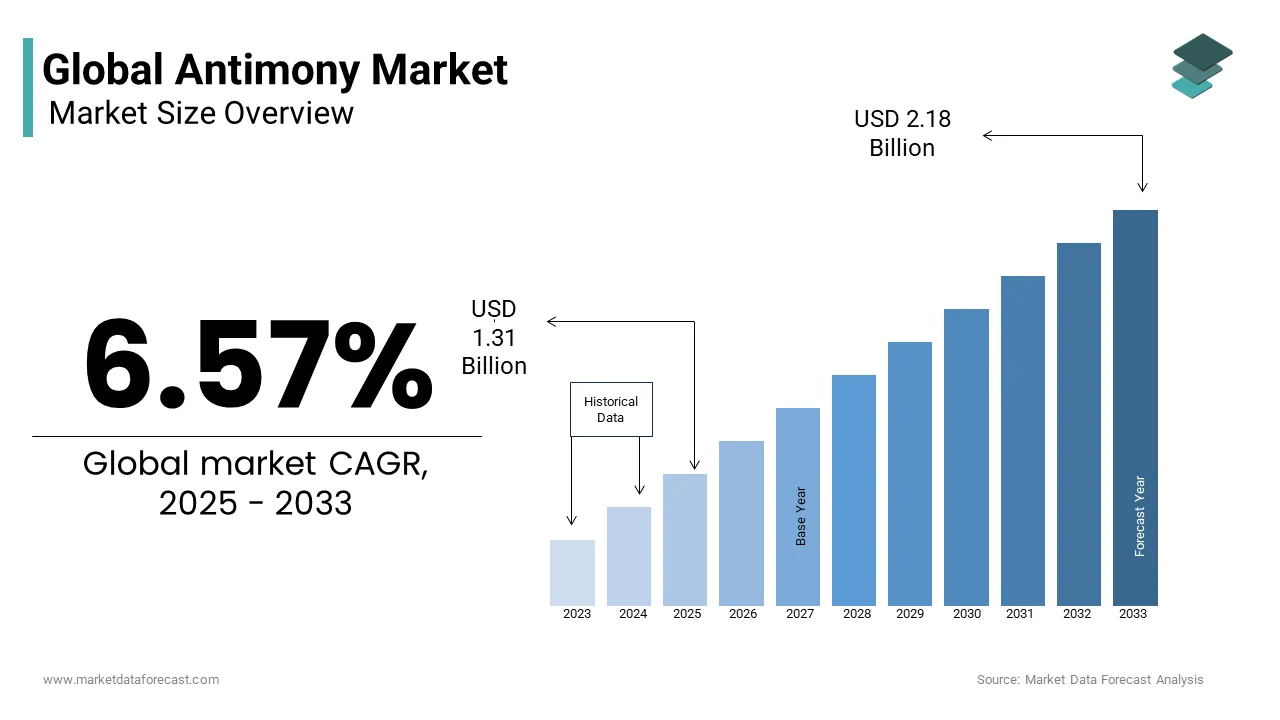
The global antimony market size was valued at USD 1.31 billion in 2025 and is anticipated to reach USD 1.40 billion in 2026 to reach USD 2.32 billion by 2034, growing at a CAGR of 6.57% during the forecast period from 2026 to 2034.
The antimony trioxide is the most prevalent derivative, which serves as a critical synergist in halogenated flame retardants used in electronics, textiles, and construction materials. As per the United States Geological Survey (USGS), global antimony production in 2023 was approximately 120,000 metric tons, with China dominating output, accounting for over 45% of total supply. Environmental scrutiny surrounding antimony’s toxicity has prompted regulatory oversight in the European Union under REACH legislation, influencing handling and disposal protocols.
MARKET DRIVERS
Antimony Demand Driven by Lead-Acid Battery Applications in Energy Storage and Automotive Sectors
The indispensable role in lead-acid battery manufacturing in grid energy storage and automotive sectors is driving the growth of the antimony market. Antimony is alloyed with lead to enhance the mechanical strength, durability, and charging efficiency of battery grids. According to the International Lead Association, approximately 85% of all lead-acid batteries produced globally incorporate antimony in their grid alloys, with the global lead-acid battery market exceeding 180 GWh in annual production capacity. The surging deployment of off-grid solar power systems in developing regions, especially across Sub-Saharan Africa and South Asia, has intensified demand for reliable energy storage, thereby increasing antimony consumption.
The integration of antimony in advanced flame-retardant formulations for electronics and transportation is additionally propelling the growth of the antimony market. According to the European Chemicals Agency, antimony trioxide is present in over 70% of halogen-based flame retardant compounds used in circuit boards and cable insulation. As per the International Energy Agency, global electric car sales surpassed 14 million units in 2023, each containing an average of 200 to 300 grams of flame-retardant materials, a portion of which includes antimony compounds. This regulatory and technological shift toward fire mitigation in high-energy-density systems continues to bolster antimony’s industrial indispensability.
MARKET RESTRAINTS
Supply Concentration and Chinese Regulations Intensify Risks in Antimony Market
The acute geographical concentration of mining and processing is hampering the growth of the antimony market. In 2023, China imposed stricter environmental audits on antimony smelters in Hunan province, temporarily reducing processing output by nearly 30%, as reported by the Asian Metal Research Institute. This monopolistic control amplifies price volatility and procurement risks for downstream industries in North America and Europe, undermining supply security and prompting regulatory scrutiny from entities like the U.S. Department of Commerce, which has classified antimony as a critical mineral due to import reliance.
Environmental and health concerns are hindering the growth of the antimony market. The World Health Organization classifies antimony trioxide as a possible human carcinogen (Group 2B), which is prompting regulatory agencies to impose strict exposure limits. The European Chemicals Agency has restricted antimony concentrations in consumer goods to below 100 ppm in certain applications, affecting textile and plastic manufacturing. Moreover, as per the U.S. Environmental Protection Agency, antimony levels in urban landfill leachate have exceeded safe thresholds by up to 15 times in some regions, raising concerns about long-term soil and water contamination. These ecological implications have led to increased compliance costs and accelerated substitution efforts in the European Union, where the substitution rate in flame retardants has risen by 12% annually since 2020, according to ChemSec.
MARKET OPPORTUNITIES
Antimony-Based Anodes Propel Advancements in Sodium-Ion Battery Technology
The development of antimony-based anode materials for next-generation sodium-ion batteries (SIBs) is offering a viable alternative to lithium-ion technology. Antimony exhibits high theoretical capacity (660 mAh/g) when alloyed with sodium, making it a promising candidate for cost-effective, large-scale energy storage. As per the Faraday Institution, pilot SIB projects in China and Europe have demonstrated over 2,000 charge cycles with antimony-composite anodes, achieving energy densities exceeding 140 Wh/kg.
Recycling and urban mining mitigate antimony’s supply risks and environmental footprint, and additionally leverage the growth of the antimony market. Currently, less than 25% of antimony is recovered from end-of-life products, according to the United Nations Environment Programme’s Global Resources Outlook 2024. However, advancements in hydrometallurgical recovery techniques now enable up to 90% extraction efficiency from lead-acid battery sludge and electronic waste. Pilot facilities in Belgium and Japan have already demonstrated commercial-scale recovery, processing over 10,000 tons of battery waste annually, as reported by the Institute of Scrap Recycling Industries.
MARKET CHALLENGES
Limited Substitutes Underscore Antimony’s Critical Role in Flame Retardancy and Alloy Strengthening
The lack of viable, high-performance substitutes that match antimony’s dual functionality in flame retardancy and alloy strengthening is hampering the growth of the antimony market. As per the Plastics Engineering Society, substitution in cable insulation applications leads to a 20–30% reduction in fire resistance efficacy. In lead-acid batteries, calcium-based alloys reduce antimony use but compromise deep-cycle durability, limiting their use in industrial applications.
The price volatility and speculative trading are likely to impede the growth of the ntimony market. Antimony prices have fluctuated between $6,000 and $12,000 per metric ton over the past five years, as documented by Metal Bulletin’s commodity price indices. These swings are exacerbated by low market liquidity, limited futures trading, and geopolitical disruptions in key producing regions.
REPORT COVERAGE
| REPORT METRIC | DETAILS |
| Market Size Available | 2025 to 2034 |
| Base Year | 2025 |
| Forecast Period | 2026 to 2034 |
| CAGR | 6.57% |
| Segments Covered | By Application, and Region |
| Various Analyses Covered | Global, Regional & Country Level Analysis, Segment-Level Analysis, DROC, PESTLE Analysis, Porter’s Five Forces Analysis, Competitive Landscape, Analyst Overview of Investment Opportunities |
| Regions Covered | North America, Europe, APAC, Latin America, Middle East & Africa |
| Market Leaders Profiled | Campine NV (Antwerp, Belgium), Huachang Antimony Industry (Yiyang, China), United States Antimony Corp (Montana, U.S.), Korea Zinc Co. Ltd, (Seoul, South Korea), Lambert Metals International (Bushey, U.K.), Mandalay Resources Ltd (Toronto, Canada), NYACOL Nano Technologies (Massachusetts. U.S.), Suzuhiro Chemical & Materials (Ibaraki, Japan) |
SEGMENT ANALYSIS
By Application Insights
The flame retardants segment was the largest and held 48.3% of the antimony market share in 2024, with the antimony trioxide’s irreplaceable role as a synergist in halogenated flame-retardant systems, especially in polymers used in electronics, construction materials, and transportation interiors. As per the European Flame Retardants Association, over 70% of brominated flame retardant formulations in Europe incorporate antimony trioxide due to its ability to reduce combustion rates by up to 60% when combined with halogens. Furthermore, regulatory mandates such as the EU’s Construction Products Regulation (CPR) require stringent fire safety ratings for insulation foams and cables, driving adoption.

The chemicals & alloys segment is likely to grow with an expected CAGR of 6.8% during the forecast period, due to the rising demand for high-strength, corrosion-resistant alloys in aerospace and defense applications. Antimony enhances the hardness and fatigue resistance of lead and tin alloys used in precision bearings and military-grade ammunition casings. Additionally, the U.S. Department of Defense has recently revised its critical materials strategy, identifying antimony as essential for munitions manufacturing, with procurement of antimony-containing alloys increasing by 18% between 2022 and 2023.
REGIONAL ANALYSIS
Asia Pacific Market Analysis
Asia Pacific was the top performer of the global antimony market by accounting for 62.3% of the share in 2024. China was the largest contributor by producing over 45% of the world’s antimony, but also consumes more than half of the global supply, driven by its vast electronics manufacturing base and lead-acid battery industry. Additionally, stringent fire safety norms in rapidly urbanizing cities like Shanghai and Shenzhen have amplified demand for flame-retardant materials in building insulation and public transport infrastructure.

Europe Market Analysis
Europe antimony market held 18.2% of the share in 2024. The European Chemicals Agency has classified antimony trioxide as a substance of very high concern (SVHC), prompting manufacturers to seek alternatives or adopt closed-loop recycling systems. Germany and France continue to rely on antimony in high-performance lead-acid batteries for start-stop vehicles, with over 80% of new internal combustion engine models in Europe incorporating such technology, according to the European Automobile Manufacturers Association.
North America Market Analysis
North America antimony market is likely to grow with a prominent CAGR throughout the forecast period. The United States, which accounted for a prominent share as a primary consumer, relying heavily on imported antimony, over 85% of which is sourced from China, can improve supply chain resilience by making it a national priority. According to the Defense Advanced Research Projects Agency (DARPA), antimony-based semiconductors are being integrated into next-generation infrared sensors, with pilot production lines in Arizona and Texas expanding since 2022.
Latin America Market Analysis
Latin America's antimony market growth is likely to grow with an emerging potential in niche industrial applications. Brazil's antimony market growth is likely to grow rapidly, with rapidly expanding automotive and construction sectors. The country’s National Transportation Agency mandates fire-resistant materials in public buses and metro systems, a policy reinforced after a series of high-profile transit fires between 2020 and 2022. Additionally, Chile’s mining sector has begun exploring antimony as a byproduct of copper and silver extraction, with the Chilean National Geology and Mining Service estimating that existing tailings could yield up to 1,200 metric tons of recoverable antimony annually.
Middle East And Africa Market Analysis
The Middle East and Africa antimony market growth is likely to grow with expanding infrastructure and energy projects. South Africa is the primary consumer, utilizing antimony in mining explosives and rail signaling systems, where flame-retardant cables are mandatory under the Southern African Development Community’s rail safety protocol. The country’s Department of Mineral Resources and Energy reports that antimony consumption in industrial safety systems grew by 6.3% in 2023, outpacing regional averages.
COMPETITIVE LANDSCAPE
Competition in the antimony market is characterized by concentrated production, regulatory complexity, and strategic maneuvering among a limited number of key players. Dominance is largely held by Chinese enterprises due to resource control and refining capacity, creating a high barrier to entry. However, non-Chinese producers are intensifying efforts to establish alternative supply chains through recycling and exploration in North and South America.
KEY MARKET PLAYERS
A few of the dominating players in the global antimony market include
- Campine NV (Antwerp, Belgium)
- China Tin Group (Hunan Chenzhou Mining Group Co., Ltd.)
- Huachang Antimony Industry (Yiyang, China)
- US Antimony Corporation
- United States Antimony Corp (Montana, U.S.)
- Ma’anshan Iron & Steel Company Limited
- Korea Zinc Co. (Ltd. Seoul, South Korea)
- Lambert Metals International (Bushey, U.K.)
- Mandalay Resources Ltd (Toronto, Canada)
- NYACOL Nano Technologies (Massachusetts, U.S.)
- Suzuhiro Chemical & Materials (Ibaraki, Japan)
Top Players In the Market
China Tin Group (Hunan Chenzhou Mining Group Co., Ltd.)
China Tin Group, headquartered in Hunan Province, is a dominant force in the antimony sector due to its vertically integrated operations spanning mining, smelting, and refining. The company operates the Xikuangshan mine, recognized as the world’s largest antimony deposit, enabling a consistent raw material supply. In recent years, it has intensified investment in clean smelting technologies to comply with China’s stricter environmental regulations, including the installation of sulfur capture systems that reduce emissions by over 40%, as reported by the Chinese Academy of Environmental Sciences.
US Antimony Corporation
US Antimony Corporation, based in Denver, Colorado, has established a growing footprint in the Asia Pacific region through niche refining and recycling initiatives despite limited domestic mining. The company has formed technical collaborations with metallurgical firms in South Korea and Taiwan to process antimony-bearing slag from electronic waste, achieving recovery rates exceeding 85% through proprietary hydrometallurgical methods. Additionally, the company has increased shipments of refined antimony oxide to Indian flame-retardant producers, capitalizing on India’s rising construction and automotive safety standards, thus strengthening its presence as a sustainable supplier in the regional value chain.
Ma’anshan Iron & Steel Company Limited (MIG)
Ma’anshan Iron & Steel, a subsidiary of China Baowu Steel Group, has diversified into antimony-based alloy production to support high-strength materials for automotive and rail applications. The company integrates antimony into specialty steel formulations to enhance wear resistance and thermal stability, particularly for components used in high-speed trains manufactured by CRRC. In 2022, MIG inaugurated a new alloying facility in Anhui Province dedicated to producing antimony-modified steel grades, capable of processing 15,000 metric tons annually.
Top Strategies Used by Key Market Participants
Key players in the antimony market are deploying vertical integration, technological innovation, and strategic alliances to consolidate their positions. Companies are acquiring upstream mining assets to secure raw material access, particularly in geologically rich but politically sensitive regions. Simultaneously, investment in low-emission smelting and solvent extraction technologies is accelerating to meet tightening environmental regulations in China and the EU. Recycling expansion has emerged as a core strategy, with firms establishing urban mining partnerships to recover antimony from electronic and automotive waste streams. Joint ventures with battery and electronics manufacturers are enabling direct integration into downstream supply chains.
MARKET SEGMENTATION
This research report on the global antimony market is segmented and sub-segmented into the following categories.
By Application
- Flame Retardants
- Chemicals & Alloys
- Lead Acid Batteries
- Ceramics & Glass
- Others
By Region
- North America
- Europe
- Asia Pacific
- Latin America
- The Middle East and Africa