- Product Description Description
- Table of Contents TOC
- List of Table & Figure LOT
- Get Free Sample PDF Sample PDF
Market Size, 2025
$0.94 BnMarket Estimate, 2026
$1.03 BnMarket Forecast, 2034
$2.19 BnCAGR, 2026–2034
9.83%Asia Pacific Narcolepsy Drugs Market Size, Growth, Trends & Forecast (2025–2034)
The Asia Pacific narcolepsy drugs market was valued at USD 0.94 billion in 2025, is estimated to reach USD 1.03 billion in 2026, and is projected to scale up to USD 2.19 billion by 2034, registering a compound annual growth rate (CAGR) of 9.83% during the forecast period from 2026 to 2034. Driven by growing awareness of sleep disorders, rising early diagnosis rates, expanding geriatric demographics, and robust healthcare spending, the regional market continues to expand significantly.
Key Executive Metrics (At-a-Glance)
- 2025 Base Valuation: USD 0.94 Billion
- 2026 Current Valuation: USD 1.03 Billion
- 2034 Forecast Valuation: USD 2.19 Billion
- Compound Annual Growth Rate (CAGR): 9.83% (2026–2034)
- Dominant Product Type: Central Nervous System (CNS) Stimulants (holding the major market share due to established efficacy in managing excessive daytime sleepiness)
- Fastest-Growing Product Type: Sodium Oxybate (expanding rapidly owing to its unique dual-action profile addressing both cataplexy and daytime sleepiness)
- Dominant Indication Segment: Narcolepsy Without Cataplexy (holding major market share due to higher overall patient presentation rates)
- Fastest-Growing Indication Segment: Daytime Extreme Sleepiness (fastest-growing category driven by increasing lifestyle stressors and better diagnostic screening)
- Dominant Region: Australia (holding the largest regional market share supported by high healthcare expenditure and lifestyle risk factors)
Core Market Drivers
- Awareness and Early Diagnosis: Active outreach programs by healthcare facilities and government initiatives educating the public and medical professionals about sleep disorders.
- Aging Population and Sleep Comorbidities: Rapidly aging demographics across Asia-Pacific leading to a higher incidence of sleep apnea, sleep-wake schedule disorders, and chronic neurological conditions.
- Expanded Therapeutic Portfolios: Development and introduction of advanced treatments targeting hypocretin pathways and broader drug pipelines by leading pharmaceutical companies.
Primary Market Restraints & Challenges
- Drug Side Effects and Abuse Risks: Adverse effects associated with central nervous system depressants (such as sodium oxybate dependency risks, respiratory depression, and strict controlled-substance regulations) alongside late or misdiagnoses.
Asia Pacific Narcolepsy Drugs Market Segmentation Breakdown
| Segment Category | Leading Sub-Segment (2025 Base) | Fastest-Growing Sub-Segment (2026–2034) |
|---|---|---|
| By Type | Central Nervous System Stimulants (dominant first-line therapy choice for wakefulness management) | Sodium Oxybate (fastest-growing therapeutic segment driven by advanced formulation compliance) |
| By Indication | Narcolepsy Without Cataplexy (leading patient population share with excessive daytime sleepiness) | Cataplexia / Daytime Extreme Sleepiness (fastest-growing category propelled by precision diagnostics) |
| By Country | Australia (dominant market leader backed by high healthcare expenditure and obesity rates) | China & India (fastest-growing regional markets driven by expanding healthcare infrastructure and rising awareness) |
Major Industry Players Profiled
Key enterprises shaping the Asia Pacific narcolepsy drugs market include Ligand Pharmaceuticals, Addrenex Pharmaceuticals, Shire Plc, Teva Pharmaceutical Industries Ltd., Arena Pharmaceuticals, Jazz Pharmaceuticals Plc, Bioprojet, and Graymark Healthcare, Inc.
 Download Free Sample Report
Asia Pacific Narcolepsy Drugs Market Size
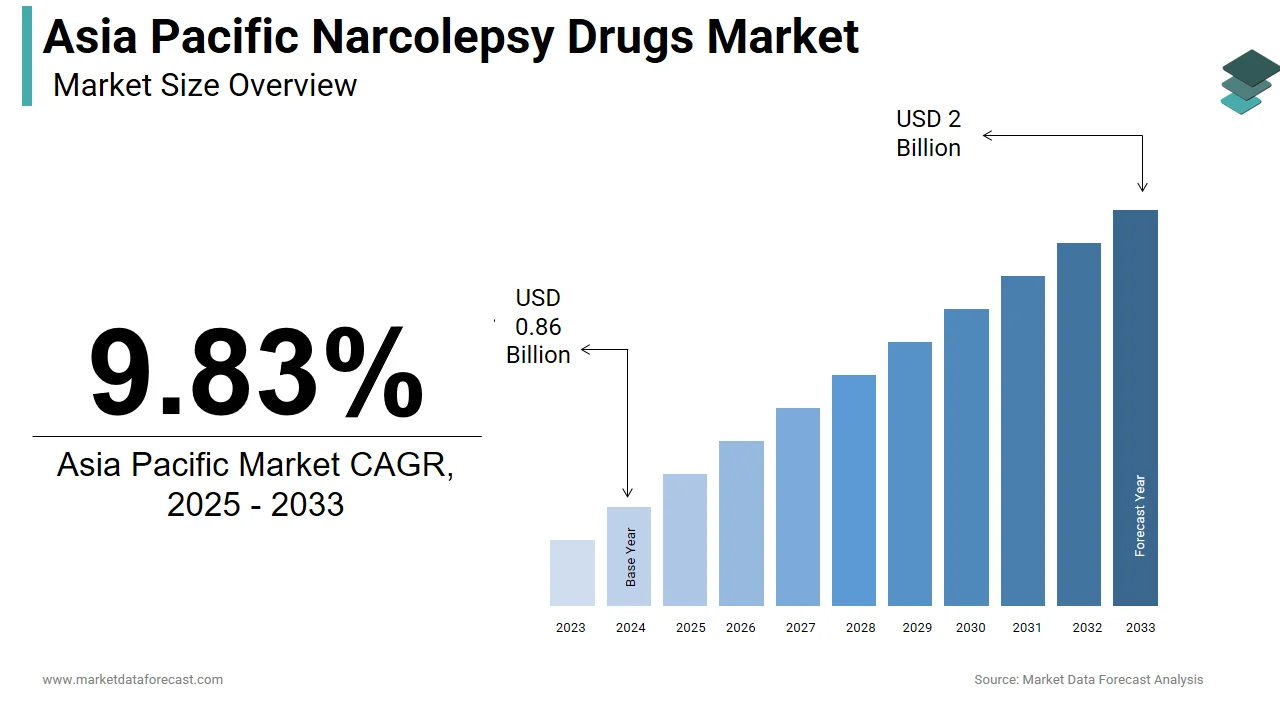
The Asia Pacific narcolepsy drugs market was valued at USD 0.94 billion in 2025, is estimated to reach USD 1.03 billion in 2026, and is projected to reach USD 2.19 billion by 2034, growing at a CAGR of 9.83% from 2026 to 2034.
MARKET DRIVERS
Growing Awareness and Early Diagnosis of Sleep Disorders
The active participation of healthcare facilities to raise awareness of the disorder and its symptoms is driving the growth of the narcolepsy drugs market in the Asia Pacific region. Other factors, such as growing concern about the benefits of early diagnosis of narcolepsy, coupled with government efforts to educate individuals and trained professionals about the disease, are accelerating market growth. Neurological disorders related to sleep are an emerging problem as the population ages at a rapid rate. The most common diagnoses other than narcolepsy were sleep apnea syndrome and sleep-wake schedule disorder in China. The prevalence rate of narcolepsy in southern China was recorded to be 0.035%. Extreme drowsiness affects most people, and sleep disturbances increase the risk associated with symptoms. In addition, cataplexy is expected to develop at a higher rate due to the sudden loss of muscle control by patients with cataplexy.
MARKET OPPORTUNITIES
Expanding Drug Portfolio and Focus on Narcolepsy Awareness
Narcolepsy without cataplexy will lead the narcolepsy drugs market in Asia Pacific during the prognostic period, owing to improving awareness of excessive daytime sleepiness with or with REM sleep patterns. Several organizations are focusing on spreading knowledge about the various sleep disorders, and their treatment options are leading to an increase in narcolepsy awareness programs. However, due to the low awareness and inaccurate depictions of the disease, most people with narcolepsy are undiagnosed. Without the diagnosis and care of a sleep specialist, the symptoms of narcolepsy can be misinterpreted as laziness or a character defect. They can limit educational and employment opportunities or lead to misdiagnosis. Additionally, the substantial portfolio of drugs for the treatment of narcolepsy is expected to positively impact the growth of the Asia Pacific narcolepsy market in the coming years. The spectrum of drugs involving sodium oxybate will increase the company portfolio.
MARKET CHALLENGES
Drug Side Effects, Abuse Risk, and Misdiagnosis Issues
The side effects and risks associated with ant narcoleptic drugs, primarily due to sodium oxybate causing central nervous system depressant, respiratory depression, seizures, and their potential for abuse. Another factor that will challenge the market can be late diagnosis and misdiagnosis of narcolepsy with other sleep disorders.
REPORT COVERAGE
| REPORT METRIC | DETAILS |
| Market Size Available | 2025 to 2034 |
| Base Year | 2025 |
| Forecast Period | 2026 to 2034 |
| Segments Covered | By Type, Indication, and Region. |
| Various Analyses Covered | Global, Regional and Country-Level Analysis, Segment-Level Analysis, Drivers, Restraints, Opportunities, Challenges; PESTLE Analysis; Porter’s Five Forces Analysis, Competitive Landscape, Analyst Overview of Investment Opportunities |
| Countries Covered | India, China, Japan, South Korea, Australia, New Zealand, Thailand, Malaysia, Vietnam, Philippines, Indonesia, Singapore, Rest of APAC |
| Market Leaders Profiled | Ligand Pharmaceuticals, Addrenex Pharmaceuticals, Shire Plc, Teva Pharmaceutical Industries Ltd., Arena Pharmaceuticals, Jazz Pharmaceuticals Plc, Bioprojet, and Graymark Healthcare, Inc. |
COUNTRY LEVEL ANALYSIS
In 2025, the regional market in Australia dominated the studied market. It is forecasted to continue to be the largest share in the Asia Pacific market during the forecast period due to increased healthcare spending in this region, significant sedentary lifestyle changes, and growing awareness in the population about various sleep disorders. According to data from the journal Sleep Science in 2018, approximately 1 in 2,000 people are suffering from narcolepsy across the globe. Moreover, the Australian Institute of Health and Welfare stated that around two-thirds, i.e., 64% of the Australian population aged 18 years and more, are estimated to be overweight or obese and have higher chances of contracting the disorder.
It is estimated that the Asia Pacific regions like India, Singapore, Malaysia, and South Korea are anticipated to have lucrative growth due to higher prevalence in Japan and the presence of emerging economies, increased research and development initiatives to advance new drugs against narcolepsy. With recent improvements in knowledge about narcolepsy, drugs targeting hypocretin have been developed, with no permanent cure and only symptomatic relief.
The Chinese market is predicted to grow due to the increasing prevalence of unhealthy lifestyles, better reimbursement policies, and technological advancements for disease diagnosis. Moreover, the growing number of cases of narcolepsy leading to increased awareness of treatment and increased healthcare expenditure is driving the growth of the market.
KEY MARKET PLAYERS
Companies playing a leading role in the Asia Pacific Narcolepsy Drugs Market analyzed in this report are Ligand Pharmaceuticals, Addrenex Pharmaceuticals, Shire Plc, Teva Pharmaceutical Industries Ltd., Arena Pharmaceuticals, Jazz Pharmaceuticals Plc, Bioprojet, and Graymark Healthcare, Inc.
MARKET SEGMENTATION
This research report on the Asia Pacific narcolepsy drugs market has been segmented and sub-segmented into the following categories.
By Type
- Central Nervous System Stimulants
- Tricyclic Antidepressants
- Sodium Oxybate
- Selective Serotonin Reuptake Inhibitor
- Others
By Indication
- Daytime Extreme Sleepiness
- Cataplexia
- Others
By Country
- India
- China
- Japan
- South Korea
- Australia
- New Zealand
- Thailand
- Malaysia
- Vietnam
- Philippines
- Indonesia
- Singapore
- Rest of Asia Pacific