- Product Description Description
- Table of Contents TOC
- List of Table & Figure LOT
- Get Free Sample PDF Sample PDF
Market Size, 2025
$9.18 BnMarket Estimate, 2026
$9.73 BnMarket Forecast, 2034
$15.51 BnCAGR, 2026–2034
6%Executive Summary: Asia Pacific Generator Sales Market
- Market Scope: Comprehensive regional Asia Pacific generator sales market analysis covering capacity segments, end-user verticals, application types, geographic leadership frameworks, key growth drivers, market trends, and strategic industry developments.
- Market Valuation: Valued at USD 9.18 billion (2025), estimated at USD 9.73 billion (2026), and projected to reach USD 15.51 billion by 2034, registering a robust CAGR of 6.00% (2026–2034).
- Primary Growth Drivers: Persistent grid instability in developing economies, expansion of energy-intensive industrial and data infrastructure, and government-led rural electrification programs. Notable trends include smart IoT-enabled generator adoption, hybrid diesel-solar integration, and dual-fuel ammonia technologies.
Key Market Segment Metrics (2026–2034)
| Category | Leading Segment (2025 Position) | Fastest-Growing Segment |
|---|---|---|
| By Capacity & Application | 75–350 kVA capacity segment (42.6% total sales) and Standby backup power (65.4% application sales) | Above 350 kVA capacity segment (9.8% CAGR) and Prime/continuous power (10.2% CAGR) |
| By End-User & Region | Industrial sector (largest end-user share at 43.6%) and India (largest regional demand share at 25.2%) | Commercial applications segment (growing at 8.7% CAGR) |
Major Market Players & Market Structure
Market Structure: Highly competitive power generation and industrial equipment landscape featuring major global enterprises competing through digital monitoring platforms, dual-fuel engine prototypes, service hub expansions, and SmartGen IoT series introductions.
Key Companies: Cummins Inc., Caterpillar Inc., Generac Holdings Inc., Himoinsa S.L., AKSA Power Generation, KOEL Green, Atlas Copco AB, Aggreko PLC, Kohler Co., Briggs & Stratton Corporation, Yamaha Motor Corporation, Greaves Cotton Limited, AGCO Corporation, APR Energy, Multiquip Inc., Kirloskar Electric Company, and Mitsubishi Heavy Industries.
Asia Pacific Generator Sales Market Size
The Asia Pacific Generator Sales Market is projected to grow from USD 9.18 billion in 2025 to USD 9.73 billion in 2026 and reach USD 15.51 billion by 2034, registering a CAGR of 6.00% from 2026 to 2034.
Generator sales refer to the distribution and deployment of internal combustion engine-driven power generation units designed to provide primary or backup electricity across residential, commercial, industrial, and infrastructure sectors. These generators, fueled predominantly by diesel, natural gas, or increasingly by hybrid and dual-fuel systems, serve as critical energy security solutions in regions prone to grid instability or lacking reliable electricity access. As per the International Energy Agency, millions of people in rural areas of South and Southeast Asia still experience unreliable grid connectivity, necessitating decentralized power solutions. With rapid urbanization, industrial expansion, and climate-induced disruptions to power networks, the demand for on-site power generation remains deeply embedded in the region’s energy resilience strategy.
MARKET DRIVERS
Persistent Grid Instability and Power Shortages in Developing Economies
Chronic electricity supply disruptions in emerging economies across the Asia Pacific region are a primary catalyst for robust generator sales. In countries like Myanmar, Pakistan, and parts of Eastern Indonesia, daily load-shedding and unplanned outages remain common, compelling businesses and households to rely on backup power. This unreliability has institutionalized generator ownership, with many commercial buildings in Colombo, Sri Lanka, operating diesel generators as standard equipment. As grid modernization lags behind demand growth, especially in rapidly urbanizing regions, the dependency on standalone power units remains entrenched.
Expansion of Energy-Intensive Industrial and Data Infrastructure
The proliferation of energy-intensive facilities such as manufacturing plants, data centers, and telecom towers is significantly driving demand for high-capacity generators. As digitalization accelerates, data center construction across India, Malaysia, and Thailand has surged, each requiring uninterrupted power and on-site backup systems. According to JLL Asia Pacific, the region added over 650 megawatts of data center capacity between 2021 and 2023, with Singapore and Mumbai leading expansion. These facilities typically deploy multiple megawatt-scale diesel or gas generators as part of their redundancy architecture. Similarly, the rise of 5G networks has increased the number of telecom base stations, many located in off-grid or semi-urban areas. This infrastructure dependency ensures sustained demand for reliable, scalable power generation units.
MARKET RESTRAINTS
Stringent Emission Regulations and Environmental Compliance Costs
Tightening emissions standards are increasingly constraining the sale of conventional diesel generators, particularly in urban and environmentally sensitive zones. Countries have adopted stringent non-road diesel emission standards. In China, the Ministry of Ecology and Environment mandated that all new industrial generators above 37 kW meet China IV emission norms by 2023, effectively phasing out less efficient units. Also, non-road diesel engines contribute to urban black carbon emissions in Southeast Asian cities. Compliance requires costly after-treatment systems such as selective catalytic reduction (SCR), raising generator prices. This financial burden discourages small businesses and rural users, slowing adoption in price-sensitive markets and pushing regulators toward alternative energy solutions.
Rising Affordability and Reliability of Renewable Microgrids
The growing competitiveness of solar photovoltaic (PV) systems coupled with battery storage is eroding the dominance of diesel generators in off-grid and remote applications. These systems offer lower operational costs and reduced maintenance compared to generators, which require constant fuel supply and engine servicing. Besides, donor-funded electrification projects increasingly prioritize clean energy, limiting diesel generator deployment. This shift is particularly evident in telecom and community infrastructure, where hybrid solar-diesel systems are replacing full diesel reliance, dampening long-term generator sales growth in off-grid segments.
MARKET OPPORTUNITIES
Government-Led Electrification and Rural Infrastructure Programs
Public sector initiatives aimed at expanding energy access in remote and underserved areas are creating substantial opportunities for generator deployment as transitional power solutions. In the Pacific Islands, where over 70% of households in Papua New Guinea and Solomon Islands lack grid access, the Asian Development Bank has funded diesel-based microgrids as part of its Pacific Energy Program. These projects prioritize reliability and speed of deployment, favoring proven generator technology over longer-term renewable rollouts. As governments balance immediate energy needs with long-term sustainability, hybrid generator systems remain a critical bridge solution.
Adoption of Smart and Hybrid Generator Systems
The integration of digital controls, IoT monitoring, and hybrid energy management is revitalizing the generator market with intelligent, fuel-efficient solutions. Modern generators now feature auto-start, remote diagnostics, and load-sharing capabilities, enabling seamless integration with solar and battery systems. In Australia and Japan, companies like Caterpillar have introduced smart diesel-gas hybrid units that reduce fuel consumption by up to 30% by dynamically adjusting output based on demand. These advancements extend equipment lifespan, lower emissions, and improve operational efficiency, making generators more viable in ESG-conscious environments. The convergence of digitalization and energy optimization is transforming generators from emergency backups to intelligent power assets.
MARKET CHALLENGES
Volatility in Fuel Supply and Logistics in Remote Regions
One of the most pressing challenges for generator operation in the Asia Pacific region is the inconsistent availability and high cost of diesel and fuel in geographically isolated areas. In archipelagic nations like Indonesia and the Philippines, transporting fuel to outer islands is logistically complex and expensive, with delivery costs sometimes doubling the base price of diesel. In mountainous regions of Nepal and Bhutan, fuel shortages during monsoon seasons frequently disable backup generators, jeopardizing healthcare and communication services. This logistical fragility undermines the reliability of diesel-dependent systems, even when the units themselves are functional. Operators face increased operational risks and maintenance costs, making long-term generator reliance unsustainable without robust fuel supply chains or hybrid alternatives.
Skilled Technician Shortage and Maintenance Gaps
A critical operational challenge in the Asia Pacific generator sales market is the scarcity of trained technicians capable of maintaining and repairing complex power units, particularly in rural and remote locations. Poor maintenance practices, such as incorrect oil changes, filter neglect, or improper load testing, can reduce generator lifespan. This lack of technical capacity increases downtime and total cost of ownership, deterring institutional buyers from investing in high-capacity units. Manufacturers and distributors are now launching training partnerships with vocational schools in India and Indonesia to build local expertise, but scalability remains a hurdle in addressing systemic workforce gaps.
REPORT COVERAGE
| REPORT METRIC | DETAILS |
| Market Size Available | 2025 to 2034 |
| Base Year | 2025 |
| Forecast Period | 2026 to 2034 |
| Segments Covered | By Capacity, End User, Application, and Region. |
| Various Analyses Covered | Global, Regional and Country-Level Analysis, Segment-Level Analysis, Drivers, Restraints, Opportunities, Challenges; PESTLE Analysis; Porter’s Five Forces Analysis, Competitive Landscape, Analyst Overview of Investment Opportunities |
| Countries Covered | India, China, Japan, South Korea, Australia, New Zealand, Thailand, Malaysia, Vietnam, Philippines, Indonesia, Singapore, Rest of APAC |
| Market Leaders Profiled | Cummins Inc., Caterpillar Inc., Generac Holdings Inc., Himoinsa S.L., AKSA Power Generation, KOEL Green, Atlas Copco AB, Aggreko PLC, Kohler Co., Briggs & Stratton Corporation, Yamaha Motor Corporation, Greaves Cotton Limited, AGCO Corporation, APR Energy, and Multiquip Inc. |
SEGMENTAL ANALYSIS
By Capacity Insights
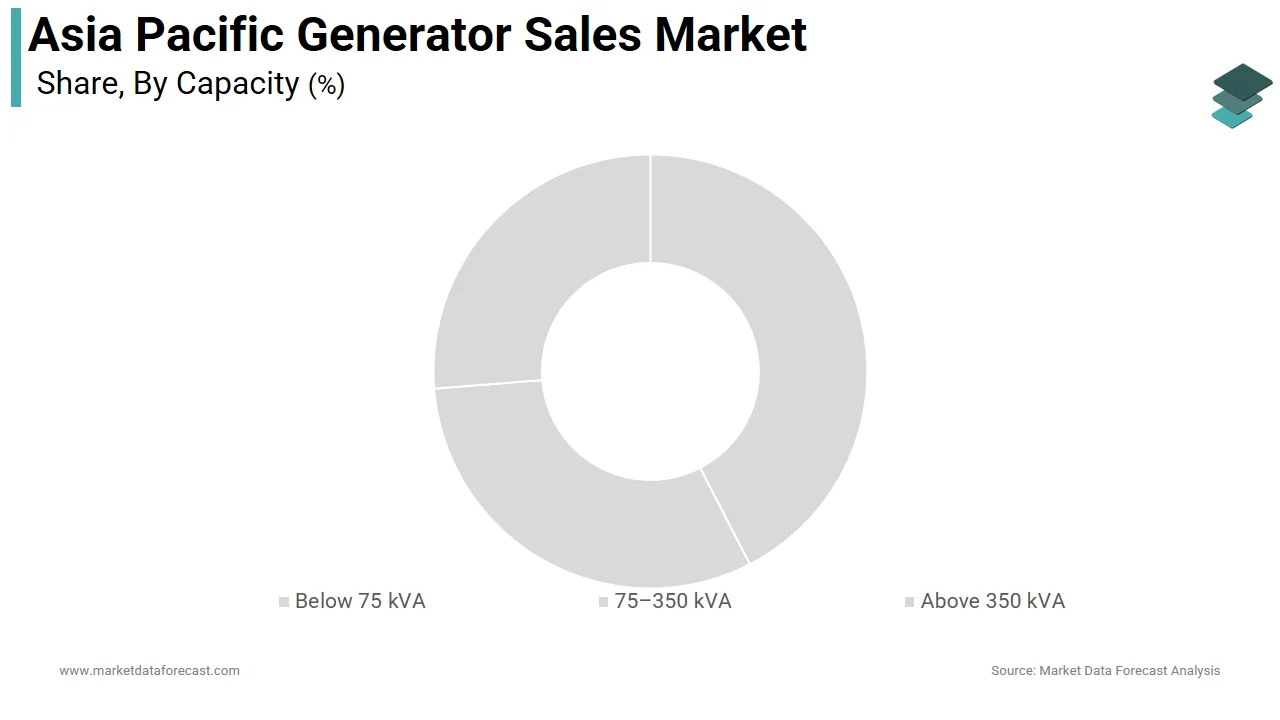
The 75–350 kVA generator segment dominated the Asia Pacific market by capturing 42.6% of total sales in 2025. This capacity range strikes an optimal balance between power output and operational flexibility, making it ideal for medium-scale industrial units, commercial complexes, and large healthcare facilities. The proliferation of mid-sized manufacturing units, where factories in electronics, textiles, and food processing require reliable backup power without the complexity of multi-megawatt systems, is a primary driver. A further critical factor is the widespread adoption of these units in commercial infrastructure such as shopping malls, hotels, and office towers across rapidly urbanizing cities. Additionally, telecom operators deploying 5G infrastructure use this capacity for hybrid power stations, combining diesel with solar. The adaptability, manageable fuel logistics, and compliance with emission norms for medium-duty cycles solidify this segment’s leadership in the regional generator sales landscape.
The above 350 kVA generators segment is the fastest-growing in the market and is projected to grow at a CAGR of 9.8% from 2025 to 2033. This surge is driven by the expansion of energy-intensive industrial parks and large-scale data centers requiring prime or continuous power solutions. In India, the government’s National Data Centre Policy has catalyzed the construction of 25 new hyperscale facilities since 2022, each requiring multiple 500–2,000 kVA generators for redundancy. Similarly, China’s Yangtze River Economic Belt hosts industrial clusters where uninterrupted power is critical for chemical and steel production, prompting investments in high-capacity on-site generation. A different key driver is the increasing deployment of prime power generators in off-grid mining and oil & gas operations across Papua New Guinea and Western Australia. These installations often use modular generator sets above 500 kVA for load-sharing and redundancy. Besides, large infrastructure projects such as Singapore’s Tuas Mega Port and Indonesia’s new capital city Nusantara require continuous power during construction phases, further boosting demand. The integration of digital load management and hybrid controls has improved efficiency and reliability, making high-capacity generators more viable for sustained operations beyond emergency backup.
By End User Insights
The industrial sector holds the largest share of the Asia Pacific generator sales market at 43.6% in 2025. This dominance is rooted in the region’s role as a global manufacturing hub, where power continuity directly impacts productivity and supply chain reliability. In China, which produces over 30% of the world’s manufactured goods, factory downtime due to outages can be costly. As a result, industrial zones maintain backup generators, with many operating them in prime power mode due to inconsistent grid quality. A major contributing factor is the rapid industrialization in Southeast Asia, particularly in electronics and automotive manufacturing clusters. These facilities, often operated by Japanese, Korean, and Taiwanese firms, adhere to strict operational standards requiring uninterrupted power for automation and precision machinery. Similarly, India’s Production-Linked Incentive (PLI) scheme has spurred the creation of new manufacturing zones, each mandating on-site power resilience. The integration of generators with SCADA systems for remote monitoring further enhances their role in industrial automation, reinforcing their indispensability in the manufacturing ecosystem.
The commercial segment is the fastest-growing end-user segment and is projected to grow at a CAGR of 8.7% from 2025 to 2033. This acceleration is fueled by the explosive growth of retail, hospitality, healthcare, and digital infrastructure across urban centers. Hospitals, in particular, are driving demand due to life-support systems and cold storage for vaccines. An additional critical driver is the rise of e-commerce fulfillment centers and cold storage logistics hubs, which require uninterrupted power for refrigeration and inventory management systems. Additionally, the expansion of digital banking and fintech has increased reliance on data centers and ATMs, many of which operate on generator backup. This convergence of urbanization, digitalization, and service-sector growth positions the commercial segment as the most dynamic in the market.
By Application Insights
The standby backup power application dominated the market by representing a 65.4% of generator sales in 2025. This segment’s dominance is anchored in the fundamental need for emergency power during grid failures, particularly in regions with unreliable electricity supply. In countries like the Philippines and Bangladesh, where scheduled and unscheduled outages are routine, standby generators are considered essential infrastructure for homes, businesses, and public institutions. The integration of standby generators into building safety codes and insurance requirements is a a key driver. In Japan, the Building Standard Law mandates emergency power systems in high-rise residential and commercial buildings for elevator operation, fire pumps, and evacuation lighting. Similarly, Australia’s National Construction Code requires hospitals and aged care facilities to maintain 72 hours of backup power. Additionally, the rise in climate-induced power disruptions, such as typhoons in the Philippines and heatwave-related blackouts in India, has heightened awareness of energy resilience. The increasing frequency of extreme weather events, as documented by the Intergovernmental Panel on Climate Change, reinforces the necessity of standby systems, ensuring sustained demand across all end-user segments.
The prime/continuous power segment is the fastest-growing application in the market and is anticipated to grow at a CAGR of 10.2% from 2025 to 2033. This growth is driven by the persistent lack of grid access in remote and rural regions, where generators serve as the primary source of electricity rather than a backup. A further major factor is the expansion of off-grid industrial operations such as mining, aquaculture, and oil exploration, where grid connectivity is either unavailable or economically unfeasible. In Western Australia, remote iron ore mines operate multi-megawatt generator fleets to power processing plants and worker accommodations. Similarly, in Myanmar and Laos, hydropower project construction sites use prime power generators during development phases. The integration of hybrid controllers that synchronize generators with solar and battery systems has improved fuel efficiency and extended operational viability, making prime power solutions more sustainable. This shift from temporary to continuous reliance on generators is redefining their role in the region’s energy architecture.
COUNTRY-LEVEL ANALYSIS
India Generator Sales Market Insights
India held the largest position in the Asia Pacific generator sales market by accounting for a 25.2% of regional demand in 2025. The country’s dominance is due to a combination of widespread grid instability, rapid industrialization, and expanding commercial infrastructure. A notable portion of India’s industrial output originates in states like Maharashtra, Tamil Nadu, and Gujarat, where power fluctuations remain common despite national grid improvements. According to the Central Electricity Authority, industrial and commercial sectors consumed 47% of total electricity in 2023. The government’s push for manufacturing under the “Make in India” initiative has led to the establishment of new industrial parks, each mandating on-site power resilience. Additionally, rising middle-class homeowners in tier-2 cities are increasingly installing 5–25 kVA units to combat outages, further broadening the market base.
Chaina Generator Sales Market Insights
China is another key player in the market which is driven by its vast industrial base, urban infrastructure development, and strategic investments in energy security. While grid reliability is relatively high in eastern provinces, western and rural regions still experience intermittent supply, necessitating backup systems. The country’s “Dual Carbon” goals have spurred innovation in low-emission and hybrid generator systems, particularly in Guangdong and Jiangsu provinces. Additionally, China’s Belt and Road projects in Southeast Asia and Africa have boosted domestic generator exports, reinforcing manufacturing scale. The integration of smart grid technologies and IoT-enabled gensets is transforming the market toward intelligent, remotely managed systems, positioning China as a leader in advanced generator solutions.
Japan Generator Sales Market Insights
Japan is characterized by a mature, high-specification market focused on reliability, safety, and disaster resilience. The country’s stringent building codes and frequent seismic activity necessitate robust standby power systems in hospitals, transportation hubs, and high-rises. The 2011 Fukushima disaster reshaped national energy policy, leading to decentralized power planning and increased private-sector investment in on-site generation. Besides, Japan’s aging population has driven demand for backup power in elderly care facilities. With limited space and high fuel costs, there is a growing shift toward compact, fuel-efficient units and hybrid systems, reflecting a market prioritizing precision, durability, and regulatory compliance over volume.
Australia Generator Sales Market Insights
Australia holds a significant share, with demand concentrated in remote industrial operations, mining, and rural electrification. The country’s vast geography and sparse population make grid extension economically unviable in many regions, particularly in the Northern Territory and Western Australia. Further, bushfire and cyclone-related blackouts have prompted state governments to mandate backup power in critical infrastructure. The Clean Energy Council reports that hybrid diesel-solar systems are now standard in new remote installations, improving fuel efficiency. Australia’s focus on operational resilience and environmental compliance positions it as a high-value market for advanced, low-emission generator technologies.
KEY MARKET PLAYERS
Key market players in the APAC Generator Sales Market are Cummins Inc., Caterpillar Inc., Generac Holdings Inc., Himoinsa S.L., AKSA Power Generation, KOEL Green, Atlas Copco AB, Aggreko PLC, Kohler Co., Briggs & Stratton Corporation, Yamaha Motor Corporation, Greaves Cotton Limited, AGCO Corporation, APR Energy, and Multiquip Inc.
TOP LEADING PLAYERS IN THE MARKET
Cummins Inc
Cummins Inc. is a dominant force in the Asia Pacific generator sales market, delivering a comprehensive range of diesel, natural gas, and hybrid power solutions tailored for industrial, commercial, and infrastructure applications. The company operates manufacturing facilities in China, India, and Australia, enabling localized production and faster deployment. The company has also expanded its distribution network in Indonesia and Vietnam through partnerships with local engineering firms. Cummins has invested in training centers in Chennai and Bangkok to upskill technicians, ensuring proper installation and service. Their focus on fuel efficiency, low emissions, and integration with renewable microgrids has strengthened their reputation as a technology-forward provider in mission-critical power sectors.
Kirloskar Electric Company
Kirloskar Electric has established a strong regional presence by offering cost-effective, durable generator sets designed for the diverse operational conditions of the Asia Pacific market. The company’s range spans from 5 kVA residential units to 2,500 kVA industrial systems, with a focus on reliability in high-temperature and humid environments. In 2023, Kirloskar launched its SmartGen series in Thailand and Malaysia, featuring IoT-enabled controls and hybrid compatibility for commercial and telecom applications. The company has strengthened its service footprint by establishing 45 new service hubs across the Philippines and Bangladesh to ensure rapid response and maintenance. Additionally, Kirloskar has collaborated with solar integrators in India to develop diesel-solar hybrid solutions for off-grid telecom towers. Their emphasis on after-sales support, localized engineering, and energy-efficient designs has solidified their position as a preferred supplier in price-sensitive yet performance-demanding markets.
Mitsubishi Heavy Industries (MHI) Engine & Turbocharger
Mitsubishi Heavy Industries plays a critical role in the high-capacity generator segment, supplying large-bore engines that power prime and continuous-duty generator sets for industrial complexes, data centers, and LNG terminals across Japan, Australia, and South Korea. Their engines are known for durability, fuel flexibility, and compliance with stringent emission standards. In early 2024, MHI introduced a new dual-fuel engine platform in Singapore capable of running on diesel and ammonia blends, supporting decarbonization goals in maritime and industrial sectors. The company has also enhanced its digital service suite, offering real-time performance analytics and remote tuning for generator operators. Collaborations with local OEMs in Indonesia and Vietnam have enabled integration of MHI engines into region-specific power packages. Their commitment to innovation in low-carbon fuels and high-efficiency power generation positions them at the forefront of the transition toward sustainable on-site energy systems.
TOP STRATEGIES USED BY KEY MARKET PARTICIPANTS
Key players in the Asia Pacific generator sales market are deploying advanced technological integration, regional localization, and sustainability-driven innovation to consolidate their market influence. A core strategy is the digitalization of generator systems through IoT-enabled monitoring, predictive maintenance, and remote control platforms that enhance operational efficiency and customer retention. Companies are expanding local manufacturing and assembly units in India, Thailand, and Indonesia to reduce lead times and comply with import regulations. Strategic partnerships with renewable energy firms are enabling the development of hybrid power solutions that combine diesel generators with solar and battery storage, addressing rising ESG pressures. Firms are also investing in technician training programs and service networks to improve after-sales reliability, a critical differentiator in regions with limited technical expertise. Additionally, product diversification into low-emission and dual-fuel technologies aligns with tightening environmental regulations in countries like Japan and Australia. These strategies collectively enhance competitiveness by improving performance, compliance, and lifecycle value.
COMPETITIVE LANDSCAPE
The competition in the Asia Pacific generator sales market is shaped by a convergence of global engineering leaders and agile regional manufacturers vying for dominance through technological differentiation and service excellence. While multinational corporations leverage brand credibility and R&D capabilities, local players compete on affordability, customization, and rapid deployment. The market is increasingly influenced by regulatory shifts toward lower emissions and higher efficiency, compelling manufacturers to innovate beyond traditional diesel models. Digital integration, hybrid readiness, and lifecycle support are becoming key decision factors for industrial and commercial buyers. Geographic fragmentation and varying grid reliability create diverse demand patterns, favoring companies with adaptive product portfolios and strong distribution networks. As energy resilience becomes a strategic priority, the competitive landscape is evolving from mere equipment supply to comprehensive power management solutions in the Asia Pacific generator sales market.
RECENT MARKET DEVELOPMENTS
- In January 2023, Cummins Inc. launched its PowerCommand® digital monitoring platform across Southeast Asia, enabling remote diagnostics and predictive maintenance for generator fleets and strengthening its service leadership in the Asia Pacific generator sales market.
- In March 2023, Kirloskar Electric established 15 new service hubs in the Philippines and Bangladesh to enhance after-sales support and reduce downtime for industrial and commercial clients in the Asia Pacific generator sales market.
- In August 2023, Mitsubishi Heavy Industries introduced a dual-fuel engine prototype in Singapore capable of operating on diesel and ammonia blends, advancing low-carbon power solutions in the Asia Pacific generator sales market.
- In November 2023, Cummins partnered with a major Indian telecom infrastructure provider to deploy 5,000 hybrid-ready generator units integrated with solar controllers in off-grid towers in the Asia Pacific generator sales market.
- In April 2024, Kirloskar Electric launched its SmartGen IoT-enabled generator series in Malaysia and Thailand, offering real-time performance tracking and remote control to commercial and industrial users in the Asia Pacific generator sales market.
MARKET SEGMENTATION
This Asia Pacific generator sales market research report is segmented and sub-segmented into the following categories
By Capacity
- Below 75 kVA
- 75–350 kVA
- Above 350 kVA
By End-User
- Residential
- Commercial
- Industrial
By Application
- Standby Backup Power
- Prime/Continuous Power
- Peak Shaving
By Country
- China
- India
- Japan
- South Korea
- Australia
- New Zealand
- Thailand
- Indonesia
- Philippines
- Vietnam
- Singapore
- Rest of APAC