- Product Description Description
- Table of Contents TOC
- List of Table & Figure LOT
- Get Free Sample PDF Sample PDF
Market Size, 2025
$0.37 BnMarket Estimate, 2026
$0.39 BnMarket Forecast, 2034
$0.65 BnCAGR, 2026–2034
6.44%Executive Summary: Asia Pacific Industrial Vegetation Management Market
- Market Scope: Comprehensive analysis of the Asia Pacific industrial vegetation management market covering application sectors (forestry, electric utilities, railroads, roadways, pipelines, etc.), product offerings (herbicides, plant growth regulators, insecticides), and an extensive country-level framework spanning India, China, Japan, South Korea, Australia, Southeast Asia, and New Zealand.
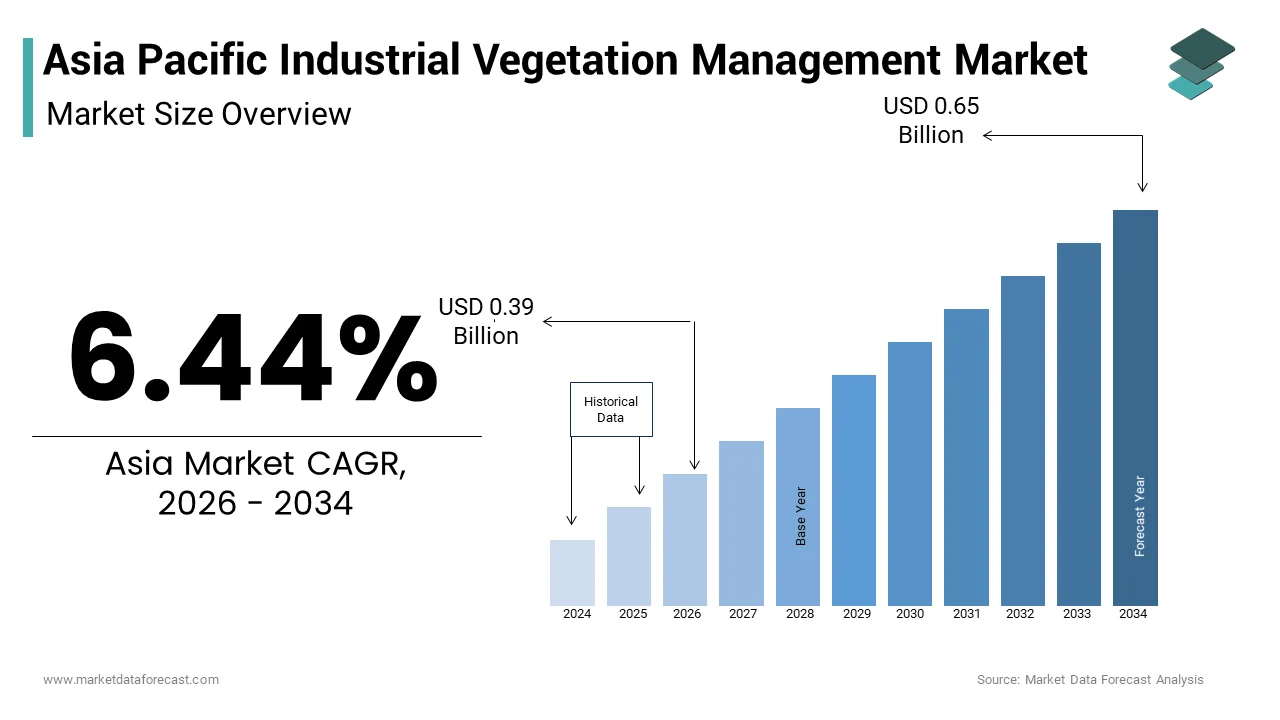
- Market Valuation: Valued at USD 0.37 billion in 2025, estimated at USD 0.39 billion in 2026, and projected to reach USD 0.65 billion by 2034, registering a robust CAGR of 6.44% over the forecast period from 2026 to 2034.
- Primary Growth Drivers: Continuous investments by electric utilities and transport operators to prevent grid malfunctions and infrastructure disruptions; increasing emphasis on strict regulatory compliance following historical blackout and bushfire events; and heavy R&D investments by manufacturing giants in product innovations and enhanced service delivery.
Key Market Segment Metrics (2026–2034)
| Category | Leading Segment / Position | Growth Details / Highlights |
|---|---|---|
| By Application | Electric Utilities, Railroads, Roadways, Pipelines, Forestry, and Rangeland | Electric utilities remain a primary expenditure area to safeguard distribution/transmission lines from tree encroachment. |
| By Products | Herbicides, Insecticides, and Plant Growth Regulators | Market pricing has faced competitive pressure from cheaper generic alternatives, prompting focus on advanced formulations. |
| By Country / Region | India, China, Japan, South Korea, Australia, New Zealand, and ASEAN economies | Driven by extensive infrastructure expansion and regional safety mandates across rapidly urbanizing economies. |
Major Market Players & Market Structure
Market Structure: A competitive and consolidating market landscape featuring global chemical conglomerates and specialized vegetation management contractors adapting to pricing pressures and advanced service delivery models.
Key Companies: Dow AgroSciences, Monsanto, DuPont, BASF, Nufarm, Makhteshim Agan, Boultbee Vegetation Management, Helena, and Dbi Services.
Asia Pacific Industrial Vegetation Management Market Size
The Asia Pacific industrial vegetation management market size was valued at USD 0.37 billion in 2025 and is anticipated to reach USD 0.39 billion in 2026 from USD 0.65 billion by 2034, growing at a CAGR of 6.44% from 2026 to 2034.
Industrial vegetation management is defined as the process of selectively promoting the growth of low-growing vegetation to inhibit the growth of taller vegetation, such as weed trees and other forms of weeds. Utility companies have to spend heavily on vegetation management to evict these unwanted plants. For instance, electrical-based utilities have to manage vegetation around power lines, as vegetation is one of the most frequent reasons behind the malfunctioning of distribution and transmission devices. As a result, electrical utilities have to continuously invest in vegetation management.
Over the past decade, the IVM market has witnessed a negative growth rate, and as a result, the overall market share of IVM has declined. This can be mainly attributed to the availability of cheaper generic products in the market. The decline is not due to a loss of consumers but due to an overall decline in the sales of IVM products, even when these generic products have forced the big manufacturers of IVM products to lower their prices to meet the heavy competition. Moreover, utility vegetation management has come under heavy scrutiny due to the events of the 2003 Northeast Blackout, the 2006 European Blackout, and the 2009 Black Saturday bushfires. As a result, governments have implemented new, stricter policies to increase expectations from companies offering IVM services. Be that as it may, there remains a huge market potential as innovative products are being introduced. IVM manufacturing giants such as Dow Agro Sciences are investing heavily in product innovation and enhanced service delivery.
REPORT COVERAGE
| REPORT METRIC | DETAILS |
| Market Size Available | 2025 to 2034 |
| Base Year | 2025 |
| Forecast Period | 2026 to 2034 |
| CAGR | 6.44% |
| Segments Covered | By Application, Product, Region |
| Various Analyses Covered | Global, Regional & Country Level Analysis, Segment-Level Analysis, DROC, PESTLE Analysis, Porter’s Five Forces Analysis, Competitive Landscape, Analyst Overview on Investment Opportunities |
| Regions Covered | India, China, Japan, South Korea and Australia, South Africa, New Zealand, Thailand, Malaysia, Vietnam, Philippines, Indonesia, Singapore, and the Rest of the Asia Pacific |
| Market Leaders Profiled | Dow AgroSciences, Monsanto, DuPont, BASF, Nufarm, Makhteshim Agan, Boultbee Vegetation Management, Helena, and Dbi Services. |
KEY MARKET PLAYERS
The market is dominated by companies like
- Dow AgroSciences
- Monsanto
- DuPont
- BASF
- Nufarm
- Makhteshim Agan
- Boultbee Vegetation Management
- Helena
- DbiServices.
MARKET SEGMENTATION
The Asia Pacific industrial vegetation management market is segmented and sub-segmented based on application, products, and country.
By Application
- Forestry
- Rangeland
- Pastureland
- Railroads
- Roadways
- Electric Utilities
- Pipelines
- Aquatic Areas
By Products
- Insecticides
- Herbicides
- Plant Growth Regulators
- Others
By Country
- India
- China
- Japan
- South Korea
- Australia
- New Zealand
- Thailand
- Malaysia
- Vietnam
- Philippines
- Indonesia
- Singapore
- Rest of APAC