- Product Description Description
- Table of Contents TOC
- List of Table & Figure LOT
- Get Free Sample PDF Sample PDF
Market Size, 2025
$4.07 BnMarket Estimate, 2026
$4.83 BnMarket Forecast, 2034
$7.95 BnCAGR, 2026–2034
7.72%Asia Pacific Insect Pest Control Products Market Overview
- Market Scope: Comprehensive regional market analysis evaluating insect pest control products across commercial, residential, and agricultural sectors, covering product types, control methods, and country-level metrics across APAC.
- Market Valuation: Valued at USD 4.07 billion in 2025, estimated at USD 4.38 billion in 2026, and projected to reach USD 7.95 billion by 2034, registering a robust CAGR of 7.72% from 2026 to 2034.
- Primary Growth Drivers: Government regulations promoting food cleanliness, public health safety initiatives, rising environmental awareness, and rapid agricultural and urban expansion across developing nations like China and India.
Asia Pacific Insect Pest Control Products Market Metrics (2026–2034)
| Market Category | Leading Segment Focus | Fastest-Growing / Key Segment Dynamics |
|---|---|---|
| By Type / Pest Type | Termites & Insects (anchored by agricultural protection needs and structural timber preservation) | Mosquitoes & Bed Bugs (scaling rapidly due to urbanization and vector-borne disease prevention) |
| By Control Method | Chemical (dominant method favored for cost-effectiveness, rapid efficacy, and broad availability) | Biological & Mechanical (gaining momentum driven by eco-friendly government initiatives) |
| By Application | Commercial & Industrial (high consumption due to strict food hygiene, hospitality, and facility sanitation standards) | Residential Sector (expanding with rising disposable incomes, lifestyle changes, and hygiene awareness) |
| By Country | China & India (largest regional markets backed by massive agricultural lands and expanding urban infrastructure) | Southeast Asian nations (accelerating growth driven by tropical climates and vector control campaigns) |
Major Market Players & Industry Structure
Market Structure: A highly competitive regional landscape featuring global chemical enterprises and multinational pest management service leaders competing on regulatory product approvals, formulation safety, and integrated commercial contract networks.
Key Companies: Rentokil Initial plc, Ecolab Inc., Bayer AG, Syngenta AG, BASF SE, and FMC Corporation.
Asia Pacific Insect Pest Control Products Market Size
The Asia Pacific insect pest control product market size was valued at USD 4.07 billion in 2025 and is anticipated to reach USD 4.38 billion in 2026 to reach USD 7.95 billion by 2034, growing at a CAGR of 7.72% from 2026 to 2034.
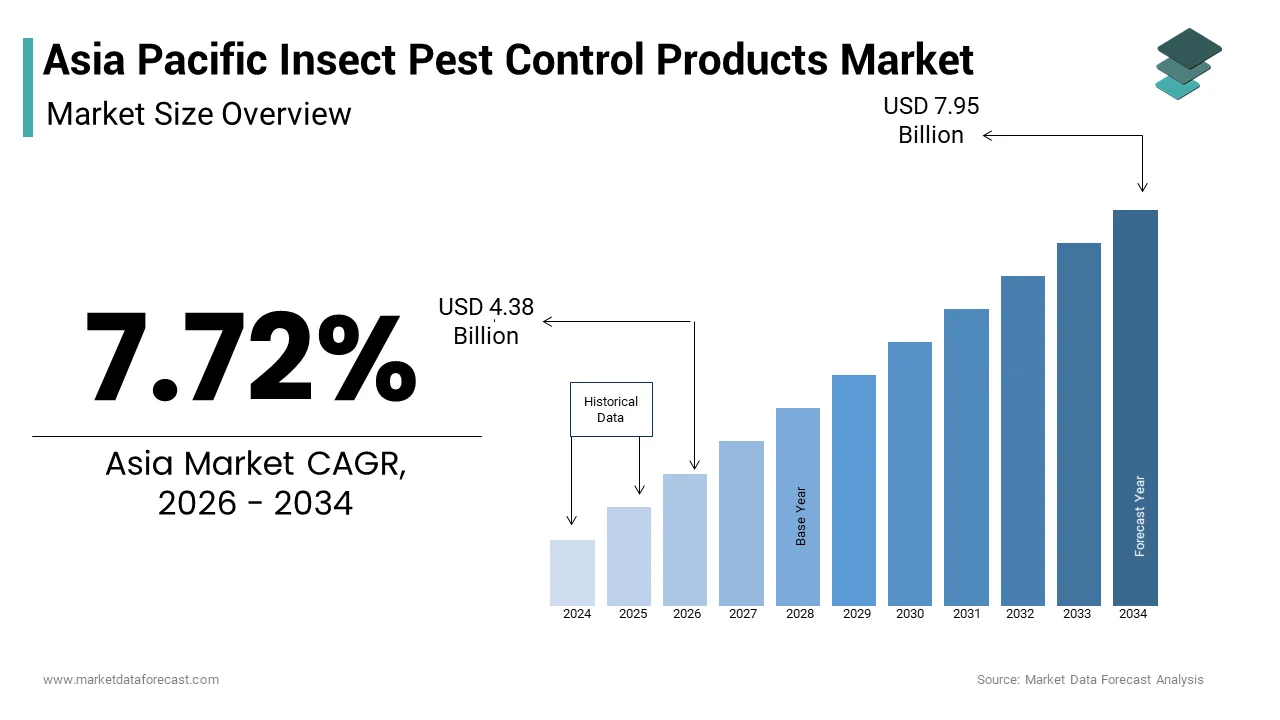
The market is showcasing evident potential in the mentioned forecasting period. The market continues to gain momentum with the rapid development in the industry.
Pest control is the control or management of pests, a species of the animal kingdom that creates an adverse impact on human activities. The human reply depends on the importance given to the damage done, on the ability to tolerate, and attempts to completely remove the pest. Pest control efforts are generally carried out as a part of a pest management strategy. The insect pest control market is fuelled by government control over food cleanliness, the health of the environment, and the public, as well as increasing public awareness. The absence of sufficiently skilled technicians and late regulation approval procedures for chemical products in several applications (like residential, commercial, and industrial areas) is considered a constraining factor for the market.
REPORT COVERAGE
| REPORT METRIC | DETAILS |
| Market Size Available | 2024 to 2033 |
| Base Year | 2024 |
| Forecast Period | 2025 to 2033 |
| CAGR | 7.72% |
| Segments Covered | By Type, Control Method, Application, Pest Type, Region |
| Various Analyses Covered | Global, Regional & Country Level Analysis, Segment-Level Analysis, DROC, PESTLE Analysis, Porter’s Five Forces Analysis, Competitive Landscape, Analyst Overview on Investment Opportunities |
| Regions Covered | India, China, Japan, South Korea and Australia, South Africa, New Zealand, Thailand, Malaysia, Vietnam, Philippines, Indonesia, Singapore, and the Rest of the Asia Pacific |
| Market Leaders Profiled | Rentokil Initial plc. (U.K.), Ecolab, Inc. (U.S.), Bayer AG (Germany), Syngenta AG (Switzerland), BASF SE (Germany), FMC Corporation (U.S.). |
KEY MARKET PLAYERS
The Top companies leading in the APAC Insect Pest Control Products Market profiled in the report are
- Rentokil Initial plc. (U.K.)
- Ecolab, Inc. (U.S.)
- Bayer AG (Germany)
- Syngenta AG (Switzerland)
- BASF SE (Germany)
- FMC Corporation (U.S.).
MARKET SEGMENTATION
This market research report on the Asia Pacific insect pest control products market is segmented and sub-segmented into the following categories.
By Type
- Termites
- Cockroaches
- Bed Bugs
- Mosquitoes
- Flies
- Ants
By Control Method
- Chemical
- Physical & Mechanical
- Biological
By Application
- Commercial & Industrial
- Residential
- Livestock
By Pest Type
- Insects
- Termites
- Rodents
- Wildlife
By Country
- India
- China
- Japan
- South Korea
- Australia
- New Zealand
- Thailand
- Malaysia
- Vietnam
- Philippines
- Indonesia
- Singapore
- Rest of APAC